|
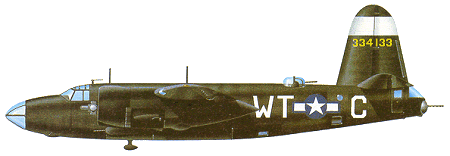
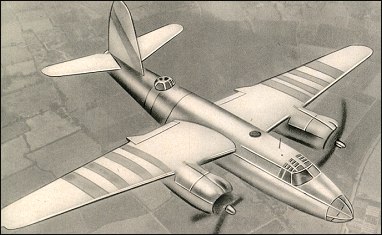
| The projected design data for the Model 179 Medium Bomber were accepted by the USAAC on 5 July 1939 and the first Marauder flew on 25 November 1940. The flow of production Marauders began on 25 February 1941 and by the end of 1944 more than 5,150 had been delivered. The Marauder first went into action in the Australian theatre in April 1942.
The B-26 initial production version was powered by two 1,378.6kW Pratt & Whitney R-2800-5 radial engines and carried a defensive armament of five 12.7mm machine-guns in the nose, dorsal turret and tail. Normal bomb load was 907kg but up to 2,631kg could be carried in the tandem bomb bays. The B-26A was similar to the earlier version except for having R-2800-39 engines and minor changes. Similar Marauder I were delivered to the RAF and SAAF in 1942 under Lend-Lease.
The B-26B corresponded to the Lend-Lease Marauder IA and II and was produced in more than one form. Power was provided by R-2800-5 or 1,490.4kW R-2800-41/-43 engines and tail armament was increased to two guns. From B-26B-10 (Marauder II) the wing span was increased from 19.81m to 21.64m; the area of the vertical tail surfaces was also increased; and armament raised to include one fixed and one flexible gun in the nose, four 'package' guns on the sides of the forward fuselage, two guns in the Martin dorsal turret, two flexible waist guns, one ventral-tunnel gun and two tail guns. The front bay could carry two 900kg bombs on special carriers and use of the rear bomb bay was discontinued. The crew was increased from five to seven. The B-26B variants were the most produced of the series.
The B-26C (Marauder II) was the same as the B-26B-10 types but built at the Martin Omaha plant. The single experimental B-26D with exhaust-heated surface de-icing equipment and the single B-26E special stripped model were followed by the B-26F and G (Marauder III). These were similar to the B-26C except for having the incidence of the wings increased by 3 1/2°, no provision for carrying a torpedo, and 11 guns fitted.
Certain examples of earlier B-26 were stripped of armament and adapted for training and general utility duties, particularly high-speed target-towing. These were originally known as AT-23 but were subsequently redesignated TB-26. A number of TB-26G were also built. The designations JM-1 and JM-2 applied to stripped versions of the B-26C and B-26G respectively, used by the US Navy for target-towing and other general utility duties. The JM-1P was equipped for photographic reconnaissance.
| CREW | 7 |
| ENGINE | 2 x P+W R-2800-43, 1410kW |
| WEIGHTS |
| Take-off weight | 17300 kg | 38140 lb |
| Empty weight | 11340 kg | 25001 lb |
| DIMENSIONS |
| Wingspan | 21.6 m | 71 ft 10 in |
| Length | 27.1 m | 89 ft 11 in |
| Height | 6.1 m | 20 ft 0 in |
| Wing area | 61.1 m2 | 657.67 sq ft |
| PERFORMANCE |
| Max. speed | 465 km/h | 289 mph |
| Cruise speed | 345 km/h | 214 mph |
| Ceiling | 6000 m | 19700 ft |
| Range w/max.fuel | 1770 km | 1100 miles |
| ARMAMENT | 11 x 12.7mm machine-guns, 1800kg of bombs |
| Heinkel Wulf, e-mail, 24.03.2018 10:55 @Tony, The B-26 had a troubled start just like the Vought Corsair, yet once crews learned it's quirks, and it went through some much needed wing modifications, it went on to become one of the finest medium bombers of the war, with a payload rivaling that of the B-17, and an exceptional record,having the fewest combat losses of any Allied bomber. It's obvious from your comments you have a strong Anti-American bias. Kindly go spread your rants on conspiracy forums instead of shilling it up on an aviation site. None of us are interested. reply | | MARIAN DABROWSKI, e-mail, 06.11.2015 21:32 My dad Joseph Dranchak was a tail gunner in a B-26 The Grinning Gremlin 42-95855 O8R. 391stBG,575BS .The plane was salvaged Dec.26, 1944.They flew 88 missions. Does anyone have any other information or pictures of this plane? reply |
| Tony, e-mail, 22.02.2015 07:14 Daniel claims I am spoiling the fun for aviation enthusiasts. Thousands died and many were left horribly injured and smashed to provide that entertainment. My protest is that those who create war are well known but the momentum for total control of the world is one completely initiated by the Central Bankers. We then hero worship such criminals as Roosevelt (couldn't make a decision unless approved by the financiers who paid the money to stop his criminal charges from when on University staff, a Turk who setting aside his depraved personal life, initiated the attempted genocide od the Armenians lionized over a prose he is said to have written...one could go through the lot but it all comes back to the central bankers,...who controlled decisions in Russia and USA, Britain and Australia throughout the cold war. My raising the issues and spoiling the 'fun' of those who enjoy getting off on the dead who were immolated or worse is to criticize war as a solution and those who use it as a solution when in fact it is no less than a profit making, boundary changing machination of the worlds most evil and wealthiest men. I will not cease to speak out for the thousands of men like George Wootten nor the women who's deaths entertain you in their contribution to the wealth and power of the creators and financiers of war. reply | | Daniel, e-mail, 01.12.2014 09:05 It's tiring stumbling through comments like the one Tony posted below this one. Why can't you nutcases just go somewhere else to commiserate with each other and just let aviation enthusiasts enjoy this website? reply | |
| | Tony, e-mail, 17.06.2014 12:46 My mother's brilliant brother died in one in Egypt. Sgt pilot George Bisgood Wootten.An Industrial Chemist aged 23 man with brilliant mind and played full back for Norths Rugby (educated Riverview)was navigator from memory. The plane went out of control at 1700 feet. The story is how safe they were AFTER the yanquis educated fliers properly. The problem was they were not educated into the idiosyncracies of these heaps of crap which became allegedly the safest plane of the War after killing many crews.WW11 was a liars paradise and I suspect that the removal to Europe of every Marauder bar 2 for destruction was an indication that the USA didn't want them examined.Songs abounded in WW11 concerning how unsafe it was to be an ally of the US soldiers and fliers and as late as Iraq 1991 that was no different..maybe worse. Two Marauders remained undemolished, one went into commercial service and eventually crashed..the other is in a museum purporting how safe they were. Young lives like my uncles were to become anchovie paste when they went forward for their country in a war created to make fabulous wealth for the profiteers and change the world into the abattoir it is...with Israel a prime part of that along with USA and the British Nations....just point and we'll follow then cry crocodile tears over the victims...not the millions murdered but our own few, enthusiastic, brave youngsters. If ever you take on board that the Reich created Israel in 1934, not the allies in 1947, that the Reich suffered a world wide BDS from 1934 onwards that most khazars didn't want to go to Palestine and thouands were betrayed trying to escape elsewhere (the real holocaust..not the German pogrom) that Pearl Harbour was supported by the Allies (see opJB Christopher Creighton, that Dieppe was betrayed to Hitler to support Creighton's actions ...some 3500 were killed horribly by waiting German forces..read about Operation paperclip, MK Ultra, MK Delta and so on you might begin to see 100 million gave their lives or had them taken for massive profiteering , massive deception, betrayal, so that globalisation and eventually one world order under Central Bankers which is close to completion was what they really suffered and died for. In closing few really realise how treacherous IG Farben, Standard Oil and others were in supporting the Reich even with USA entering the conflict. IG Farben, part of a massive Jewish conglomerate created zyklon B as a vermin an exterminator but also created the mustard gas which was an abomination on all including khazars in WW1. Its inventor Fritz Harben a scientist married to a scientist went on well after his wife, hearing what he'd done, suicided.The Marauder is a good starting point to start poking through the allied b /s and not just stick to the propaganda vilifying (however justly so) the German b /s. The few control the many now and dissenters meet death or torture or family extermination of use as guinea pigs in Israel Biological /Chemical experiments. I don't know what one does with these satanic politicians and rulers...none is a leader in my view. Maybe rise and demand they obey not cringe and obey them. Do something to justify the deaths of our families and 100 million more...probably now 160 million if we add in the atrocities since WW11 "finished". I don't say 'agree' I say seriously research..prove me wrong and I'll respect and change. reply | | KEVIN WALKER, e-mail, 29.10.2013 01:28 MY dad built tail sections for the B-26 IN MIDDLE RIVER MD.i still have his tool box he made and custom tools he made to do his job. towards wars end he was sent to VENICE ITALY,and he returned home. reply | | John Price, e-mail, 16.06.2013 01:37 My father (5'5" and 125 pounds) was a tail gunner and backup radio operator on the B26. He told me that his egress from the aircraft require sliding down a tube, strapping on his parachute and dropping out the bomb bay. He also said that the aircraft commander taught everyone in the crew how to land the aircraft. reply | | Klaatu83, e-mail, 20.04.2013 16:11 Just as a matter of clarification, during World War II the U.S. Army Air Force designated the Martin "Marauder" medium bomber "B-26" (B for Bomber), while the Douglas "Invader" was designated "A-26" (A for Attack). Among the changes made when the U.S. Air Force was created as an independent service in 1947 was that the "A" for "Attack" designation was abolished. By that time all the Martin Marauders had been retired, and the designation for the Douglas "Invader" was changed from "A-26" to "B-26". The Douglas "Invader" remained in service for many years thereafter, during the 1950s and even into the 1960s, under the designation "B-26". reply | | Klaatu83, e-mail, 20.04.2013 03:59 Early on, the B-26 was widely known among it's crews as the "Widow-maker" because of the number that crashed in training accidents, and "The Baltimore Whore" because the wings were so small that "the airplane had no visible means of support". However, later on, after the bugs of the initial versions had been worked out, the B-26 had the lowest combat loss rate of any medium bomber. reply | | Bill Arehart, e-mail, 11.04.2013 18:30 Does anyone remember a B-26 sitting out along the road at the Douglas plant in Tulsa.The story was it was new and had been sitting there since the war ended.I saw it probably 1959 or 60.I,m not even sure it was a b-26 but am curious to know more about it. reply | | Stan Hunt, e-mail, 23.03.2013 10:47 My uncle, Hurst Sears, was a top gunner on the B-26 "Bird Legs" flying out of England (I don't know which base) in 1943 and 44. They crashlanded two planes coming in after completing missions, one in England and one on Occupied France after the Allies had taken that territory. So they ended 65 missions in Bird Legs III. He described it as a flying brick, it had a glide range like a rock...if one engine went out, get out fast because it was going down. He was proud of the crew and the plane though, leaving the military at the end of the war as a Staff Sgt. He talked of debriefings at the end of the flights and they would be handed a bottle of Scotch to take a good swig to calm their hands from shaking so bad just before the debriefings. He passed away a few years ago. I don't remember him having bad dreams about the war but it did mess up his life, he had a bad time with gambling after he came back home, but he still lived to be in his upper 80's. He spent most of his life in Alaska, he loved fishing and hunting. He could talk about it but he said that those that the best way to look at their life during
WWII was that they were'nt going to make it, and accept that, and don't worry about it. On lots of missions the planes shot down were so numerable that your time to be shot down was just too high in probablilities. Maybe the probablities of being shot down on each mission were matched in the probabilities in his later gambling....I don't know. reply |
| Walt Gunkel, e-mail, 12.10.2012 03:59 I flew 76 combat missions as a pilot of B26s stationed near Earl's Colne,England. I recall signing for our plane -stated value $187,000. We left Barksdale about May 1943. We flew to Scotland via the Northern route. At the fueling stop in Greenland we learned that all B26's had been grounded because of 100% losses on 1st mission. Future missions despite no heat or oxygen would be flown at 8-12K ft. I lost 3 of our crew of 6 when they filled in other crews. Our 1st Dday bomb run was at 3000 ft. Exciting! reply | | Marty, e-mail, 25.05.2012 18:30 Another page starting to load up with garbage from scumbag con artists reply | | shel, e-mail, 18.10.2011 11:18 My uncle, Al Kramer was a S /Sgt, USAAF, in WWII. He inspected and certified the B-26s that were modified with longer wings and other changes to improve flight safety.
One Marauder's wings were out of spec. My uncle said he measured the distance from the wing tips to the ground and this plane had almost a foot difference. He refused to certify the plane.
The base CO ordered my uncle to certify the plane. (I suppose the CO had some quota of planes to accept) My uncle again refused. The CO, himself, signed off on the certification and ordered the plane to fly to its assigned base. The Marauder crashed on takeoff. My uncle was transferred off that base to another station the same day...before the IG could make an investigation, I suppose. reply | |
| | Jim Upper, e-mail, 04.09.2011 22:30 My father, Mayo Reece, was a pilot of a tb-26 towing targets in Norfolk, VA in May, 1945 when his plane crashed into water at Cape Charles. Only the tow reel operator survived. Would anyone know anything about this crash or about the survivor, S /Sgt Michael Matyola. reply | | coburn webb, e-mail, 08.06.2011 21:59 I flew these beautiful airplanes at Del Rio Lawson field 44b and a buddy of mine went on to Tampa and flew them and he said that after the one a day in tampa bay that several pilots dropped off their wings in a bucket at headquaraters. There were one a day that went in the bay. Prop problems mainly reply | | Pete Smith, e-mail, 11.05.2011 20:22 A retired BGen was at Tampa, Fl, where B-26 training occurred. He told me their motto was:"One a day in Tampa Bay!". Anyone else heard that? reply | | Pete Smith, e-mail, 11.05.2011 20:21 A retired BGen was at Tampa, Fl, where B-26 training occurred. He told me their motto was:"One a day in Tampa Bay!". Anyone else heard that? reply | | a.casais, e-mail, 19.11.2010 21:29 Sorry, before i said the B-26 intruder, but i talked about the "B-26 invader" much better plane and very versatile. reply | | a.casais, e-mail, 19.11.2010 21:20 I wrote before in the A-26 intruder, thinking that was the real "Widowmaker", but not the B-26 Marauder is the one. In here i heard many good things about, myself ear others thing no too good about it. reply |
|
Do you have any comments?
|
| 
COMPANY
PROFILE
All the World's Rotorcraft
|


 Stan Hunt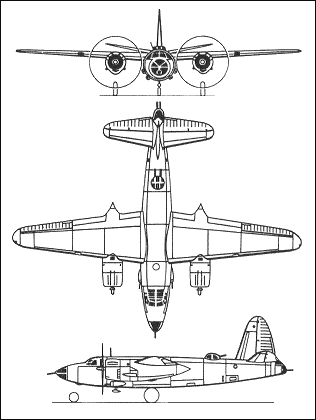


I understand that I am replying to your comment which is almost a decade old at this point, but I wanted to say that my Great-Grandfather also flew on The Grinning Gremlin.
reply