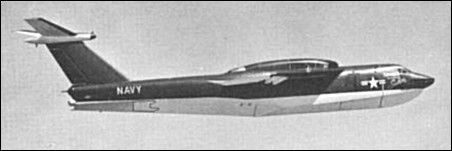
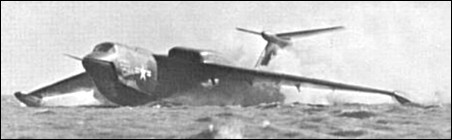
To meet a US Navy requirement for a high-performance multi-role flying-boat, the company offered its very advanced Martin Model 275 design. This had an all-metal hull of high length/beam ratio, mounting a cantilever high-set sharply-swept wing incorporating so much anhe-dral that the stabilising floats at the wirwg-tips could be attached permanently; the tail unit was of T-tail configuration with all-swept surfaces. Above the wing, to minimise spray ingestion, were mounted four Allison turbojet engines, and pressurised accommodation was provided for a crew of five. The first XP6M-1 prototype was flown on 14 July 1955, the second following on 18 May 1956, and Martin received orders for six pre-production YP6M-1 boats powered by Allison J71 turbojets each developing a maximum 5897kg afterburning thrust. Successful flight testing led to an order for 24 production P6M-2 aircraft named SeaMaster, which differed primarily by having 7711kg thrust non-afterburning Pratt & Whitney J75-P-2 turbojet engines. However, the contract was cancelled on 21 August 1959 after only three had been built and these, together
with the YP6M-1s, were scrapped at a later date. They were the fastest flying-boats ever built.
This was intended to be the Navy's answer to the nuclear jet bombers of the Air Force's Strategic Air Command. The post-WW-II Navy's high command was concerned that, due to the intercontinental striking potential of the Air Force's SAC, policy makers in Washington might perceive the entire Navy as redundant. Unfortunately, it took so long to develop the P6M that. by the time it was ready, the submarine-launched Polaris ballistic missile was nearly ready for introduction and the Seamaster was already virtually obsolete.
Hi: everyone. My grand father was in the Decemeber 7, 1955 test fight. Hebert Scudder. My sister had given me a great piture (copy) of my grand father standing in front of the Seamaster in his life jacket. If any one has any more pictures or storys to tell, feel free to email me. Thank you
Ref the comment by Harvy Hop dated 27-4-2011 about seeing a Seamaster with an FJ-4 'in chase'. I believe it was the same year, 1958 that I saw a similar flyby in June on graduation day at the US Naval Academy. But this was with the FJ in close formation off the right wing as they flew in a bank not more than a 1000 ft above apparently as a 'salute' to the new officers. I'm still thinking of having a 6 or7-ft model built replicating that formation flight for a spot above my front door. Greetings from north FtWorth TX.
Mike, I read your email with interest. Do you recall if the SeaMaster took off from the Severn River in front of the Naval Academy? I, as a youngster, recall seeing a flight with great noise and spray track down the Severn. Would you know the date? Many thanks. Capt. Mike Dodd
I was a kid on a pier on the Chesapeake Bay and saw a P6M fly over on a test flight. It was the biggest airplane I had seen at that time. The Navy refurbished the old seaplane base at Harvey Point, N.C. for the P6M base. That base now belongs to the CIA.
Mr. Shettle, I am curious exactly where did you see the SeaMaster fly over. As a youngster, I recall watching the huge and noisy seaplane head out the Severn River. It may have been the summer of 1956 or 1957. Thanks. Capt Mike Dodd
While working at The Glen L. Martin Company I recieved my first patent for an explosive anchor for the P6M beach craft (the P6M had do landing gear). Using four of these anchors the beach craft could be oriented into the wind making entry much easier.
My father, CDR. Harlin "Bud" Keister, was somehow involved in the P6M program, though I'm not sure to what extent or in what capacity. I do know that he was scheduled to fly on the mission that crashed on 12 /07 /55 but for some reason didn't make the flight (for some reason I think he was bumped to make room for someone else). At any rate, to the day he died (12 /06 /96) he always wore his P6M tie-clasp whenever he wore a tie. I have it somewhere in his effects.
The Sea Master was developed as a strategic bomber for the US Navy. Having been snubbed at the end of WWII by the formation of the USAF which took over so much of the assets of both the Army and the Navy the USN looked for ways to re-establish it's authority in the airborne strategic field. The answer was the Seaplane Strike Force centered round the Sea Master. The original Allison engines did not match up to spec, but the replacement Pratt & Whitney J57 were more than capable.It soon became apparent that the concept was floored because not only was the aeroplane itself costly but the support of the Seaplane Strike Force had considerable on costs from the special beaching dollies to the support ships required including converting a submarine to be a deep sea tanker for aviation fuel. The number of aircraft was cut to a total of eleven (includuing the two ill fated prototypes)and with other projects taking priority like the USS Forestal aircraft carrier and the Polaris missile and the nuclear submarines which would fire them the US Navy had plenty of other projects to spend it's money on and so lost interest in the SSF. Let's face it the idea of a seaborne strategic bomber even in the sixties was a bit of an anachronism. It has to be noted that this was the last original design for a fixed wing aircraft made by this company who went on to other aerospace work before merging with Lockheed.
Re. weapon loading: The rotary bomb door was loaded via an overhead hatch. It is interesting to consider a landplane equivalent of the P6M as a purpose-built low-altitude strategic bomber.
I was a "Navy Brat" living on NATC Pax 57-59. I was in plane lover's heaven. One day in 58 I heard a different sound and looked up to see the Seamaster with an FJ4 in chase. It was beautiful. My Dad, Harvey Hop Sr. Cdr and XO of Electronics test was being groomed for the first P6M squadron commander job.
Arrived at the Martin Company as a newly minted aero engineer and former fighter pilot. Flew as a Flight test engineer on several P6M-2's with chief test pilot Bob Turner who was lost in a B-57 test flight a few years later
I used to fly out of Martin State Airport with the Air Guard. All the local restaurants had pictures of Martin "birds". When I first joined the unit, there were guys who remembered one of the pilots (Gino C.) who died during test flights of this bird. They said he was a really good stick. I used to work with one of the design engineers on the project, Maurie Scheider. Brilliant guy. There used to be a bunch of old Marin seaplanes down by the water. One was a supersonic fighter. It's not shown or the site.
With the advanced speed, how would they have fared in a trapping pattern? Would they have been stable at 200kts in a 3000 yd pattern? Doubt it. Probably more of a Barrier plane with lots of bouys in the water monitoring and call in a trapping aircraft, like the p5m or the s2 if they got something. I cant imagine working a lot of buoys at low altitude in that.
Probably why it was cancelled, as it was too fast to do the dirty low altitude work.
Did some wind tunnel testing on the P6M in 1957 at U of Md in College Park MD.Don't remember much but I believe the other person with me was a MR. Gross?? Not sure-too long ago.Great concept but just never worked out.
Did some wind tunnel testing on the P6M in 1957 at U of Md in College Park MD.Don't remember much but I believe the other person with me was a MR. Gross?? Not sure-too long ago.Great concept but just never worked out.
Always thought the Seamaster was a Cool Aircraft! You may or May Not agree but, I think the Seamaster looks like it Came from the TV Series 'Thunderbirds'!
I got to Pax River in 58 and the program had just been scratched. I hoped to see something from AE-1 Gregory, he was assigned to Martin Baltimore when I arrived and I think he made a flight or 2 on the P6M. There is still a large sea pen at Pax River to park the P6M. Russia has a similar plane on there site. There are some recent photos of it flying.
I got to Pax River in 58 and the program had just been scratched. I hoped to see something from AE-1 Gregory, he was assigned to Martin Baltimore when I arrived and I think he made a flight or 2 on the P6M. There is still a large sea pen at Pax River to park the P6M. Russia has a similar plane on there site. There are some recent photos of it flying.
I remember George Rodney's first flight as he returned the undercarraige tail section being "wrinkled." Rick's B57E flight to Arizona, decorated with White Wheels and a Fox Tail on the nose. He & John Susi's return thru LA carrying two parachutes seeking a chances on a safe flight return to Baltimore.
Paul the "Caspian Sea Monster" is or was an ekranoplan,not strictly an aeroplane as we know it and any resemblance to the Sea Master would be purely conincidental.


 M. L. Shettle



Mike,
I read your email with interest. Do you recall if the SeaMaster took off from the Severn River in front of the Naval Academy? I, as a youngster, recall seeing a flight with great noise and spray track down the Severn. Would you know the date? Many thanks.
Capt. Mike Dodd
reply