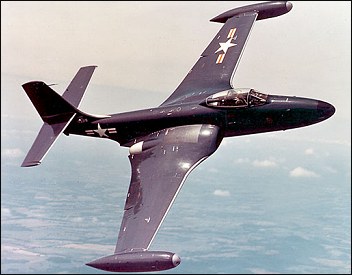
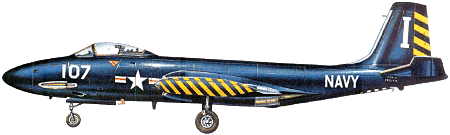
Following the success of the FH-1 Phantom in US Navy and US Marine service, McDonnell was requested to submit its design for a new and improved jet fighter to supersede the FH-1. The company's design submission led to the receipt of a contract in early 1945 for three McDonnell XF2D-1 prototypes, these later gaining the name Banshee. McDonnell's design covered an improved version of the Phantom of increased size, incorporating folding wings, and with a lengthened fuselage to house more fuel, and with similarly-mounted and more powerful Westinghouse turbojet engines. The first prototype was flown on 11 January 1947, by then redesig-nated XF2H-1, and successful testing and evaluation led to contracts that were to call eventually for a total of 892 production aircraft of which details are given under Variants. Initial deliveries of production F2H-1s, to US Navy Squadron VF-171, began in August 1948, and the type proved of great value as an escort fighter during the Korean War. By the end of that conflict the F2Hs had been superseded by more advanced fighters, but continued in use in a reconnaissance role for a number of years and, in service with US Navy Reserve units, were flown until the mid-1960s. In November 1955 a total of 39 ex-US Navy F2H-3s was transferred to the Royal Canadian Navy, these being that service's first operational jet fighters; when the last were retired, in September 1962, they also proved to be the last carrier-based fighters in Canadian service.
McDonnell F2H Banshee on YOUTUBE
Specification
MODEL
F2H-3 "Banshee"
CREW
1
ENGINE
2 x Westinghouse J34-WE-34 turbo-jet, 14.4kN each
WEIGHTS
Take-off weight
11437 kg
25214 lb
Empty weight
5980 kg
13184 lb
DIMENSIONS
Wingspan
12.73 m
42 ft 9 in
Length
14.68 m
48 ft 2 in
Height
4.42 m
15 ft 6 in
Wing area
27.31 m2
293.96 sq ft
PERFORMANCE
Ceiling
14205 m
46600 ft
Range
1883 km
1170 miles
ARMAMENT
4 x 20mm cannon, 2 x 227kg bombs
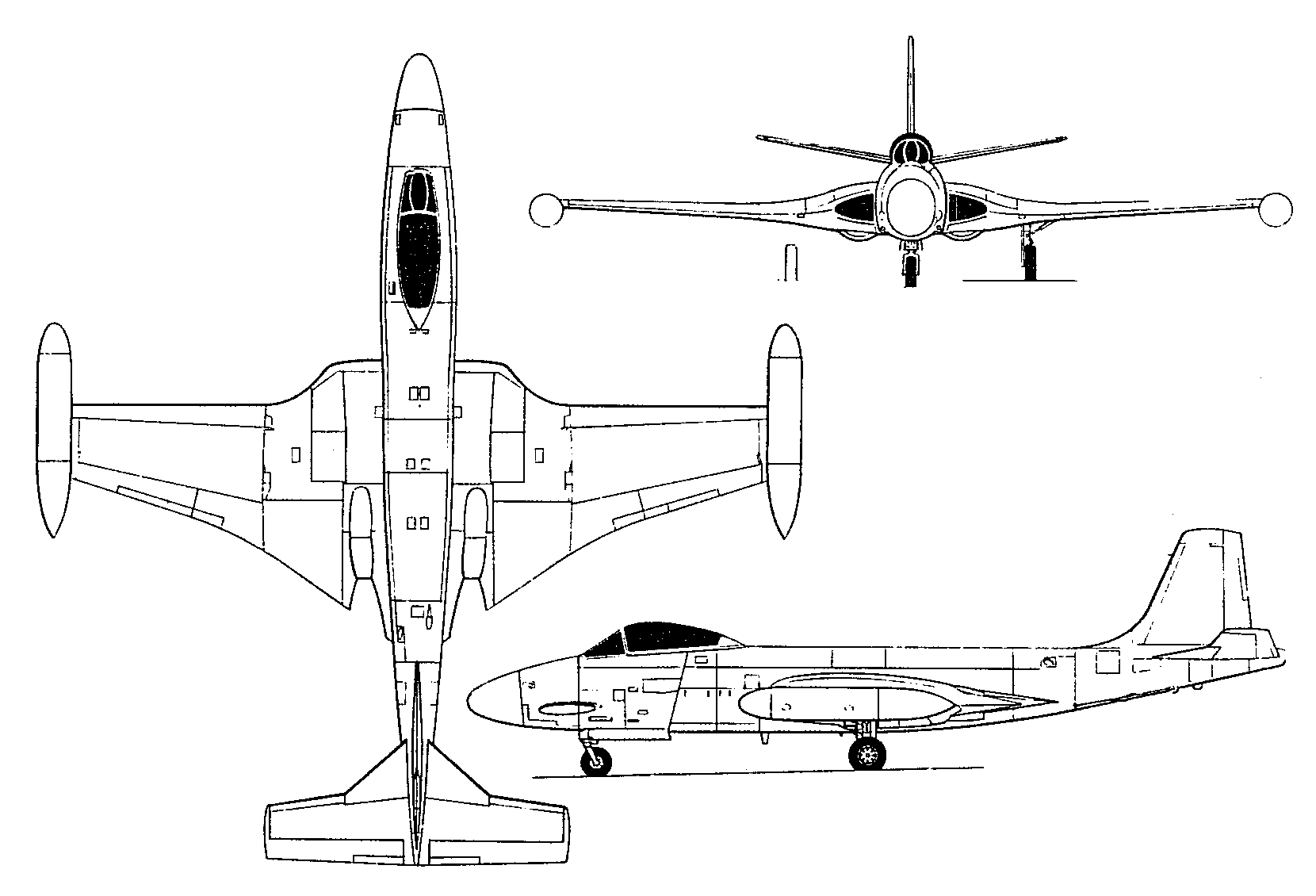
3-View
A three-view drawing of F2H-4 Banshee (1660 x 1130)
My father was CO of VF-23 flying F2H-3 for a couple of years ca. 1954-1957. They were at Moffett Field, CA. He made at least one cruise in Essex to SEA in the fifties.
Hi R Rodermund, there is now an F2H-2 Banshee at the Pima Air & Space Museum in Tucson. I'm a docent there. I was in VF-52 and made a cruise on the Ticonderoga in '58-'59. VF-52 was part of ATG-1 and was Alameda based.
I flew the F2H3 while flying with VF41. We were the airgroup which helped "shake down" the USS Forrestal in 1955 and were early in the conversion from the old reliable LSO to the brand new mirror landing system!
The F2H-3 was the first aircraft I worked on as an aviation electrician after completing "A" school in Jacksonville, FL in 1956. I was attached to VF23 and stationed at NAS Moffett Field, in California.
I was in VMF 214 in Hawaii in 1955 and 1957. worked on the radio and radar gear. Tubes galore! ARC 27 UHF radio weighed about 70 lbs. now a 3-5 lb. radio out performs them.
I worked at the Navy Bureau of Aeronautics from 1949 to 1954. In August 1952, I was aboard the USS FDR, CVB-42, to witness carrier qualification landings of the F2H. Eighteen landings. Met Jim McDonnell. Maybe it was the USS Midway. I still have a couple of pictures.
Flew the F2H-3, 1957-58 while attached to VF-152 based at Moffett Field Calif. Did two cruises during that time. One aboard the Hornet, CVA-12, and a second one, less than a month later due to a crisis on the USS Bennington, CVA-20. It was the last crises for both carriers as CVA's. Lost two pilots during the warm-up period. One just flew into the water during car-quals, unknown reason. The other lost at night during practice intercepts. This though to be an oxygen problem. It was a fairly stable platform to bring aboard the boat. Many of us in the squadron wished we had been able to fly the newer and faster fighters but I think we survived the two cruises because the Banshee was just a nice "Old Girl", tho a little bit slow, to bring aboard.
Hi I saw this note while reading about the history of the Banchee. I was a radar tech in VF-152 on the same two cruises (Hornet and Bennington) in 1958. It was a long year away from home but I loved working on the Banchee radar. I'm afraid I do not recognise your name but it has been a long time. I hope all is well with you. Bill
Len Eisner is right. Big Banshee was good on one engine. On low level flivhts we "sinvled up", i.e. cut one engine and cruised at 290 kts. Closed duct doors...which were later removed...sometimes wld not open.
Worked on both F2H-2 and F2H3 aircraft. As an ADJ in VX3, in Atlantic City, N.J., we were the first to install air-to-air refueling system on the F2H-3. Later while serving in Air Group 17, attached to VF171 aboard the USS Wasp, we made a world cruise with F2H-3 aircraft. Our sister squadron, VF172, flew the F2H-2 Banshee. Both planes seemed to be good carrier aircraft. Leaving Jacksonville, Fl, we headed north going on to Operation Mariner, a NATO operation. However, weather prevented us to reach the Artic circle, so then on to the Med, then thru the Suez canal and on to the western Pacific. Arriving back to the U.S. in San Diego. We were air lifted back to Jacksonville, Florida, our home base. This was in the year 1954.
Worked on both F2H-2 and F2H3 aircraft. As an ADJ in VX3, in Atlantic City, N.J., we were the first to install air-to-air refueling system on the F2H-3. Later while serving in Air Group 17, attached to VF171 aboard the USS Wasp, we made a world cruise with F2H-3 aircraft. Our sister squadron, VF172, flew the F2H-2 Banshee. Both planes seemed to be good carrier aircraft. Leaving Jacksonville, Fl, we headed north going on to Operation Mariner, a NATO operation. However, weather prevented us to reach the Artic circle, so then on to the Med, then thru the Suez canal and on to the western Pacific. Arriving back to the U.S. in San Diego. We were air lifted back to Jacksonville, Florida, our home base. This was in the year 1954.
As a recalled NYC Detective I led t he last CAP (carier air patrol) of the Korean warand made the last carrier landing My Squadron was VF62 (Gladiators)and My Carrier " Lake Champlain" The fighting was declared over during my flight and I was sent to Tokyo with the headline for newspapers " NYC Cop blows whistle on Korean police Action"The Banshee F2H2 could outclimb any of our jets, including the F86 and we always hoped we would tangle with a Mig. Hope the name Banshee is picked for a future fighter
William G Schultz, e-mail, 16.03.2023 Jack Sullivan
Is this the same Jack Sullivan who was the maintenance officer at Cubi Point who built the famous water ride in the Cubi O'Club and was my neighbor across the street at Pax in the early '70s?
Jack, when you were with 62 I was on the Kearsarge with the World Famous red Rippers, VF-11 (!951-52) Larry Flint was the CO
Now in Williamsburg...turned 93 last November...lost Fran in 2021.
I was a pilot in vf172 "52-54". My first look at New York city was from 52,000' on my way to Bangor, Maine. Had 99 landings on the FDR,Wasp, Bennington,Coral Sea and Midway. No one ever got used to the aircompressor kicking "on" at night.
I was in VF-194 fighter squadon with the F2H3's in 1956-57 I was a plane captain.Made two cruise's to the Far East,First was in 1956 on the USS Orisknay CVA 34 and next one was 1957 on the USS York Town CV-10.The Banshee was a great plane.Just with I could bring that time back.
On two occasions One aboard ship I lost an engine on being catapulted secured the engine burned off thefuel to get lighter and made my landing safely,second time going thru night intercept at Boca ChicaNaval air station, lost engineon on take off. Intake door inadvertly closed( electric malfunction) again had to burn off fuel to land with the stick completely over to the side of neutral.
I worked at McDonnell at Lamberts Field in St louis as a sheet metal worker and drill press operato before joining the Navy. I was disappointed when visiting the Pima Air Museum in Tuscon, that there were No Banshee"s on display. I recieved infor today that the museum in San Diego has one so I will be making the 6 hour trip from Phoenix to SanDiego soon. Thanks for all the above info
I was in VNCJ-1 at Ping Tung Korea in 1953.LtCol Marion Carl was the CO.We were moved to Japan in early 1954 and later that year were dployed down to Ping Tung,Formosa. Several classified missions were flown there.The long nosed F2H2-P was a great bird!


 Jack Sullivan



Hi
I saw this note while reading about the history of the Banchee. I was a radar tech in VF-152 on the same two cruises (Hornet and Bennington) in 1958. It was a long year away from home but I loved working on the Banchee radar. I'm afraid I do not recognise your name but it has been a long time. I hope all is well with you.
Bill
reply