|
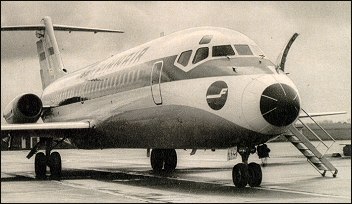
| Design study data on the DC-9, originally known as the Douglas Model 2086, were released in 1962.
Preliminary design work began during that year. Production started 6 March 1964. It flew for the first time 25
February 1965 and five DC-9s were flying by the end of June 1965. These aircraft were of the basic version
now known as the DC-9 Series 10. A total of 976 DC-9 aircraft were built. The last one was built in 1982.
| CREW | 2 |
| PASSENGERS | 65-90 |
| ENGINE | 2 x P+W JT-8 D-5, 53.4kN |
| WEIGHTS |
| Take-off weight | 35245 kg | 77702 lb |
| DIMENSIONS |
| Wingspan | 26.7 m | 88 ft 7 in |
| Length | 31.8 m | 104 ft 4 in |
| Height | 8.3 m | 27 ft 3 in |
| Wing area | 85.9 m2 | 924.62 sq ft |
| PERFORMANCE |
| Max. speed | 895 km/h | 556 mph |
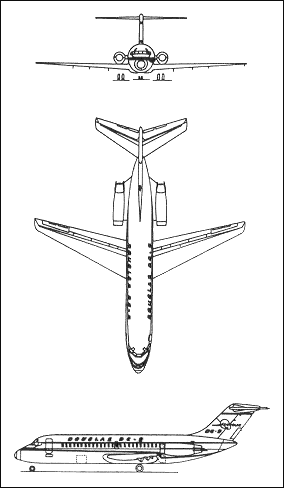
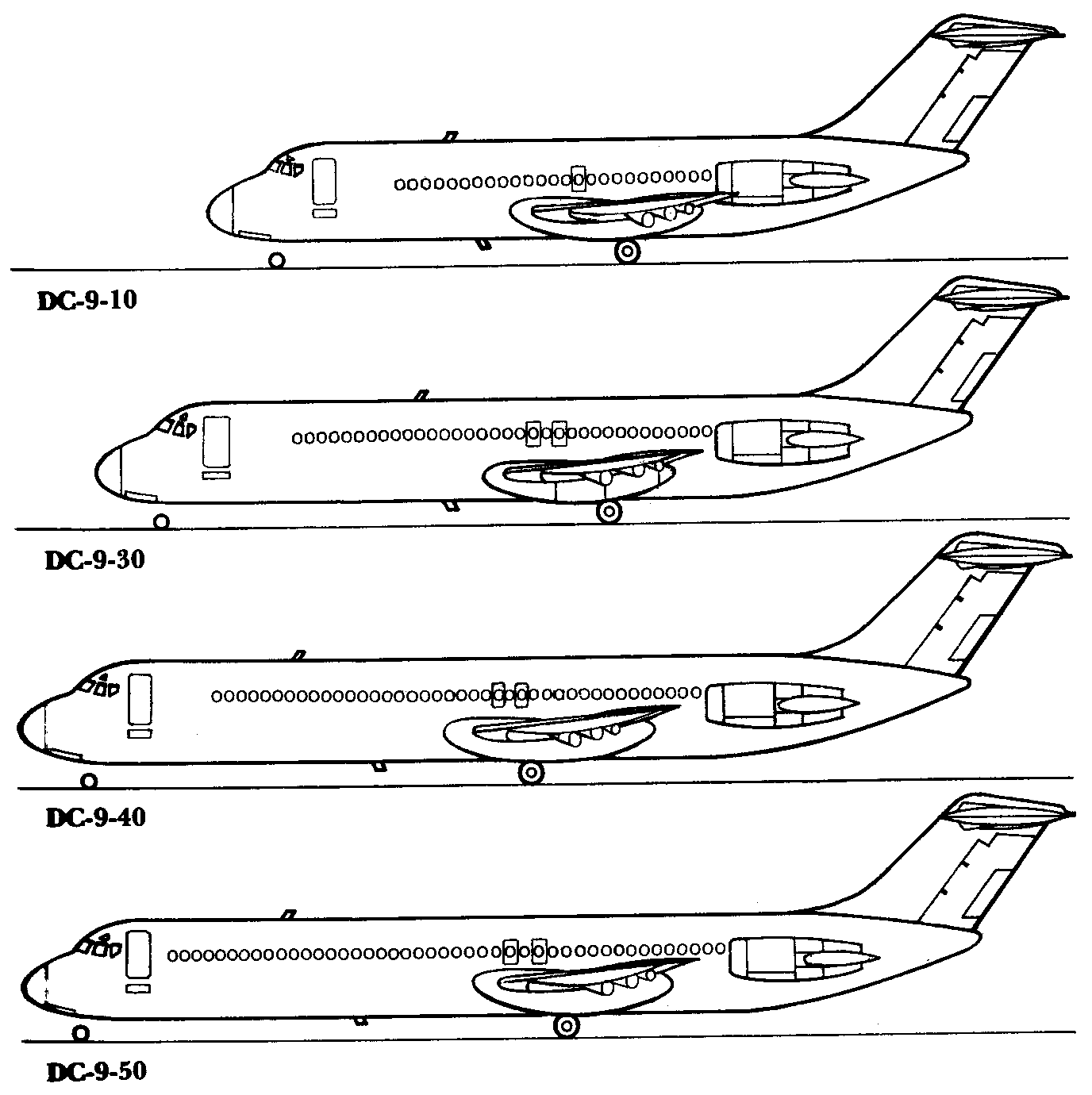
 | A three-view drawing (1376 x 1380) |
| Capt. Chuck KEndrick, e-mail, 02.03.2011 04:14 I flew the DC9 series -10.-31 at EAL and the _82,-83,=87,-88 at MCDAC in Long Beach. One TYPE RATING for all aircraft. The -10 series had a hard wing and was a sports car, fastest a /c in the world from the outer marker to the runway. Over 10,000 hours in the "Nine" and no major problems. They were as tough and strong as the old DC-3. A -10 air frame at Long Beach had over 200,000 cycles and did not fail. Can't say the same for the B-737, B-727,B-757, B -747 all of which have had explosive decompressions in flight due to skin failure.The DC-9 was a wonderful "pilots" aircraft. More responsive than the Boeing. reply | | Bill Roll, e-mail, 22.02.2011 07:22 I flew the DC-9-10,-30,-50 for Hughes Airwest becoming Republic then Northwest. I spent 20 years in the DC-9 before going to the A320 Airbus and it was my all time favorite airplane. I've been out of it for 17 years but I feel I could still take it around the pattern without hurting myself! I called it the DC-3 of the jet age and I typed in that one too. reply | | Dan Rowan, e-mail, 08.01.2011 05:42 Flow all the DC-9 models from the -10 to the MD-88. 14,000 hours, all command. Couldn't make a better airplane. Truely a pilots airplane, in the transport category. Straight forward, reliable, if maintained properly, and honest to fly. Enjoyed every hour. reply | | Russ Adams, e-mail, 13.12.2010 03:15 Regarding the Alaska Air crash from the horizonal stabilizer problem... I was with American for 40 years in maintenance and they operate the most MD-80s of any airline. From my understanding those stabilizer jackscrews were neglected and badly in need of maintenance. Ours are kept well lubed with grease (you don't want to rub up against one that's for sure) and those in that Alaska fleet were neglected to the point of rust. Pretty sorry maintenance. reply | |
| | Bo Dunn, e-mail, 11.12.2010 07:26 I did't fly the "9" version of this airplane but spent 9 years on the left seat of the "88" version. I don't know how the 9 flew but the 88 was a pain. Had to trick it to get it to descend smoothly and again trick it to keep the autothrottles from bursting to near full power when it leveled off under certain conditions. One of the airplanes in our fleet experienced massive electrical problems in the avionics in the middle of a CAT III approach. Turned out one of the computer cards on these airplanes was produced in Mexico and they used a coating of lacquer high in lead content. The lead caused arcing on the board. I couldn't wait to get back on a real Boeing. reply | | Roy Mills, e-mail, 13.11.2010 21:18 In my 50+years with both military and commercial aircraft and the 7 years with the C9A, C9B and VC9C's. The most rewarding and memorable events occured while I was working with the C9A's of the USAF as a Douglas Aircraft /Pacific Aeromotive Field Service Repsentative at Scott AFB.
During my years of 73 thru 76 those 12 aircraft served both the injuried, wounded, maimed and burned military and civilians with equal meticulous care. Those folks were moved from locations too numerous for me to keep up with to treatment centers saving many eyes, limbs and lives.
When on an emergency mission the aircraft and it's contents are treated as second to none(including Air Force One)regarding route selection, passage, landing and taxi rights.
One particular mission I was privledged to be with involved a New York City Fireman. The aircrew and I were out at the runup pad at Scott late one evening when an emergency radio call came thru. We were to taxi back to base op's and pickup a medical crew that was enroute from the base hospital. We then took a direct route to NYC and landed at La Guardia and loaded a second medical staff and the very badly burned fireman. Then taking off in front of numerous commercial aircraft, flying directly to San Antonio Tx. where the US Army's Brooks Burn Center is located. We were back at Scott before daylight that next morning.To my dismay I do not know the outcome of the fireman.
I experienced several other similar events during my stay at Scott both flying with the "9" and on the other end of "oh dark thirty" phone call. However this one remains tops. You can picture all the effort Air Traffic Control rose too, getting the C9A out of the NYC area uninterrupted.
I also spent time with the "PLAYBOY's DC9, but that's a story for another day.
The "9" is truly a universal and dependable aircraft that for it's time was a joy to fly and maintain. reply | | James M. Kelley (Sgt) USAF, e-mail, 02.10.2010 17:31 I flew with the 11th Aeromedical Airlift Squadron, 375th Aeromedical Airlift Wing, Scott AFB, Ill. from 6 /69 to 11 /70 as an Aeromedical Technician. I was assigned that station when USAF took delivery of the initial 12 C-9A's. Until that time we had flown C-118's and C-131's for air-evac. It was a great aircraft and flew until 2003. reply | | Bruce Kobara, e-mail, 10.09.2010 00:28 The USAF had a dedicated Aeromedical Evacution C-9 Called the Nightingale named after Florance Nightingale. It was equiped with a special "cargo door and ramp on the left forward portion of the cabin. It even had an ultraviolet anti airborn system which we preflighted by sticking our flight boot toe in the light chamber to see if the lights were working. I got qualifide on the Nightingale as a Charge medical tec with the 9th AES out of Yakota AFB. reply | | Jimmie Castex, e-mail, 08.09.2010 15:21 Spent the bests years of my time in the US Navy working on and flying around the world in the Navy's version, the C-9B. Great aircraft and as mentioned very predictable! reply | | ali, e-mail, 18.08.2010 10:29 i think MD80 Better than dc9 reply | | JohnTompkins, e-mail, 05.03.2010 17:49 I flew the 10, 30, 40 and 50 for Northwest Airlines up until retirement in 2005. Was on the a /c for almost 20 years but a newby compared to some of my old Southern friends. Great airplane, very dependable, predictable, a mechanic's favorite. A little hot in the summer but you learn to deal. Kinda proud to go out "old school" on the 9. It put my kids through college, bought me a house, and retired me. I owe the aircraft a lot. reply | | muhsin hamza, e-mail, 02.07.2009 11:11 I want to know more abt McDonnell Douglas aircraft plz mail me if possible ten q reply | | jerre fedor, e-mail, 27.12.2008 17:14 There was a single flaw in the Horz Stab drive that caused the accident. That unit was under a continious mtc inspection for wear in the jack screw and originally had a overhaul life of 20,000 hrs. The unit that failed was since new and had been inspected under the mtc program requirements. As I remember the unit had something less than20K hrs since new. There was an AD issued that required a wear check across the fleet and the data from that showed the USAirways fleet in complience were Delta had I think 5 a /c requireing jackscrew replacements because of wear limits. The wear inspection is straight fwd but unless accomplished properly could be misleading. I also remember that a high perecentage of replaced units from the AD inspection were since new. Which would lead to question a possible material change that excellerated the wear rate. I dont think there was ever a acceptable diffinative answer. cause reply | | Jack, e-mail, 15.07.2008 01:57 I thought that the DC-9 was upgraded as the MD-80. Many were built. It had a flaw in the horizontal stabilizer drive mechanism, I believe, that led to the Alaska Airlines crash into the Pacific. reply | |
| | Roger Moore, e-mail, 20.06.2008 04:28 Flew the DC9 for what seemed like an eternity at TWA and the only complaint I have is the air conditioning system was designed and adequate for the DC9-10 but completely inadequate beyond that. I had a temp gage in my nav kit and frequently saw it pegged at 120 in the summer on the MD80. Was glad to upgrade to the B767 and B757 to get cool cockpits in the summer. reply | | Frank Lollar, e-mail, 13.05.2008 21:55 The DC-9 is incorrectly listed under the "McDonnell Douglas" column. It should be moved to the "Douglas" column.
DC-9 first flight 2 /25 /65
DC-9 FAA type certification 11 /23 /65
Douglas merged with McDonnell 4 /28 /67 reply | | Jessica Cooper, e-mail, 28.03.2008 05:45 The real Boeing 717 is better known as the KC-135 and was designed in parallel with the 707 so yes, the 717 was indeed designed before the DC-9. The real one, that is. After the merger iwth Boeing, the McBoeing marketers decided that they couldn't live with "someone else's" airplane in the Boeing lineup and noticed that there wasn't a commercial 717. The rest is marketing history, revision style. reply | | drew gorton, e-mail, 16.05.2007 02:51 Was the boeing 717 designed before or after the dc-9.Please contact me if you know. reply |
|
Do you have any comments?
|
| 
COMPANY
PROFILE
All the World's Rotorcraft
|