|
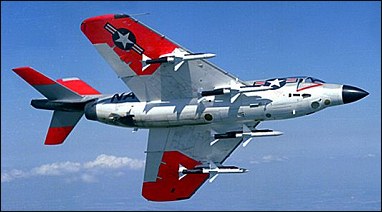
| The prototype of the Demon naval fighter proved to have poor stability,
poor forward visibility and a low roll rate. These faults were corrected
on the initial production model, but the poor reliability and performance of
the J40 engine meant that most of the 58 built never flew. Many were barged directly from the factory to shore bases for use as ground trainers. The J40 was replaced by the J71, which still gave limited power. A modified afterburner system gave power in the range needed to make safe carrier landings, although the accident rate was horrendous by modern standards.
The later versions weren't too bad, apart from persistent hydraulic leaks,
but by the time they were in service the Demon had gained a reputation that was hard to shake off.
Jim Winchester "The World's Worst Aircraft", 2005 FACTS AND FIGURES © The fuselage of the Demon was not
large enough to accept bigger and
better engines such as the Pratt &
Whitney J57. Some other makers,
notably Douglas, made provision for
a 'growth engine' in their designs. © The early Demon's J40 engines
were known to cut out when flying
through rain. They gave so little
power that it was easy to get into a
position in slow-speed flight that it
was impossible to recover from. © Later versions had more powerful
and reliable engines, but were
more of an all-purpose aircraft
than a pure interceptor and the
addition of extra equipment
further hampered performance.
| MODEL | F3H-2 "Demon" |
| CREW | 1 |
| ENGINE | 1 x Allison J71-A-2E turbo-jet, 62.23kN with afterburner |
| WEIGHTS |
| Take-off weight | 15377 kg | 33901 lb |
| Empty weight | 10039 kg | 22132 lb |
| DIMENSIONS |
| Wingspan | 10.77 m | 35 ft 4 in |
| Length | 17.96 m | 59 ft 11 in |
| Height | 4.44 m | 15 ft 7 in |
| Wing area | 48.22 m2 | 519.04 sq ft |
| PERFORMANCE |
| Ceiling | 13000 m | 42650 ft |
| Range w/max.fuel | 2205 km | 1370 miles |
| ARMAMENT | 4 x 20mm cannons, 2722kg of weapons |
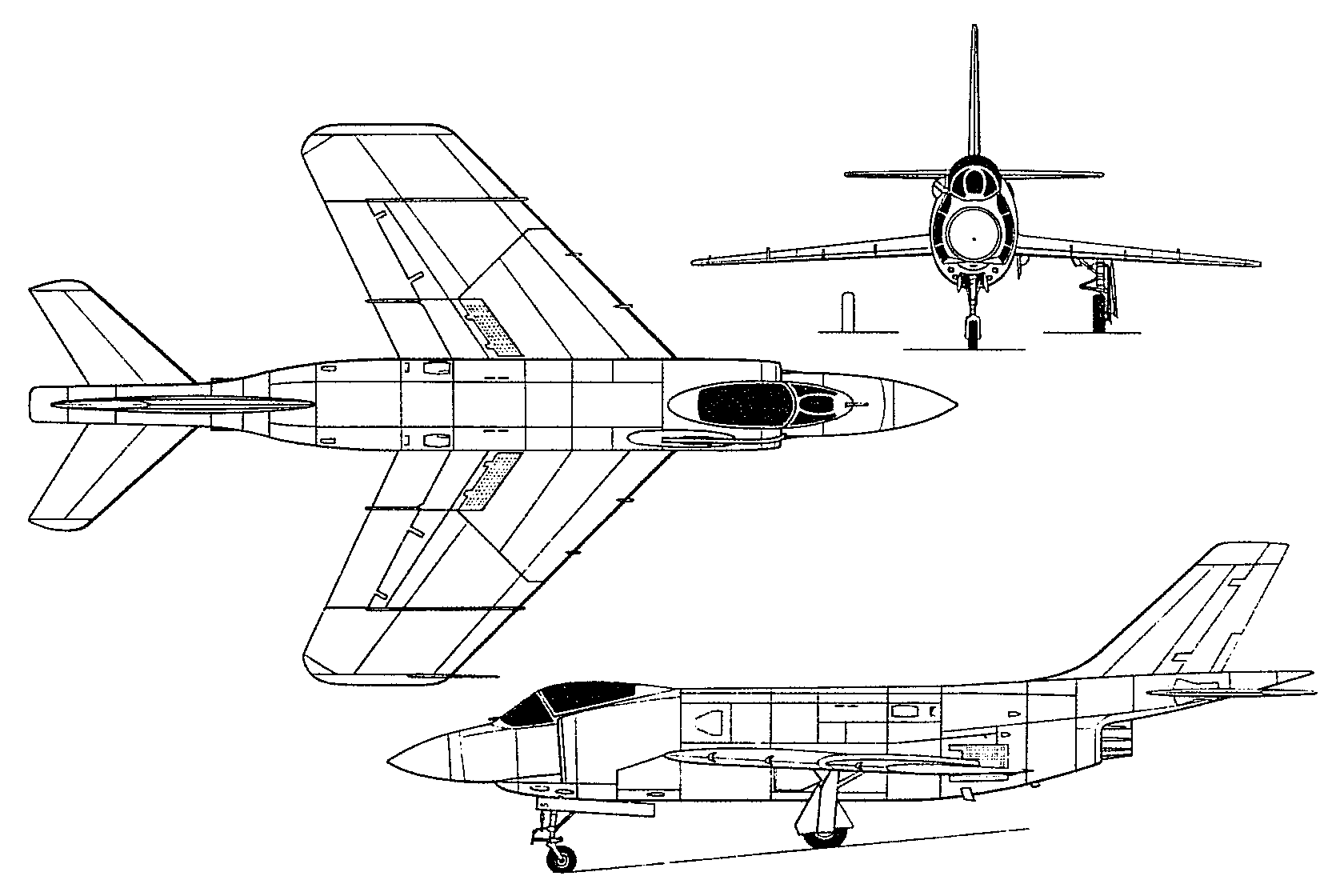
 | A three-view drawing (1680 x 1120) |
| Dick Hallahan, e-mail, 02.07.2015 21:38 In reply to John Robertson: I was attached to VF-131 when it was established in late 1961, and made the transition you describe to VF-13 in September, 1962. reply | | Gordon Hofstra, e-mail, 31.03.2015 03:28 I flew the Demon with VF-14 Tophatters aboard FDR (CVA-42) Sept 1962 - May 1963 for one full Med Cruise. A very stable bird but under powered. Turning in on final to the carrier was 100% power and you had 98-100% to play with in the slot. Was barely supersonic. At low altitude max power you had to disarm the auto spoiler system or they would kick in and not necessarily together. Was interesting to fly at night low level (500') in autopilot and your head in the radar scope. Had to trust the airplane
. Poor forward visability taxiing on the deck because of the high nose strut. Dick Thomson had a radio failure and nozzle failure one night and made a good carrier landing in modified afterburner (stable bird). I liked the Demon but oh what a difference with the F-4. reply | | tyrone morgan, e-mail, 23.07.2014 05:15 can you make a model for me reply | | Ray Crews, e-mail, 23.05.2013 20:53 Was plane captain on F3H Demon in VF-151 Nas Miramar /USS Coral Sea 1962-65 Later ADJ-3 on McDonnell F-4. Three years assembly mechanic at Mcdonell in St Louis. Over 30 years at Lockheed Martin (still working) in Marietta GA (retireing soon, the second time). reply | |
| | John Robertson, e-mail, 21.06.2012 04:04 Dick Hallahan & Jim Matheny: Was either of you attached to VF-131 (which flew the Demon) in 1962 when VF-131 was re-designated as VF-13 and replaced the old VF-13 which flew the F4D fighters and stationed at NAS Cecil Field? reply | | DAVID BONNOT, e-mail, 31.05.2012 09:37 I was a demon doctor on the first three aircraft delivered to Point Mugu, Ca. for sparrow test. Of the three, one was always in the hanger and it did not take long before they were renamed from the Screaming Demon to the hanger Queens. In fact we had reserve area set up inside the maintance hanger for the beast. The best I can remember about maintance was the ratio was something like twenty five hours maintance to one hour flight time. reply | | Ernie Hiscox, e-mail, 16.03.2011 16:58 I was an AQ in VF-53 at Miramar when we lost a demon on climb out. This was apparently a vertigo incident given a thin overcast at 1500 to 2000 feet. The squadron picture event was marred by having the Demon towed over some blacktop taking a sharp turn. If I remember correctly, we left a hole in the blacktop and damaged the strut. reply | | Barry, 11.02.2011 16:37 This was not a good plane. It certainly laid waste to a number of McDonnell test pilots, not helped by the poor in house designed ejector seat. The F3H-1 was designed around the extremely poor Westinghouse J40, which in both it's standard -6 form and it's afterburning -8 form never achieved it's design thrust. So bad and costly in fact that it put paid to Westinghouse altogether.
The FH3-2 was then fitted with the Allison J71, a better engine but not designed for an aircraft with a bifurcated inlet. Coupled to this the U.S.Navy increased it's design criteria and you had a front line fighter which was underpowered with an engine, which because it wasn't designed for this application, had a prepensity to flame out and do all sorts of other dispiriting things (see below). Sure it was fitted with Sparrows (Designed for 4 but usually carrying only 2) but lets face it every time the cannon were fired the engine would flame out. The only good to come of this was you can see the parentage of the F101 Voodoo and best of all the F4 Phantom II. reply | | Pat Ball, e-mail, 08.02.2011 21:18 VF-193 took delivery of the Demon in 1957 and it was a very predictable and stable platform for IFR and as an interceptor. We deployed on USS Bonnie Dick CV-31 twice. I had a flameout off the cat when i lit A /B at 3500' and 280Kts. Fully loaded in good daytime weather. I had 3 choices: eject (NO); attempt relight; and /or ditch. I got a relight with absolute minimum conditions (after jettisoning Sparrows - Cry!) and brought the plane back aboard in the middle of the Pacific. We had removed the in-flight refuel booms and never carried drop tanks. We flew in lots of bad weather w /o losing a plane. reply | | Lew Byars, e-mail, 08.12.2010 00:12 An F3H-2N, Bu No 133564 was launched from the USS Forrestal @ 2045R (22 Mar 58). The Pilot was presumed dead on 22 March 58.
What Engines were installed at that time? What was concluded as to the cause of the accident? Was the pilot found? reply | | Ed Bowley, e-mail, 18.11.2010 13:19 I was a crew chief in the test cells at Westinghouse and worked with the engineers developing the J-40 engine in 1953-4. Two engines blew in my face inthe cell..fire consumed the magnesium of the compressor housing and fire bottles were useless..I recall 13k thrust on the thrust gage in takeoff power...with afterburner during acceptance runs for the Navy...but our contract was cancelled. I left the company shortly after. reply | | Dave Greene, e-mail, 27.10.2010 03:13 I was Tomcatter in VF-31 from 1960-64. Made 3 6 month Med cruises on theUSS Saratogs CVA-60 and no telling how many short cruises to Gitmo or for carrier-quals, etc. I was a mech and don't recall having all that much trouble engine wise. I don't think we ever lost a Demon on cat shots and can only recall one airborne accident, a mid-air collison with a private plane off Mayport and the pilot survived. I do remember one night landing accident on a Med cruise where a Demon landed on top of the spares being taxied forward. The plane had caught a wire but there were several aircraft destroied and some fatalities on the flight deck crew. All in all the Demon was a challenge but fun to work with. reply | | ttgrimmett, e-mail, 24.09.2010 22:40 I was with VF 64 on the Midway in 1959.
We lost 7 Demons because of compressor seizures. The engine was not "all weather" as represented. reply | | Ta-183, 15.05.2010 17:18 DUH! reply | |
| | Graeme Choat, e-mail, 02.09.2008 07:08 Was the F3H the first US naval aircraft to have an after-burning engine?? reply | | Tom Wimberly, e-mail, 26.05.2008 03:38 I was a squadron mate of Dick Hallahan and Jim Matheny. By the time I got into the machine (about April 1962), I was told that the compressor blade tips had been trimmed and that chance of engine seizure in rain was remote. Trimming of course reduced compressor efficiency, hence reduced thrust available. Remarks about the J-40 are somewhat irrelevant; Navy recognized the J-40 would not do and because they wanted to get the Sparrow operational as soon as possible, they developed the J-71 w /afterburner to make the Demon work. The aircraft had sufficient power to make a safe carrier approach; I had never heard it damned for a high bolter rate. It was easy to fly; honest, no bad tendencies, but not a lot of excess thrust. Aboard Shang in 1963-64, the ship would use us for the air intercept compexes in preference to the Crusader, because of our head-on capability with the Sparrow. Of course, it was a little humiliating if you tried to keep up with a Crusader or a Vigilante. reply | | Frank Bahman, e-mail, 25.05.2008 16:11 As a shaky 1st tour pilot, the Demon was what I needed. It was stable on the glide slope, easy to land on the ship. The one A /B landing I made due to a nozzle failure was an OK 3 wire. Most of all, the confidence I gained around the ship made the transition to the Crusader a piece of cake. reply | | MANNY SOUSA, e-mail, 24.05.2008 18:49 I flew Demons from 4 /59 to 6 /62, '61 VF-53 Ticonderoga WESTPAC cruise and VF-121 instructor /LSO. Ignored in all the damning comments is the fact that Demon was the only allweather interceptor with a head-on (Sparrow) capability and acceptable radar. Forward visibility and roll rate were excellent. It was the J71 (not J40) which tended to compressor stall in visible moisture - never resolved because engine and airframe mfgs were in denial, pointing their fingers at each other. (I had one quit at 35Kft, restarted at 28Kft - "ground checks OK" writeoff! Also, the J-71 occassionally shifted two feet aft on cat shots with broken mounts (didn't produce enough thrust to keep up?)with ditching results. The night carrier landing rate bolter rate was 25%. With engine at 98% rpm on approach and high fuel consumption, the afterburner's "turkey feathers" provided thrust changes. All in all, I enjoyed flying the Demon - but was OVERJOYED to move up to Phantoms. reply | | Dick Hallahan, e-mail, 14.05.2008 20:04 I flew the Demon for over three years, and was a VF-13 squadron mate of Jim Matheny. The quote that a "modified afterburner system gave power in the range needed to make safe carrier landings" is misleading. The system was designed in case the tail nozzle failed open, causing a radical loss of normal thrust. I never used it. reply | | Jim Matheny, e-mail, 28.04.2008 01:57 I flew this aircraft on its last operational deployment in VF-13 on board the USS Shagri-La in 1963. We lost two aircraft and one pilot on that deployment. The aircraft also had high fuel consumption and a relatively short reserve at landing weights. reply |
|
Do you have any comments?
|
| 
COMPANY
PROFILE
All the World's Rotorcraft
|