|
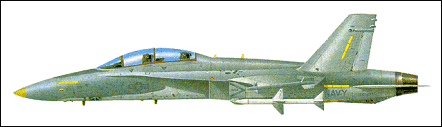
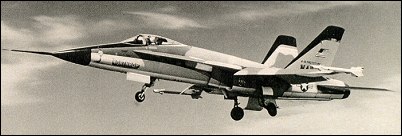
| The F/A-18 design began as the Northrop YF-17 Cobra, one of two competing designs for the USAF's Lightweight Fighter Program, on which the USN was a minor partner. The YF-17 prototype first flew in 1974. The Navy preferred the YF-17 over the winning F-16 Fighting Falcon, because of its twin-engine design. For the Navy version, Northrop teamed with McDonnell Douglas to capitalize on the latter's extensive experience in building carrier aircraft, including the highly successful F-4. When the two services ended up choosing different aircraft, McDonnell Douglas became the primary contractor for the Navy design (McDonnell Douglas merged with Boeing in 1997).
The Navy's design concept originated from Vice Admiral Kent Lee. He drew on his experience as a naval aviator in WWII, where fighters hastily converted for bombing with jury-rigged bomb racks proved to be versatile assets, which were capable of defending themselves once they had dropped their bombs. He and his supporters pushed for the VFAX concept, a cheap and lightweight strike fighter, to complement the F-14 Tomcat which had become operational and was just being introduced to the carrier air wings in 1973.
F/A-18 Hornets (A and B variants) were first test-flown in 1978, and entered service in 1983, replacing the F-4 Phantom II and the A-7 Corsair II. The F/A-18 first saw combat action in 1986, when Hornets from the USS Coral Sea (CV-43) flew SEAD missions against Libyan air defenses during the attack on Benghazi.
After a production run of 371 F/A-18As, manufacture shifted to the F/A-18C in September 1987. As the A-6 Intruder was retired in the 1990s, its role was filled by the F/A-18. The F/A-18 demonstrated its versatility and reliability during Operation Desert Storm, shooting down enemy fighters and subsequently bombing enemy targets with the same aircraft on the same mission, and breaking all records for tactical aircraft in availability, reliability, and maintainability. The aircraft's survivability was proven by Hornets taking direct hits from surface-to-air missiles, recovering successfully, being repaired quickly, and flying again the next day. Ten F/A-18's were lost in the Gulf War, most to surface to air missiles although one was allged to have been shot down by an Iraqi MiG-25PD in the first hours of the air campaign. F/A-18's were credited with two kills, both of MiG-21's, during that conflict.
In the 1990s the US Navy faced the retirement of its aging F-14 Tomcat, A-6 Intruder, EA-6 Prowler airframes without proper replacements even in development. To answer this deficiency, the Navy developed the F/A-18E/F Super Hornet. Despite its designation, it is not an upgrade of the F/A-18 Hornet, but rather, a new, larger airframe utilizing the design concepts of the Hornet. Until the deployment of the F-35C, Hornets and Super Hornets will serve complementary roles in the US Navy carrier arsenal.
| CREW | 1 |
| ENGINE | 2 x General Electric F-404-GE-400, 72.5kN |
| WEIGHTS |
| Take-off weight | 20000 kg | 44093 lb |
| DIMENSIONS |
| Wingspan | 11.4 m | 37 ft 5 in |
| Length | 17.1 m | 56 ft 1 in |
| Height | 4.5 m | 15 ft 9 in |
| Wing area | 37.2 m2 | 400.42 sq ft |
| PERFORMANCE |
| Max. speed | 2000 km/h | 1243 mph |
| Cruise speed | 1250 km/h | 777 mph |
| Ceiling | 15000 m | 49200 ft |
| Range w/max.fuel | 3700 km | 2299 miles |
| Range w/max payload | 740 km | 460 miles |
| ARMAMENT | 1 x 20mm cannon, 7700kg of weapons |
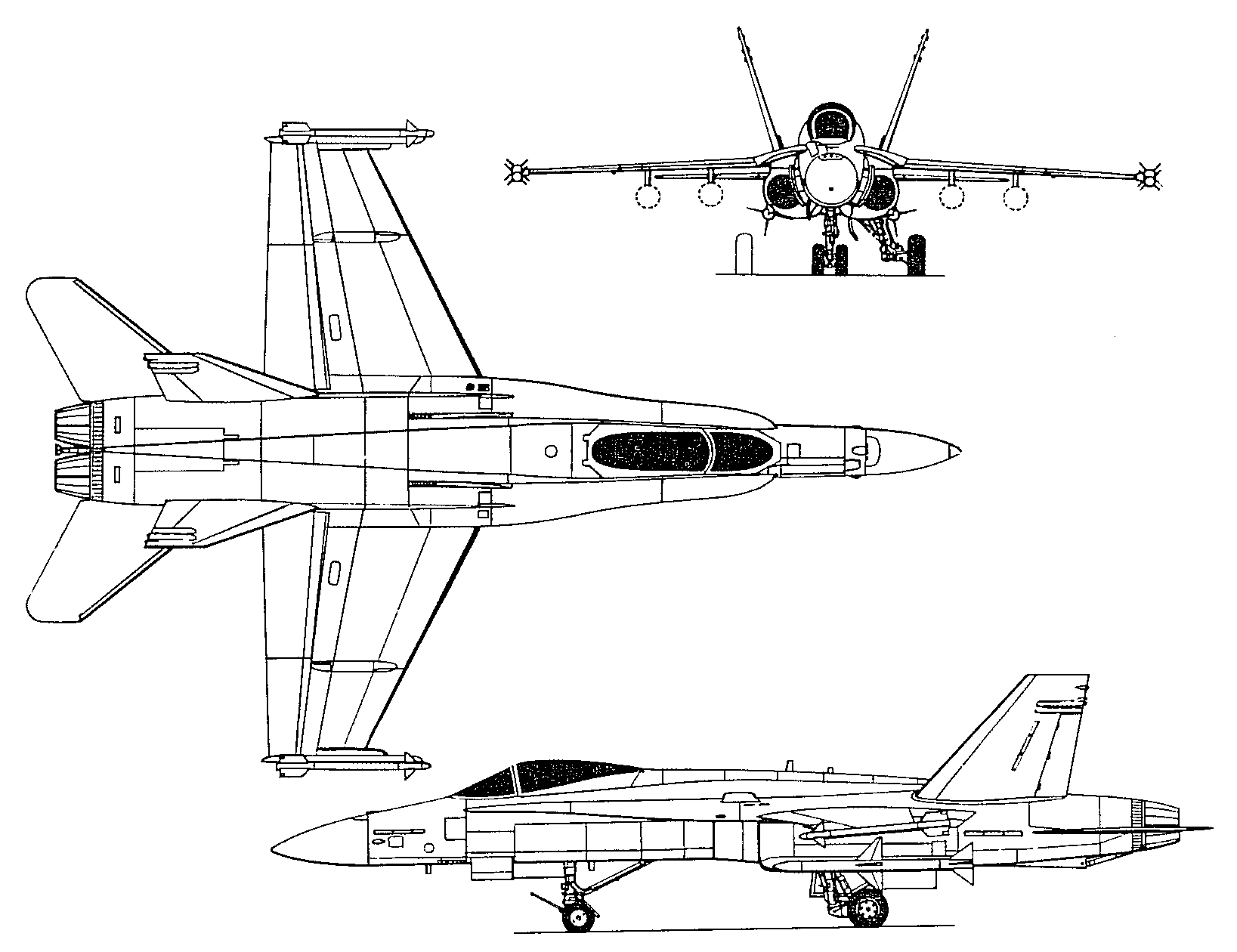
 | A three-view drawing (1637 x 1260) |
| Charles Caldwell, e-mail, 12.09.2012 22:14 Few people know the story of how mid level officers in the Pentagon realized the Air Force cannot buy the number of F-15's needed to defend America. They knew generals don't want a more affordable fighter so they hid the development of the F-16 in research contracts. The Air Force didn't want the A-10 either to protect ground troops. The secretary of defense forced the projects on the air force. When request for proposals came out Northrop wanted to be part of the contest and built the YF-17 with two engines. Navy officers were afraid they will be forced to buy naval F-16's and had a rush program to develop their "affordable fighter". I don't know if Northrop realized to sell the design to the navy they need a navy contractor or if Douglas asked to partner to sell the contract. A great book is about John Boyd - believe rest of title is he revolutionized war in the air and on the ground. The first F-16 had direct costs of about $10 million with 6 borrowed engines from the navy for the two prototypes, borrowed radar from other airplanes, and may have had ejection seat from another airplane to get it in the air. Boyd is also known for the OODA loop (not sure of spelling) used to gain air superiority over enemy pilots in fighters before the F-15, F-16 and F-18. With the exception of the A4 older generation fighters didn't have the wing area to have excellent maneuverability to fight better in dogfights. Boyd was questioned about fuel payload on the F-16 by a general and he quoted specifications in pounds to say it has less range so the design spec cannot be sabotaged to be less than the F-15. When in fact the design was designed to stay airborne longer or close to where needed longer to fight longer if needed.
After retired Boyd studied ground warfare success. And was invited by VP Cheney to advise him about his thoughts on invading Iraq. Schwarzkopf's first order of battle was for a WWI type fight that may take years and thousands of lives to win. The second order of battle was more a Panzer like operation to find entry to take over Iraqs command and control centers. Winning the war in around 110 days with only around 100 Americans dead in the invasion.
The book is an interesting read on Pentagon infighting over programs. reply | | Scott, e-mail, 23.02.2012 18:14 Actually Lance, it did replace the F-4. But it was in the MarinecCorps not the Navy. I was in one of those squadrons. VMFAV-115 was the first east coast squadron to retire its phantoms and stand up as an F /A-18 squadron. reply |
| Eric Ray, e-mail, 30.05.2011 06:51 I worked at McDonnell in the St. Charles avionics laboratory in 1978-79. Was at the flight line the evening the Hornet was first fired up and taxied. I saw the first flight. I did FA-18 ACL integration testing. Sat in the cockpit of the #3 aircraft and pushed the ACL button on the UFC. I never got to see the ACL land an aircraft on a carrier. Suppose it worked just fine. reply | | Dakota, 12.05.2011 22:16 I'm doing a project over this and i need some real good information over this aircraft reply | |
| | Lance Lemcool, e-mail, 17.03.2011 23:45 Incorrect info in the above write-up. F /A-18's never replaced the F-4. When they were first introduced they replaced the A-7 Corsair. Eventually, the A-4 Skyhawk and A-1 Spad went away too, although most of these squadrons had transitioned to the A-7. Agree with Russ. The F /A-18 can't even be in the same airspace as the A-6 intruder vis-a-vis attack role. reply | | E. Adam, 25.02.2011 23:26 The FA-18 Hornet is not only a superb and reliable air-to-air and air-to-surface multi-role aircraft, It was the first production tactical aircraft with a 'Glass Cockpit' and fully electronic Helmet Mounted Display and Tracking System. reply | | sachit kshatriya, e-mail, 21.11.2010 12:11 coolest aircraft ever seen!!!!!!!!!!!!!!11 reply | | Cpt. Fucko, e-mail, 24.08.2010 22:37 Hey....the plane put the F-14 out of business, whaddaya expect? lol Good plane though. reply | | Dylan, e-mail, 18.03.2010 16:47 man this web is like so dumb there is no information :)::):):):):)xD reply | | justin, e-mail, 18.03.2010 16:40 y is there no good info on here?? reply | | James, e-mail, 11.06.2008 03:53 The F /A18 has got to be the most versitle combat aircraft ever built.
Its relative flexibality and affordability puts the stealth aircraft to shame. reply | | Ken Langford, e-mail, 15.05.2008 03:40 Having over 8,000 hours in high performance tactical jet aircraft at the time in 1983, my first flight in the Hornet was the culmination of what I believe a fighter airplane should be. I still believe it. reply | | Russ Early, e-mail, 23.04.2008 05:28 The F /a-18 may have filled the hangers and ramp space at NAS Oceana, and Taken the Deck space on U.S. Carriers but in no way has it or will it ever fill the role of the A-6 Intruder. reply |
|
Do you have any comments?
|
| 
COMPANY
PROFILE
All the World's Rotorcraft
|




I stand humbly corrected...
reply