|
| The XFJ-1 marked the entry of North American into the field of jet-propelled military aircraft. The first prototype flew on 27 November 1946. Thirty production FJ-1 single-seat fighters were delivered to the US Navy, featuring straight wings and a 17.8kN Allison J35-A-5 turbojet engine. After being used for jet familiarisation, these were transferred to Naval Air Reserve units.
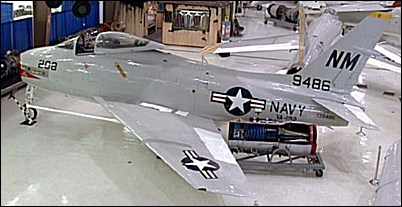
Although carrying FJ Fury designations, the next series of single-seat fighters for the US Navy were swept-wing aircraft based on the F-86 Sabre. The first was the FJ-2, first flown in prototype form on 14 February 1952. Production FJ-2 were powered by the General Electric J47-GE-2 turbo-jet engine and were basically navalised F-86E. FJ-3 and FJ-4 variants followed, powered by Wright J65-W-2/W-4/W-16A engines, bringing the total number of swept-wing Furies built by 1958 to 1,115.
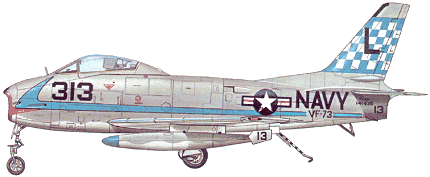
| MODEL | FJ-4 |
| CREW | 1 |
| ENGINE | 1 x Wright J-65-W-16A, 3470kW |
| WEIGHTS |
| Take-off weight | 9131 kg | 20131 lb |
| Empty weight | 5992 kg | 13210 lb |
| DIMENSIONS |
| Wingspan | 11.91 m | 39 ft 1 in |
| Length | 11.07 m | 36 ft 4 in |
| Height | 4.24 m | 14 ft 11 in |
| Wing area | 31.46 m2 | 338.63 sq ft |
| PERFORMANCE |
| Max. speed | 1094 km/h | 680 mph |
| Range | 2390 km | 1485 miles |
| ARMAMENT | 4 x 20mm cannon |
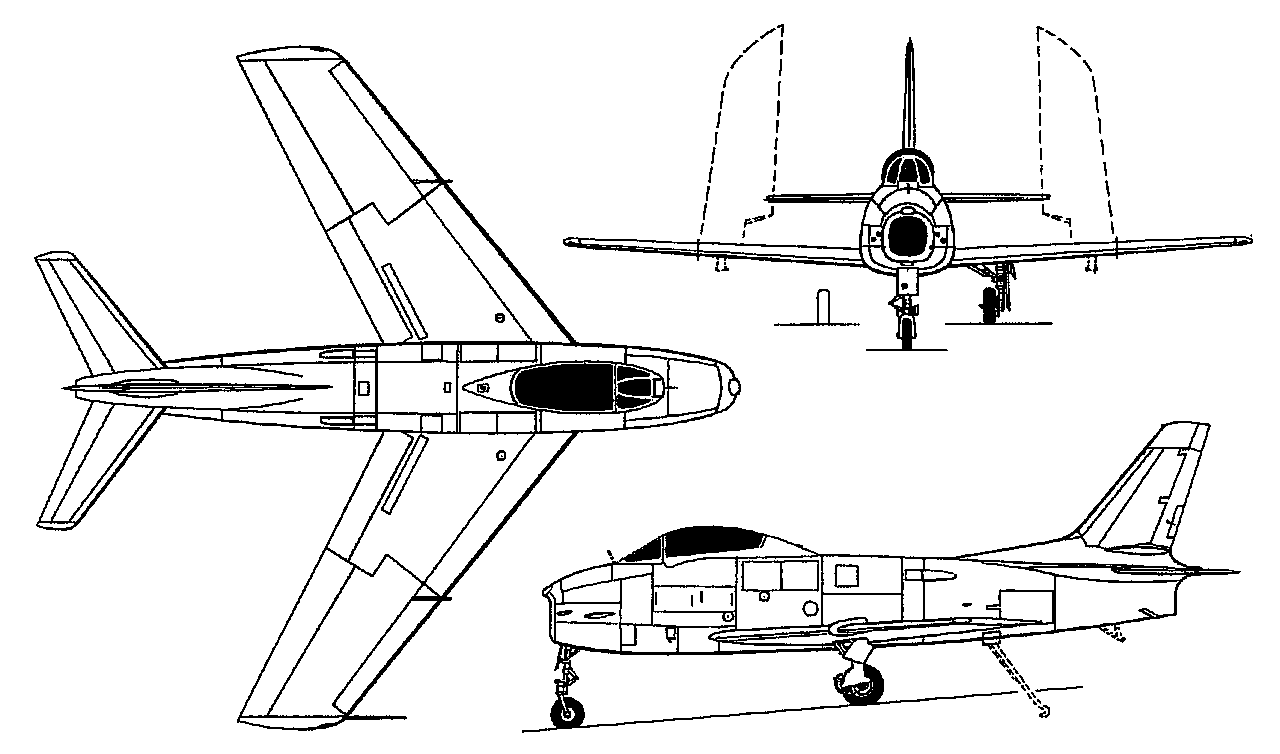
 | A three-view drawing of FJ-3 (1280 x 754) |
| Eric Krask, e-mail, 11.02.2018 02:00 You don't fly a FJ-3. You strap in and the wings grow out of your shoulders. It's all you and only you. reply | | PAUL CHRISTIAN, e-mail, 20.09.2016 21:04 ON THE FJ-4B, THE CIRCLE LOWER LEFT OF AMMO DOOR LEFT SIDE.IT'S A RED CIRCLE WITH A WHITE STRIPE THROUGH IT. HAS SOME SORT OF PROBE STICKING OUT. CAN YOU HELP US FIGURE IT OUT. WE'RE RESTORING A FJ-4B TKS PAUL reply | | Duane Van Valkenburg, e-mail, 08.05.2016 02:24 In late 1955 our squadron VF-21 got 17 new FJ-3. Myself & Harry Errington painted those planes with a 17' upside down check mark & all of the numbers. We took these planes & got on the USS Forrestal Jan. '56 I think we were the first Air Group on the Forrestal. We went to Cuba for training. reply | | PAUL CHRISTIAN, e-mail, 08.12.2015 21:41 DO YOU HAVE ANY INFORMATION ON JACKING POINTS UNDER WINGS ON FJ-4 MODEL. TKS reply | |
| | Clive Turner, e-mail, 26.06.2014 13:01 Hi Jim, I think the FJ-4 serial was: 139286-Nate Decker has a website on old US jets: Forgotten Jets. Hope this helps. Regards reply | | Ralph K, e-mail, 24.02.2014 07:04 I am trying to find an old original VF-173 / VF-73 JESTERS, VF-21, and or
VF-143 King Pins patch. Also desperate for any {old} original USNR and or USMCR Fighter or Attack squadron patches.
If you have a patch, I would be happy to send you 'up front' a new book which chronicles the FJ-3 / FJ-3M or FJ-4 / FJ-4B. The book covers all of the pre-1970 USNR and USMCR units which flew the Cadillac.
If you have only one patch, I can reproduce the patch + send the book. An embroidery shop with a loom, can spin an EXACT reproduction of the patch - same size, design, and colors. Please kindly look at your leisure for an old patch. Thanks for your interest. reply | | alain peulet, e-mail, 04.02.2014 20:48 I love this jet and other US naval fighters of this period , Cutlass etc... Unfortunately , no one in French museums . The only one in the sky is a Corsair F4U7 (french version). You in USA are lucky and keep many many wonderfull planes...
Many thanks !!! From France reply | | alain peulet, e-mail, 04.02.2014 20:48 I love this jet and other US naval fighters of this period , Cutlass etc... Unfortunately , no one in French museums . The only one in the sky is a Corsair F4U7 (french version). You in USA are lucky and keep many many wonderfull planes...
Many thanks !!! From France reply | | JIM NASH, e-mail, 06.12.2012 22:25 I AM RESEARCHING A FATAL CRASH OF AN FJ-4 FROM THE FACTORY AT COLUMBUS, OHIO. THE BIRD WENT DOWN JUST NORTH OF URBANA, OHIO ON OCTOBER 9, 1956. THE PILOT WAS A COMPANY TEST PILOT. THE PLANE OBVIOUSLY BROKE UP IN FLIGHT. THE TAIL WAS SEVERED CLEANLY AND (COINCIDENTLY ?) RIGHT WHERE THE TURBINE SECTION WOULD HAVE BEEN LOCATED. (TAIL WAS IN MY YARD)
I AM TRYNG TO FIND ANY OFFICIAL RECORD AS TO CAUSE AND NOT HAVING MUCH LUCK. (I'M NEW TO THIS) I AM SATISFYING A CURIOSITY I'VE HAD SINCE I WAS 6 YEARS OLD AND ALSO SHARING THIS WITH THE LOCAL HISTORICAL SOCIETY. I AM A PRIVATE PILOT AND HAVE BEEN SORT OF A "REVERSE ENGINEER" MOST OF MY LIFE. IF ANYBODY CAN HELP WITH THIS PLEASE E-MAIL ME. reply |
| Erik McMillan, e-mail, 26.08.2012 02:08 I flew the FJ-3D with Guided Missile Group-2 in '57-'59 and controlled the SSM-N-8 Regulus Missile which was launched from submarines, cruisers, and carriers. The tactical missile carried a 44 Kton warhead. As part of the Regulus Assault Mission we trained to attack targets in the USSR. It was demanding, but fun to control recoverable training versions of the missile. The FJ-3D helped to provided me the most exciting time of my life. reply | | Chash, e-mail, 06.08.2012 22:32 I saw these at Kaneohe Bay TH in the mid 50's. I thought VMF 212 had the FJ 3's and VMA 232 replaced the AD's with F8u Crusaders. reply | | RAYMOND WILLIAM WORDEN, e-mail, 05.02.2012 23:58 i am airplane spotter since i was nine years old i am seventy years old now 1 /5 /2012
airplanes is my hobby then and like it very much keep my eyes on them
all kinds thank you very much sincerely bill worden reply | | TJ Meyer, e-mail, 06.12.2011 15:20 Hello I work for NASA at the Wallops Flight Facility, which is the former Chincoteague Naval Air Station /Naval Aviation Ordnance Testing Station. Im looking for anyone who served at Chinco; topics of interest are GMSRON-2, GMGRU-2, Regulus Missile, NAOTS, VU-2, VX-2, VAHM-13, Wallops Island Ranges and general life at Chinco. reply | | Jeff Haven, e-mail, 04.09.2011 01:38 My Father, LTCDR Robert F Haven was one of the test pilots on the rocket assist FJ-4F at Pax River. He was with the A-3J project after that. I have many photos from this period. He was later head of military sales in Europe. He died in a FJ-4, Sept. 1962, and is buried in Arlington NC. Anyone know of him? reply | |
| | bill query, e-mail, 06.08.2011 18:18 I ended up with a little over 1,000 hours in the FJ-3m. Flew it in VF-173, VF-62 and VU-10. It was my favorite plane of the 26 I have flown. I made 2 water landings and am still here to tell about it----tough airplane!! reply | | Bob White, e-mail, 07.07.2011 01:24 Was flight deck troubleshooter with VA144 during westpac cruise in 1960 aboard the Oriskany. Our guys flew the FJ4B
and as I remember they were good old kites. reply | | BOB GIUSTI, e-mail, 28.05.2011 03:15 WORKED ON FJ3M'S IN VMF235 57-59 6442. WORKED WITH PEDRO FRESNO, MENTIONED IN THE LEAD ITEM. IS THERE A WAY TO CONTACT HIM. LOVED THE PLANE, IT WAS A BULL STRONG AND EASY TO WORK ON. reply | | ron lewis, e-mail, 19.05.2011 12:14 To CHARLES DAVENPORT: The red circle you asked about appears to be a red warning /caution decal or stencil over the inspection hatch for the "Alernate Flight Control System Refill Indicator (Accumulator Gage Rod)," per the manual for the FJ-2. I've seen several photos that have such a stencil but the distance from the camera and the resolution makes it impossible to read the text. However, other stencils similar to it on the FJ-2 cite specific pressures for fuel, so the lettering probably states what pressures or levels the hydraulics are supposed to read. I would guess that it was seen on Navy planes and not Marine aircraft because the manual states that the alternate hydraulic flight control system will not transfer from the primary to secondary if pressure in the alternate is low. Usually, when one service goes out of its way to mark something that other users did not, it means that they had an accident, or a series of them. Any ex-FJ-3 drivers know anything further on that? Hope that helps. reply | | RON LEWIS, e-mail, 19.05.2011 11:19 TO MIKE McGOVERN: Mike, if you care to share any info on the rocket-boosted FJ-4F, I am all ears. reply | | RON LEWIS, e-mail, 19.05.2011 11:16 To Charles Davenport: I checked detailed photos that I have of a USMC FJ-3, starboard side, upper right field of the star-and-bar insignia, and the only thing I could find was one of the engine cooling air scoops in that position. is it possible that you saw photos of an earlier /later model of the Fury? reply |
|
Do you have any comments?
|
| 
COMPANY
PROFILE
All the World's Rotorcraft
|




Hey Jim,
I just saw your post today June 27, 2022. I am curious if you had any luck in your research. It is a very interesting story.
Thanks,
Pete Simoneau
reply