|
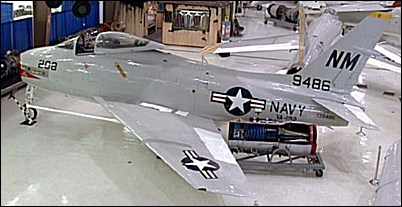
| The XFJ-1 marked the entry of North American into the field of jet-propelled military aircraft. The first prototype flew on 27 November 1946. Thirty production FJ-1 single-seat fighters were delivered to the US Navy, featuring straight wings and a 17.8kN Allison J35-A-5 turbojet engine. After being used for jet familiarisation, these were transferred to Naval Air Reserve units.
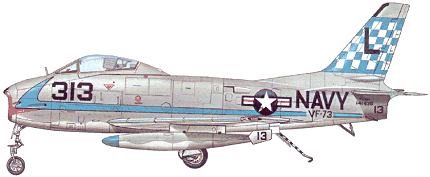
Although carrying FJ Fury designations, the next series of single-seat fighters for the US Navy were swept-wing aircraft based on the F-86 Sabre. The first was the FJ-2, first flown in prototype form on 14 February 1952. Production FJ-2 were powered by the General Electric J47-GE-2 turbo-jet engine and were basically navalised F-86E. FJ-3 and FJ-4 variants followed, powered by Wright J65-W-2/W-4/W-16A engines, bringing the total number of swept-wing Furies built by 1958 to 1,115.
| MODEL | FJ-4 |
| CREW | 1 |
| ENGINE | 1 x Wright J-65-W-16A, 3470kW |
| WEIGHTS |
| Take-off weight | 9131 kg | 20131 lb |
| Empty weight | 5992 kg | 13210 lb |
| DIMENSIONS |
| Wingspan | 11.91 m | 39 ft 1 in |
| Length | 11.07 m | 36 ft 4 in |
| Height | 4.24 m | 14 ft 11 in |
| Wing area | 31.46 m2 | 338.63 sq ft |
| PERFORMANCE |
| Max. speed | 1094 km/h | 680 mph |
| Range | 2390 km | 1485 miles |
| ARMAMENT | 4 x 20mm cannon |
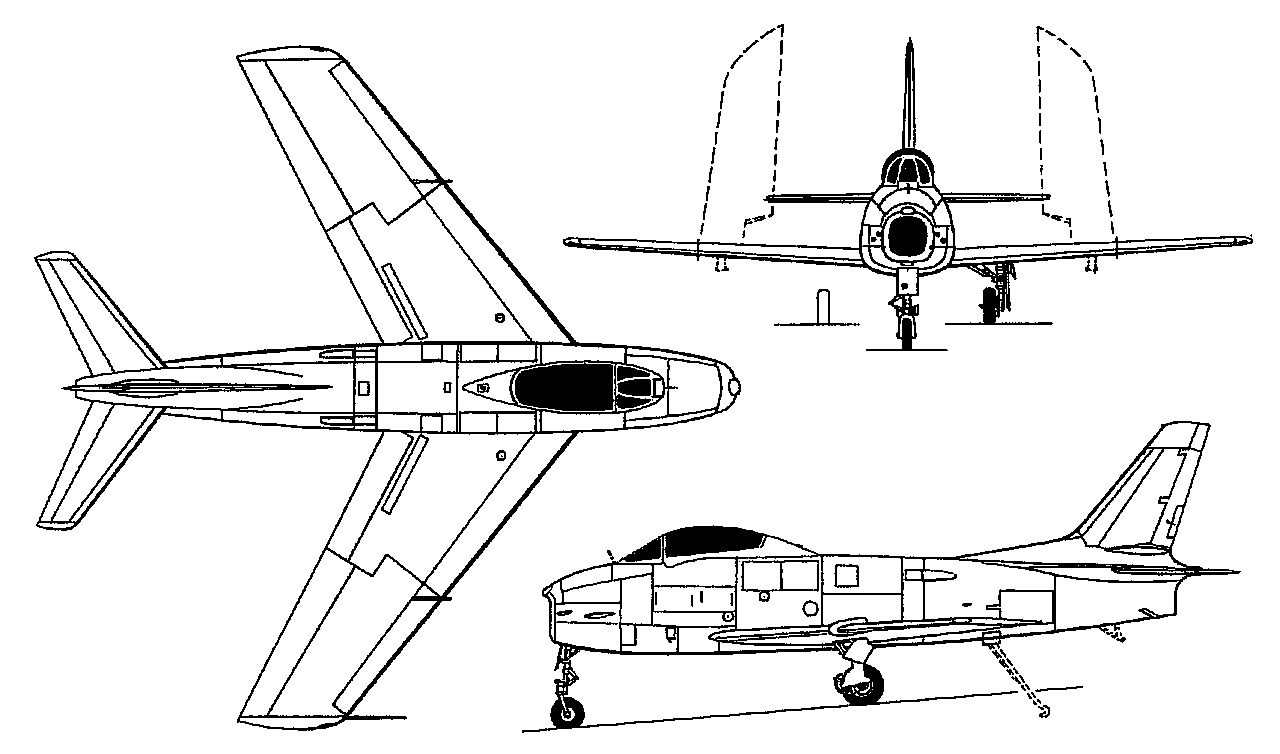
 | A three-view drawing of FJ-3 (1280 x 754) |
| Joe Storey, e-mail, 11.08.2010 06:42 In 1958 and 1959 flew FJ-4's with VA-56 and VA-126 at Naval Air Station,Miramar. Loved it! reply | | Leo (Buddy) Lemoine, e-mail, 23.12.2009 22:51 Dec 23, 2009
Attached to GMGRU-1 Feb 57 to Sep 57 at NAS Barbers Pt then transferred to Detachment at ALF Bonham on Kauai.
Was detachment Yeoman till transfer in May 59. Skipper
was LCDR George W. Absher at that time. Witnessed may
launches and recoveries of the Regulus. Retired in Jun 79 as YNC. Was assigned with detachment was changed to GMU 90
under command of SUBPAC. reply | | Dusty Rhodes, e-mail, 09.05.2009 13:02 In 1956 I was a 1stLt flying FJ-2s with VMF-451 at NAS Atsugi, Japan. We got brand new FJ-4s that were brought aboard a light carrier across the Pacific and offloaded at a field on the Eastern side of Tokyo Bay. Great increase in performance over the FJ-2 and no need to carry drop tanks. reply | | Bill Query, e-mail, 28.07.2008 20:22 I flew the FJ-3M with VF-173 and VF-62. Made the 1959 Med. cruise with VF-62 on the CVA-9. On that cruise I had the misfortune to ditch astern of the boat when the engine failed while in the groove at appox.200Ft. Later went into the drink again when the number 2 wire broke and I went off the angle deck. Still, this was my most favorite plane of the 26 I have flown (including the F-8). reply | |
| | Rich Sugden, e-mail, 22.07.2008 04:22 Own and fly the last one left flying ... take a look at www.migfuryfighters.com reply | | Marv Garrison, e-mail, 20.06.2008 05:55 This was my first swept wing ride and I loved it. It was a agreat improvement over the Panther and Banshee and light-years over the F-80 /T33 and T1A, The FJ-4 was the best non afterburning aircraft I ever flew. We had to get into the F4D and F8U yo best the FJ's performance.Same number of take-offs and landings. reply | | Jim Bo, e-mail, 08.06.2008 04:41 Was station in GITMO Cuba,Watched them bring in the Regulus we had to clear the area during practice.There were some hairy moments,but it gave us somthing to do,we had no liberty. reply | | Jerry Avallone, e-mail, 01.06.2008 02:52 Served in GMGRU-1 at NAS Barbers Point,HI from 1956-1958.
The squadron had FJ3D Furies. Our squadron delivered the Regulus missile after it was lauched from a submarine via radio controls. Training for the pilots was conducted with RED Regulus missile equipped with tricycle landing gear so they could be reused after launch and landed at NAAS Barking Sands on Kauai,HI. Those practice landing (crashes) were spectacular when the landing wasn't perfect.
The narrow spacing of the main gear on the missile made it critical to have the wings level or it was bye bye baby. reply | | John Powers, e-mail, 22.05.2008 14:46 I flew the FJ3 and FJ4B in the reserves out of Floyd Bennett across from Idylwild (aka JFK). This by itself made for exciting flying. It was an incredible delight to fly except when things went wrong which happened too often. One of the most memorable was my introduction to PIO (aka the JC maneuver). reply | | Ken Langford, e-mail, 15.05.2008 03:26 I flew the FJ-4 and 4B's and they were great air to air and air to ground machines. The ergonomics of the cockpit layout left a lot to be desired and you had to be alert to the ultra clean wing in the landing pattern. Four 20 MM cannons in the nose virtually under the cockpit were great. Turn capability extraordinary. reply | | Ken Langford, e-mail, 15.05.2008 03:25 I flew the FJ-4 and 4B's and they were great air to air and air to ground machines. The ergonomics of the cockpit layout left a lot to be desired and you had to be alert to the ultra clean wing in the landing pattern. Four 20 MM cannons in the nose virtually under the cockpit were great. Turn capability extraordinary. reply | | Jack Sullivan, e-mail, 16.04.2008 19:10 Best swept wing the Navy had at the time. It outptreformed the F98 and was fun to fly but all our engines were weak at the time. GE and the rest of the engin manufacturers had a lot to learn in these years reply | | Norman L. Padgett, e-mail, 31.03.2008 17:12 I flew the FJ-4 in the fleet introductory progaram at Pax River. It was a 'rocking chair' with virtually no surprises. While it didn't have an afterburner, it was supersonic in a slight dive I believe there were only 150 produced and only the Marines had active squadrons of them. reply | | Jim Bo, 02.10.2007 02:47 Great airplane,Was in squadron VF 84 aboard the USS Forrestal during the fifties.We had FJ3m"s. Not complicated easy to work on. reply | |
| | larry, e-mail, 06.02.2007 13:22 Its a very neat aircraft, possibly one of the best carrier aircraft after world war 2 reply | | BREEN, e-mail, 19.02.2007 06:07 UNDER POWERED LIKE MANY OF THE JETS OF THAT DAY...THE AIR FORCE HAD THE F-100 WITH A BURNER... MADE A BIG DIFFERENCE...IT HAD A FLYING TAIL AND WAS A RUGGED BIRD. reply | | AL, 10.03.2007 23:43 WT AND MEASUREMENTS, HOW HARD TO GET? reply |
|
Do you have any comments?
|
| 
COMPANY
PROFILE
All the World's Rotorcraft
|