|
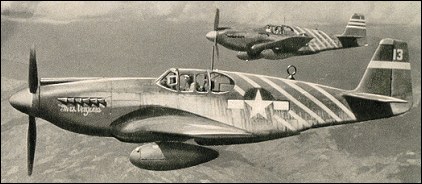
| On of the best fighters of the World War II. The first prototype flew on October 26, 1940. Entered production in 1941 and a total of 15386 aircraft were built in the USA.
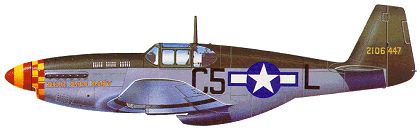
| MODEL | P-51D |
| CREW | 1 |
| ENGINE | 1 x Packard Merlin V-1650-7, 1264kW |
| WEIGHTS |
| Take-off weight | 5488 kg | 12099 lb |
| Empty weight | 3232 kg | 7125 lb |
| DIMENSIONS |
| Wingspan | 11.28 m | 37 ft 0 in |
| Length | 9.83 m | 32 ft 3 in |
| Height | 2.64 m | 9 ft 8 in |
| Wing area | 21.65 m2 | 233.04 sq ft |
| PERFORMANCE |
| Max. speed | 703 km/h | 437 mph |
| Ceiling | 12770 m | 41900 ft |
| Range w/max.fuel | 3347 km | 2080 miles |
| ARMAMENT | 6 x 12.7mm machine-guns, 454kg of bombs |
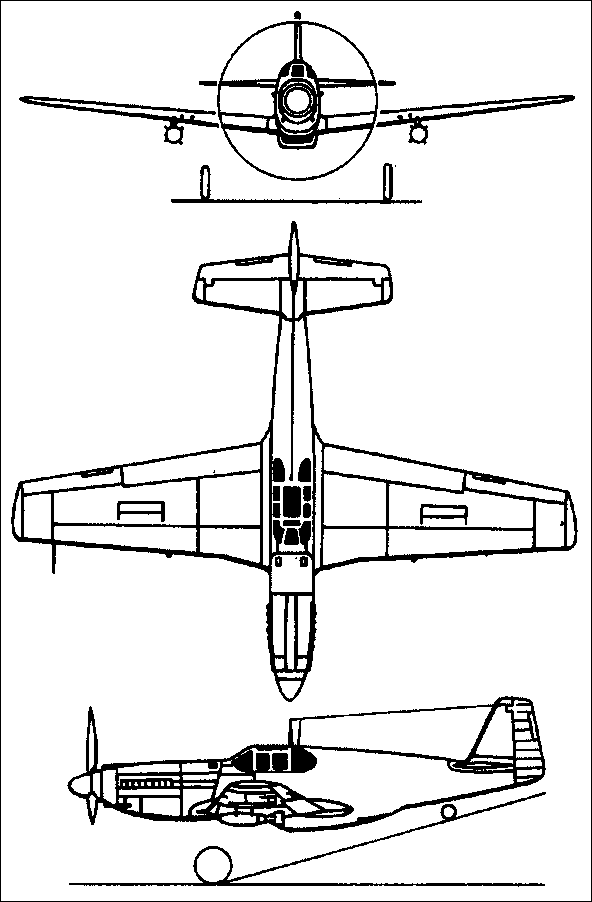
 | A three-view drawing (592 x 902) |
| Laté631, e-mail, 16.11.2025 06:33 Bonjour ! Sur l'image, il semble qu'il s'agisse plutôt d'un P-51B ou peut être C, mais pas d'un P-51D, la cellule et la verrière ne correspondent pas... Concernant le P-40, je suis absolument convaincu qu'il aurait été top avec un bon moulin, ses ailes étant davantage adapté pour pouvoir avoir une forte capacité à cabrer, là ou les Spitfire excellaient ! Du côté allemand, les Focke-Wulf Fw-190 (les versions D tout particulièrement) avaient une capacité à rouler sans égale à cette periode de la guerre...
PS : Si quelqu'un vie dans les Yvelines, je suis en train de faire des recherche sur un Lancaster qui est tombé en 1944 à côté de chez moi, si certains sont curieux de voir ce que j'ai pu trouver, vous pouvez répondre à mon commentaire.
amicalement !
Louis :-) reply | | Anonymous, 25.01.2024 20:11 (SELECT (CASE WHEN (8418=8707) THEN '' ELSE (SELECT 8707 UNION SELECT 9716) END)) reply | | Anonymous, 25.01.2024 20:11 8809 reply | | arachni_name, e-mail, 30.12.2020 06:46 1 reply | |
| | Ron, 16.10.2017 22:53 The 93 P-51A Mustangs with 4X20mm Mk II Hispano cannons did not have the problem with reliability like the US M2 Hispano.
If any of these had Merlin instead of Allison engines or if some Merlin P-51s had M2 cannons, is less clear. Perhaps photos of a Merlin Mustang with 20mm cannons was not a production model.
The idea of RAF P-51As with reliable RAF cannons makes one think the weight was too much for a dogfighter version. I think the extra power of the Merlin should have allowed for a good contender even with 2 Hispano and 2 Browning like the later Spits had. They needed more than 4 fifties in the RAF P-51 Mk II. This was an opportunity to have a US fighter with a reliable cannon. 93 should have been much more. reply | | William T. Schwander, e-mail, 20.03.2017 20:52 Your "A" model is designated as an "D" model. reply | | Harvey, e-mail, 23.04.2016 11:26 The picture of the plane at the top of this article is not a P-51D, which had a bubble canopy. The C and earlier versions had the type of canopy illustrated. reply | | Klaatu83, e-mail, 27.07.2015 03:05 The P-51As in the photo at the top, painted with the distinctive diagonal stripes, belonged to a unit known as the Air Commandos, which operated in Burma during 1944 in support of General Orde Wingate's famous Chindits. reply | | Fred Benenati, e-mail, 25.01.2015 14:38 Just to set the record straight, the P-51D, with a Packard built Rolls Royce Merlin engine, developed 1,490 horse power, as opposed to the 1,200 horse power stated by a Mr. D'Amario. Reference: Robert Gruenhagen's book about P-51 Mustangs. Yes, it was a wonderful aircraft. reply | | Ron, e-mail, 20.10.2014 22:10 I was disappointed to learn of the stress fractures limiting turns to 2.5g for the P-51H. Engine trouble was another serious problem. Thus, the weight trimmed Mustang was a fighter between wars while the sturdier, trusted P-51D saw action again in Korea. reply | | Ron, e-mail, 07.08.2014 01:16 I like the way the Fiat G55 Centauro has a similar wing planform. It was a world-beater like the P-51 but for it's production quantity. I was wondering if the design similarities were not a coincidence(general wing shape, ventral air-scoop, razorback); even both prototypes temporarily sported under-nose 12.7mm MGs! But no, just parallel coincidence of design.
It had me wondering though, because of the influence of a former Messerschmitt employee on the P-51 design and the fact that the Centauro outclassed the Messerschmitt Bf 109 and impressed the Germans. Alas, the P-51 prototype was too early (Oct 1940) and the Fiat G55 followed it. And visa-versa, I'm sure the G55 design wasn't influenced by the Mustang either.
All 3 shot eachother down. The Bf 109G usually shot at the G55 perhaps mistaking it for a P-51 which it resembled except from the side view (also, after Rome switched sides, many Italians flew against the Luftwaffe in the Co-belligerant Italian air force for the Allies).
All the same, the performance of the P-51 and the G55 were both top-notch, I like to think of the Fiat Centauro as an Itlian Mustang. They both ruled high altitude.
Both out-turned the Bf 109 Gustav (especially at speed) and out-ranged it. Both could out-dive it too, but not out-climb it. Though the G55 was chosen to be the standard Italian fighter mid-war, it was numbered only in the hundreds (barely), not thousands like the P-51 or prolific Messerscmitt. reply | | Tom Everhart, e-mail, 31.05.2014 19:54 Hey Guys! You need to "Learn More" about the P-40 and the P-51. They did put a RR Merlin on the "F" model P-40 and then went back to the Allison V1710. They also made a "Proto Type P-40 Q" that had the Mustang style "Bubble Canopy" and a "Laminar Flow Wing". That Plane became an "Air Racer" and Crashed during the Cleveland Air Racers right after the War. reply | | Bob Kusterer, e-mail, 18.02.2014 02:58 I used to fly the P-51D "Boomer" when it was owned by Gary Koenig. I had flown an AT-6 and a P-40 prior so it was not completely foreign to me. WOW ! ! what a performer compared to the P-40 ! ! I really liked the airplane; very honest and easy to fly. My only "surprise" was when I made my first go-around with full flaps. That last notch of flaps has a tremendous amount of drag. When I came up to climb power, the plane hardly accelerated; I thought something was wrong with the engine because I had experienced really impressive acceleration on takeoff. Also, it took a whole big bunch of right rudder whereas surprisingly little was required for takeoff. When I raised the flaps, it was like I lit the afterburner. After that "learning experience" I felt right at home in the bird. One of the nicest planes I've ever flown. Thanks, Gary, for letting me fly your beautiful plane. reply | | Peter Dewsnap, e-mail, 20.12.2013 19:19 An excellent aircraft built to British specifications and fitted with a Rolls Royce Merlin engine. We saw one at the Latrobe Air Show in Pennsylvania some years ago. Most impressive. reply | |
| | RM Hardoko Mardiko, e-mail, 15.09.2013 14:24 to John company4u=yahoo.com
Sorry., just make a comment again about P-51 although already answered by you more than one year ago .... THANK A LOT ... my new question is : Are there these old Mustang still flying in USA now days ( perhaps in Air show or exibition) ??? (sorry rather childish hehehe question) reply | | Alfred J. D'Amario, e-mail, 19.08.2013 04:56 I was privileged to fly the P-51D for 70 hours while in advanced pilot training at Craig AFB, Alabama in 1951 (class 51H) As everyone who has flown it says, it was a wonderful airplane. You had to be sure to keep the nose down on the turn to final, or it would kill you. But, other than that, it was fantastic.
Just before graduation, we took a weekend cross-country to Miami with a stop at the SAC base in Savannah, Georgia. Since they were a bomber base, they were used to one minute intervals between takeoffs. When we were ready to go, we were cleared at one minute intervals. But, I was number four, and before the tower could clear me, some idiot transport pilot started filing a complete flight plan over the tower frequency. by the time the tower could break in and give me the OK to go, my flight had joined up and was almost abeam of me going the other way. I firewalled the throttle and as soon as I was airborne I sucked up the gear and started a left turn. I passed by the control tower at about window level and not more than 50 feet away. I joined up with my flight and we got out of there before they could call me back to give me a hard time.
We continued on toward Miami where my instructor proceeded to land at the wrong airport, gear up. In route, I had assumed the #3 position, flight lead. So, I had the flight join up on me and we proceeded to the Miami International Airport and a great weekend on the beach.
The P-51 is everything everyone says about it. When you firewall the throttle, you know you have 1200 horses in your left hand. I had 70 hours of some of the most exciting and satisfying flying anyone could ever have. And I loved it. reply | | Keith Lindsay, e-mail, 06.03.2013 11:53 I found the information; the mustang had ten degrees of dihedral. reply | | MIke, e-mail, 05.03.2013 18:44 Yes that IS a P-51-d... not all had the clear canopy.. some even had the "malcom" hoods.. reply | | Keith Lindsay, e-mail, 04.03.2013 18:51 anyone know what the wing dihedral was? 5 degrees?
thanks reply | | ron, e-mail, 12.02.2013 04:28 My Dad trained in P-51s in Florida. He said the skin started coming off so they sut down the program until the problem was fixed. The AAC sent him and others to fly B-17s while the design problem was getting fixed. Does anyone have information about this? I see one reference to teeting problems. reply |
|
Do you have any comments?
|
| 
COMPANY
PROFILE
All the World's Rotorcraft
|