|
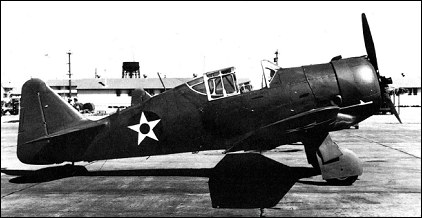
| The P-64 designation falls out of chronological order and belongs to a North American product the USAAC never intended to use. The company Model NA-50A, ordered by Siam on 30 December 1939, was little more than a single-seat pursuit ship patterned after the Harvard trainer and developed from the NA-50 used by Peru. The six examples of this strictly export craft were built at Inglewood and painted in Siamese markings, and were en route to Siam when the US Army confiscated them, removed the armament, and assigned them to training duties at Luke Field, Arizona. A widely-published report that the Siam-bound aircraft were caught at Pearl Harbor during the 7 December 1941 Japanese attack is inaccurate: the NA-50As were apparently embargoed in October 1940 and a camouflaged example in USAAF markings was noted at Luke as early as 16 September 1941.
Never really a fighter in USAAF service, the six P-64s were essentially base 'hacks' and possibly never received American serial numbers. A privately-owned survivor in civil registry as N840 was airworthy in the US as recently as 1975.
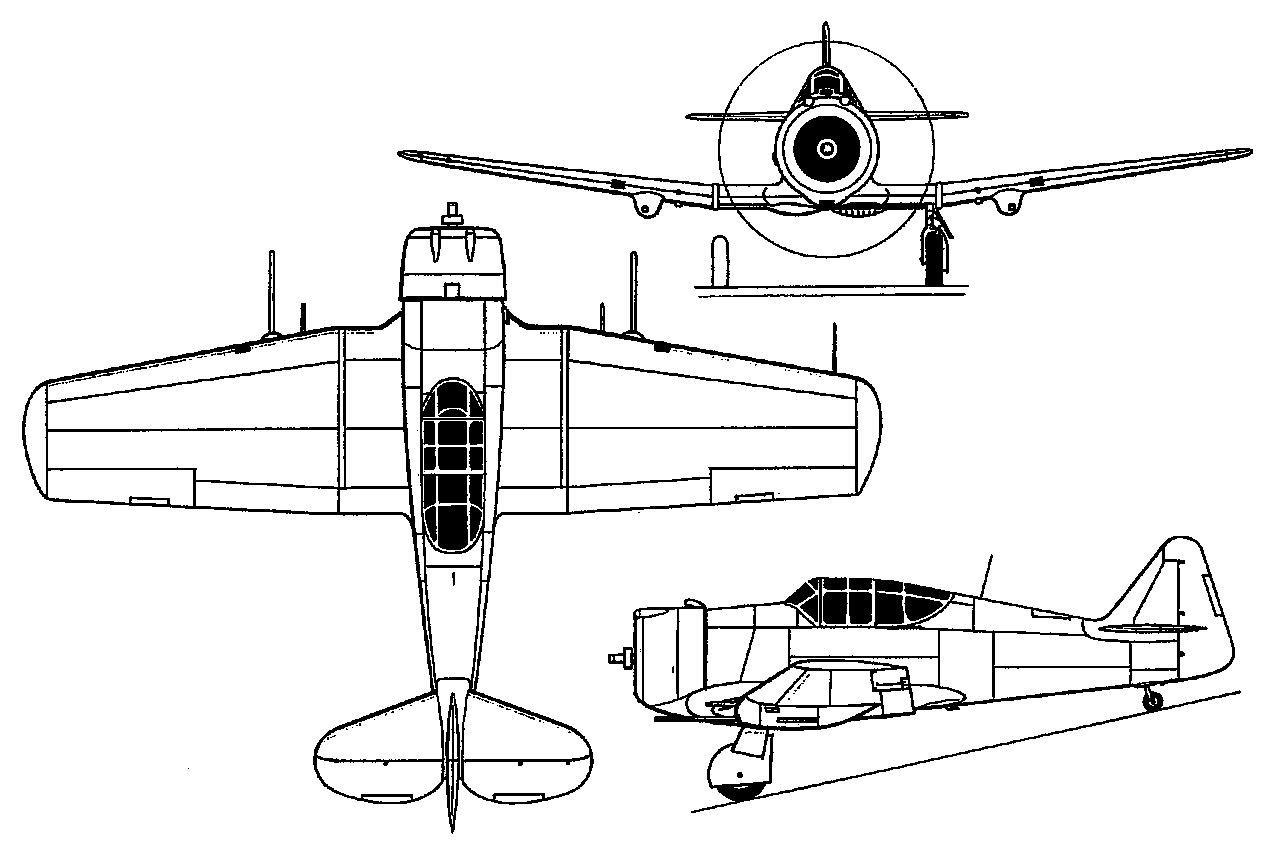
 | A three-view drawing (1278 x 852) |
| WEIGHTS |
| Take-off weight | 2717 kg | 5990 lb |
| Empty weight | 2113 kg | 4658 lb |
| DIMENSIONS |
| Wingspan | 11.35 m | 37 ft 3 in |
| Length | 8.23 m | 27 ft 0 in |
| Height | 2.74 m | 9 ft 0 in |
| Wing area | 21.18 m2 | 227.98 sq ft |
| PERFORMANCE |
| Max. speed | 434 km/h | 270 mph |
| Ceiling | 4260 m | 14000 ft |
| Range | 1380 km | 858 miles |
| 3g83TBggKzjmtmrfj, e-mail, 28.01.2023 15:16 1NkWuEmpN8OZZW1fD88zF9KzCpLrSIAIdYKqaLFTNmyFcmfPfBeNwLtO5EorzcRueCSk0K reply | | Jim Johnson, e-mail, 14.11.2016 23:55 Good story on this history, and renovation to a flying model (Oshkosh 2016) in current (Nov 2016 EAA magazine. Also info on Wikipedia by googling North American P-64. reply | | Klaatu83, e-mail, 09.09.2011 00:15 Makes an interesting comparison with the Australia's Commonwealth "Boomerang". reply | | Norman Poberezny, e-mail, 18.04.2011 18:46 My brother Paul flew the P-64 quite a bit. It was retrived
from South America and complely rebuilt bt EAA. Like the gentelman before me Brian Baker said it is now in the EAA museum. Paul is the founder of EAA. reply | |
| | Edsel Reynoso, e-mail, 09.12.2010 23:02 I saw one return to Luke AFB in late Nov 2010. It was flown by a retired AF lt.Col. whose name I can't remember. It was painted a dark blue and from a distance thought it was either an F-6 Hellcat (because of the dark blue paint and fastback roofline) or a repro Texan. The pilot said it was restored in 1999 and bought from the friend that restored it. This was the genuine article and he did explain the history of the six. At the time I assumed there were more built later on but I guess not. Plane and pilot currently reside in Calif. reply | | Rich Barnes, e-mail, 18.04.2008 10:27 I can only imagine what the surviving pilots comments were after fighting all day against aggressive enemies who flew superior aircraft! reply | | Brian R. Baker, e-mail, 26.12.2006 04:42 The P-64's actually had AAF serials. They were 41-19082 through 41-19087, a total of 6 aircraft. One aircraft is currently in the EAA Museum at Oshkosh, WI. It is the only survivor, although several "conversions" of AT-6's have been done, but they are not accurate. reply |
|
Do you have any comments?
|
| 
COMPANY
PROFILE
All the World's Rotorcraft
|