|
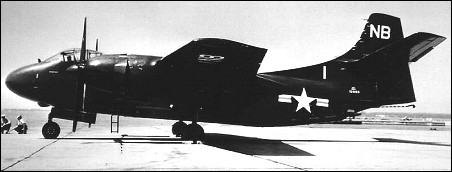
| The first naval combat aircraft designed to carry an atomic bomb and for a time the world's largest carrier based aircraft, the Savage was developed (as the North American NA-146) to meet a US Navy requirement for a high performance attack bomber capable of carrying a nuclear weapon.
In order to meet the specification's demands a large aircraft was required, this in turn dictating the need far an unusual composite powerplants configuration - a pair of Pratt & Whitney R-2800 Double Wasp radials as the primary engines augmented by an auxiliary Allison J33 turbojet in the lower rear fuselage.
This third engine was intended to provide a high speed 'dash' capability during the attack phase of the aircraft's operation and for extra boost on takeoff when required.
Other features included shoulder mounted folding wings, tricycle undercarriage, wing tip fuel tanks and (on the first models) dihedral tail planes.
The Savage was ordered In June 1946, the first of three XAJ-1 prototypes flying on 3 July 1948. These were followed by 55 initial production AJ-1s, the first one flying in May 1949.
Deliveries to US Navy squadron VC-5 began in September 1949 and the first carrier landings were performed aboard USS Constellation in August 1950.
The AJ-2 first flew on 19 February 1953, this upgraded model featuring revised versions of the same powerplants, increased fuel capacity, systems modifications, a taller fin and no tailplane dihedral.
Preceding the AJ-2 bomber was the photo-reconnaissance AJ-2P (first flight 6 March 1952) equipped with 18 cameras for day and night photography at high and low altitudes, photo-flash bombs in the weapons bay, automatic control of most of the cameras, the associated electronics equipment in a modified nose and additional fuel capacity. Four US Navy combat squadrons were still operating the AJ-2 in 1958 and these received AJ-2Ps.
A number of AJ-1s and AJ-2s were converted to flight refuelling tankers with a hose-and-reel unit installed in the weapons bay. The few Savages still in service in September 1962 when all USAF and USN aircraft designations were combined into the existing Air Force system were redesignated A-2A (AJ-1) and A-2B (AJ-2).
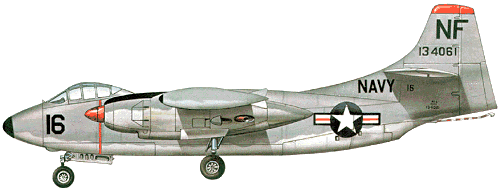
| MODEL | AJ-2 |
| CREW | 3 |
| ENGINE | 2 x Pratt & Whitney R-2800-44W, 1790kW + Allison J33-A-19 auxiliary turboprop, 2087kg |
| WEIGHTS |
| Take-off weight | 23973 kg | 52852 lb |
| DIMENSIONS |
| Wingspan | 22.91 m | 75 ft 2 in |
| Length | 19.20 m | 63 ft 0 in |
| PERFORMANCE |
| Max. speed | 758 km/h | 471 mph |
| Chuck zicari, e-mail, 20.02.2024 19:31 I was stationed in Sanford fla. VC7 squadron on August 27 1956 when the .aj2 savage crashed into two homes in the town of sanford. I knew one of the crew, as he was in the bunk next to me in our barracks. We got to be friends for a very short time. ALL l can remember is his name was ski. He had promised to take me up on the next flight after his run that day. I was so lucky he didn't ask me to go up with him the day of the crash. What l am trying to find out is his full name but have not had any success. Does anyone have an idea how I can find out the crew members names? By the way I stood watch at the site that day to keep the crash scene CLEAR. Thank for any way you can help. reply |
| Harry Scholz, e-mail, 28.11.2022 11:48 Dad, Harry Scholz, Sr., was stationed at Pax River, San Diego, And Sanford. His rating was ADR /J maybe at the time.
I've his log book from the era and didn't know of his experience with AJ's until after his death in '86. It is then that the log book came to light.
He didn't talk about the service at all, even after retirement.
I was born at Pax River so I know he was there in '47, was in San Diego when I two or three years old and we moved to Sanford when I was about five years old. Some time in 1953-4 he was deployed, and log shows him on the Coral Sea.
Possibly the log may have info that could be useful. reply |
| JOHN JOSEPH SAWYER, e-mail, 07.06.2021 00:01 I HAVE A BOOK ON THE NORTH AMERICAN AJ SAVAGE BY STEVE GINTER PUBLISHED IN 1992.ITS PUBLISH # ISBN 0-942612-22-1.STEVE'S ADDRESS THEN WAS ....STEVE GINTE, 1754 WARFIELD CIR. , SIMI VALLEY, CALIFORNIA 03063. I WAS IN VC6 FROM 1954-1955 WHEN I WAS DISCHARGED FROM ACTIVE DUTY. SPENT HALF OF THAT TOUR IN SAN DIEGO AN THE OTHER HALF IN NAS ATSUGI JAPAN (USN 3835).WAS AN AD3 BUT SPENT THAT TIME IN THE MAINTAINTENANCE OFFICE REPORTING TO CDR KEN MOSHER. I BELONG THE VC6 GROUP RUN BY WILLIAM CORNWELL. reply | | Douglas Parker, e-mail, 19.02.2018 02:29 My father was Base Operations Officer at Sanford (NAAS?) later NAS??
Lt Commander Chester A. Parker "CAP". I believe he was there in the 1953-1956 time period. Wasn't Sanford a Fleet Air Heavy Attack Wing base during this time with VC and /or VAH squadrons flying AJ-1 or AJ-2 "Savage"s? Please contact me (I'm trying to put a biography together for my children and grandchildren). I am unsure correct dates for Sanford duty...NAAS base reactivation or later NAS Heavy Attack period. I was born in ORL in 1954 and we moved to Chincoteague NAS (CO of VU-5) during 1956-57. Thank you for any responses!
Douglas Parker reply |
|
| | Patricia Blais, e-mail, 02.01.2018 17:43 Looking for information about Flight Surgeon LTCMDR Clyde Joseph Fairless, M.D., who was killed on March 6, 1951 when an AJ-1 he was in, piloted by LTCMDR Wickendoll "Wick" crashed during an exercise in the Mediterranean off the USS Franklin D. Roosevelt (near Palermo, Italy). I'm told he was in the VC-5--and due to be assigned to the Heavy Aircraft Wing ONE by April 1951. Does anyone know if he was ever stationed at NAS Moffett Field, CA--or just NAS Norfolk, VA. Thanks! blaisp @ aol. com reply |
| Steve Erwin, e-mail, 15.11.2017 00:05 Jack you may have been in same detachment as my dad Cliff Erwin. I have pictures he took in Naples & Turkey. He was VJ-62 Det King Nelm Area 54-55. His AJ-2P was #9.
Jack Baird, 10.07.2007
I flew in the AJ2P as a Photographers mate 2nd class in VJ62. 1952-1955. We were based in Sanford Fla. Crews deployed to Naples Italy for 6 month tours, mapping areas in Europe. reply |
| Manny Sousa, e-mail, 16.05.2017 00:20 I was in VAH-6 Jan 1957 to decommissioning (VAH-16) 1959. I made the 1958 Hornet cruise in the left seat as a Ltjg, Then did the VAH-16 Atsugi shore detachment. I have eleven flights in the Museum AJ-2. Documented in my memoirs. Currently living in The Villages FL. MANNYSFL@AOL.COM reply |
| Robert Belter Captain USN Ret, e-mail, 02.10.2016 22:28 Interesting incidents in AJ-2 (Both in the same aircraft)
Incident #1 - USS Bennington. Broken wire on trap,
went off the angled deck barely flying. Witnesses said
tailhook made a rooster tail in the water. Recovered
safely.
Incident #2 - Out of Hong Kong on Bennington,
launched with 4,000 lb bomb shape. Cat shot dis
lodged the shape which went through the aft bulkhead,
tearing the jet engine off its mounts with an accom-
panying fire (not sustained due to kinked main fuel
hose). Opening bomb bay to release shape cause the
fins to rip out a control cable cluster on the way out.
Lost flight control boost. Controls loose but aircraft
was flyable with brute strength. After discussion with
the Air Boss, bingoed to Okinawa - good decision
because jet engine was free and loose and would have
come through the cockpit on a trap. NOTE: The cause
of the shape being dislodged was determined to be
the result of an AirPac aircraft bulletin which called for
the removal of a rivet head which impinged upon the
single shackle bomb suspension /release follow up system. reply |
| Chuck Seeber, e-mail, 01.10.2016 13:49 I ended as AT-2 in VC-6, 51 - Dec 54. Pax. Rv; P.Lyauty; North Is; Atsugi. Flew some third crewman off Oriskany and Lake Champlain TF 77 in 53.
I have lost all contact with squadron members. Like to hear. reply |
| allen vrooman, e-mail, 28.01.2016 05:04 I was in VAP-62 1956-1957 I was AD1 flight mechanic of TP9 bureau number 134074 AJ-2P . I will never forget one flight we were carrier qualifying on the USS Forestall cv-59 we were launched off the canted deck by the LSO ,from the spot we had just landed on, and almost went into ocean tip tank hit an antenna at end of canted deck and split tip of it, was later in det. echo in Turkey I beleave. lt Gorski pilot. reply |
| Laura Millsaps Costello, e-mail, 08.01.2016 16:38 My dad, Lewis Millsaps, was a Lt. in 1955, a member of Heavy Attack Wing One Squadron VAH-7. According to an old news clipping, on 12-21-1955 "he and his crew were en route from a 5 months tour of duty in the Mediterranean to their new home base at NAAS Sanford....When the mishap occurred about 30 miles offshore from Boston, they were flying about 10,000 feet headed for Patuxent River, Md. A sudden vibration was felt in the port engine and about 7 seconds later the port engine tore off and fell into the sea." He landed it safely in Boston with no injuries,and no additional damage to the plane, though "two tires were torn to shreds as it dragged to a stop on a cleared runway." I wish our family had the official Navy photo of the actual aircraft (lost). The clipping says it was an AJ-2 Bureau Number 314039 (possibly the last two digits are 89) My dad received a commendation, never talked about this at home, but I heard the story from my mom, who had also saved the clipping.... reply | | matt hamilton, e-mail, 02.01.2016 06:42 I see from earlier posts that the following people were in Detachment Love in Turkey in the 1950's . Frank Voltoline and John Rowe. My e-mail is jullinsfrozen@comcast.net reply | | Matt Hamilton, e-mail, 02.01.2016 06:23 Does anyone remember CPO Dempsey (DOC) Hamilton. He was in the Detachment Love . and did training in Sanford. Have pics of a Savage AJ7 with his name listed on it. reply | | Charles Hill, e-mail, 25.05.2015 19:20 I am looking for information on my Grandfathers plane crash on February 4, 1953 of an AJ [Savage]. His name was Lt. McFaddin Moise [some records list him as "Hoise", but his name was Moise.] Also killed in the accident was AD2 James Vaughn. Mechanical trouble just after take-off was to blame. This occurred at the Naval Air Station - Patuxent, Maryland. There is a street named in his honor [Hoise Street - I am working to get the proper name on the street and also a Vaughn Street on the Naval Air Base - Not sure why they have his name wrong]. I see several people on here, including Chuck Emmitt who might have information or would have been there. Please feel free to reach out to me if anyone does. e-mail: Charlesehill17@gmail.com or cell # 330-466-3969 reply | |
| | Wm. Cornwell, Jr. AT-1, e-mail, 02.02.2015 15:18 VC-6 Lives again! 1950-1956 has been re-ignited and still kicking! If you were a "6" member, please contact me at sherrybillc@gmail.com, and let us know who you are. Everything that has been exchanged between us, will be sent to you. God Bless all of you,from this site past and present. Cornwell reply |
| Dan Sullivan, e-mail, 27.01.2015 04:50 Just verifying Peter Ardans comments as we were shipmates in VF-63 aboard the Essex (CVA-9). Pete please contact me via email: sailor_81_kck@yahoo.com
Dan reply | | CHUCK EMMITT, AD3, e-mail, 14.01.2015 20:31 WE WERE TESTING THE XAJ-1 AT PATUXENT RIVER, TACTICAL TEST UNIT IN 52 AND 53, DOING IN FLIGHT REFUELING TESTING [THE J-33 ENGINE WAS REMOVED FROM THE FUSELAGE AND REPLACED BY A LARGE BLADDER FUEL TANK]. WE ALSO DID PRECISION BOMB SIGHT TESTING OVER THE NAVAL BOMB TESTING AREA IN VA. I WAS FORTUNATE TO HAVE BEEN THE PLANE CAPTAIN AND CREWMAN OF THE SAVAGE--I STILL HAVE MY SQUADRON PATCH. reply | | CHUCK EMMITT,ad3, e-mail, 14.01.2015 20:11 I flew as plane captain and crewmen reply | | E.J.Zemaitis USN retired, e-mail, 27.12.2014 15:19 I witnessed the crash of an AJ-1 upon takoff of the FDR in 1950. The copilot ejected but lost the pilot and crew member. reply | | Chuck Huber, e-mail, 30.09.2014 16:37 We now have a Face Book Group for the Heavy Attack Composite squadrons which flew the AJ Savages. I was in VC-8 1954 /55. Search Face Book for "VC-5,6,7,8,9." reply |
|
Do you have any comments?
|
| 
COMPANY
PROFILE
All the World's Rotorcraft
|

 Harry Scholz


sorry if this is redundant- one source states: Av Tech1c William V Swigonski -- of Sanford...
reply