I’m researching a book project regarding the Cold War and the Great Lakes. Am looking to talk with anyone knowledgeable about the F-89. Thank you. -Jon Billman Professor of English, Northern Michigan University 906-373-7397
I volunteer at the New England Air Museum in Windsor Locks CT. Myself and 2 other guys are in the process of preserving a F89J. We have looked at many pictures but finding a color scheme from Maine is almost impossible. We know the fuel tanks are red outside and dull black inside . What is the color scheme of the tail section? If anyone knows who might have wheel bearings for the nose gear it would be greatly appreciated.
My first assignmemt as an Ro was the 54th FIS for 1 Year. Then it was off to Tyndal for training as A weapons Controller. Then to the 801st AC&W . It was located on the base at Malstrom. I got my flight time on KC-97s. Next was another site at Hopedale Labador, located 150 miles North of Goose Bay, I was short on flying time and requested an assignment to McClellan AFB to fly on the EC121. Was there almost 11 years and retired,. Sometime during later years I was at Wright Patterson looking at the F 89J with a genie rocket lieing on the floor. I asked a docent what the white was and he didnt know, He was really surprized when I told him him was an atomic rocket.
Jon Billman, e-mail, 09.01.2023 bernard schnieders
Hello Bernard. I’m researching a book project about the Cold War and an F89 incident over Lake Superior. I’d very much like to talk with you, if possible. I’m an English Professor at Northern Michigan University. Thank you. -Jon Billman 906-373-7397
I started on the F 89 D at Yuma Ariz.4759th Test Sqdn in June 1955. We received new H model in 1956 . In may 1957 the 4750th moved too Tyndall A F B Florida. In traffic too Tyndall the pilot got a low fuel light and switched tanks in error went too empty tanks .lost both engines three miles short of the runway both crewmembers Ok
Hello Jim. I'm researching a book involving the disappearance of an F-89C over Lake Superior in 1953--I'd love to talk with you about your experiences! Sincere best, Jon Billman 906-373-7397
Hello Bobby. I'm researching a book involving the disappearance of an F-89C over Lake Superior in 1953--I'd love to talk with you about your experiences! Sincere best, Jon Billman 906-373-7397
Can anyone supply details on the fatal crash on an F-89 (model unknown)at the Northrop plant in December 1953? Northrop test pilot, Gene Townsend, was killed.
Steve Taylor: Saw your comment about your dad Earl Taylor posted on 4 /15 /16. I was in the 84th Fighter Interceptor Squadron in 1952 and 1953 and flew in the F-94s and F-89s. I do not remember your dad and did not see his name in the squadron flight rosters from that time. However in the 28th Air Division 1954 year book I see a James A Taylor 2nd Lt in the 84th at Hamilton. At that time I was in the 666th Aircraft Control and Warning Squadron and knew most of the personnel in the 84th but never met James A Taylor.
Donald Harvey,2nd Lt 84th FIS Sqd Hamilton AFB, Ca 1952-1953 666th ACW Sqd Mill Valley AFS, Ca 1st Lt 1954-1955
Hello Donald. I'm researching a book involving the disappearance of an F-89C over Lake Superior in 1953--I'd love to talk with you about your experiences! Sincere best, Jon Billman 906-373-7397
My dad, Capt. Earl Taylor flew F-94s,F89s and F101s in the 84th at Hamilton fron 52 to 56. He then went on exchange duty with the RAF until July 1958 when he was killed in a crash flying RAF Gloster Javelin. Looking for any info anybody may have. Thanks
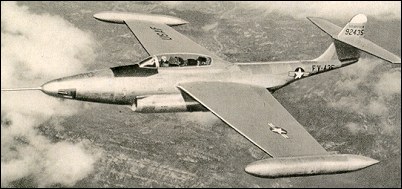
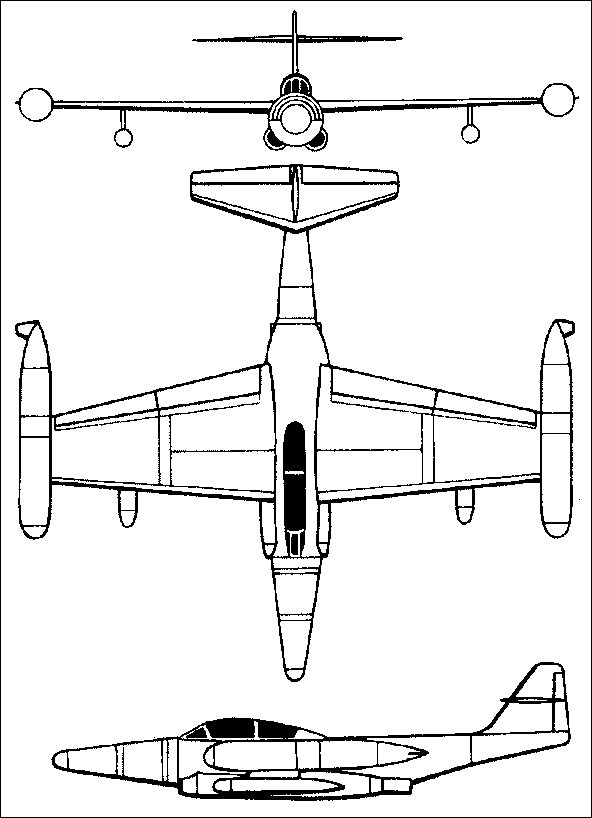
"Was with 61FIS at Harmon '53-'55, first with F-94B then transitioned to F-89D, ugly but it grew on you. Easy to fly but def not for dog-fights." the F-89 was never intended for "dogfights", and it is unfair to compare it with smaller jet fighters that were. The F-89 was designed to be an "all-weather interceptor", which meant intercepting incoming enemy bombers by day or night, or during conditions of reduced visibility. The mission it was designed to fulfill also required the F-89 to be able to remain aloft for a fairly long time, which meant being able to carry a substantial amount of fuel. As a result the F-89 was, by necessity, a fairly large and heavy aircraft, equipped with radar and accommodating a crew of two, consisting of a pilot and a radar operator. Any such aircraft would clearly never have qualified as a "dog-fighter". It's WW-II equivalent, the Northop P-61 Black Widow, which was designed for the same purpose as the F-89, was an excellent night-fighter, but clearly could never have competed in a dog-fight with fighters such as the Mustang or Spitfire.
I'm researching a book involving the disappearance of an F-89C over Lake Superior in 1953--I'd love to talk with you about your experiences! Sincere best, Jon Billman 906-373-7397
I was one of the aircrew members Gene Francis mentioned in his narrative concerning the midair over the Olympics on 4 Oct 1956. Actually, Ira Wintermute was the Group Commander. The two F-89's that hit the mountains NE of Pain Field flew into Whitehorse. Also the solo crash in the Sound near Point-No-Point resulted in both crew members being lost. A good source of information can be found in publications by "Seattle Mountain Rescue". It might interest historians that I first flew in the F-89 at Paine AFB as an RO, then after attending pilot training for 14 months, returned to Paine AFB as a pilot flying with the same guys in the same flight. (my time at Paine, 1955 through 1960).
Hello Jim, I hope you are well an still on this group. I'm a historian up here in Minnesota, and would like to ask you some questions about your military career, especially when with the 321st FIS with the f-89s. Please feel free to reply to my home email address of prsc8@comcast.net. Thank you, and I look forward to talking with you. Dave
To: MARC B. Yes, I knew a Doc Blanchard @ JCAFB, Waco, TX. He was an R /O instructor and a great guy; very likable; I never flew with him because we were both R /Os. I went to Pilot School and ended up with C118s at WRI AND HIK. Then C124s @ Hill, joined UAL flying B747s. ret. USAF @ UAL; now living in Coeur D'Alene, ID. after 33 yrs. in Reno, NV KGM
I was a F89D /F94C radar mechanic for the 3630th A&E Maintenance Squad starting in 1956 through 1958 at Moody AFB. Loved the F89 and had the pleasure of working on a F94 with Kent VanDeMark when a fellow technician, Joe Dean, sitting in the front cockpit, released the tip tanks at the radar "Dock" maintenance area. Can you believe that someone didn't check the wing pins or CB interlocks that evening? Our boss, C C Bates was fit to be tied. I later followed the F89's to JCAFB and worked there for a couple more years on both the F89's and B25's used for RO training. Anyone interested in interacting about Moody or James Connally during the late 50's, shoot me a note at george.leiby@comcast.net.
Hello George. I'm researching a book involving the disappearance of an F-89C over Lake Superior in 1953--I'd love to talk with you about your experiences! Sincere best, Jon Billman 906-373-7397
"The F-89 Scorpion was a consolation contract awarded to Northrop in the aftermath of the controversial cancellation of its YB49 Flying Wing in favor of the Convair B-36." At the time the nearest competitor to the F-89 for the Air Force's "all-weather fighter" contract was the Curtiss XF-87 "Blackhawk". The XF-87 was a much bulkier aircraft than the F-89, with side-by-side seating and four jet engines. Of the two aircraft the F-89 was the obvious choice.
Hello Andy. I'm researching a book involving the disappearance of an F-89C over Lake Superior in 1953--I'd love to talk with you about your experiences! Sincere best, Jon Billman 906-373-7397
My Dad flew in the F-89 at Portland, OR, Moody and Thule in the late 50s. Richard Hashimoto was a RO. Told me some stories about ice skating in the 89 out to the runwat at Thule, poopie suits and painting his room at Thule- green, black and red. Anybody remember him, let me know. He lives in MS. retired as O-6 in 1985.
Flew D, H & J. Terribly underpowered but very stable platform from which to fire rockets. Early models short on kill probability - Genies made J model very effective.
Hello Fritz. I'm researching a book involving the disappearance of an F-89C over Lake Superior in 1953--I'd love to talk with you about your experiences! Sincere best, Jon Billman 906-373-7397
It was F89D, F89H and F89J. The first time I saw the Model J was, when I was reporting for Alert Hanger duty and did not have clearance for Nuclear weapons, so I got escorted to the brig by an Policeman, until I got the authorization for me corrected, it only took one morning to get it fixed>


 Jim McLoud



Hello Bernard. I’m researching a book project about the Cold War and an F89 incident over Lake Superior. I’d very much like to talk with you, if possible. I’m an English Professor at Northern Michigan University. Thank you.
-Jon Billman
906-373-7397
reply