|
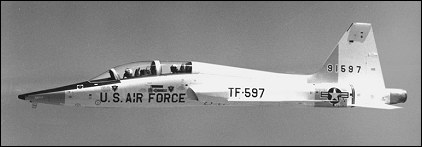
| To meet a US government requirement
for a high-performance lightweight
fighter that would be suitable for supply
to and operation by friendly nations via
the Military Assistance Program, Northrop
began the private-venture design of
such an aircraft in the mid-1950s, identifying
it as the Northrop N-156. This
initial design concept was to form the
basis of a family of aircraft, including a
supersonic trainer which had the company
designation N-156T. Three YT-38
prototypes were ordered in December
1956, this number being increased to six
in June 1958, and the first of them was
flown on 10 April 1959. Cantilever lowwing
monoplanes with slender arearuled
fuselages, the first two prototypes
were each powered by two 953kg thrust non-afterburning
General Electric YJ85-GE-1 turbojets,
but the remainder of this first batch had
YJ85-GE-5 engines with an afterburning
thrust of 1633kg. Testing with
these latter engines resulted in an initial
contract for the T-38A Talon, the first
of them entering service with the
USAF's 3510th Flying Training Wing, at
Randolph AFB, on 17 March 1961. The
Talon, which seats instructor and pupil in
tandem on ejection seats and has a fully
powered control system, has gained one
of the best safety records of any supersonic
aircraft in USAF service. As a result,
when production ended in early
1972 a total of 1,187 T-38s had been built
for the USAF. The US Navy acquired five
from the USAF, and three of these remain
in service with the Test Pilots
School at Patuxent River. Also supplied
through the USAF and operated by the
German Luftwaffe were 46 used for pilot
training in the US. Only export customer
was Portugal who received two batches
of six Sidewinder-equipped ex-USAF aircraft
in 1977 and 1981 to replace F-86 Sabres used in the dedicated air defence
role but doubling as advanced pilot trainers.
NASA also acquired a number from
Northrop, using them as flight-readiness
trainers for astronauts. The designations
AT-38A and NT-38A were allocated to
two T-38As following their conversion
for evaluation as an attack trainer and research/
development aircraft respectively.
Four of the US Navy's T-38s converted
to serve as drone directors were
redesignated DT-38A. The AT 38B is a
lightly armed version serving in the
Lead-in Fighter Training role at Holloman
AFB, New Mexico. Some 700 of these
aircraft remain in service in 1992.
| ENGINE | 2 x 1745kg afterburning thrust General Electric tubojets |
| WEIGHTS |
| Take-off weight | 5485 kg | 12092 lb |
| Empty weight | 3250 kg | 7165 lb |
| DIMENSIONS |
| Wingspan | 7.7 m | 25 ft 3 in |
| Length | 14.14 m | 46 ft 5 in |
| Height | 3.92 m | 13 ft 10 in |
| Wing area | 15.79 m2 | 169.96 sq ft |
| PERFORMANCE |
| Max. speed | 1381 km/h | 858 mph |
| Ceiling | 16335 m | 53600 ft |
| Range w/max.fuel | 1759 km | 1093 miles |
| Bill Heiter, e-mail, 23.02.2015 20:30 About 1,400 fantastic Talon missions (Vance & Craig) and still kicking - now 35 years later - Don't have much to compare it to but for me it was a hoot! One of my "students" had flown 105's in Nam, later A-7's - and he agreed with that assessment. reply | | Vern flowers, e-mail, 11.01.2015 16:27 Was in the 3511 FLMS at RAFB in 1961 when we became the first operational sqd of T-38s. Once we shook out the initial bugs, it was a great aircraft. reply | | dejjdnjdeuahfdpefqewjfewqfpiew, e-mail, 03.01.2014 20:09 ÄãÊDZ»´ð reply | | vincent wang chen i am also, e-mail, 03.01.2014 20:07 To meet a US government requirement for a high-performance lightweight fighter that would be suitable for supply to and operation by friendly nations via the Military Assistance Program, Northrop began the private-venture design of such an aircraft in the mid-1950s, identifying it as the Northrop N-156. This initial design concept was to form the basis of a family of aircraft, including a supersonic trainer which had the company designation N-156T. Three YT-38 prototypes were ordered in December 1956, this number being increased to six in June 1958, and the first of them was flown on 10 April 1959. Cantilever lowwing monoplanes with slender arearuled fuselages, the first two prototypes were each powered by two 953kg thrust non-afterburning General Electric YJ85-GE-1 turbojets, but the remainder of this first batch had YJ85-GE-5 engines with an afterburning thrust of 1633kg. Testing with these latter engines resulted in an initial contract for the T-38A Talon, the first of them entering service with the USAF's 3510th Flying Training Wing, at Randolph AFB, on 17 March 1961. The Talon, which seats instructor and pupil in tandem on ejection seats and has a fully powered control system, has gained one of the best safety records of any supersonic aircraft in USAF service. As a result, when production ended in early 1972 a total of 1,187 T-38s had been built for the USAF. The US Navy acquired five from the USAF, and three of these remain in service with the Test Pilots School at Patuxent River. Also supplied through the USAF and operated by the German Luftwaffe were 46 used for pilot training in the US. Only export customer was Portugal who received two batches of six Sidewinder-equipped ex-USAF aircraft in 1977 and 1981 to replace F-86 Sabres used in the dedicated air defence role but doubling as advanced pilot trainers. NASA also acquired a number from Northrop, using them as flight-readiness trainers for astronauts. The designations AT-38A and NT-38A were allocated to two T-38As following their conversion for evaluation as an attack trainer and research / development aircraft respectively. Four of the US Navy's T-38s converted to serve as drone directors were redesignated DT-38A. The AT 38B is a lightly armed version serving in the Lead-in Fighter Training role at Holloman AFB, New Mexico. Some 700 of these aircraft remain in service in 1992.
Specification
ENGINE 2 x 1745kg afterburning thrust General Electric tubojets
WEIGHTS
Take-off weight 5485 kg 12092 lb
Empty weight 3250 kg 7165 lb
DIMENSIONS
Wingspan 7.7 m 25 ft 3 in
Length 14.14 m 46 ft 5 in
Height 3.92 m 13 ft 10 in
Wing area 15.79 m2 169.96 sq ft
PERFORMANCE
Max. speed 1381 km /h 858 mph
Ceiling 16335 m 53600 ft
Range w /max.fuel 1759 km 1093 miles
Comments 1-20 21-40
wervnjdjmv, kdeijfdoisfsuiedhfu, 02.01.2014
ck chen, 34567890-22, 02.01.2014
Entered UPT Class 66C at Williams Air Force Base, Chandler, Az. in fall of 64. After the Basic T-37 Program went to the T-38.Previously the Air Force had a Heavy wash Out rate in the 38. By the time got into the T- 38 they Training Program was modified. You were introduced to Instrument Training AFTER SOLO. It was found that due to the sensitivity of this Aircraft compared to the Tweet it was such a High Degree of Difficulty in order to fly this Aircraft precisely they introduced Instrument Training (under the Bag so to speak), to allow the student to utilize very small Stick and Throttle Adjustments versus the heavier inputs used in the T-37. You were than introduced back to Contact Flying and the wash out rate improved, - from about 60% back to about 50% as was normal at that time. (At least at Willie)! Greatest Military Training Aircraft ever built!
Granpa, Codilac=Integra.net, 09.09.2013
Recently the Smithsonian Air & Space Museum magazine (Sept page 38) referenced the T-38 as a "single-seat trainer". Has anyone ever heard of a conversion like this? I am familiar with the F-5 & F-20.
Ben Hackworth, av8r62=hotmail.com, 07.06.2013
Flew T-38s in the 80s (worked for one Lt Col Ham on this listing, hi sir). Loved every time I strapped on the jet. Favorite memories were IP only formation sorties when we came out of burners only as lead reported initial (after a .6 hour sortie, bingo fuel).
Jake Jacobs, jakedestin=aol.com, 01.04.2013
I had been a "Herk Driver" before coming back to the T-38 as an IP. Barely made it through PIT, but managed to make it to Laughlin and have the best time with that jet and my job. I marveled at the "Fast Mover" (and Warthog) pilots in the squadron that really loved the airplane. At one time, all Air Force Pilots flew the advanced trainer during the roughly, last half of "UPT" after flying the "Tweet". The T-37, T-38 and UPT experience were the common denominator that bonded all of us.
Steve Ham, steven_ham=comcast.net, 29.12.2012
I was fortunate to fly the Talon from 19 ... reply | |
| | wervnjdjmv, e-mail, 02.01.2014 23:43 ck chen, 34567890-22, 02.01.2014
Entered UPT Class 66C at Williams Air Force Base, Chandler, Az. in fall of 64. After the Basic T-37 Program went to the T-38.Previously the Air Force had a Heavy wash Out rate in the 38. By the time got into the T- 38 they Training Program was modified. You were introduced to Instrument Training AFTER SOLO. It was found that due to the sensitivity of this Aircraft compared to the Tweet it was such a High Degree of Difficulty in order to fly this Aircraft precisely they introduced Instrument Training (under the Bag so to speak), to allow the student to utilize very small Stick and Throttle Adjustments versus the heavier inputs used in the T-37. You were than introduced back to Contact Flying and the wash out rate improved, - from about 60% back to about 50% as was normal at that time. (At least at Willie)! Greatest Military Training Aircraft ever built!
Granpa, Codilac=Integra.net, 09.09.2013
Recently the Smithsonian Air & Space Museum magazine (Sept page 38) referenced the T-38 as a "single-seat trainer". Has anyone ever heard of a conversion like this? I am familiar with the F-5 & F-20.
Ben Hackworth, av8r62=hotmail.com, 07.06.2013
Flew T-38s in the 80s (worked for one Lt Col Ham on this listing, hi sir). Loved every time I strapped on the jet. Favorite memories were IP only formation sorties when we came out of burners only as lead reported initial (after a .6 hour sortie, bingo fuel).
Jake Jacobs, jakedestin=aol.com, 01.04.2013
I had been a "Herk Driver" before coming back to the T-38 as an IP. Barely made it through PIT, but managed to make it to Laughlin and have the best time with that jet and my job. I marveled at the "Fast Mover" (and Warthog) pilots in the squadron that really loved the airplane. At one time, all Air Force Pilots flew the advanced trainer during the roughly, last half of "UPT" after flying the "Tweet". The T-37, T-38 and UPT experience were the common denominator that bonded all of us.
Steve Ham, steven_ham=comcast.net, 29.12.2012
I was fortunate to fly the Talon from 1970-1975 (Craig UPT and Randolph PIT), and 1986-1989 at Vance. I assumed command of the 25th FTS in 1987, and two hours into the job a captain ran into the office shouting "mid-air!!" Gulp ....... It turned out to be a harmless wing bump by two Stan- eval IPs ... Wouldn't you know it! Favorite memory was flying the WX ship and taking off just before dawn and doing acro in the working area before most people were out of bed - upside down at the top of a loop looking down at just a few cars moving on the roads below west of Vance.
Jim McMichael, jim.mcmichael=mac.com, 08.12.2011
I loved the Talon during my UPT at Lauglin, PIT at Randolph and as an IP with ENJJPT at Sheppard. Oh the stories that can be told. Anyone remember the Charlie Brown over to Seguin? How about the west tower radio call sign at Randolph? If you guessed "Hangover," you guessed correctly. The tweets used that more than us but it was fun to hear.
Dick Tucker, rtucker6=rochester.rr.com, 24.09.2011
Class 64-D at Reese /Lubbock- The plane was described as so well designed that it was if a pilot, a maintenance man(in those days) and an engineer all collaborated on it. Fond memory was several of the birds strung out across West Texas on solo night round robin flight when WX was CAFB.
Bill Crothers, bill28104=yahoo.com, 18.06.2011
Flew 'white rockets' @ Vance AFB in class of 69-06. Learned all the basics of formation flying /aerobatics..40 yrs. later & I'm flying airshows w / Team RV in the S.E. Those old skills never go away. RV-8 is the cheaper fun machine to replace the T-38. What a great training experience. Recall that full aileron deflection was prohibited due to 2 1 /2 rolls / second rate. Those of us lucky enough to fly the White Rocket' can't help but smile..
Johnny Collins, jmcollins333=gmail.com, 18.06.2011
I flew the T-38 as an IP at Laredo and Columbus AFB in the 70s (of course I put in a bit of time at Randolph while attending PIT). When we took a student up on his "dollar ride" we'd get clearance for a burner climb and from a standing start on the runway we would reach 30,000 feet in 90 seconds. It was like flying a Corvette with wings. A great flying machine!
Bill Crielly, capsarpilot=aol.com, 04.04.2011
To Jim Portale: It has been 40+ years since I flew the T-38, but I belive the roll rate was 720 degrees /second NOT 720 /minute. I did some max deflection aileron rolls, for a few seconds, and my visual keept on rolling even after the a /c was straight and level. Almost bought the farm one day when we were crusing at about 20K. We needed to descend, so the IP in the back seat said "lets just pretend we're at the top of a loop...roll inverted and finish the bottom half and we'll be at altitude to RTB. Good thinking, but we were cruising much higher than normal speed at the top of a loop, and never considered that! We were pointed straight down when we w ... reply | | jack chen, e-mail, 02.01.2014 23:27 Entered UPT Class 66C at Williams Air Force Base, Chandler, Az. in fall of 64. After the Basic T-37 Program went to the T-38.Previously the Air Force had a Heavy wash Out rate in the 38. By the time got into the T- 38 they Training Program was modified. You were introduced to Instrument Training AFTER SOLO. It was found that due to the sensitivity of this Aircraft compared to the Tweet it was such a High Degree of Difficulty in order to fly this Aircraft precisely they introduced Instrument Training (under the Bag so to speak), to allow the student to utilize very small Stick and Throttle Adjustments versus the heavier inputs used in the T-37. You were than introduced back to Contact Flying and the wash out rate improved, - from about 60% back to about 50% as was normal at that time. (At least at Willie)! Greatest Military Training Aircraft ever built!
Granpa, Codilac=Integra.net, 09.09.2013
Recently the Smithsonian Air & Space Museum magazine (Sept page 38) referenced the T-38 as a "single-seat trainer". Has anyone ever heard of a conversion like this? I am familiar with the F-5 & F-20.
Ben Hackworth, av8r62=hotmail.com, 07.06.2013
Flew T-38s in the 80s (worked for one Lt Col Ham on this listing, hi sir). Loved every time I strapped on the jet. Favorite memories were IP only formation sorties when we came out of burners only as lead reported initial (after a .6 hour sortie, bingo fuel).
Jake Jacobs, jakedestin=aol.com, 01.04.2013
I had been a "Herk Driver" before coming back to the T-38 as an IP. Barely made it through PIT, but managed to make it to Laughlin and have the best time with that jet and my job. I marveled at the "Fast Mover" (and Warthog) pilots in the squadron that really loved the airplane. At one time, all Air Force Pilots flew the advanced trainer during the roughly, last half of "UPT" after flying the "Tweet". The T-37, T-38 and UPT experience were the common denominator that bonded all of us.
Steve Ham, steven_ham=comcast.net, 29.12.2012
I was fortunate to fly the Talon from 1970-1975 (Craig UPT and Randolph PIT), and 1986-1989 at Vance. I assumed command of the 25th FTS in 1987, and two hours into the job a captain ran into the office shouting "mid-air!!" Gulp ....... It turned out to be a harmless wing bump by two Stan- eval IPs ... Wouldn't you know it! Favorite memory was flying the WX ship and taking off just before dawn and doing acro in the working area before most people were out of bed - upside down at the top of a loop looking down at just a few cars moving on the roads below west of Vance.
Jim McMichael, jim.mcmichael=mac.com, 08.12.2011
I loved the Talon during my UPT at Lauglin, PIT at Randolph and as an IP with ENJJPT at Sheppard. Oh the stories that can be told. Anyone remember the Charlie Brown over to Seguin? How about the west tower radio call sign at Randolph? If you guessed "Hangover," you guessed correctly. The tweets used that more than us but it was fun to hear.
Dick Tucker, rtucker6=rochester.rr.com, 24.09.2011
Class 64-D at Reese /Lubbock- The plane was described as so well designed that it was if a pilot, a maintenance man(in those days) and an engineer all collaborated on it. Fond memory was several of the birds strung out across West Texas on solo night round robin flight when WX was CAFB.
Bill Crothers, bill28104=yahoo.com, 18.06.2011
Flew 'white rockets' @ Vance AFB in class of 69-06. Learned all the basics of formation flying /aerobatics..40 yrs. later & I'm flying airshows w / Team RV in the S.E. Those old skills never go away. RV-8 is the cheaper fun machine to replace the T-38. What a great training experience. Recall that full aileron deflection was prohibited due to 2 1 /2 rolls / second rate. Those of us lucky enough to fly the White Rocket' can't help but smile..
Johnny Collins, jmcollins333=gmail.com, 18.06.2011
I flew the T-38 as an IP at Laredo and Columbus AFB in the 70s (of course I put in a bit of time at Randolph while attending PIT). When we took a student up on his "dollar ride" we'd get clearance for a burner climb and from a standing start on the runway we would reach 30,000 feet in 90 seconds. It was like flying a Corvette with wings. A great flying machine!
Bill Crielly, capsarpilot=aol.com, 04.04.2011
To Jim Portale: It has been 40+ years since I flew the T-38, but I belive the roll rate was 720 degrees /second NOT 720 /minute. I did some max deflection aileron rolls, for a few seconds, and my visual keept on rolling even after the a /c was straight and level. Almost bought the farm one day when we were crusing at about 20K. We needed to descend, so the IP in the back seat said "lets just pretend we're at the top of a loop...roll inverted and finish the bottom half and we'll be at altitude to RTB. Good thinking, but we were cruising much higher than normal speed at the top of a loop, and never considered that! We were pointed straight down when we went MACH 1. Somehow, with ... reply | | yourtye, e-mail, 02.01.2014 23:21 the plane suck like egg reply | | yourtye, e-mail, 02.01.2014 23:19 the plane suck like egg reply | | coolest, e-mail, 02.01.2014 23:12 t-38 is cool plane reply | | Ralph Bianco, e-mail, 22.09.2013 20:55 Entered UPT Class 66C at Williams Air Force Base, Chandler, Az. in fall of 64. After the Basic T-37 Program went to the T-38.Previously the Air Force had a Heavy wash Out rate in the 38. By the time got into the T- 38 they Training Program was modified. You were introduced to Instrument Training AFTER SOLO. It was found that due to the sensitivity of this Aircraft compared to the Tweet it was such a High Degree of Difficulty in order to fly this Aircraft precisely they introduced Instrument Training (under the Bag so to speak), to allow the student to utilize very small Stick and Throttle Adjustments versus the heavier inputs used in the T-37. You were than introduced back to Contact Flying and the wash out rate improved, - from about 60% back to about 50% as was normal at that time. (At least at Willie)! Greatest Military Training Aircraft ever built! reply | | Granpa, e-mail, 09.09.2013 16:52 Recently the Smithsonian Air & Space Museum magazine (Sept page 38) referenced the T-38 as a "single-seat trainer". Has anyone ever heard of a conversion like this? I am familiar with the F-5 & F-20. reply | | Ben Hackworth, e-mail, 07.06.2013 04:16 Flew T-38s in the 80s (worked for one Lt Col Ham on this listing, hi sir). Loved every time I strapped on the jet. Favorite memories were IP only formation sorties when we came out of burners only as lead reported initial (after a .6 hour sortie, bingo fuel). reply | | Jake Jacobs, e-mail, 01.04.2013 02:40 I had been a "Herk Driver" before coming back to the T-38 as an IP. Barely made it through PIT, but managed to make it to Laughlin and have the best time with that jet and my job. I marveled at the "Fast Mover" (and Warthog) pilots in the squadron that really loved the airplane. At one time, all Air Force Pilots flew the advanced trainer during the roughly, last half of "UPT" after flying the "Tweet". The T-37, T-38 and UPT experience were the common denominator that bonded all of us. reply | | Steve Ham, e-mail, 29.12.2012 16:43 I was fortunate to fly the Talon from 1970-1975 (Craig UPT and Randolph PIT), and 1986-1989 at Vance. I assumed command of the 25th FTS in 1987, and two hours into the job a captain ran into the office shouting "mid-air!!" Gulp ....... It turned out to be a harmless wing bump by two Stan- eval IPs ... Wouldn't you know it! Favorite memory was flying the WX ship and taking off just before dawn and doing acro in the working area before most people were out of bed - upside down at the top of a loop looking down at just a few cars moving on the roads below west of Vance. reply | |
| | Jim McMichael, e-mail, 08.12.2011 16:12 I loved the Talon during my UPT at Lauglin, PIT at Randolph and as an IP with ENJJPT at Sheppard. Oh the stories that can be told. Anyone remember the Charlie Brown over to Seguin? How about the west tower radio call sign at Randolph? If you guessed "Hangover," you guessed correctly. The tweets used that more than us but it was fun to hear. reply | | Dick Tucker, e-mail, 24.09.2011 01:33 Class 64-D at Reese /Lubbock- The plane was described as so well designed that it was if a pilot, a maintenance man(in those days) and an engineer all collaborated on it. Fond memory was several of the birds strung out across West Texas on solo night round robin flight when WX was CAFB. reply | | Bill Crothers, e-mail, 18.06.2011 19:28 Flew 'white rockets' @ Vance AFB in class of 69-06. Learned all the basics of formation flying /aerobatics..40 yrs. later & I'm flying airshows w / Team RV in the S.E. Those old skills never go away. RV-8 is the cheaper fun machine to replace the T-38. What a great training experience. Recall that full aileron deflection was prohibited due to 2 1 /2 rolls / second rate. Those of us lucky enough to fly the White Rocket' can't help but smile.. reply | | Johnny Collins, e-mail, 18.06.2011 06:47 I flew the T-38 as an IP at Laredo and Columbus AFB in the 70s (of course I put in a bit of time at Randolph while attending PIT). When we took a student up on his "dollar ride" we'd get clearance for a burner climb and from a standing start on the runway we would reach 30,000 feet in 90 seconds. It was like flying a Corvette with wings. A great flying machine! reply | | Bill Crielly, e-mail, 04.04.2011 01:24 To Jim Portale: It has been 40+ years since I flew the T-38, but I belive the roll rate was 720 degrees /second NOT 720 /minute. I did some max deflection aileron rolls, for a few seconds, and my visual keept on rolling even after the a /c was straight and level. Almost bought the farm one day when we were crusing at about 20K. We needed to descend, so the IP in the back seat said "lets just pretend we're at the top of a loop...roll inverted and finish the bottom half and we'll be at altitude to RTB. Good thinking, but we were cruising much higher than normal speed at the top of a loop, and never considered that! We were pointed straight down when we went MACH 1. Somehow, with both of us pulling on the stick, we pulled out at 3 to 4K feet. The G-meter told us we'd overstressed as well. A lesson learned. I did black out as well, but never lost consciousness. reply | | Michael Hickey, e-mail, 10.03.2011 22:48 Reese AFB, 68C (Lubbock, TX). Someone gives a 22 year old kid a supersonic hot rod! Hey, what's not to like? My most fun time in the USAF. reply |
|
Do you have any comments?
|
| 
COMPANY
PROFILE
All the World's Rotorcraft
|