 |
Piper PA-28 Cherokee1960 |  |
| LIGHTPLANE | Virtual Aircraft Museum / USA / Piper |
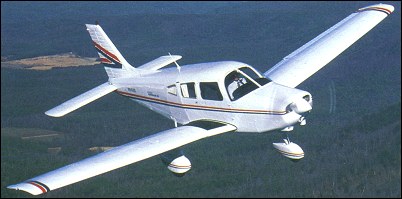 |
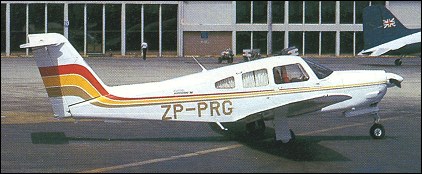
It is unlikely that when Piper first flew the prototype of the four-seat Piper PA-28-150 Cherokee sporting/training monoplane on 14 January 1960 that the company could have anticipated the almost infinite variety of this basic design that was to result, or that its production would still be continuing in 1990s. The type started life as a cantilever low-wing monoplane of all-metal construction with fixed tricycle landing gear and four-seat accommodation in an enclosed cabin, and with power provided by a 112kW Avco Lycoming O-320, or 119kW O-320-B2B flat-four engine in the PA-28-160 Cherokee. The first production Cherokee was flown on 10 February 1961, and the type was available from the beginning in the same Standard, Custom, Super Custom and AutoFlite models as the PA-24, and a similar scheme of optional models with different standards of equipment continues to this day. The PA-28-180 Cherokee was introduced for 1962 with a 134kW O-320-A2A engine, and in 1963 it was followed by the PA-28-235 which had structural strengthening and installation of a 175kW Avco Lycoming O-540-B2B5 flat-six engine for operation at a higher gross weight. In the following year the range was expanded in the opposite direction when the two-seat PA-28-140 Cherokee became available with the 104kW O-320-A2B flat-four engine, but with introduction of the PA-28-180R Cherokee Arrow on 19 June 1967 came a significant change, with retractable tricycle landing gear, fuel-injection engine and a constant-speed propeller as standard; at this time production of the PA-28-150 and PA-28-160 versions came to an end. In 1969 Piper made available an optional PA-28-200R Cherokee Arrow with a 149kW IO-360-C1C engine, and in 1971 new models of the PA-28-140 appeared as the Cherokee Flite Liner, a two-seat trainer for use by Piper-sponsored training schools, and the Cherokee Cruiser 2 Plus 2, which was a de luxe two/four-seat version which in the following year became the standard production model. For 1973 the long-standing PA-28-180 was renamed as the Cherokee Challenger, with slight increases in wing span and fuselage length, and improved interior and standards of equipment; at the same time similar changes were introduced on the PA-28-235 which was renamed as the Cherokee Charger. In 1974 there came a number of changes in the Cherokee line, the Cherokee 2 Plus 2 being renamed Cherokee Cruiser, the Cherokee Challenger the Cherokee Archer, and the PA-28-235 the Cherokee Pathfinder. At the same time a new member of the family was introduced, the PA-28-151 Cherokee Warrior which, powered by a 112kW O-320-E3D engine, was basically similar to the Archer except for having a completely new wing of increased span. In 1977 Piper ended production of the Cherokee Cruiser and Cherokee Pathfinder, but introduced at the same time the PA-28-236 Dakota which, generally similar to the Archer, was powered by the 175kW O-540-J3A5D flat-six engine and had the new wing of increased span; in 1978 a version of this aircraft with a 149kW Continental TSIO-360-FB turbocharged engine became available as the PA-28-201T Turbo Dakota, but only limited demand meant that its production ended in 1980. In this same year, Piper developed to meet the requirements of the Chilean air force a tandem two-seat trainer based on the Cherokee series. Designated PA-28R-300 Pillan (devil) in prototype form, this has retractable tricycle landing gear and is powered by the 224kW Avco Lycoming AEIO-540-H1K5 engine. Following initial construction by assembly, Industria Aeronautica de Chile was expected td be manufacturing some 80% of this aircraft, designated T-35 by the Chilean air force, by the end of 1983. Production of the Cherokee family continued in the 1980s with the introduction of the PA-28-161 Warrior II with a 119kW Avco Lycoming O-320-D3G engine, alongside the CPA-28-181 Archer II with a 134kW Avco Lycoming O-360-A4M. At the higher performance end of the scale the PA-28RT-201T Turbo Arrow IV in corporated the same powerplant as used in the Turbo Dakota. EMBRAER also continued to build aircraft under licence in Brazil. Financial problems and the crisis of product liability acted as a severe brake on sales, but a trickle of late model aircraft continue to be built. By January 1991 2,985 PA-28-161s had been sold along with 9,894 Cherokee 180/ Archers IIs, and small numbers of Arrows and Turbo Arrows.
|  COMPANY PROFILE | |||||||||||||||||||||||||||||||||||||||||||||||||||
|


|