Even in the mid-1950s the superiority of the jet powerplant for combat
aircraft was questioned by some. A modern technology propeller driven
by a turbine (a turboprop) offered high speeds, long endurance and low landing
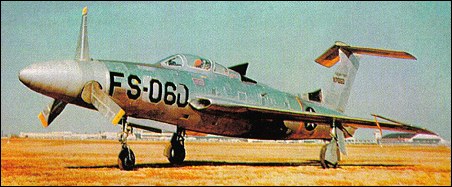
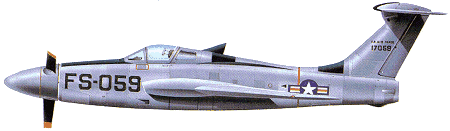
speeds. To test this concept the USAF commissioned two XF-84Hs from
Republic. Powered by the troublesome T-40 turboprop, the noise the F-84H
made has been described as an 'unholy shriek', leading to the nickname
'Thunderscreech'. Resonance off the ground made groundcrew physically
sick. The two aircraft only made a dozen test flights, all but two of which
resulted in emergency landings and the USAF refused to accept it for their
own tests, cancelling the programme in 1956.
The first XF-84H spent 40 years on a pole at Bakersfield Airport,
California, its propeller slowly (and quietly) rotated by an electric motor.
Costas I can not comment on the noise of the XF84H, but the noise of the T6 Texan is due to the propellor being direct drive,i.e. not going through a gear box. Also,if the propellor tips are in excess of Mach they would fold back.
I remember seeing an example of this plane on that pole at the enterance to Bakersfield Airport back in 1969. There was a placard saying that the Air National Guard flew a squadron of this model there in earlier years. A few years ago, I located it again using the GoogleEarth photos. Last month I went looking for it once again on GoogleEarth program, but it appears that the plane has been removed.
The noise because most of each propeller blade was supersonic when spinning (e.g. the T-6 Texan makes a distinctive buzzsaw noise because the prop tips are supersonic). Even with the engine idling and the prop feathered the noise was awful, as it is a constant speed unit and thrust variations are made by pitch change. IT would cause extreme discomfort and nausea to anyone near it, and there is at least one instance of a man collapsing to the ground with (epileptic?) convulsions a fair distance from the Thunderscreech.