|
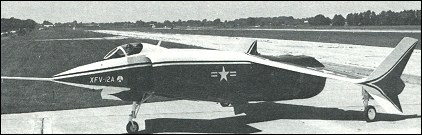
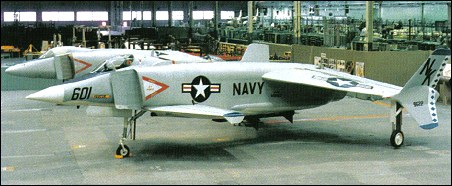
| Rockwell became responsible in 1972 for development of the US Navy's XFV-12A V/STOL Fighter/Attack Technology Prototype programme. Basically a single-seat all-weather V/STOL fighter/ attack aircraft, the XFV-12A made use of an augmentor wing concept in which the efflux of its single Pratt & Whitney F401-PW-400 afterburning turbofan engine could be diverted to nozzles in the wings and foreplanes for V/STOL operations. An ejector-flap system was incorporated in the design of each wing and foreplane, in which ambient air was mixed with turbine efflux in a ratio of 7:1 to provide the essential jet-lift for vertical operations and, when the flaps are raised or lowered progressively, for transition from vertical to horizontal flight and vice versa. The programme proved a disappointment and failed to provide an alternative to the Harrier.
FACTS AND FIGURES © The whole XFV-12 programme
was conducted on the cheap. The
main landing gear, canopy and
other cockpit parts came from an
A-4 Skyhawk. The main wing
box and parrs of rhe inlets were
from an F-4 Phantom. © In vertical flight yaw was
controlled by vectoring the
ejector units. Roll control came
from varying the amount of
thrust supplied to each. © The XFV-12 had what was called
a 'thrust augmentor wing'. Engine
gases were to be channelled along
ducts in the canard and wing
surfaces for vertical flight.

| ENGINE | 1 x 133.4kN Pratt & Whitney F401-PW-400 turbofan |
| WEIGHTS |
| Take-off weight | 11000 kg | 24251 lb |
| DIMENSIONS |
| Wingspan | 8.69 m | 29 ft 6 in |
| Length | 13.35 m | 44 ft 10 in |
| Height | 3.15 m | 10 ft 4 in |
| PERFORMANCE |
| Max. speed | 2560 km/h | 1591 mph |
| Mike, e-mail, 28.12.2015 00:11 The testing was no more negative than any other experimental aircraft program. The real reason the Navy cancelled was the lack of armament capabilities. The plane had no place to attach missiles as the wings would not except hard points due to ducting issues. Engine changes could have eliminated the ducting issues reply | | FrancisZ, e-mail, 04.08.2014 22:08 After all of the work that was done to piece this thing together, and the testing and evaluation that was done, the aircraft was scrapped since it couldn't get off the ground vertically.
Even more astonishing is that it works well as a STOL vehicle rather than VTOL with a very short roll out, where hypermixing comes in line with the mathematics.
Perhaps the designers thought that any evaluation would have recognized the major advantages of this configuration. The armed services had a practical mach 2+ aircraft with STOL characteristics on their hands and dumped it in the garbage. reply | | jjk308, e-mail, 15.10.2012 15:16 A couple of items from my NAVAIR days.
There was never any chance of the XFV-12 or TAW system working due to basic structural, weight and lift system loss considerations. It never should have been started. George Spangenberg's evaluation summary says it all: "Risk level ZERO, Failure Assured!" Yet a Naval Material Command decision was made to fund the XFV-12 demonstrator in spite of this.
And the F401 was cancelled because of unreliability. It kept coming apart. A friend of mine was almost hit by a turbine disk that went through the wall of the test chammber at NASA Lewis, through a chain link fence and buried itself in the ground next to his foot. reply | | dave witter, e-mail, 29.04.2012 23:28 the remains of the prototype xfv-12a were recently found half buried at the milan township ohio nasa facility. the nearby ehove vocatioal school is attempting to restore this aircraft to flying condition. reply | |
| | Doug Winkeljohn, e-mail, 15.05.2011 18:46 I reread the comments I made earlier and realized that I had typed "Tomahawk" instead of "Tomcat" referring to the Grumman F-14A. Sorry about the obvious error. reply | | DOUGLAS M WINKELJOHN, e-mail, 08.03.2011 22:35 Just a couple of comments from someone who was involved in the original concept, proposal, and early development of the XFV-12A. The basic problem was with the canard configuration. In order to have the CG in the correct place to maintain positive longitudinal static stability in conventional flight, AND to balance the wing and canard lift forces in hover, the canard augmentors had to produce proportionally quite a bit more lift in much smaller surfaces and ducting than the wing augmentors. In order to do this, the AUGMENTATION RATIO, or the ratio of the augmentor lift force to the lift force of the basic airflow without entrained air, had to be much larger for the canards than for the wings. Couple this with the losses in the canard ducting due to the much longer duct runs, smaller ducts, turns, etc., and that balance was not achievable with any practical useful load. Had the state of the art in artificial stability then been what it is today, the design could have been flown with negative static margin (i.e., a more aft cg) and it might have been able to balance in hover as well. There were secondary issues with the F401 engine in that the engine bypass ratio was lower than ideal to provide adequate canard augmentor airflow. The F101 engine in the B-1 would have been a better match.
A couple of pieces of trivia are that as cost saving measures, the XFV-12A was proposed and built using the entire forward fuselage from an A-4 Skyhawk. This had the bonus of providing a qualified ejection seat installation with minimum development risk. The inlets were from an F-4 Phantom, reworked and cut down to provide the proper inlet size for the single F401 engine. The main landing gear were from a T-2B Buckeye.
Most of the ducting in the aircraft was fabricated from titanium rather than steel for weight-saving reasons. Initially, many of the large and complex fittings, swivel joints, etc., were to be machined out of solid blocks of titanium, but the cost became so prohibitive that many of the parts were changed to titanium weldments - in itself a challenge because the welding of large titanium parts was not well understood.
Another piece of trivia is that the P&W F401 engine used in the XFV-12A was a prototype of the engine originally intended for the F-14A Tomahawk, but canceled as a cost-saving measure by DOD in favor of the TF-30 from the F-111B. This engine had a bypass ration that was TOO HIGH and denied that otherwise great airplane the performance it should have had from the beginning. The higher bypass ratio also was intolerant of inlet airflow distortion and rapid throttle excursions - both problems for combat aircraft maneuvering at high angles of attack and coming aboard a carrier. reply | | dan, e-mail, 14.11.2009 02:42 Is the prototype still @ Langley? Or did they once again destroy a piece of aviation history? Anyone have a lead on its whereabouts? reply | | Harold Smith, e-mail, 22.10.2009 15:25 Don't know if Don's still interested, but there IS now a resin kit of this aircraft. I'd advise reading this review and thinking carefully about it though:
modelingmadness.com /scotts /viet /us /xfv12.htm reply | | leo rudnicki, e-mail, 10.05.2009 15:57 And if XFV-12 had been successful, the USN would have trouble beating Argentina. Thanks for the explanation, Captain. Know anything about the Avenger? reply | | Ern Lewis, e-mail, 10.05.2009 13:22 Should have added the '1591 mph' obviously didn't come from Navy as we measure speed in knots (and /or Mach). I dont recall that value -- probably a projection for an operational jet -- but truth is, I continue to tussle with those who add hyperbole to system description.
...and Don -- the only model I ever saw was a few 1:48 desktop display models. Good luck of you plan to build one.
CAPT Ern Lewis, USN ret reply | | ern lewis, e-mail, 10.05.2009 12:59 Perhaps I can shed a bit more light on the XFV-12 Project for those who are interested. After 15 years as a jet carrier pilot -- including a combat tour in VietNAM -- I earned an MSAE and was accepted into the Aeronautical Engineering Duty Officer corps. In my first PM assignment I was assigned to head the XFV-12 Project during the Test & Evaluation Phase -- after the prototype was built -- and headed it for about 18 months from late 1977 through early 1979.
Mr Rudnicki's comments seem a bit simplistic -- and are not strictly speaking true. The research objective was to explore the concept of THRUST AUGMENTATION using momentation exchange. Basically the design concept was a 'jet pump'. Of course we have used jet pumps for many years to move fluid -- but the notion of augmenting thrust through momentation exchange had not been tried in an experimental aircraft.
The "...tin-bangers" were dealing with titanium ducting -- and the "...plumbers" and "...guys that drive the train" were struggling to package high thrust ducted flow and modulated flow mixing to exchange the momentum and entrain more mass [F=MV] to achien=ve augmented thrust and vector it down to achieve veriical lift -- while controlling the roll,pitch,yaw,lift, surge and slip by modulating differentially the wing and canard augmenters.
Within a week after I assumed the job, I was thoroughly briefed on the problems. Both the Navy and Rockwell well understood the duct losses -- and were trying to reduce duct losses, mixing losses and reduce weight -- as we were all acutely sensitive to the risk that the prototype would not generate enough thrust to lift off vertically.
The project had several other research objectives but ALL knew the vertical lift tests -- which were conducted at NASA Langley in 1978-79 -- were a one-shot deal.
The technical challenge was being exercerbated both by political issues -- by legitimate concerns that this project had been pushed too fast and was being used as a rationalization to reduce the funding for upgrading the big-deck aircraft carriers.
So the problems were not simply technical.
If you were there during the test program, I must appologise as I don't recall your name. I should say the then Commander of the Naval Air Systems Command, VADM FC Peterson (who was the first Navy pilot to fly the X-15 as a young test pilot) understood R,D, T &E very well. He convened a panel of top scientists and engineers (including the late Dr Hans von Ohain & Dr. Bill Sears) to work with our engineers --and ALL agreed we were at one of the more murky edges of aero science at that time -- given the complexity of the control surfaces, ducting and system desgned to integrate flight controls from VTOL through STOVL transition to CTOL were NOT trivial. Even the JSF today is still struggling to optimize the control balance.
Actually the XFV-12 did get off the ground -- and was tested in a tethered mode. 'Twas an interesting and educational FIRST PM & I co-authored a paper on the PM aspects. We must recall this was a technology research and development prototype -- and many experimental aircraft prototypes in the past that have not flown have still taught us lessons -- hence the designator "X" FV-12.
The comprehensive tech report added to the technology base that has led us to the Joint Strike Fighter.
Ern Lewis reply | | leo rudnicki, e-mail, 09.05.2009 00:27 Somebody made a model of this thing. They didn't have any good tin-bangers or plumbers or those guys that drive the train, engineers, to explain ducting losses. It never got off the ground. 1591 mph? It didn't even move. reply | | Don Seleman, e-mail, 26.12.2007 04:09 oh i just like this aircraft to me it has special design features. i'm trying to find out if anyone ever made a model of this. reply |
|
Do you have any comments?
|
| 
COMPANY
PROFILE
All the World's Rotorcraft
|