|
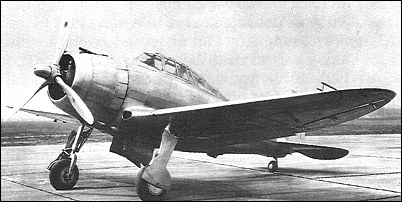
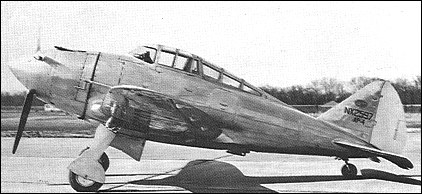
| Preceded by the AP-7, the AP-4 possessed a superficial
resemblance to the AP-2 and was intended as a high-altitude
interceptor. The first Seversky fighter to
feature flush-riveted skinning, the AP-4 was powered
by a 1,200hp Pratt & Whitney R-1830-SC2G equipped
with a belly-mounted turbo-supercharger. As a company-
funded development, the AP-4 was intended to
participate in a USAAC competition scheduled for 25
January 1939 and was expected to demonstrate the
superior medium- and high-altitude performance
obtainable with a turbo-supercharged R-1830. The
same engine, fitted with a mechanical supercharger,
had been specified by the USAAC for the XP-41. The AP-4 was evaluated at Wright Field during February-
March 1939, demonstrating exceptional climb and altitude
performance. Early 1939, it was fitted with a close-fitting,
high-inlet-velocity engine cowling matched
with an oversize propeller spinner as a continuation of
a drag reduction programme supervised by the NACA
and initiated earlier with the AP-1. The AP-4 was subsequently
fitted with a modified engine cowling, without
the spinner, but, on 22 March 1939, caught fire in
the air, the pilot bailing out. On 12 May 1939, a contract
was awarded for 13 service evaluation models under
the designation YP-43.
| WEIGHTS |
| Take-off weight | 3075 kg | 6779 lb |
| Empty weight | 2462 kg | 5428 lb |
| DIMENSIONS |
| Wingspan | 10.97 m | 36 ft 0 in |
| Length | 8.23 m | 27 ft 0 in |
| Height | 3.81 m | 13 ft 6 in |
| Wing area | 20.44 m2 | 220.01 sq ft |
| PERFORMANCE |
| Max. speed | 534 km/h | 332 mph |
| Range | 1255 km | 780 miles |
| Klaatu83, e-mail, 21.02.2017 20:28 The AP-4 was powered by a Pratt & Whitney R-1830 engine with a turbo-supercharger mounted in the fuselage behind the pilot in order to give the fighter good performance at higher altitudes, which was an attribute sadly lacking in the Bell P-39 and Curtiss P-40. This aircraft became the prototype for the Republic P-43 Lancer and set the pattern for the larger and more powerful Republic P-47 Thunderbolt. It has been alleged that the Army Air Force only ordered the P-43 in order to keep Republic's production line operating until the fighter they really wanted, the far-superior P-47 Thunderbolt, was ready to go into production. reply | | Don Friedman, e-mail, 29.07.2010 06:56 I have another picture of the AP-4 and on the back it says first flight by Frank Sinclair December 22, 1938 reply |
|
Do you have any comments?
|
| 
COMPANY
PROFILE
All the World's Rotorcraft
|