|
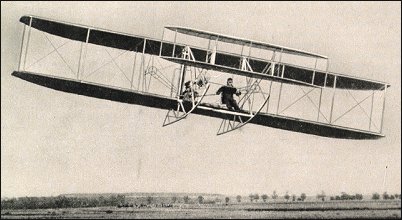
| On December 17,1903, the Wright brothers
changed the world when Orville went
up in this aircraft for the first successful
controlled, powered, heavier-than-air
flight. Although fragile, the Wright Flyer,
which is composed of wood and fabric,
and braced with steel wire, achieves a
balance between lightness and strength.
The Wright brothers constructed the air-
craft at their bicycle shop in Dayton,
Ohio, and sent it by rail to the coastal
dunes of Kitty Hawk, North Carolina,
for its flight trials.
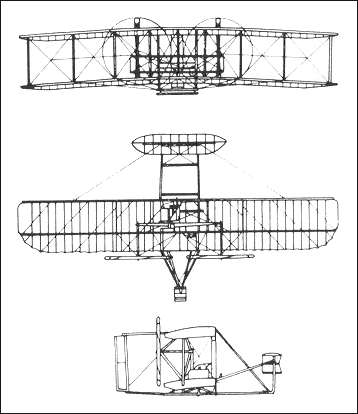
| CREW | 1 |
| ENGINE | 1 x Wright, 12kW |
| WEIGHTS |
| Take-off weight | 340 kg | 750 lb |
| DIMENSIONS |
| Wingspan | 12.3 m | 40 ft 4 in |
| Length | 6.1 m | 20 ft 0 in |
| Height | 2.4 m | 8 ft 10 in |
| Wing area | 48 m2 | 516.67 sq ft |
| howard warriner, e-mail, 30.11.2012 15:56 When I read this today, Nov 30, 2012, there are two paragraphs that are repeated wrt the Smithsonian history. Simple editing is required to correct the situation. Thank you. reply | | Terrence I. Murphy, e-mail, 15.02.2012 16:40 Here's the sad part, at least for the Wright brothers: The Smithsonian Institution, and primarily its then-secretary Charles Walcott, refused to give credit to the Wright Brothers for the first powered, controlled flight of an aircraft. Instead, they honored the former Smithsonian Secretary Samuel Pierpont Langley, whose 1903 tests of his own Aerodrome on the Potomac were not successful. Walcott was a friend of Langley and wanted to see Langley's place in aviation history restored. In 1914, Glenn Curtiss flew a heavily modified Aerodrome from Keuka Lake, N.Y., providing the Smithsonian a basis for its claim that the aircraft was the first powered, heavier than air flying machine "capable" of manned flight. Due to the legal patent battles then taking place, recognition of the 'first' aircraft became a political as well as an academic issue.
In 1925, Orville attempted to persuade the Smithsonian to recognize his and Wilbur's accomplishment by offering to send the Flyer to the Science Museum in London. This action did not have its intended effect, and the Flyer went on display in the London museum in 1928. During World War II, it was moved to an underground vault 100 miles (160 km) from London where Britain's other treasures were kept safe from the conflict.
In 1942 the Smithsonian Institution, under a new secretary, Charles Abbot (Walcott had died in 1927), published a list of the Curtiss modifications to the Aerodrome and a retraction of its long-held claims for the craft. The next year, Orville, after exchanging several letters with Abbott, agreed to return the Flyer to the United States. The Flyer stayed at the Science Museum until a replica could be built, based on the original. This change of heart by the Smithsonian is also mired in controversy – the Flyer was sold to the Smithsonian
The Smithsonian Institution, and primarily its then-secretary Charles Walcott, refused to give credit to the Wright Brothers for the first powered, controlled flight of an aircraft. Instead, they honored the former Smithsonian Secretary Samuel Pierpont Langley, whose 1903 tests of his own Aerodrome on the Potomac were not successful. Walcott was a friend of Langley and wanted to see Langley's place in aviation history restored. In 1914, Glenn Curtiss flew a heavily modified Aerodrome from Keuka Lake, N.Y., providing the Smithsonian a basis for its claim that the aircraft was the first powered, heavier than air flying machine "capable" of manned flight. Due to the legal patent battles then taking place, recognition of the 'first' aircraft became a political as well as an academic issue.
In 1925, Orville attempted to persuade the Smithsonian to recognize his and Wilbur's accomplishment by offering to send the Flyer to the Science Museum in London. This action did not have its intended effect, and the Flyer went on display in the London museum in 1928. During World War II, it was moved to an underground vault 100 miles (160 km) from London where Britain's other treasures were kept safe from the conflict.
In 1942 the Smithsonian Institution, under a new secretary, Charles Abbot (Walcott had died in 1927), published a list of the Curtiss modifications to the Aerodrome and a retraction of its long-held claims for the craft. The next year, Orville, after exchanging several letters with Abbott, agreed to return the Flyer to the United States. The Flyer stayed at the Science Museum until a replica could be built, based on the original. This change of heart by the Smithsonian is also mired in controversy – the Flyer was sold to the Smithsonian reply | | Terrence I. Murphy, e-mail, 15.02.2012 16:01 And also change the title. The one you have sounds like Attila the Hun. Change the title to Wright Flyer. And remember, they made four flights that day. They covered distances of 120, 175, 200, 852 feet. They were planning to fly it longer, but a gust of wind damaged the plane, which ended their day. reply | | Bill Anderson, e-mail, 03.01.2010 01:15 I suggest that you change this photo for the official first flight photo Wilber made when the Flyer first lifted off on that fateful December day in 1903. reply | |
| | brian, e-mail, 10.10.2009 22:17 the 1903 glider's last flight lasted a whoping(at the time)67 seconds reply | | tomas padua, e-mail, 10.06.2009 23:14 podria algun amable aeromodelista facilitarme el plano del flyer de los hermanos Wright 1903 reply | | William Curry, e-mail, 25.04.2008 04:38 The picture you show under the heading "Wright the Flyer 1903" is NOT the 1903 machine, which carried its operator in a prone position, but more likely a 1908 machine Wilbur is flying in France.
And contrary to the writer's statement that "On December 17,1903, the Wright brothers changed the world when Orville went up in this aircraft for the first successful controlled, powered, heavier-than-air flight", the world din't change, nor even take much notice, until four and a half years later, when Wibur created a sensation in France by flying circles and staying aloft for more than two hours, feats no other flyers would be able to match for years. By the end of 1908, the Wrights, having flown demonstrations in Europe and Arlington, VA, had become the first world-wide celebtites of the twentienth century.
But in 1903, they were nobodies!
Cheers -
WC reply |
|
Do you have any comments?
|
| 
All the World's Rotorcraft |