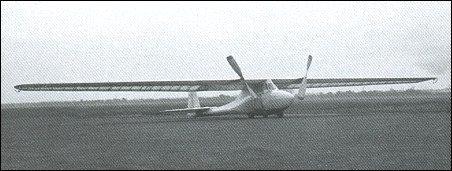
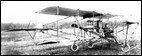
The “Pedaliante” (= “pedal glider”), also known as “Cicloaliante” (= “bike glider) was a flying machine built in 1936 and that became the first aircraft to fly only by human power. Enea Bossi - an engineer born in Milano, but naturalized in the U.S.A. - was a pioneer in the history of aviation, above all in the design of pioneer helicopters; after several tests in the States and in Europe, he convinced himself that a single biker could have the strength to make a light airplane fly. Basically, the “Pedaliante” was a plywood glider with two wooden airscrews in the root of the wings, that increased their diameter during the tests from m. 1,95 (= 6’ 1/3) to m. 2,25 (= 7’ 1/3). The two airscrews were counter-rotating, because Bossi feared that a single propeller should have generated serious problems of torque. These airscrews were linked to the pedals by a bike chain and a transversal transmission shaft. Its empty weight should have been of 73 Kg. (= 161 lb.), but the Ministero dell’Aeronautica compelled the designer to build it with the same structural rules of a conventional airplane, instead of a glider: this stupid imposition made its empty weight grow to 97 Kg. (= 214 lb.), worsening for sure its flight characteristics. In the first months of 1936 the pilot (Maj. Emilio Casco, an Italian bike runner renowned in those years for his resistance) made a first jump of about m. 91 (= 100 yards); but, because of the weight of the airplane, Bossi decided to use a sort of 27 feet high catapult for its take off. With this solution, the 18th March 1937, Maj. Casco flew for Km. 1 (= 0,620 miles) at the astonishing speed of 37 Km/h (= 23 m.p.h.): probably the slowest airplane ever built… The “Pedaliante” made a total of 80 experimental flights and it has been scrapped after 1938.
deaftom, e-mail, 28.02.2011 06:36
According to my files, this aircraft was named the "Pedialante".
Fatal error: Uncaught Error: Undefined constant "isMob" in /data03/virt15346/domeenid/www.aviastar.org/htdocs/comments/comments.php:165
Stack trace:
#0 {main}
thrown in /data03/virt15346/domeenid/www.aviastar.org/htdocs/comments/comments.php on line 165