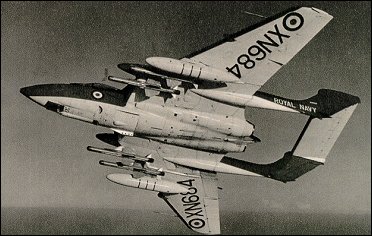
I worked on Vixens for a number of years in the trade of airframes and engines (FAA) with 766 & 899 Sqdns. & yes, they could be a pig to work on! I remember running out to my a/c XS557 on a number of occasions as it waited in line for the cats prior to launch to shake the wings up and down to engage the wing fold locks; flying control hydraulics which had to be manually bled with an installed hand pump, checking for the presence of air in the hydraulic fluid as it passed along a sight glass; the alignment and locking of the accessory gearbox inclined drive shaft could be better achieved by a gynacologist; changing the cold air unit which was jammed down between the engine compressor casings was not easy and neither was the hydraulic alternator in the underbelly wich you had to balance on your feet whilst lay on your back covered in hydraulic fluid and fuel. Ahhhh De Havilland! But what a class act when she was airborne!
Harold Smith, e-mail, 21.02.2013 18:57
I too was at the airshow on the day of the tragic accident. I was on the hill where the engine landed in the motorcycle park. Little did I know then that several years later I would be involved in the canopy redesign for the production version of the DH 110 Sea Vixen. I emigrated to Canada in 1956 before the first flight.
Geoff Pollard, e-mail, 10.10.2012 15:46
Having worked on the Mk2 Vixen, both ashore and afloat I can safely say that it was not an easy aircraft to work on. It was heavy and dangerous work with lots of things that could trap your fingers or stick in your head (especially 3" Rocket Rails). the Wing Fold mechanism had to be cleaned and lubricated regularly otherwise it would corrode and the Latch Pins wouldn't lock the wings down unless you jumped up and down on the outer Wings. Having said all that, I had a blast working on them (and flying in them a couple of times) and the memory of those times will always be with me.
Paul Scott, e-mail, 13.07.2012 16:15
The days when this country was great, we actually had a Fleet Air Arm and aircraft carriers - I despair at the defence cuts just because our msiguided government(s) think it more right to let foreign spongers take the piss AND give foreign aid out to the tune of £34 billion EVERY year. It makes my blood boil.
M.D.Saunders, e-mail, 29.12.2010 16:24
Please read Brian Rivas and Annie Bullens book on John Derry pages 190/192 for the exact cause of the wing failure of the 110 at Farnbororgh 1952. I was also there and saw the whole accident wh.ich seemed to happen in slow motion but it only took one second
Eric Brett, e-mail, 04.12.2010 23:06
Two previous contributors have referred to the disintegration of the DH110 in 1952. I can comment as a witness, having attended (at 16.1/2) as the youngest of a group of apprentices on an 'outing' from Electro-Hydraulics and Rubery Owen (Warrington). The aircraft had just completed a high-speed dive, breaking the sound barrier. This feat must have seriously weakened the airframe. As the pilot banked round and approached the crowd, the nose suddenly went up, displaying the whole of its underside, and two black dots appeared to fall away (I stated the obvious to my companion: "It's breaking up"). The two dots got bigger and bigger; it was soon apparent that they were the engines. I watched from the edge of part of the crowd as the first engine went over the crowd (about 50 to 100 yards to my left). Later, I learned that it went through a radar van and landed in the motorcycle park. The second engine appeared to be coming straight towards me. I turned right and ran. After hearing a dreadful thud, I stopped. A woman ran past with a small child 'in tow'; they were spattered with what looked like red soil. I turned round and my attention was immediately drawn to the eyes of a woman on one knee; her dress was torn and there was blood on her leg. I'm afraid that my reaction was to turn again and run down into a small 'valley' and up into another section of the crowd. Only then did I turn to look again. There was no sign of the engine, so I thought it was buried; in fact, I think it had bounced and come to rest behind a lorry from which apples had been on sale. I remember watching part of the clear-up when 'things' were being collected and loaded onto a truck. A group of apprentices from our party were in direct line with the incoming engine. One fainted and woke with a gash in the back of his coat with traces of metal. Another, Stanley Morris, perished. That was the last apprentice outing from our works whilst I was there!
Walter Burgher, e-mail, 29.08.2010 15:04
Armaments
Only bombs & rockets. i.e. the greatest mistake was it never carried a gun.
Brian Gerrard, e-mail, 09.03.2010 22:57
I can remember seeing the DH110 on many occasions doing test flying from Boscombe. The DH110 bares little resemblance to the Sea Vixen. If I remember correctly John Derry took off from Boscombe to go to the Farnborough airshow where the aircraft blew up killing Derry and the navigator.
Leslie Stephens, e-mail, 08.02.2010 20:38
The Sea Vixen, although a dangerous aircraft in one of its roles - that of illuminating ships at night with very powerful flares (during which procedure many were lost, together with their crews), was a very successful fighter. Not only was it very successful in that role, it was good at ground attack. It was vastly superior to the RAF's equivalent, the Gloster Javelin, which was an aircraft prone to getting itself into a flat spin, from which it often couldn't recover. Basically, had the RAF opted for the Sea Vixen (with its fine radar - AI Mk18), there might even have been a Mark 3 Sea Vixen. Both Services would, dare I suggest, have been better off from having this aircraft.
paul scott, e-mail, 19.10.2009 02:38
Pilots seemed to love it though - though the ones that said that, probably didn't get to fly an F-14!
Rob, e-mail, 11.04.2009 13:09
I have had the pleasure of working on XN685, and still do from time to time. The Vixen is still classed as one of the Navy's finest fighters and in its time was a superb fighter. It is also a very uncomplex airframe to work with. It is easy to access all components, providing the correct procedures are followed and the two RR Avon 208's gave it excellent power to weight ratio, making it very quick and manouverable. I personally think its one of the finest all weather fighters the UK has made and if was given the choice of owning a Typhoon fighter or a Sea Vixen, the Vicky would win hands down.
bigfoot, e-mail, 01.02.2009 19:36
I REMEMBER THE PROTERTYPE OF THIS AIRCRAFT AT FARNBOROUGH IN 50S IT DISINTERGRATED WHILST DOING LOW FAST FLY PAST KILLING THE PILOT AND NAV PLUS A LOT OF PEAPLE IN THE CROWED THEY RECEVED THE 2 ENGINES THAT WHERE FIRED FROM THE EXSPLOSION, NO!NOT GOOD .
Roland Livings, e-mail, 21.07.2008 21:42
The Sea Vixen never had 30mm cannon in service, also they are not called machine guns, They never flew around the streets of Chicago, They were too slow to be any use, 18 months of taking ejector seats out to change black boxes use to drive me nuts,Once the tail plane cracked that was the end of their service life, The Red Bull one plonks around at about 400knots, 893 Squadron HMS Centaur 1962/3
Marc, e-mail, 19.02.2008 14:34
The FAW(2) had an improved range by 200 miles i.e; the FAW(1)600 miles and the FAW(2) 800.