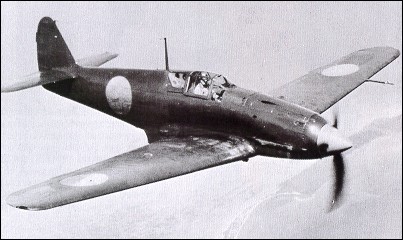
These alternatives are all very interesting, but many ignore the technical limitations of the Japanese. The Tojo was not a superior aircraft to the Oscar: In fact the Oscar was vastly preferred to the Tojo and Tony, and for very good reasons: The Japanese Army, unlike the Navy, was not fanatically averse to turning, and turning is the correct tactic when faced with aircrafts diving from above with superior speed. In fact the Oscar was preferred even to the Ki-84, because its tighter turns (11-13 s. both ways vs the Ki-84 at 17-18 left 20-21 right) which instantly broke diving attacks, to the point wise Allied pilots gave up on their dives in mid-dive, when they saw they were spotted by the Oscars below them (See the Osprey book on Oscar aces). The altitude advantage meant very little in WWII, contrary to what historians have been repeating like a mantra since, often from a few ace pilots dedicated to surprise attacks on stragglers more than actual combat, and who had to fire at point blank range to keep the surprise effect as late as possible.
The main limitation for hit and run was that WWII guns did not like high overtaking speeds, so you could only really fire point blank... Turning "captured" the target in your turn (roll reversal, once engaged, was usually fatal) and turning also protected you from diving attacks.
The Japanese Army only had 3 really good fighters in WWII: The Ki-43, the Ki-84, and the Ki-100, which was the best. The Ki-43 always lacked firepower, but was still better armed than the Zero and its slow-firing wing mounted cannons. Even 4 of those Type-99-IIs on the N1K were slow to take effect on a Hellcat...
I do not know if the 30 mm Japanese cannon was a practical weapon, but I do think the B-29 was an ineffective high altitude bomber over Japan, until it came in at low altitude at night. The B-29 was a crew-killing pile of unfinished junk that killed thousands of US airmen, who feared their mounts far more than the Japanese (about 500 lost of the 1600 built by VJ day, probably near 250 of those by engine fires alone). The problem with the B-29 was that its defensive system was one of the most remarkable weapons ever invented during WWII (the one thing about it that was not crew-killing junk), with 6 times the effectiveness per round of the B-17G. I think tackling the B-29 at low altitudes at night was worth it, with twin engine night fighters, but not intercepting it at high altitudes in broad daylight. Even at high altitudes during the day, putting guns on the spine of a twin was probably the right idea, to stay away from its defensive fire.
I simply do not think the Japanese had sufficient technology to profitably intercept the B-29 at high altitudes, except maybe through ramming. Germany might have been different, but even against escorted B-17Gs, I wonder if the cost of interception was worth it for them, as the Luftwaffe's own high altitude performance was not up to the US fighters they faced. Even the Me-262 had less than a 1:1 kill ratio until it started to use R4M rockets in salvos of 12 or 24. Without rockets, the 262 was actually worse than a regular piston engine fighter: It could not wait out (and trap) divers by making continuous tight circles...
Bob, e-mail, 23.03.2022 00:06
I read forty or so years ago that when Australian mechanics examined a captured Hein, they found that the Japanese had reversed the rotation of the motor from the way the Germans had designed the motor to suit the direction they ran the rotation of the props. Doing this starved the bearings of oil. They redrilled aditional oil holes in the crankshaft to the direction they should have been for this altered rotation and there was no problem with oil starvation from that point.
Ron, e-mail, 10.09.2017 06:50
Some say Ichikawa had his Ki 61-I'd Kai with the 30mm Ho-155-I cannons in the cowl with successintercepting B-29s. If true, the only problem would be the 58 r/m or so rate of fire each. The already slow rate of fire at 120 r/m would be cut by over half to synchronize through the prop. But at least it would be accurate vs the wing mounted 30s that damaged the spar with it's recoil. Putting the 20mm Ho-5s in the wings instead works fine and is very fast firing at 850 r/m each. But still better would be putting only one 30mm cannon in the hub fire half the weight of 2 and still the rate of fire of 2. This cuts out the weight of the interrupt or gear too. Lighter on it's feet but with the same punch, his Hien would've been a better dogfight as well as B-29 slayer. Then there is the fast and light 30mm Ho-155-II in 1944. It did 600 r/m! The perfect motor-cannon for the 1944 Ki 61-II.
ron, e-mail, 16.08.2017 03:18
I like the fact that the Japanese at least had the potential to overcome the main faults of the Ki 61-I.
The 20mm Mausers cannons could've been in the cowl or wing-roots at 630 r/m RoF. Their drawback was only an OK 800-850m firing-range. The Mineshell was their plus, in addition to the synchronized RoF advantage vs Browning-based Japanese cowl guns and cannons. Japanese copies could keep Japanese fighters in good supply beyond the imported batch. The 30mm Ho-155 could've been in the hub with good 900m range vs the faster 30mm MK 108 cannon. This suite of 3 cannons would leave the wings unweighted for agility but still great firepower.
The speed/climb penalty could be more than offset with triple ventral rocket boosters like the Judy D4Y4 used!
The wingloading penalty could be addressed with the automatic combat flaps used on the N1K1 for a 30% tighter turn radius!
Then, the unreliable engine could've been beefed up. If chromium was not available, why not add more supports with slider-bearings so the drive shaft wouldn't fail around 200 hours run time, for example...etc?
The Ki 61-II could entertain the bigger DB 603 or Jumo 213 based engine and the long-range 37mm Ho-204 hub-cannon or fast 30mm Ho-155-II with the Mauser-based 20mm cannons. Of course the bubble canopy for this new Tony would've been sweet.
The Hydraulics and electronics would've needed to be addressed too, perhaps by crossing over from IJA to IJN suppliers if necessary.
The Ta 152H was received by sub in Japan. The Ki 61-II Tony could've been effectively the equivalent, potentially.
ron, e-mail, 10.08.2017 03:46
The 20mm Mauser wing cannons hurt the turn radius but putting the Ho-5 cannons in the cowl tightened the radius again. Electric gun fuses were prone to blow at inopportune times. Against the USN F6F the Tony pilots adopted hit-and-run tactics with relative effectiveness.
Against B-29s, the Tony would be stripped of armor and perhaps all but one cannon for better altitude.
The Tony was prone to stall on take-off, landing, and pullout. The Ki 61-II prototype still had a very weak crankshaft and an unreliable engine. The revised airframe was weak and the new wing was rejected. The Ki 61-II had frequent failures of main bearings and superchargers, oil and coolant systems. But when working right, it held it's own if well piloted.
ron, e-mail, 04.07.2017 01:12
Fighter Gun kg Wt R/S GP kg/s M/V m Range GP/Gun Wt _________________________________________________________ Ki 61-Ib Kai 130 39 471 3.228 775/727 900/850 3.6 Ki 61-Ic Kai 120 43 285 2.324 775/820 900 2.4 Ki 61-IIa 120 43 261 2.324 775/703 900/600 2.2 Ki 61-IIbKai 148 41 437 4.040 703 600 3
These are my estimates. Take with a grain of salt. These don't include Tony fighters without 20mm cannons. The Ki 61-Ia and -Ib with only 7.7mm and 12.7mm MGs aren't in this comparison.
As a B-29 interceptor, the 20mm cannon was key in the Tony. The first is with the Mauser MG 151/20; next version has the cowl Ho-5 twins; then the same but after the Ho-5 was degraded; finally the Ho-5 quartet.
If you wonder about the discrepancy between the WoF and the GP of the Maser version, the potent HE/M shell is included in the ammo belt in my opinion. But remember, these were in limited supply and may have been gone by the time the B-29s arrived.
These Tonys did not utilize hub-cannons like their German brother, the Bf 109 Gustav with mostly 30mm cannons in the hub. These were the very short range 30mm MK 108 cannon. The IJA had a better one, the 30mm Ho-155 cannon. This was called for when Ki 61s were intercepting B-29s, which the Gustav never had to face. No other Japanese fighter could have a motor-cannon, only the inline engine Tony (and fighter version of the inline D4Y2-S Judy perhaps). It would be curious to know how such a Ki 61 would've done in WW2. The Ki 61-Id had this 30mm cannon, but only in the wings. Thus accuracy was non-existant and the wingspar cracked from the recoil, so these were sidelined at training bases. Putting it in the spinner would've avoided these drawbacks. Thousands of Tonys were available to be converted to dragon slayers. They would only need 2 Ho-5 cannons to compliment it. 118-124kg for gun weight. The Ho-155-II was only 44kg and about as fast as the MK 108! Both versions of the Ho-155 had more than twice the firing range at 900m vs 365-400m! And the MK 108 was also more prone to jam!!
ron, e-mail, 29.06.2017 03:21
I like the idea of a motor-cannon in the Ki 61. The 30mm Ho-155 cannon outperforms the MK108 in the nose of 17,000 Bf 109 Gustavs in the Luftwaffe. The Ha-40 and 140 should accommodate it since the DB 601 is the parent engine. (It is interesting that the RLM considered the DB 605 a sick engine) Anyway, the Gustav made heavy use of motor-cannons. Does anyone know why the Tony didn't use it?
ron, e-mail, 15.06.2017 08:38
1. The Italian versions of the DB 601 and 605 should've been built in Japan instead of the Japanese versions which proved so much more unreliable.
2. The Ki 61 was lacking the advantage of a motor-cannon. Why? The Bf 109 and Fiat G.55 had motor-cannons with basically the same inline engine. Perhaps over 80,000 fighters of WW2 utilized this advantage. But not Japan! P-39s, P-63s, MiGs, LaGGs, Yaks, Reggianes, Fiats, Bf 109s, Fw 190Ds, and Ta 152s had hub-guns and cannons firing through the spinner. The best 20mm, 30mm, and 37mm cannons of late-WW2 were arguably Japanese. Perfect as world-class motor-cannons. The 400 r/m 37mm Ho-204 was the fastest 37mm and out-ranged the defensive fire of US bombers. The 30mm Ho-155-II was lightest at 44kg and fast at 600 r/m and had good range. Everyone knows about the fastest 20mm cannon of the war, the 850 r/m Ho-5. The IJN had good ones too.
These 2 changes could've made the Tony so much better. Of course this is the advantage of hindsight. As it was, the biggest production version of the Ki 61s only had 4x12.7mm HMGs, and all versions were unreliably powered! It's no wonder the Tony had the worst loss ratio vs the USN (28/1) of all Japanese fighters in the last year of WW2! On the other hand it was a good B-29 interceptor.
ron, e-mail, 21.02.2016 08:03
About 30 Ki 61-IIKai were produced with 4x20mm cannon. The remaining 69 had HMGs in the wings as well as the 2x20mm nose-cannon the wings. Another 25 were preproduction.
The 30mm wing-cannon in some Ki 61-Is had no accuracy besides warping the wing and cracking the spar. So they were sidelined. In my opinion, a dorsal mounting of the 30mm on an angle ala Zero night fighter would have worked.
Ki 61s were successful at ramming B-29s due to their strong build vs all other Japanese fighters. Pilots would many times survive and ram again. On one raid, over 900 interceptors rose to combat the B-29 force.
Ron, e-mail, 08.11.2015 02:06
Kawasaki biuld quality was superior to Nakajima. Maybe the best in Japan. Of course I'm not talking about the engine, hydrolics, or electrical. Just everything else. Stronger and protected.
Ron, e-mail, 13.07.2015 01:28
That brings us to 6/1944 and the Ki 61-II in response to the bitter complaints of mechanical nightmares near and far. The cockpit was roomier. All the better to quickly bailout when ramming B-29s and do it again on the next raid. 26were built. Then came 69 of the Ki 61-IIa from 8/1944, followed by 30 of the 4x20mm Ki 61-IIb starting from 9/1944. Reason for the slow production? The new high altitude Ha-140 engine production.
You guessed it, the engines were more unreliable than before. Another big problem now was frequent electrical system breakdowns.
The weight was increasing and since the new wing was rejected, the old wing bore the burden. 1929 lb increase from the tight-turning Ki 61-Ia to the heavily armored 4 cannon Ki 61-IIbKai. that's about a ton! Still it could climb to 5Km/6min.30sec. and top speed was 373 mph unboosted. The main 2 cannon Ki 61-IIa did better at 379 mph and 6 min. 5 sec/5Km climb.
Ron, e-mail, 13.07.2015 00:47
The comparison test of the captured Ki 61-Ib by the Navy vs late and post-war navy fighters is misleading in my opinion. The -Ib of 1942-3 is hardly a contemporary of the 1944-46 USN fighters even if it was in good repair and it wasn't. I can see why it was captured.
Anyway, a properly working Ki 61-Ib had a top speed of 368 mph at 5km altitude which it could reach in 5 min 31 sec. Few US fighters could climb better in 1943. Normal loaded weight was 6900 lbs. 4x12.7mm Ho-103 HMGs.
Then in August came the Mauser armed Ki 61-IbKai. It was slowed to 360 mph. But those cannon were good.
Hydrolics was one of the biggest problems for the Ki 61-I. The prop, guns, flaps, undercarriage, all involved.
Then in January 1944 the Ki 61-Ic weighs in, at 7650 lbs normal load. Climb to 5Km/7 min! But it had the cowl mounted 20mm Ho-5s. Probably heavy enough to dive with a P-40.
Don't forget, the early Ki 61-Ia at 6504 lbs could out-dive a P-39 and turn almost as well as an Oscar from 8/1942. Of course it only had double the guns (2x7.7mm & 2x12.7mm) of the typical Ki 43.
Ron, e-mail, 12.07.2015 23:54
The 30mm armed Tony was the Ki 61-Id Kai. They were unsatisfactory and few were made. So these were largely relegated to training duty.
Ron, e-mail, 02.07.2015 22:19
The early Italian MC.205 and Re.2005 overheated in sustained climb but the G.55 was no problem. I don't know if they fixed the others. The faster, more agile Re.2005 dove at 609 mph but rudder balance was easily abused causing flutter and fuselage deformity. An example of the Re.2005 was bought by the Germans who installed a boosted domestic DB 605 and VDM prop of the Bf 109 attaining speeds of 437-447 mph! So it was a world-beater but iffy.
I wonder how the Ki 61-II would have done with that version of the DB 605 and prop instead of the weak, lightened, unreliable Kawasaki version? It could probably compare favorably or beat the 417 mph (boosted) G.55 but with much better max range. I'd add a hub-cannon to the Ki 61 like the 30mm Ho-155 with 900m range to best the MK 108 of the Bf 109 low velocity 30mm (even in a trade-off with the cowl Ho-5s). Swap the Ho-155 for the reliable German DB 605 in exchange. Worthy of tackling B-29s, this could have been the best DB 605 powered fighter. If wing loading is too high given the failure of the new lareg Kawasaki wing, copy the wing of the Re.2005 or G.55 and hold off on adding the tail ballast and drop tanks to save weight.
The Allies were fortune things didn't go this way.
Ron, e-mail, 26.09.2014 19:01
I often wondered why the Japanese had so many of their Broning derived guns installed in the cowl when synchronising reduced the RoF so much more than others (like the MG 151/20 cannon).
The Tony imported Mausers for wing mounting but when the nose was lenthened to replace the Ho-103 with cannons in the cow, The up-sized the Browning 0.50 Cal to 20mm for the H0-5. Why not a Mauser derivative? The synchronised HMG and cannon designs on most Japanese fighters were Browning-based, cutting RoF in half. Note this post on synchronised Brownings:
"A practical example of the effect of synchronisation is graphically provided by comparative tests held by the USN in 1926/7 of the .30" M1921 and .50" M1921, both on a test stand and in synchronised mountings. These also shed some light on the differences between claimed and actual rates of fire, and between different installations of the same gun. The .30" had a claimed RoF of 1,200 rpm, but proved capable of between 800 and 900 rpm on the test stand. When synchronised, the RoF went down to an average of 730 rpm (a fall of about 15%), with a range of between 667 and 818 rpm for different installations and propeller speeds. The .50" had a claimed RoF of 600 rpm, and did rather well to achieve between 500 and 700 rpm, depending on the recoil buffer adjustment (although a contemporary British report put this at 400-650 rpm, the difference possibly caused by belt drag when installed), but this fell to an average of 438 rpm when synchronised, varying between 383 and 487 rpm. As the synchronised guns were adjusted for maximum RoF, this represented a reduction of around 37%. There is no inherent reason why a larger calibre weapon would suffer a bigger reduction in RoF, so the synchronisation conditions must have been better suited to the .30" gun's natural RoF."
The Mauser was synchronised with much success by the Luftwaffe electrically for a 10% reduction in RoF!
The Type 3 and Ho-103 HMGs as well as the Ho-5 cannon all got 400 or so RoF synchronised. All Browning style designs.
Imagine the Tony with 4 Mausers! One reason the synchronised LMG persisted in Japanese fighters so long was their rapid RoF since they were not Browning-based.
Ron, e-mail, 23.09.2014 00:35
Unfortunately with episodes like the one where 2/3 of the Tonys transfering from one base to another were lost in flight, pilots were wishing they had their Oscars back. With Ki 61 losses like that due to engine trouble, you don't need enemies. Tropical climates didn't help either. They should have been kept in temperate climates close to maintenance depots. At least until they could get reliable engines ala Ki 100 but in 1943 at the latest. It's not like they had to wait for the inline engine factory to be bombed to have the Ki 100 engine. It existed mid-war.
Failing that, put the reliable Tojo on fast track production to take up the slack, at least in the tropics.
Ron, e-mail, 08.03.2014 00:29
The odd tail was the P-40K. But the Gypsy Rose Lee was the P-40L stripper with various degrees of undress, reducing guns, armor, and fuel loads for performance and handling. 720 built. Still the Ki 61-I was much lighter without sacrificing firepower, range, and armor. At least the Ki 61-II weighed more perhaps but it had much greater firepower than the Gypsy's 2 MGs!
Ron, e-mail, 07.03.2014 23:13
Biair, Are you speaking of the P-40 version with the odd tail? That's the only plane I know of by that name if I'm not mistaken.
Steve, e-mail, 11.09.2013 23:55
What was the KI-61 that flew into Yontan and was captured and painted USMC colors? I know they had to get the smallest pilot to fly to Kadena. Yjen USAF took it over. My question is He flew in from Korea or at least he had Koren currency on him. Who was the Pilot? Where is that plane, I dont think it went to scap like the others. and it had blue german swatski maker mark inside the fuselage,(metal imported I guessing for the manufacture of this one aircraft.
Blair, e-mail, 01.03.2013 23:54
I have to vote for Miss. Gypsy Rose Lee
Ron, e-mail, 17.07.2012 02:45
The DB605 engine was not without troubles even in Germany early on. They beefed up certain parts etc... and were able to use boost thereafter. The Fiat version powering the Italian series 5 fighters, was likewise corected later (1944). Unfortunately the Kawasaki version of the engine never got rid of its problems in the Ki 61-II 'Tony'. (check out my Fiat post recently). Perhaps the Japanese tendency to make a lighter version of the DB601 from the begining in the Ki 61-I fighter (instead of beefing it up) had something to do with this all along.
Hiroyuki Takeuchi, e-mail, 23.03.2012 02:52
Aaron I think it's an overstatement to say that "the majority of B-29s lost to Japanese fighters were shot down by the Ki.61-II". Very few model IIs went into combat units, probably just 55 and 56 sentais plus a few at the Air Evaluation Unit at Tachikawa (Koku-Shinsa Bu). The famous B-29 intercepition unit, the 244 Sentai, were equipped with model Is of various marks which were later replaced by Ki100s instead of Ki61 IIs.
The tactic was to have a "Shinten Seiku Unit" (Sky-Quake Air Superiority Unit) whose aircraft were stripped of armament and armour and ramming the B-29s to break up formation. The sturdy Hiens were suited for such tactic, as several Hien Shinten Seiku Tai pilots such as Matsumi Nakano, Masao Itagaki, and Teruhiko Kobayashi survived the crash to fight again. In fact Nakano and Itagaki rammed other B-29s late and survived again. However, such feats are not recorded in other units using Ki44 or Ki45 planes, the pilots disintegrating with their planes on impact.
Hiroyuki Takeuchi, e-mail, 22.03.2012 03:48
Hi. A comment about armament variants. I think your description of the variant names and armament is based on Francillon and widely spread in western aviation publications but is differenct from what is widely known in Japan. In Japan, the "standard" published information is as follows;
DESIGNATION Armament Model 1 KO(Ki61Ia) 2 x HO103 12.7mm (Fuselage) 2 x Type 89 7.7mm (Wing)
Model 1 OTSU(Ki61Ib) 2 x HO 103 (Fuselage) 2 x HO 103 (Wing)
Model 1 HEI (Ki61Ic) 2 x HO 103 (Fuselage) 2 x MG151/20 (Wing) Model 1 TEI (Ki61Id) 2 x HO 5 20mm(Fuselage) 2 x HO 103 (Wing)
There are no official records nor designation for a 30mm cannon armed model. I am not even sure such existed.
Also, the Ki61I-kai designation was an initial name for the long fuselage models with the 20mm Ho5 guns in the nose. These were later redesignated as Ki61Id. I have never seen a Ki61I-kai-c or Ki61I-Kai-d designation in Japan, although I have seen a lot of it in Western studies.
Aaron, e-mail, 23.06.2011 21:51
Wikipedia lists the Ki.61-II as one of the very few Japanese fighters able to reach the operational altitude of the B-29s raiding Japan with decent firepower. Subsequently, the majority of B-29s lost to Japanese fighters were shot down by the Ki.61-II.
Aaron, e-mail, 23.06.2011 21:44
Ron, Thank you and thanks for sharing all the great information that you have posted. Well, I'm sitting at home on a day off so I dug out the TAIC report 154A1-4. The performance figures of the Ki.61-1 on this report match exactly to the figures given on the confidential report COMPARATIVE PERFORMANCE AND CHARACTERISTICS REPRESENTATIVE ENEMY AND ALLIED AIRCRAFT Jap Fighters report that I have listed elsewhere on this sight. They are: Test Weight: 6,982 lbs. Engine: Kawasaki Type 2/1,160hp/S.L. Range Clean: 1,520mls/156mph/1,500ft/199gallons. Max: 2,010mls/148mph/1,500ft/299gallons. Max.Speeds: 302mph/S.L. 322/5Kft. 340/10Kft. 358/15Kft. 361mph/15,800ft. 352/20Kft. 340/25Kft. 318/30Kft. Climb: 2,440fpm/SL. 2,520/5k. 2,500/10K. 2,300/15K. 1,750/20K. 1,200/25K. 1,000/27K. 500/31,2K. 100/35K. 5,000ft/1.9min. 10K/4.0. 15K/6. 20K/8.5. 25K/11.7. 30K/16.0. In another report PROJECT TED NO. PTR-1115 Roll Rate at Low Speeds: Equal to FM-2, F6F-5 and F7F-3. Inferior to F4U-1D, F4U-4 and F8F-1. High Speeds: Slightly inferior to FM-2. Inferior to F4U-1D and F7F-3. And Greatly inferior to F6F-5, F4U-4 and F8F-1. The FM-2 was the only fighter in this comparison that could outturn the Ki.61-I at any speed. The Tony 1 gave up maneuverability to gain speed but by U.S. standard was still very maneuverable at lower speeds.
Ron, e-mail, 08.06.2011 04:55
Thanks Aaron. Great find!
Aaron, e-mail, 30.05.2011 19:37
Found a military document document marked RESTRICTED dated March 1945. The document(s)is numbered 154A-1 through 154B-4. It is titled TONY 1 and TONY 2. I only have time now to post one part of the document, so I'll start with the Ki.61-II first. Page 154B-2 states that the performance figures are based on fragmentary documentary evidence and resultant extrapolation of engine ratings. Engine: Kawasaki Ha-140/1,440 hp at War Emergency power/5,700ft. Maximum Speed: 335mph/S.L. 423mph/28,000ft. Climb: 3,425fpm/S.L. 3,560fpm/6,000ft. 1,000fpm/37,400ft. 100fpm/43,000ft. 10,000ft/3.2min. 20,000ft/6.6min. Test Weight: 7,232lbs. Maximum Range: 2,120mls./150mph./1,500ft./305gallons. This is the only document I have ever seen that gave the Ki.61 (any variant) a speed of over 400mph.
Ron, e-mail, 06.05.2011 01:28
check the ki 100 site John.
JOHN H., e-mail, 12.04.2011 18:54
WHAT!? NO MENTION OF THE KI 100? IT HAD BETTER NUMBERS THAN THE KI 61. THE JAP COPY OF THE DB 601 ENGINES HAD A LOT OF PROBLEMS WITH MAIN BERINGS SO THEY HUNG A GOOD RADIAL ENGINE ON THE KI 61 AIRFRAME AND CALLED IT THE KI 100. LIGHTER,FASTER AND A BETTER RATE OF CLIMB.WOULD LOVE TO HAVE ONE TO PLAY WITH.
Ron, e-mail, 07.03.2011 18:40
I'm amazed how people cling to WW 2 propaganda that was discarded by 1943. This is 2011. Some still won't admit the Ki 61 is a Japanese fighter design. It's as absurd as calling the P-51 with the 'Malcom hood' an American copy of the Spitfire because it has the canopy and engine shared. Heck even the guns in some versions. The Mustang name was British too. These folks keep repeating that Japan bought examples of German Heinkel and Messerschmitt fighters, well so did Russia. Does that make the Soviet LaGG-3 a copy of the He 100 just because it was influenced by some of it's features? They won't say that but they'll say it for the Ki 61. Pure ignorance! Voght and Doi had nothing to do with Heinkel or Messerschmitt! Unfounded propaganda should be exposed for what it is.
Ron, e-mail, 03.02.2011 09:54
Background of the Kawasaki Hien fighter: Takeo Doi graduated from Yamagata University in 1924, and Department of Aeronautics, Faculty of Engineering, Tokyo Imperial University. In 1927, he started his career in Aircraft Department of Kawasaki Dockyard Company Limited, Kobe. (1923 - 1933). The company invited Dr Richard Vogt from Germany as a technical advisor to teach its engineers in the construction techniques of Dornier Flugzeugwerke on aircraft which Kawasaki was building under license. As a chief designer, Vogt trained new-face engineer Doi to be his successor. They worked jointly on several aircraft projects, including the (KDA-5 Army Type 92 biplane fighter, KDA-2 Army Type 88 reconnaissance Surveillance biplane, KDA-3 single-seat fighter, and KDA-5 Army Type 92-I biplane fighter). During this period, Doi was dispatched to Europe, where he worked for one and a half years. In Europe, he studied the art of aircraft engineering in the field of airplane industry. When Doi was in the United Kingdom, he paid attention to the technology of George Dowty, founder of Dowty Aviation Dowty Rotol, a British manufacturing company based in Cheltenham manufacturing propellers.. As Dowty's technology in aviation hydraulic systems was state-of-the-art and met the requirement of the Japanese military, Doi chose his product as the landing gear of Type 92-I biplane fighter. This decision helped Dowty to develop his company, Dowty Aviation, and became a milestone for the expansion of the Dowty Equipment group thereafter. After Vogt returned to Germany, Doi became the key person in the design bureau of Kawasaki Aircraft until the company ceased operations at the end of World War II. His most important and outstanding work was the design of Army Type 3 Fighter Kawasaki Ki-61. The Kawasaki Ki-61 Hien was a Japanese World War II fighter aircraft used by the Imperial Japanese Army Air Force. The first encounter reports claimed Ki-61s were Messerschmitt Bf 109s, then an Italian design, which lead to Allied code name "Tony", assigned by the United States War Department. The Ki-61 Hien demonstrated surprising performance that surpassed the famous Mitsubishi A6M Zero. (- Online astronomy & history site.) The myth that the Ki 61 was an He 100 copy is not borne out here.
vimy, e-mail, 16.12.2010 17:21
the reason why the Tony was chosen over the tojo is a simple one
the pilots prefered the easier to fly and more stable Tony. The Tojo was a beast to fly and required the pilot be experienced in order to handle also, dispite its great statistics it was not very stable in the air which made aiming the guns and keeping a bead on the target very difficult in short, it was a great hot rod but a mediocre war plane.
The Tony, on the other hand was easier to fly and very stable in flight, meaning it was more ideal plane for the inexperienced rookie pilots that filled the ranks of the Japanese air force.
Ron, e-mail, 05.12.2010 02:35
I WOULD LIKE TO SEE THAT REPORT AS WELL. My opinion is that the build and armor of the Tony is more battle worthy than the Tojo's but the reliable, less vulnerable radial engine of the Tojo compensates. I also agree that the manueverability or the early Tony doesn't come with all the safety restricted moves of the Tojo (no snap roll, no stall, no inverted flight, no flick moves ...etc). The Tojo had the climb rate especially vs later model Tonys. I say early and later Tony because the Tony was so much heavier with each model. That's not so true of the Tojo. It gained less than 500 lbs loaded. The last inline Tony gained about a ton since the mock dogfight in August, 1942.
Aaron, e-mail, 16.10.2010 19:09
Ron, I would love to see the actual report on the Ki.61-I vs Ki.43-II, Ki.44-I, Bf.109E and P-40E. It would be very interesting to see how the Ki.61-I bested its foes. It is obvious to see the Hien's ascendency over all but the Ki.44-I. I have not seen any actual test reports of the Tojo so all I have to go on is articles and commonly published figures. From what I have read to date, the Ki.44 has the maximum speed, roll rate and climb advantage. IMO dive, acceleration and ruggedness are similar. The Tony's only clear advantage is a tighter sustained turn. But as I said, this is just my opinion.
Ron, e-mail, 12.10.2010 08:49
Aaron, I saw that website before but I'm still unsuccessful in spotting some of the info you found there. There are some similar that I saw in the past but can't seem to find again. Sometimes Aviation History or Flight Journal magazines ..etc, have some good stuff.
Debtman, You must have your tongue in cheek. Otherwise, a book I want to recommend to you is Japanese Aircraft of the Pacific War by Rene J Francillon.
While it's true that the Ki 61-I emerged victorious outright in mock dogfights between the standard Ki 43-II, a Ki 44-I, a Bf 109E and a captured P-40E in the summer of 1942, something is lost in the translation on the way to your comment, Debtman. The 30-mm cannons were not the low velocity short range MK 108s. The Ho-155(105) wing mounted 30s on the Ki 61-I KAId had a decent range of 900 m. The cowl guns were 12.7-mm machine guns.
DebtMan, e-mail, 01.10.2010 22:35
The Ki-61 was an hybrid between a leased Me-109 and a captured P-40.During the last stages of WW2,a few number of Tonys was used in kamikaze missions.The standard variants was the Ki-61Ko (4xRu 12.7mm machine-guns),Ki-61 Otsu (2xRu 12.7mm machine-guns and 2xHo-5 20mm cannons) and Ki-61KAIc (4xMK-108 30mm cannons)
Aaron, e-mail, 23.09.2010 09:41
Ron, Thank you for the complement. I am just an anthusiast like yourself. I have been fortunate to come across so many military and manufacturers document only through the computer (internet, which my wife Diana said I had to get years ago, bless her heart). Yes, I totaly agree that the Ki.61 was superior to the P-40E in 1943, but the contemporary P-40 would be the N-1. This curtiss fighter would outclimb and outturn the Hien. But you are correct that the E model was still in great numbers in the Pacific and probobly the model the Tony would most likely apose. However, apples to apples the P-40E was a full year old by that time. The Tony had a very good roll rate at slower speeds. I have not found any posted exact figures at this time. You are exactly right though about the comparison being later US fighters. It is a navy report dated Jan. 26,1943. Controlled sercumstances, I am sure. I would really like to see the Ki.61-1 compared to its actual contemporarys like the P-39N. Especially if the Allison is pushed to the limits.
Ron, I am really starting to wonder. Did you get my e-mail about the sight that has a lot of the info that I have been sharing? If not, please let me know. There are a lot of great sights out there. I would be very interested in all the sights/books that you have found the great information that you have been sharing with the rest of us. Please do not hesitate to e-mail me at Yahoo. No, I'm not going to try to sell you insurance. I work at a hospital in the maintenance department. I am a stationary steam engineer and CPO (pool boy) among other things. My college degree is in accounting....go figure. We'll talk about my kids later if you promise to take one or two....three or four.
michael petersen, e-mail, 25.08.2010 22:44
hi i am building a model and i am going to fly it wing span is 1830 long great isnt it.
Ron, e-mail, 22.08.2010 07:42
Aaron, I certainly appreciate the info you find and share with us. I notice in the comparison you posted, the US fighters are much later models than the Ki 61-I which took air supremacy from the P-40E (it's contemporary) when it entered service with the IJAAF in early 1943. It was better than other Japanese fighters in armor and dive at the time. I read somewhere once that the Tony could out-roll US Navy fighters. Now I hold that suspect. If it was true, perhaps only to the left. I wish I could read that report in detail. In fact you add much in the way of facts to many fighters on this virtual museum. Wish I could find all of your sources, not just this Tony.
Aaron, e-mail, 12.08.2010 08:07
NOTE: The Ki.61-IIa and -IIb also had teardrop canopys. There were about 30 of these examples produced in the spring of 1944 before the deliveries of the Ha.140 engines dried up.
Aaron, e-mail, 12.08.2010 07:57
In an USN comparison test titled PROJECT TED NO. PTR-1115 a Ki.61-1 Tony I Type 3 is compared to the following planes: FM-2, F6F-5, F4U-1D, F4U-4, F7F-3 & F8F-1. In this report it list the advantages of the USN fighters as: a. Greater Speed. b. Higher rate of climb c. Higher rate of roll at high speeds. d. Better altitude performance. e. Faster acceleration. f. Greater high speed maneuverability. The Tony has the following advantages: a. Shorter minimum turning radius (except to the FM-2). b. Greater maneuverability at low speeds. Under the introductory section it states that: The Tony becomes very inferior (under the sub-heading ROLLS) at high speeds due to the excessive aileron stick force. I found it interesting that the FM-2 could outturn the Tony slightly. The only other widespread US fighter that could outturn the Tony (that I know of) was the P-40N.
Ron, e-mail, 08.08.2010 08:00
Controls of the Tony were superior at high speed to those of the '109 but with it's unreliable Ha-140 lightweight power, it was slower at maximum level speed and climb. It had a cleaner view and in the end had a teardrop canopy (Ki 100 Tony). But the '109 had that center-line hub gun and the great synchronized cowl gun rate almost up there with the Russians, so wing guns could go. With the covered tail wheel, wide-stance undercarriage and clean body and wings of the tight turning Tony (even with internal wing guns) together with the trusty powerplant and concentrated punch of the fast-climbing Messerschmitt should have been combined and mass produced. They solved each others nagging problems.
Ron, e-mail, 08.08.2010 06:57
What could have been if in the spring of 1943 the Luftwaffe got their hands on a specimen of the Ki 61 Hien and installed a real DB 601A power plant, and 3 MG 151s all in the nose. The cowl mounted pair with reliable electric synchronization (none of the Browning derived slow rate synchronization suffered by Japanese pilots) with a 20-mm motor hub cannon and no wing guns to compensate for the heavier engine. Voila! You have a much more aerobatic ninja fighter than the Bf 109. The Hien was the first tough Jap fighter. Now it's drawbacks would be gone early on. The best of both fighters in one should result.
Ron, e-mail, 26.06.2010 17:00
I appreciate the comment on dive speed. On comparing this fighter to the Zero, my answer would be that the A6M2 ruled in 1942 till it was demystified and the Ki 61 followed by taking back air superiority on it's debut. Allied tactics were updated to dive against Zeros and that played right into the strength of the Tony. Of course it could still dogfight too (perhaps better than it's European counterparts). With the -II version it had improved altitude performance and range, gaining it's reputation against B-29 raids. Unfortunately, it was still dogged by engine trouble. Enter the Ki 100 surprise!
Mark, 26.05.2010 11:04
Can we cut out the politics and just see comments on the plane - Chinese! PO! 14/06/2009
Steve Tullius, e-mail, 13.03.2010 06:50
Hello, I came across this site looking for information on the captured TONY at yontan , Okinawa. My father was stationed there and i am looking for information on that aircraft that flew in after the capture of the airstrip. Thanks if you can help
TERENCE ENRIGHT, e-mail, 14.02.2010 21:21
FINALLY GOT MY EMAIL RIGHT SOMETIMES IT SAYS .COM AND SOMETIMES .NET OK ONE LAST TIME TEPE88@VERIZON.NET IS THE RIGHT ONE FORGIVE ME AS I AM AN OLD MAN AND COMPUTERS ARE A BUNCH OF JUNK I STILL WOULD LIKE TO GO BACK TO TWO CANS AND A STRING FOR COMMUNICATION
marg enright, e-mail, 11.02.2010 18:17
correcting the email again. hope its right THIS time. terry enright at tepe88verizon.net, me at neelford@yahoo.com if anyone would like first hand knowledge of this plane. also, still looking for location of the particular plane that he was working on. we heard it made it back to the states. but the trail went cold. any info appreciated. thanks.
marg enright, e-mail, 11.02.2010 18:05
correcting my dads email. tepe88@verizon.com he was one of the mechanics in New Guinea that was to rebuild this shot down/abandoned plane to fly back to the United States for evaluation. He has detailed pics including insignias that modelers have been asking about.
tony, e-mail, 05.11.2009 20:38
was it a good plane beter than the zero!
marg enright, e-mail, 02.10.2009 20:59
hi,wanted to update my dads email. he worked on this in the south pacific and we have detailed pics, including the insignia under the window, which seems to be unclarifiyed in previous posts. there are other sites, mainly model builders, that want the real info...we have origninal pics which we would love to send to anyone interested. we have been looking for the location of this plane for maybe 30 years. anyone with info??? please post to tepe88@verizon.net or neelford@yahoo.com thanks very much.
TERENCE ENRIGHT, e-mail, 15.08.2009 01:53
I WOULD LIKE SOMEONE TO CONTACT ME REGUARDING THE CAPE GLOUSTER TONY FIGHTER AS I MAY HAVE INFORMATION AS I WAS ONE OF THE FOUR GUYS THAT GOT THE PLANE AT THE CAPE I HAVE PRIVATE PHOTOS ANYONE WHO WANTS COPIES SHOULD CONTACT ME AT MY EMAIL AND THEY CAN THEM HAVE FOR FREE
CHINESE, 14.06.2009 19:44
THE CHINESES WAGED THE BATTLES TO DESTROY THE EVIL FORCE OF THE JAPS!
CHINESE-PILOT, 08.04.2009 17:36
CHINESE Ki-61 AFTER THE WW2: http://hk.myblog.yahoo.com/jw!owWqfLiRGBJbisRWdd0UJtGfMNc-/article?mid=4970
Hiroyuki Takeuchi, e-mail, 30.01.2009 05:09
Correction in subtype description which is probably based on the widely spread Francillion data.
Ki61I-ko(a) 2X7.7mm 2X12.7mm Ki61I-otsu(b) 4X12.7mm Ki61I-hei(c) 2X12.7mm (nose) 2X20mm (MG151/20 imported by submarine from Germany) Ki61I-tei(d) 2X20mm Ho-5 nose guns 2X12.7mm wing guns (also called Ki61I-kai, this had a longer fuselage and additional fuselage tank).
The Ki61 was an exceptionally sturdy aircraft. I have read ex-pilot's accounts of this aircraft attaining over 550mph IAS in dives and pulling out.
Chinese-pilot, 29.12.2008 12:18
Hien means "Flying Swallow"(¸¿P) in Japanese and Chinese. It also joined the Chinese Airforce after the WW2.
Mick Dunne, e-mail, 23.11.2008 08:27
The Japanese armaments planning was generally excellent! They certainly started the war with the Best Navy in the world and were no slouches at producing fine aircraft either! However, Kawasaki should NEVER have stuffed around with the German engine...BIG mistake! The Hein was an EXCELLENT fighter...ask the Australian and US pilots who had to fight little suckers!
Jabo, e-mail, 02.07.2008 23:50
I find it interesting how there was insufficent planning of armaments by the japanese to result in an airplane of this nature. Further it was read once where Japan had a multitude of various caliber guns on there warships instead of a standard type.I just wonder why.