Spot On Miguel, The thing that haunted the Japanese later in the war was the quality of their airmen. Victims to some extent not only Allied aircraft, but also by the Bushido code. So concerned were these airmen to not bring dishonor onto their families, that they needlessly squandered their lives in suicidal attacks just to stave off capture. Even when their capture wasn't imminent. I imagine I flight of Ki-44's in the hands of experienced and seasoned pilots would have been quite formidable.
RB, e-mail, 21.07.2020 08:46
Enter the Ki 44! Could Nakajima muster a better B-29 interceptor? They already had the Ki 12 with 20mm motor cannon and reliable inline engine. Alas, it was too heavy for the hp. But at least it had a narrow engine. The later Shoki was the opposite. Plenty of hp per lb, but too wide an engine blocking the view forward and no cannon. This could be the making of a B-29 interceptor without going the mid-engine route like the Ki 88 or P-39 with crossed control vices and directional instability to get more nose-ammo. It could be simple and straight forward. By the time B-29s raid Japan, the inline version of the Ki 44 would have something akin to the high altitude VK-107 434 mph Yak-9U engine with a selection of excellent IJAAC choices for the nose-cannon.
From 5x20mm Ho-5 cannons like the G.55/II Centauro;
to the 30mm Ho-155-II motor cannon and 2x20mm cannons [wing or cowl, to your taste] like a Ta-152;
or the 37mm Ho-204 hub-cannon with 4x12.7mm Ho-103 HMGs like a P-63 but better in every case.
Food for thought.
RB, e-mail, 19.07.2020 10:55
The Shoki may have had 37mm Ho-203 wing cannons but there was another option easier on the wings. Nakajima could feasibly combine this also used as the Ha-140 powered Kawasaki Ki 88 interceptor hub-cannon [P-39 style], and the updated Nakajima Ki-12 prototype's HS engine alias Klimov. If the Russians could use that French engine and eventually come up with the Yak-9T so could Nakajima, as a reliable alternate to the Kawasaki Ha-140. Now update the slow 37mm cannon to the high velocity Ho-204 as a motor-cannon in place of the French 20mm Hispano 404, and you beat the Yak-9T easily! When the Russians attacked Japan at the end of WW2, they could tangle.
I suspect the big disappointing B-29 destroyer Ki 88 was dropped because it followed the mid-engine way like the Cobra instead of the better handling design of the motor-cannon Yak. To succeed the Kawasaki Ki 61 as an interceptor, the Ki 88 needed to climb better but it didn't.
thomas, e-mail, 19.06.2020 21:53
The 40mm was not effective in actual use. 150 yards brings the Tojo into effective range of defending fire. Range , slow fire rate, low ammo were poor.
as with other posts the 37mm gun was better, but too heavy.
thomas, e-mail, 19.06.2020 21:47
I appreciate the comment, the ," Germans didn't face the B-29..." B-29 were fast at high altitudes, Japan had few planes capable of getting to those altitudes before they dropped their load.
RB, e-mail, 06.06.2020 22:22
B-29 raids dodged a bullet!
Did Nakajima have an early enough start to threaten B-29s? Their Ki 12 flew in the mid-1930s with a 20mm HS 404/inline engine combo. Their Ki 44 was parallel with the Ki 43 from the start. It had excellent climb to intercept at medium altitude but was at it's limits to attack B-29s so high. Thus, the Kawasaki potentially did better up at B-29 altitudes. The Japanese had the ingredients for a more potent B-29 interceptor on the order of the Luftwaffe Bf 109 Gustv armed with a 30mm Mk 108 cannon. In fact the IJAAC 30mm Ho-155-II cannon was more potent. But the Japanese did not combine these ingredients into one interceptor.
The Gustav had fast interceptor climb like the Ki 44. The Ki 61 did not, but it had an inline engine potentially compatible with the 30mm motor-cannon like the Ki 12, and was the best Japanese fighter for high B-29 altitudes. The Bf 109 had 17,000 30mm packing interceptors to stop B-17s and B-24s. Nakajima could mass produce more than any other Army fighter maker. Fortunately for the B-29, all of these elements did not combine for Japan, but they could have. Yes, the B-29 benefitted by default. The Bf 109 never had to face the B-29 like Japan did. An Uber 'Gustav' was called for. However, Army pilots were more into dogfighting than stopping B-29s, so the unpopular Ki 44 interceptor was dropped while the obsolete Ki 43 kept being produced to the end. Thus, the spectacular Ki 44-III fell victim to the Oscar.
ron, e-mail, 17.03.2017 06:59
The Shoki was as good as most US fighters in turn and stall. But it excelled in vertical tactics as did US fighters. Dive limit was well beyond 500 mph. P-38, P-47, P-51 were all redlined just under 500 mph in the dive. Climb was no contest at all. No US fighter comes close to the Ki 44-II. Since most US fighter pilots embraced vertical combat tactics, the Shoki pilots should have been pleased. They could gain lead on most any target and close for a great shot. This is what the very short range 40mm Ho-301 cannons needed. These were available for the Shoki intended for intercepting B-29s. Unfortunately, this was suicidal given the 914m range, strong defences of the B-29 combat boxes and the point-blank 150m range of this 40mm cannon. Or should I say rocket shells?
Think of these shells as 20 air-to-air rockets but with clean wings aerodynamically. Using climb and dive, the Shoki could aquire over 5 kills per combat flight, no sweat. That is averaging 4 rounds of 40mm and 4 rounds of 12.7mm per short burst. Fatal. Nevermind that it is mixed ballistics with no harmony. Certainly one of the 40mm shells will hit in the climb at least. 65g of TNT explosive per 40mm HEI caseless shell is fearsome. There is virtually no recoil to throw off aim, so uniform fire isn't necessary. Rocket propulsion is less than accurate so 150m range makes some sense. Besides, the Shoki was the gunnery champ of Japan for accuracy.
I say it was safer to get on the tail of fighters with similar tactics and which the Ki 44 could match or better. Now this 40mm can shine. The pilot would have to strictly stretch his 40mm ammo of 10 shells per wing to fire only 1 or 2 at a time per cannon along with the 12.7mm cowl guns. Each 40mm hit makes a 1.5m hole!!! No US fighter could survive that. After the 40mm ammo was spent, the cowl guns still had 30 seconds of ammo to get safely home.
I think very few Japanese pilots grasped this potential.
ron, e-mail, 29.09.2016 08:41
To further clarify my last post, my estimation of a 37mm Ho-203 hit is 1/3 more leathal than a 40mm Ho-301 shell. The 37mm HE/I shell is only 475g vs 585g for the 40mm and 37mm has RDX vs TNT for the 40mm shell. The M/V is 576m/s vs an abismal 245m/s! M/V gives the 37mm 6x the firing range of the 40mm! I meant to include the M/V factor in that post: 900m vs 150m. RDX is superior to TNT also. In my estimation, the 20mm Ho-3 scores 20.5 pts per shell of Cartridge Power; the 20mm Ho-5 is 12 pts per shell (10 pts 1945); the 20mm Type 99-I is 10.2 pts per shell; the 20mm Type 99-II is 14 pts per shell; the 37mm Ho-203 scores 55 pts per shell; the 40mm Ho-301 scores 30.1 pts per shell. The points per shell is the average since HE/I is not the only shell type in most belt compositions. So take my estimations with variations in the ammo belt in mind. Your estimation may differ.
ron, e-mail, 29.09.2016 07:41
If the 4x20mm cannon Shoki had 100 rpg, it had the best total firepower of any IJA fighter and all IJN fighters but the J2M3 and N1K2. After 15 seconds it would be down to just 2 20mm cannons for another 16. The J2M3 had 22 seconds and 3 more for just 2 cannons. The N1K2 had 24 seconds and 6 more for just 2 cannons. WoF was just under 3kg/s vs 4.362kg/s for the Raiden and 4.276 for the Shiden Kai. A hit from the Tojo's Ho-3 was 2x as deadly as a hit from the Jack's old pair of Type 99-I cannons. The Type 99-II split the difference. The 37mm Tojo did 2.4kg/s for 12.5 seconds and the 40mm armed Tojo only had 1.3 seconds of ammo but for a wopping 9.261kg/s!! A hit from the 40mm H0-301 was more than 2x deadlier than the new Type 99-II hit and the 37mm Ho-203 hit was 4x deadlier than the Type 99-II hit! This is included the HE/I factor in addition to the WoF (kg/s).
Ron, e-mail, 22.09.2016 06:57
“Contrary to 9,500 meter reconnaissance missions, the B-29 formations flew at 9,000 meters during bombing missions and so we were finally able to catch up with them in our Shokis. But when we reached 9,000 meters, it was always individually, not as a group, so we had to deal with the rain of defensive fire a ten B-29 box formation was throwing at each one of us. On November 24 the first air raid took place. In December and January there were air raids almost every second day. Corporal Mita of the "Shinten Seiku-tai", which originated from my 2nd Chutai (Fuji-tai), was the first to perish in a ramming attack in the Kanto area. The next year, on January 9, Sergeant Sachi was also lost during a ramming attack. He crashed head long with a B-29, his aircraft was completely destroyed but the B-29 lost only its right outboard engine. With one less engine it flew out of formation and our other Ki 44 aircraft were able to attack and shoot it down. I was amazed that the bomber was still able to fly after suffering such damage.” -Japanese blog.
rRon, e-mail, 22.09.2016 06:45
The 37mm Ho-203 had a range of 2,950 ft (900m), only 1,890 f/s (576m) M/V. RoF was 120 r/m or only 2 r/s with each wing-gun. 12.5 seconds of ammo for 25 r/g. 436.2g/shell.
ron, e-mail, 06.09.2016 08:15
“Ki.44-II has a range of armament options. The first machines Ki.44-II-ko (model 2-ko), which was released not too much, carrying weapons, the corresponding test Ki.44 seven - two regular and two heavy machine guns. Much more built Ki.44-II-Otsu (Otsu-2 model) with four large-Ho.103. Especially for air defense units prepared Ki.44-II-hey with different types of weapons, the main of which was set, including two machine guns Ho.103 fuselage and wing two 37-mm cannon Type 3 (Ho.203). Despite the low rate of fire and small ammunition (total of 25 rounds on the barrel), Ho.203 proven quite effective weapons against American bombers. 70th Regiment, based in Anshan (China), successfully used such machines against strategic bombers B-29. In a smaller number of fighters were issued with 40-mm cannon Ho.301. These guns had an effective range of 150 m and is usually used to destroy ground lightly armored targets. As attack aircraft with weapons used in Burma. Ho.301 had caseless projectiles - a charge of powder was pressed into a recess in the projectile Donets. Hence the low initial speed of its flight and a small firing range. Ho.301 get from the plane was quite difficult, but with a successful shot a projectile could destroy the enemy car to pieces, and even in the huge B-29s made a hole diameter of a meter and a half.Therefore Ki.44 with guns Ho.301 sometimes used against American bombers. On this machine flew one of the best Japanese aces Lt. Ogawa. A significant disadvantage of these airplanes was negligible ammunition - only 9 rounds per gun. There is also an option Ki.44-II-hey with four 20-mm cannons.” -This was from a Russian site.
This is a cannon on the Ki 44-IIc. A quartet of these helps offset the slow RoF. Ammo is 50 per magazine, 100 per double magazine. I used 1.26% RDX formula with TNT as 1.00% baseline for the CP and GP calculation. I lacked more details beyond the APT and HEI rounds, so my results are limited to them.
These cannons give the Tojo interceptor long range leathality compared to the 40mm Ho-301 recoiless cannon on some Ki 44-IIc fighters. Plus it had up to 10x more ammo. The alternate Ho-301 had only 10 rpg and had a suicidal 150m range as compared to 900m for the 20mm Ho-3. The Ho-3 was well suited to B-29 interception. It had the best M/V and heaviest shell of any 20mm in WW2. The US Hispano had better M/V but not such a heavy shell, and it jammed too much. With such a growing threat from B-29s, why stop production of these Ki 44-IIc interceptors instead of the obsolete Ki 43? The Ki 84 didn't have the altitude improvement over the Tojo. The faster Ho-5 lacked the punch of these Ho-3s too. And the Ho-5 only got worse. They were good for dogfighting, so the Franks and Tonys should have escorted the Tojo interceptors in greater quantity against the B-29 raids.
Ron, e-mail, 02.12.2015 03:24
93 mph stall on wiki.
Ron, e-mail, 08.11.2015 01:42
The Ki 44-III is hard to find photos of. If you wonder what it looked like, I had the engine, prop, and tail of the Ki 84 and probably a wing like the Ki 84 too. So my guess is a Ki 84 would be close in looks. Now if only the Ki 84 started out with the 4 Ho-5 20mm CNs found on the Ki 44-III. Just a thought.
Ron, e-mail, 07.11.2015 07:11
360 turn took nearly 20 seconds for the Shoki. Thus it could be out-turned by the P-51B version of the Mustang.
Some say the heavy 20mm Ho-3 CN that Francillion sources talk about, were not used by the Ki 44-IIc. I'm not easily swayed.
When Chenault encountered the Shoki he said it was the best fighter in China.
Ron, e-mail, 09.10.2015 02:39
This is a fighter that could have done well in the Luftwaffe. All it needed was some German production lines. It's short range was long range in Europe. It's lack of maneuverability and high altitude performance would be a non issue on the Russian front. armed with 4xMG151/20s and you have a 'Fw 190' that climbs like a Bf 109!
Ron, e-mail, 16.02.2015 01:12
The Shoki could match the 528 mmph dive limit of the Ki 100! In China, P-40 pilots knew it wasn't a 'Zero' when it stayed with them in a dive. Chennault called the Tojo the best fighter in China in 1943. Few Japanese pilots utilized it's strengths to the full like the 85th did. It excelled in vertical tactics (even the diving right turn).
Ron, e-mail, 22.09.2014 22:14
The Ki 44 deserved more production. The Oscar and Zero were produced more but they lacked it's high performance. All the rest of the new high performance Japanese fighters lacked the reliability of these 3. The Tony, Frank, Jack, and George all had engine troubles relative to the Tojo.
Therefore the Tojo should have been produced to compensate. As it happened, the Oscar was instead, which would have worked better if it had the twin 20mm cannons of the Ki 43-IIIb by mid-war instead of post-war!
The Tony and the others should have stayed where the maintenance depots could supply the needed mechanics.
The Tojo could take its place in the tropics, just add drop tanks
yk, e-mail, 30.05.2014 18:05
This plane was modified from Ki44-I at 1942 for testing Pe-7XP-1 propeler. Only one plane was build.
Hasegawa released 1/48 limited model.
Rottensox, e-mail, 25.05.2014 22:30
I have a question. I have a photo of a Shoki with contra rotating props. Does anyone have any definitive information on this version to authenticate or document it? The photo looks real, but with photo shop just about anything can be depicted.
Ron, e-mail, 29.04.2014 23:54
The Ki 44-IIc was mostly armed with 4 high velocity 20mm Ho-3 cannons which were slow (400 rpm) but the shell was heavier than any other 20mm in the war even the Allied Hispano of similar high velocity (other Ki 44-IIc Tojos armed with the 40mm were fewer and ineffective). And that on a top gun platform like the Ki 44! This was effective for bomber interception. The non-production Ki 44-III with the 37mm cannons had 12.7mm MGs in the cowl. The 4x20mm Ki 44-III had the fast Ho-5 cannons. Neither would be as good against bombers as the 4xHo-3. (historyofwar.org)
I'm inclined to agree. What do you think?
Ron, e-mail, 25.04.2014 05:13
A top gun platform among Japanese fighters, very interesting.
I understand the Tojo was respected as a challenge to all mid-war Allied fighter pilots. Even for P-51s and Spitfire VIIIs that could turn inside it. Its combat flaps effectively reduced its wing-loading by a good margin for the horizontal fight but it was the vertical performance that was so impressive for a Japanese fighter.
I heard its dive was between that of the P-39 and the P-40. Not bad for its day as a contemporary of the Oscar. Then came the Tony which could dive but not climb better than the Ki 44.
The Ki 44-I was unreliable compared to the Ki 44-II with the Ha 109 motor. The Ki 44-III had the unreliable 2,000 hp motor of the Frank. Thankfully the reliable one was mass produced. All the Japanese fighter types that followed had unreliable powerplants, from the Tony to the Frank and from the George to the Jack (except a few J2M5s and Ki 100s). So The Tojo is significant as the last reliable one in quantity that could challenge Allied fighters and bombers Better than the hordes of Zeros and Oscars that overstayed their time in the ring.
It's like the Army's equivalent to the Navy's Jack fighter but beat it out of the gate by a mile.
The Ki 44 Tojo is really under-appreciated if even heard of by most people.
Ron, e-mail, 23.04.2014 09:27
The Shoki was a good match for the Spit VIII, the P-51A, and the F6F as well as the P-38. An RAF Spitfire Mk VIII pilot over Burma even dove and zoom climbed to 18,000' and was alarmed to see the pursuing Japanese fighter could stay right with him. It was the Ki 44! The Shoki was considered an equal challenge to these Allied fighters as a dogfighter with the combat flaps - in addition to it's vertical prowess. It was not maneuverable enough only by Ki 43 Hayabusa standards. Not only that, it also tackled Allied bombers with far more success than the lightly armed Ki 43.
Miguel Junior, e-mail, 02.04.2013 22:59
In fate, the Ki-44, like Ki-100 and Kawanishi N1K1, have only one serius problem: the lack of pilots... Best regards, Miguel Junior '''''''''''''
steve, e-mail, 04.08.2012 02:44
If the Granville brothers (GeeBees) had designed a fighter, it likely would've looked like the Ki-44 - an engine with wings!
Ron, e-mail, 27.04.2012 03:17
I understand some P-51s could turn at least as well as the standard Shoki.
Ron, e-mail, 13.04.2012 07:36
Despite inferior maneuverability to it's stable mate (Ki43), the Shoki 'won the approval of pilots. They especially liked ...ki 44's spin performance and lateral stability' as a more focussed gun platform when firing. I think moving the tail fin back ala the Zero helped because that is why the A6M did that - to keep the wing cannons from spraying left and right so much. With a dive performance between the P-39 and P-40 and a climb like the P-39 and Spitfire, it could still be more competetive than the Hayabusa. And the Allies thought it was maneuverable if not the Japanese. It had those combat flaps too so don't let wing-loading fool you. For all I know it didn't suffer from an unreliable powerplant like all the newer Japanese fighters that followed (Tony, Jack, Frank, and George). That's a biggie.
Aaron, e-mail, 12.06.2011 19:33
Hey blue and devin, I gave up studying English and Literature in 1973 when I graduated college. I like Star Wars and Star Trek but we are not discussing fiction on this sight. I suggest youall read that there first listing of blue's there. You know what I mean. That there "The reformation of manners",1678-1790.
bombardier, e-mail, 24.05.2011 19:04
Imagine a B-29 being hit by 2 40mm cannons
blue, 18.04.2011 21:09
"The reformation of manners", 1678–1790 2.5.4 Fiction as a new experimental field, 1700–1800 2.5.5 The novel as national literature, 19th-century developments 2.5.6 Pushing art to its limits: Romanticism, 1770–1850 2.5.7 "Realism" and the reevaluation of the past and the present, 1790–1900 2.5.8 Explorations of the self and the modern individual, 1790–1930 2.6 The novel and the global market of texts: 20th- and 21st-century developments 2.6.1 Writing literary theory 2.6.2 Writing world history 2.6.3 Writing for the market of popular fiction 3 See also 3.1 Genres of the novel 3.2 Literature 3.3 Novels-related articles 4 Notes 5 Further reading 5.1 Contemporary views 5.2 Secondary literature
[edit] Definition Gerard ter Borch, young man reading a book c.1680, the format is that of a French period novel.
Madame de Pompadour spending her afternoon with a book, 1756 – religious and scientific reading has a different iconography.
Winslow Homer, The New Novel (1877), again reading in a relaxed position
Urban commuter reading a novel, Berlin 2009.
The fictional narrative, the novel's distinct "literary" prose, specific media requirements (the use of paper and print), a characteristic subject matter that creates both intimacy and a typical epic depth can be seen as features that developed with the Western (and modern) market of fiction. The separation of a field of histories from a field of literary fiction fueled the evolution of these features in the last 400 years.
[edit] A fictional narrativeFictionality and the presentation in a narrative are the two features most commonly invoked to distinguish novels from histories. In a historical perspective they are problematic criteria. Histories were supposed to be narrative projects throughout the early modern period. Their authors could include inventions as long as they were rooted in traditional knowledge or in order to orchestrate a certain passage. Historians would thus invent and compose speeches for didactic purposes. Novels can, on the other hand, depict the social, political, and personal realities of a place and period with a clarity and detail historians would not dare to explore.
The line between history and novel is eventually drawn between the debates novelists and historians are supposed to address in the West and wherever the Western pattern of debates has been introduced: Novels are supposed to show qualities of literature and art. Histories are by contrast supposed to be written in order to fuel a public debate over historical responsibilities. A novel can hence deal with history. It will be analyzed, however, with a look at the almost timeless value it is supposed to show in the hands of private readers as a work of art.
The critical demand is a source of constant argument: Does the specific novel have these "eternal qualities" of art, this "deeper meaning" an interpretation tries to reveal? The debate itself had positive effects. It allowed critics to cherish fictions that are clearly marked as such. The novel is not a historical forgery, it does not hide the fact that it was made with a certain design. The word novel can appear on book covers and title pages; the artistic effort or the sheer suspense created can find a remark in a preface or on the blurb. Once it is stated that this is a text whose craftsmanship we should acknowledge literary critics will be responsible for the further discussion. The new responsibility (historians were the only qualified critics up into the 1750s) made it possible to publicly disqualify much of the previous fictional production: Both the early 18th-century roman ŕ clef and its fashionable counterpart, the nouvelle historique, had offered narratives with – by and large scandalous – historical implications. Historians had discussed them with a look at facts they had related. The modern literary critic who became responsible for fictions in the 1750s offered a less scandalous debate: A work is "literature", art, if it has a personal narrative, heroes to identify with, fictional inventions, style and suspense – in short anything that might be handled with the rather personal ventures of creativity and artistic freedom. It may relate facts with scandalous accuracy, or distort them; yet one can ignore any such work as worthless if it does not try to be an achievement in the new field of literary works[1] – it has to compete with works of art and invention, not with true histories. The new scandal is if it fails to offer literary merits.
Historians reacted and left much of their own previous "medieval" and "early modern" production to the evaluation of literary critics. New histories discussed public perceptions of the past – the decision that turned them into the perfect platform on which one can question historical liabilities in the West. Fictions, allegedly an essentially personal subject matter, became, on the other hand, a field of materials ...
devin, 18.04.2011 21:08
The fictional narrative, the novel's distinct "literary" prose, specific media requirements (the use of paper and print), a characteristic subject matter that creates both intimacy and a typical epic depth can be seen as features that developed with the Western (and modern) market of fiction. The separation of a field of histories from a field of literary fiction fueled the evolution of these features in the last 400 years.
[edit] A fictional narrativeFictionality and the presentation in a narrative are the two features most commonly invoked to distinguish novels from histories. In a historical perspective they are problematic criteria. Histories were supposed to be narrative projects throughout the early modern period. Their authors could include inventions as long as they were rooted in traditional knowledge or in order to orchestrate a certain passage. Historians would thus invent and compose speeches for didactic purposes. Novels can, on the other hand, depict the social, political, and personal realities of a place and period with a clarity and detail historians would not dare to explore.
The line between history and novel is eventually drawn between the debates novelists and historians are supposed to address in the West and wherever the Western pattern of debates has been introduced: Novels are supposed to show qualities of literature and art. Histories are by contrast supposed to be written in order to fuel a public debate over historical responsibilities. A novel can hence deal with history. It will be analyzed, however, with a look at the almost timeless value it is supposed to show in the hands of private readers as a work of art.
The critical demand is a source of constant argument: Does the specific novel have these "eternal qualities" of art, this "deeper meaning" an interpretation tries to reveal? The debate itself had positive effects. It allowed critics to cherish fictions that are clearly marked as such. The novel is not a historical forgery, it does not hide the fact that it was made with a certain design. The word novel can appear on book covers and title pages; the artistic effort or the sheer suspense created can find a remark in a preface or on the blurb. Once it is stated that this is a text whose craftsmanship we should acknowledge literary critics will be responsible for the further discussion. The new responsibility (historians were the only qualified critics up into the 1750s) made it possible to publicly disqualify much of the previous fictional production: Both the early 18th-century roman ŕ clef and its fashionable counterpart, the nouvelle historique, had offered narratives with – by and large scandalous – historical implications. Historians had discussed them with a look at facts they had related. The modern literary critic who became responsible for fictions in the 1750s offered a less scandalous debate: A work is "literature", art, if it has a personal narrative, heroes to identify with, fictional inventions, style and suspense – in short anything that might be handled with the rather personal ventures of creativity and artistic freedom. It may relate facts with scandalous accuracy, or distort them; yet one can ignore any such work as worthless if it does not try to be an achievement in the new field of literary works[1] – it has to compete with works of art and invention, not with true histories. The new scandal is if it fails to offer literary merits.
Historians reacted and left much of their own previous "medieval" and "early modern" production to the evaluation of literary critics. New histories discussed public perceptions of the past – the decision that turned them into the perfect platform on which one can question historical liabilities in the West. Fictions, allegedly an essentially personal subject matter, became, on the other hand, a field of materials that call for a public interpretation: they became a field of cultural significance to be explored with a critical and (in the school system) didactic interest in the subjective perceptions both of artists and their readers.
Ron, e-mail, 07.11.2010 07:12
4x20-mm HO-3 cannon! Ha-109 reliable engine! But alas. No flick moves or snap rolls like the Oscar. The Tojo will punish such aerobatics. What could replace them both at the right time - midwar? So what would be the harm of an Oscar with that Ha-109 engine and 4 HO-3 cannon? Just as a reliable stable-mate for the unreliable Tony and Frank later. It could have the fuselage of the Tojo with the wings and tail of the Oscar. Imagine an Oscar that can dive fast and decimate bombers! Or is it a Tojo without vices in a dogfight? Or do you just put them both in the same battles as they were? I think it's better minus the weaknesses of both. But that's fantasy. I know the J2M5 and the Ki 100 fill the bill - but way too few and at curtain time besides.
Aaron, e-mail, 07.10.2010 06:48
The Ki.44 was probably the first Japanese fighter that clearly outclassed the contemporary P-40. It could out accelerate, outclimb and dive with it more or less. I do not have any official documents on its ability to turn or roll but I have see a few articles that liken the Shoki to the FW-190A and the power to weight ratio was definitely in the Ki.44's favor. I am a firm believer, if Nakajima had dropped the Oscar and concentrated on the Tojo the Army boys would have had a much rougher time.
Aaron, e-mail, 19.09.2010 03:43
My mistake, I meant the Ki.44 would outperform the Ki.84 not the Ki.43. I just finished an addition to the Oscar and got my wires crossed, sorry.
Aaron, e-mail, 19.09.2010 03:40
According to Yadika and William Green a few Ki.44-IIIa aircraft had been delivered to the JAAF by January 1945. The Ki.44-IIIa carried 4x20mm cannons and an engine capable of 1800-2000hp. If anyone has more information on the engine and especially on performance of this model, I would very much like to know. The Ki.44-III's loded weight is listed at 6362lbs. and the Ki.84-1a's loaded weight is about 7965lbs. This is just an opinion, but I believe the Ki.44 would outclimb, out accelerate and out roll the Ki.43 at 2,000hp. The Ki.84 would probably have a slightly higher top speed due to its cleaner lines, but who knows? No really, who does know? I'm all ears and eyes.
Aaron, e-mail, 17.09.2010 01:02
On a confidential military sheet listing Japan's fighters and titled COMPARATIVE PERFORMANCE AND CHARACTERISTICS REPRESENTATIVE ENEMY AND ALLIED AIRCRAFT, the following is listed for the TOJO 2 type 2 Nakajima (Ki.44-II): Engine: Nakajima type 2. 1500hp/S.L. 1300hp/17,200ft. Armament: 4x12.7mm. Maximum Range: 1,050mls/166mph. Radius of action 195mls./197gallons of fuel. Test weight (6,100lbs.) performance follows: Climb: 3940fpm/S.L. 3400fpm/17,200ft. 10,000ft/2.5min. 20,000ft/5.5min. Maximum climb around 5000ft/is about 4100fpm. Service ceiling is listed as 36,500ft. Maximum speed is listed as: 325mph/S.L. 376mph/17,200ft. No attached info on the conditions of testing given. Does anyone have any official information about turn time, turn circle or roll rate? To date, all I have come up with is published coments that the Shoki rolled much like the Fw-190A.
Jackie, 09.08.2010 05:11
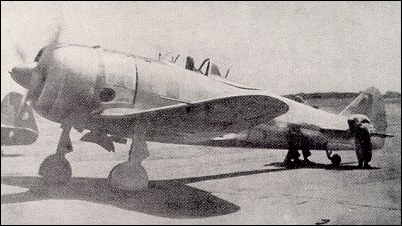
The Nakajima Ki-44 Tojo entered service in 1942. The pilots disliked the Tojo because its less maneuverable than its predecessor, the nimble Ki-43, and pilots disliked its poor visibility on the ground, its higher landing speed, and severe restrictions on maneuvering. However,the Ki-44 proved to be superior in flight tests.It was an outstanding interceptor and could match Allied types in climbs and dives, giving pilots far more flexibility in combat. And, its arnament( some versions have Ho-301,103,5 or 203 cannons) was far more deadly than the Ki-43's two 12.7mm machines guns. These make it an effective bomber destroyer and was used to intercept and destroy the B-29 Superfortresses in the last months of the war. But poor pilot training in the last part of the conflict often made them easy targets for Allied pilots. Some were used as kamikaze aircraft in the last part of the conflict. The 47th Sentai based at Narimasu airfield even used bomber collision tactics against the B-29s during the defense of Tokyo.
Ron, e-mail, 25.05.2010 09:22
Does someone know the reliability of the Ha-109 engine? I wonder when the Ha-112 was available. Like the Ha-109 it was a bomber engine. The -112 was very reliable and not so bulky. It was chosen for the successful Ki-100 Tony radial. Perhaps the Tojo's -109 predates it although they both have 1500 hp on take off. Can you imagine a Tojo with the streamlined cowl of the Ki-100? Granted, the fighter body designs are years apart. However the engines could have been of the same 'generation' since the hp was so close.
Ronald, e-mail, 16.07.2009 09:38
My favorate Shoki is the Ki 44-IIc variant with four 20-mm Ho-3 cannon. These preceeded the famous rapid fire 20-mm Ho-5 used in the Ki-44-III and subsequently on all IJA fighters. The Ho-3 was slow but had far more velocity and a much heavier shell. This would complement it's bomber interceptor role more than dog fighting other fighters. Unfortunately the bulk of Shoki production was only armed with 4 fast Ho-103 MGs (12.7-mm) favoring a dog fighter due to a denser pattern of fire but far less striking power. They say it was a worthy opponent for the P-38. If only the IJN Raiden had visibility from the cockpit like the Shoki!
ulf larsson, e-mail, 27.05.2009 22:22
Very nice aircraft,seems to me very powerful too,by judging from its nickname it must be.It must have been scary in the eyes of enemy pilots. With kindly regards.Ulf Larsson
Hiroyuki Takeuchi, e-mail, 30.01.2009 03:53
Yes. Shoki is no demon. He destroys demons. Shoki is the figure on the tiger in the painting below. http://ja.wikipedia.org/wiki/%E3%83%95%E3%82%A1%E3%82%A4%E3%83%AB:Gyosai_The_Tiger.jpg
Also, the widespread error in subtype defintion should be corrected. The IIb is armed by two 12.7mm nose guns only and could carry two 40mm cannons in the wings as "special equipment". The IIc was armed with four 12.7mm guns. No 20mm guns were ever fitted in any production Ki44s. Also, there is no evidence that the Ki44III ever got beyond the prototype stage.
Chinese-pilot, 29.12.2008 12:44
Shoki(ÄÁŘP) is a ghostbuster in the Chinese story.