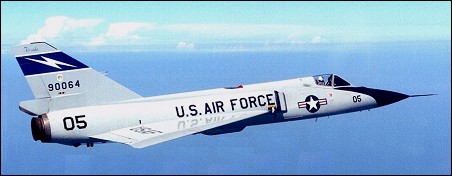
Don't know if this was mentioned in an earlier post, but while the body of the writeup states that the engine of the 106 was [correctly] the J-75 the "Specification" table states J-57.
Joe Czachorowski, e-mail, 01.01.2023 16:55
Tom, did you know about the upcoming 119FIS at ACY honoring the 6 for its 50th anniversary? They call it the Dart-In.
Zack
Darrel, 25.02.2020 05:51
Worked 106 at george 1960-1964 loved it.
Nancy Elliott, e-mail, 18.10.2016 17:40
I cut my teeth on the F-106 at K.I. Sawyer AFB in 1975. I still love that plane, there is an absolutely gorgeous one on display at Castle AFB, better paint job than the ones we used to fly. I have been an aircraft & power plant mechanic all my life, after 5 years in the AF, 16 years working for P&W in FLA, and now Tinker AFB. Many great memories of great people, and so many stories! Capt. J. crashed two 106's, the base lost a B-52 and her crew off the end of the runway at Sawyer, hours and hours spent chipping ice from grounding points, 25 deg F fuel running down my arm into my armpit, the night I saw my first C-5 on the end of the runway, and the aurora borealis. Joe's or what bar in Marquette, and the big treat, the Northwoods Supper Club. Yes we would get Coors in the missle bay, packed in with the golf clubs. A case of beer from a pilot if he messed up, or a keg if it was really bad. I still remember the 20-something bolts to be safety-wired on the variable inlet ramp, where was the new safety cable and guns when you needed them? Ah, packing a new chute right over the top of a 600 deg tailpipe, since someone popped it at the end of the runway BEFORE T/O. (That was a case of beer) Illegal run-ups on jacks in the flight line shelters, too cold to roll outside. Wild animals on the trim pad, big cats are REALLY big when you are out there alone. At Tyndall, wash, wash, wash, salt is no one's friend. Working at the R&D center for P&W, the J-75 was our slave. Literally. It ran for days on end, burning anything that would go through the pipes, stopping long enough to do a hot section, and start it back up again. We had two of them. Also while there, I worked on just about everything and anything that Pratt had, and a few things that "don't exist". The F-106 was a fantastic thrill to watch, full burner T/O at night, max climb, the visceral roar and pressure of the engine that was as old as I was. You always remember your first!
Bob Elkins, e-mail, 20.05.2016 11:56
On duty FEB'65-APR-68, 456th FIS, CAFB, flight line AWCIS tech for the Ol' Flyin' Malfunction. We were crack outfit - 2 years Aid Defense Command "A" award, 2nd place Hughes trophy one year, Pres. unit citation; set the record for 109 missions in one day. Good duty, good people, lousy climate (but better than Minot!).
JL brown jr, e-mail, 11.05.2016 19:23
Does anyone know of any old aim-4 or ATR-2A load trainers for sell
Larry Roche, e-mail, 18.05.2015 04:44
I was on another site and remembered something that had happened while I was still at Sawyer. I worked Phase Docks for a while and we did 57-2547, one of the B Models. Now, I believe it was a FCF flight they were doing but can't be quoted at 100%. I remember a bunch of people coming out as it came it including the commander. As we were waving it into the hanger, the canopy started to pop up and as it stopped, it was chocked. Suddenly the back seat pilot started to climb out of the airplane. We still had the engine running and hadn't even gotten the ladders up. The co pilot hopped down past the intake and hit the ground. He walked over by where I was and was shaking. They took off with the crew in the commanders car. What was told to us, and again, I only got what was told by the pilot to the crew chief, was they were flying at 30,000-40,000 ft. The aircraft then flipped over on its back and started down. From the explanation neither pilot could get the stick to move and they had no control what so ever. This continued on down to something like 20,000 ft or so. As quickly as it started, they regained control and headed back to base immediately. I see why they were a bit shaken up. What I have always wondered was is the story true of what the aircraft did? I know we spent a few weeks going over everything and never really found a true 100% reason. Does anyone remember this incident? I can't remember a lot of names but I would sure like to know the true story and what really happened. Anyone who knows, please either tell it here or EMail me
Larry Roche, e-mail, 16.05.2015 05:38
I was stationed at KI Sawyer from 1982 till we were deactivated. I was an Aircraft Electrician. There isn't another aircraft I've seen that gives your heart a jump like a 6 kicking in the afterburner when you were standing out on 4 row. Sound familiar? I see names in here of guys I worked with so long ago. I went to Alaska and worked 130's, 141's, KC-10's, KC-135's, HH-3's and C-5's. It took me almost a year before I could do anything on them because you could actually SEE what you were doing! How many of you remember working on things where you just stuck your hand in the hole without seeing what you were fixing? They built a lot of fighters afterwards but no one ever had that one stage after burner, or looked as sleek in the air. And if you got lucky, there would be an FCF flight and the pilot would go to the north end of the runway. Do you remember how long it was? But as it came close, he'd pull the stick back and climb into the sky !! I would LOVE to find one of those videos. Anyone knows of one, I'd sure love to hear from you.
Steve Dannahower, e-mail, 08.05.2015 06:52
Looking for info about an F106 that flamed out turning base to final for rwy 13 at Tyndall. Might be 58-0778 on July 8th, 1981, or 59-0079. Would greatly appreciate any clues. I was the controller working the tower. Always wanted to discuss with the pilot but never got the chance.
M Shapiro, e-mail, 02.04.2015 01:14
Weapons Control was too sophisticated for its time. Rarely worked @ the 329th FIS George,Afb 1960-1964 We had a lot of fun though seating and reseating black boxes.
Bill Marshall, e-mail, 30.03.2015 21:30
Worked this aircraft from 1970 to fall of 1983 as an aircraft maintenance technician-Flight controls,engine,egress,weight & balance etc at Duluth and K.I. Sawyer with the 87th FIS.Great aircraft but a lot of maintenance man hours expended per flying hour.
Rick Grebs, e-mail, 22.03.2015 21:37
Was a MA-1 mech with 49th at Griffiss from April 72 to April 76. Loved the Six and still do. Loved night launches. Does anyone recall all the canon plug replacements that had to get done. Many fond memories. A print of 028 with signatures hangs in my dining room for all to see. Missed the 2013 reunion at WP but my son, who is an A-10 Warthog IP, 357th at DM, arranged an up close and personnel touch with 787. Still one of the best aircraft ever made. My hats off to all those pilots out there that flew the Six. Fly safe. Be safe.
Jim, e-mail, 23.02.2015 05:18
I was in the Mock-up for most of my time with the Six, 6 months on Flight line. Was hoping someone has pictures of the different stands or of MA-1 door open on the bird? Thanks
Bill "Regis" Fihlman, e-mail, 22.02.2015 17:00
I joined the 102nd fighter wing at Otis in Dec. of 1969 after 4 years in the Navy as an Aircraft Electricion on the A-7 Corsair. I joined the 102nd at Otis, worked on the six and eventually became the Electric shop chief. I retired after 31 years, 20 as a full time air technician. I loved working (and partying) with Tom Baker. He knew every system on the six. Does anyone have his contact information? I would love to chat with him.
Norm Komnick, e-mail, 15.02.2015 04:11
Best plane I ever flew! And Tom Baker was the best tech who ever worked on them. The power plant was a J75-P-17' not J57.
Darrell Dunafon Jr., e-mail, 08.02.2015 20:26
MY father, Darrell Dunafon was a test pilot at Convair and recieved his Mach 2 certificate on 6-29-59 in the F-106B.
Tom Lund, e-mail, 02.02.2015 22:29
The "6" was an ageing aircraft when I checked out at Tyndall in 1973. 14 years later, I was still flying her at the 119 FIS, Atlantic City which was the last unit to fly this beautiful a/c. We celebrated the life of this wonderful fighter one weekend at ACY. Fly-bys, stories and a lot of renewed friendships were the norm. I had the honor of performing MC duties at the "Dart Out" dinner at the Showboat Casino Hotel. Over 500 people attended this last event to honor the life cycle of this grand old bird.
Leonard Musgrave, e-mail, 28.01.2015 08:22
My first duty assignment after Maintenance Officer School at Chanute AFB was with the 438th TFS at Kincheloe AFB in Upper Michigan. I was the Flight Line Maintenance Officer for the 507th Maintenance Squardon. We had 18 A's and 2 B's. It was a great mechanical airplane but the electronics were a bit of a problem. Col. Martindale was the Base Commander, Major Hartz was the 507th Commander and Major Whitford was the Maintenance Control Officer. Spent 3 years at Kicheloe and then to 389th TFS in Dang, Vietnam for F's. Left the Af in 1968 and spent the next 44 years in the oil services business.
Gary D. Eppler, e-mail, 26.01.2015 15:46
My first assignment out of A/C maintenance officers course at Rantoul, IL.was with the 27FIS, Loring AFB, ME (Brrr). Black Bart was the CC. Was OIC of FMS, OMS and Maintenance Control before going to Thailand in Dec 1968. Returned to 408th CAMS @ Kingsley Field Oregon, supporting the 460 FIS. Was the Mobility officer to relocate the 460 FIS to Grand Forks, North Dakota (Brrr again). I could talk all day about my many experiences at these locations and various TDY assignments. Great Memories - but the best ones were that cool looking A/C and the interesting people associated with it. Both of the Convair Tech Reps were great. SAC was not always the best "Host" to ADC units! God I loved that bird. Col Gary D. Eppler USAF, Retired
Paul Scott, e-mail, 05.05.2014 18:11
Excellent aircraft, would have the edge over the Mirage III series, but obviously, more expensive.
Mike Dahlke, e-mail, 26.04.2014 06:53
My dad, Gene Dahlke, was an MA-1 troop from 1960 until he retired after 22 years in the AF in 1972. Stationed at McChord, Duluth and Langley. I grew up hearing and watching the 6 and to this day I think it is one of the most beautiful aircraft ever to grace the skies. I spent my 4 years in the AF as an avionics tech on the F-111D, not nearly so gorgeous an airframe.
Bob Kusterer, e-mail, 18.02.2014 04:47
Hey Bob, I've flown your old bird. 72470 was one of our birds in the MA ANG at OTIS AFB on Cape Cod, MA. It's possible that I flew it to the bone yard at DM. My first 6 was 72466 which was dead sticked into Albany Muni after an engine failure by Tom Gorman. I gave 466 to Tom; I figured he owned it. My next 6 was 72505. Both 466 and 505 were converted to drones and shot down. Don't feel bad about your old bird being shot down; that's a much more glorious way for a proud bird to go than just being cut up for scrap.
Bob Mazzarone, e-mail, 22.01.2014 23:25
The F106 is a part of me, and will always be a part of me. I was a crew chief on 6's at McGuire AFB (539th FIS) and Dover AFB (95th FIS)from 1967-1970. I trained at Sheppard in 1966 on the F100 and F102 but when I saw the 106 there was nothing as beautiful either on the ground or in the sky. My bird was 72470 in McGuire and 72501 at Dover, both 1957 builds. Sadly, both met their demise as drones but its better than being home for fish, which they probably are anyway in a manner of speaking! Today there is a fully preserved and functional 6 at Dover AFB on the very ground that the 95th utilized back in the 60's and 70's. It's a 59 model but it bears the 95th markings (Mr. Bones) and actually served with the 95th back in the 70's. I'm a frequent visitor as it resides in the AMC museum that now occupies the old hangar and flightline. I spent many cold and hot days and nights on these planes and never regretted a minute of it. The F106...gone but not forgotten!
Merrill Eastcott, e-mail, 20.12.2013 01:45
Just found this site. Greatly enjoyed reading all comments back to 2008 and recognized many names. I was A-Flight commander flying the Dart at Minot AFB 75-79. The sign over the main gate said, "Only the best come north." I actually came south to get to Minot as I was in Thule, Greenland the year before! I then flew the Dart at Tyndall AFB for two more years, first as Ops Officer of 2FITS, then commander. One of my prized possessions is a 2' x 3' water color of the "6" painted by Kathleen Ritter, the wife of one of our squadron pilots. Another treasure is a 3-d model of the F-106 cast entirely in stained glass, also created by a squadron member. Both are displayed prominently in my home office. As many have mentioned, the Dart was a magnificent machine for its day and it is a shame that most aviation museums do not even have one or aren't aware that it still to this day holds the world's single engine jet speed record. While at Minot I was the squadron maintenance test pilot and have flown more maximum Mach runs than I can count, all above M2. The kit plane industry has matured to the point where there are many sophisticated kits on the market, especially of some war birds such as the P-51. Sure which someone would offer a 50 or 60% F-106 replica kit!! I'd mortgage the house and kids to get my hands on one.
rob gondek, e-mail, 11.11.2013 19:16
I worked MA-1 at Sawyer till 1979, I remember you Bob Serfas. I didn't go to Iceland, I was working Maintenance Control then. After they were deactivated, I went to ILL where they were being outfitted for Drone use. I missed seeing Col. Wotring by one day
Bob Kusterer, e-mail, 18.09.2013 07:32
I flew the F-106 with the MA ANG for 14 years logging 2500 hours in it. I knew Tom Baker when he was there as AF advisor (Hi Tom). Really sweet flying bird but should have had better missiles. I flew a few to the bone yard at DM. My airplane, 572505, was converted to a drone and shot down; a much better demise for a proud bird than being scrapped.
Larry Vargo, e-mail, 29.08.2013 06:06
Remember living in a coal-mining town in south-east Ohio and watching the AF doing flight tests/intercepts right overhead. In those days (late 50's) contrails meant military planes exclusively. And it was quite a show! Even the occasional sonic boom was entertaining. Focussing a telescope upon the end of a contrail revealed a delta-winged shape speeding through the sky. In 1965 my first active-duty assignment was with the 1st A&E at Selfridge AFB MI as AFSC 30130 (radio mechanic). I was only there about a year due to the Vietnam War but it was a fantastic futuristic ship, looking much like the spacehips I'd seen on tv shows. But this was real; only now instead of watching from afar via optics, I was one of the ground crew keeping it flying over our planet. I recently retired from the reserves and the airlines but have always felt privileged to have such a high-flying (sorry) career in the aviation/electronic fields....two of the leading high-tech fields of the 20th century.
Bud Gorman, e-mail, 20.04.2013 08:43
Worked the MA-1 system. 69 to 71 at Duluth, 87th FIS., 71 at K.I. Sawyer and last 6 months at Homestead AFB, Florida, Det 2 for Langley if I remember right. Then in the ANG. 72-73 at Otis ANGB Mass. And on to Selfridge 73-78. What a great bird. And a ride in F 106B 900150 on my last day. A good end to a cut short career.
Lynn Ford, e-mail, 28.03.2013 02:50
I was a MA-1 Weenie at Paine Field and was assigned to repair 59-009 Balls Nine after it had crashed at Paine. The right main gear drag strut broke and when Capt L set down the nose gear collapsed as it went off runway. I watched it fly again days before discharge! Loved those sixes.
Dick Venters (MSGT retired), e-mail, 16.12.2012 23:51
My first real AF assignment was with the 329th FIS, George AFB, Calif.I was an Instrument repairman and 'volunteered missle' loader for the 13 months at George. I retired in 2004 after 26 yrs USAF service. My last station was the 49 TFW, Kirtland AFB, NM working on A-7's then F-16's/w/FLIR. I got see places all over the world, North Africa, Turkey, Italy, Panama, and many other places too many to mention. The F-106 was my favorite A/C and best people I ever worked with.OOORAH to all you all..excellent memories and friends throughout my career.
Ken Wigton, e-mail, 04.12.2012 03:03
To all F-106 troops, maintenance, pilots and interested folks: There is an upcoming all F-106 reunion at Wright Patterson AFB September 11-15, 2013. Open to all and any folks connected in any way to the 106. Contact kwigton@comcast.net or Bob Kwiecinski bobski9933@aol.com
Tom Baker (MSgt. Ret.), e-mail, 03.11.2012 19:34
Best aircraft I ever had the pleasure to work on. I had 16 years on the 6 starting in 1963 with the 498th, Geiger Field, then to McChord with the 318th. After a year in Thailand it was on to the 27th and 83rd in Lorning. Next was three years with the Mass. ANG on Cape Cod as an Air Force Advisor. After 17 months in England it was back to McChord for my last three years until I retired in 1980. I was lucky to have several rides in the 6 with one being a Mach 2 flight in 1965 over Puget Sound WA. Best of the best.
I was a SAGE winnie at Duluth Sector 61 to 65 and knew all the 6 drivers during the time. L/C Kuppersmith was sq cmdr during the time, does any of you fromer drivers know cpt Granville Anderson, Howard Bell where abouts, both were flight cmdrs and IP's. I am not sure what type bird Anderson flew before Duluth, Bell had flown duces in the Netherlands prior. Col Morris Petty our base commanders lost his life in 6 north of Superior @ 63, The WWII ace Coilonel Harry Thyng was sector commander and was qualified with everything assigned to the base. A young Lt we called "Tailpipe" Walters whom was first class zoomie grad was in charge of all classified matters at the KAK Codes for penetrating the ADIZ. The Red Bulls also had Lt Win E. DePorter who happen to be the first to eject from a 6 during a ops hope to Minot 5FIS, I ran into him again when he was flying Spads in RVN out of Pleiku. The Red Bull were were big party dawgs and regularily upset the O Club, in fact the put the sq commanders Volks Bug on top of the club one night when they had a big beach comer that was 20 below outside. I use to be the off duty chef in the club and done the bartender trick there for several years. I will never forget what it was like when we were notified of the Cuba Crisis, of my 3 combat tours in RVN I never had fear like I did the morning the Senior Director (Colonel Dan Wolf) broke the new during the day shift briefing. I am in my 70's at 100% disable and still member how to control them 6's, I have several pictures of the original Red Bull birds taken by the base photo lab, o yeah, I was on the flight line when that 38 went down on TO trying to beat the weather window, the student pilot was from Duluth and his IP was from Superior. The Dart's will always be on my watch.
Manny Rodriguez, e-mail, 18.10.2012 06:49
I was a member of the 539FIS from mid 1956 to late 1959. First with the F86D/L and then as a test force squadron for the F106. I'm interested in communicating with a name I see here, Rich Rispoli I'm a senior tech with Delta Airlines , and one of my mechanics Is a Joe Risploi, any relation? It sure would be nice to tell Joe Rich and I served in the same outfit.
joe bush, e-mail, 26.09.2012 18:47
I also was assigned to the 319th at bunker hill arrived there around sept 1962 and went to selfridge. i was in what they called back then mechanical accessories and our shop was in a small corner of the engine shop. i spent 120 days tdy at clark,pi working on the f-102 until permanent duty personnel was reassigned to the shop.
Richard "Hooter" Huth Sr. USAF, e-mail, 12.08.2012 04:52
The F-106 was my first jet at 84th FIS Castle AFB Ca. till '75 then back from a year in Korea was stationed in the 87th FIS @ KI Sawyer AFB, Mi from '76 to '84. Was a Crew Cheif. I spent have my career on the F-106 I knew that jet very well and enjoyed workin on it most of the time!! Its a beautiful jet!!
Richard Rispoli, e-mail, 11.02.2012 20:15
I was in 539th FIS, MvGuire,1964-1966, Hydraulic Mech. I helped replace a wing on a bird that was in a mid air collision, it landed at a Air National Guard Base in Atlantic City or Asbeury Park, can't remember which one. Looking for old buddies from 539th or 64th
alvin cales, e-mail, 24.12.2011 16:52
I was at Minot AFB, North DAkota from 1959 until July 61 assigned to the 5th Fighter Interceptor Sq. . I was a Jet Engine Mechanic and helped set up a Jet Engine Test cell for the Pratt & Whitney J- 75 Engine that was installed in the F- 106. It was a very powerful engine..I believe it's normal thrust was around 17,000 lbs. but in extremely cold weather it put out a lot more than it's rated thrust. Was at Minot 22 months and had 2 children born there.. cold weather is a bitch.
Bob Serfas, e-mail, 21.12.2011 19:06
I was stationed at KI Sawyer with the 87th FIS, was an instrument tech, 8 years. Loved this aircraft for it's beauty,still the sharpest aircraft ever though tough to work on, some pretty cramped places on that bird. I remember Dick Stultz and his nose art, did the "William Tell" shoot off in 1976 at Tyndall, great time. I cried when the "droned" all the sixes, pitiful end to a storied career. I also was on the ICELAND deployment ! anyone else remember that one? I was born in Marquette, had the privelage to be stationed at KI, miss the sounds and smell of the aircraft in the air over town. Thanks for the nice webpage.
Bob "SURF" Serfas, ex Tsgt (not retired)
Jack Krause, e-mail, 12.09.2011 03:30
Established the first formal F-106 pilot's ground school at Tyndall in 1965. 600 hours. Hit Mach 2 on tests 65 times according to my log. Flew the bird at McGuire, Tyndall, Loring and McChord. Great, great machine.
Bob Steger, e-mail, 15.07.2011 04:41
Anyone out there that was with F106 test program at Holloman AFB 1956-1962?
Dave Hanthorn, e-mail, 06.07.2011 10:17
I was with the 318th (as a tech on the MA-1 system) when we made that historic little camping trip to Osan, Korea in February of 1968. The "six" was the coolest aircraft in the sky, and we had some wild adventures (most were classified back then) and good times and bad, but its was an experience I wouldn't trade for anything looking back on it (though I wasn't always so happy at the time). Worked with some really good people (and the few inevitable assholes). Haven't had any contact with any of those guys since then, but would love to trade a few lies and a few beers if I should ever meet up with any of them again. Thanks for this website, the memories have been flooding back.
Fred Robson, e-mail, 27.06.2011 19:30
Anybody out there who was in Minot N.D. with the 5th FIS from 1966-68? I was crew chief on 90026 and spent many cold days and nights on that great bird!
Jim McNamara, e-mail, 24.06.2011 22:30
Flew the 106 at Duluth, the 11th FIS, (after checkout at Tyndall) for two and 1/2 years, 1964, 65 and 66. The original Red Bulls. The squadron moved in the late 60's or early 70's and became the 87th. It flew as great as it looked. Went to Tyndall and some of us got fitted in pressure suits that they said were similar to the ones used in the Gemini program. Had a little cooler box and all. We ran on U-2's at 65,000 feet. We were at 60,000. Accelerate to 1.8 mach at about 37,000, then climb at 1.8. The missle firing range at that altitude was 8 miles. And we were not to fly past the U-2. They feared the shock wave from the 106 would flame them out, and might have done some structural damage. Not sure. We also ran quartering head on passes on one of our guys in a Six. He was at 65,000. What a closure rate. 2500 knots or so. And the MA-1 fire control system worked great. Some times I don't think we appreciated just what we were doing at the time. Sure savor the memories. And the fellow pilots and the terrific maintainers. Pretty high tech. As you can see from what Mike is saying, below. I sure never needed to know that much about the system. And the SAGE hook up really worked. We called it auto/auto. Meaning auto pilot and auto track. The system took us out to the target, through the intercept and break away, and back to home base. picked up the ILS. Took over at 100 feet or so. Slick!! Great to have had the opportunity.
Gene Leary, e-mail, 05.05.2011 06:35
This was my Father's favorite aircraft. He always had stories from when he was flying the "6". He has since passed and I was wondering if there were any former pilots or crew that would have any pictures of him and his "6". He would have been a Capt (Bill Leary) at the time (mid to late '70's? I think) and flew with the 87th FIS Red Bulls out of K.I. Sawyer, MI. Any info would be appreciated (I've been looking on the Delta Dart forums as well, with no success. Thanks.
mary hartley, e-mail, 28.04.2011 19:59
how does it fly so high ?
Robert N. Mazzarone, e-mail, 07.04.2011 22:48
I worked on 6's from 1967-1970. I was in the 539th FIS at McGuire AFB right after tech school and then went to Dover when the 539th was consolidated into the 95th. I have nothing but good things to report about this beautiful airplane and it pains me so much to see that they're all but gone. I spent 2 1/2 years of my life at DAFB and they were most enjoyable. Fortunately for me, I now live in Delaware and often visit the AMC Museum there, to which I am now a member of the ground crew, to visit a lone F-106A that was actually a 95th bird and still wears the 'Mr. Bones" paint scheme. The 90023, a 1959 model was after my time there, but it gives me chills to look up at that tail and see that logo, on the grounds that I walked for 2 1/2 years back in the late sixties. It's so hard to believe that the 106 is obsolete and all but gone.....my heart goes out to tail numbers 72470, 72501, and 72499.....
Dave Simon, e-mail, 04.04.2011 06:36
Worked in the F-106 Flight Simulator Section at MANG. Got a ride once in the F-106B. What a blast. Glad that there are many of you keeping the six dream alive through forums like this and at f-106deltadart.com
Dave Simon Captain Citation 560XL (C56XL), Embraer Phenom 100 (EMB500) Million Air Salt Lake City, UT MANG 1979-1984 E-5 AFSC 34154
Paul J Grignot Jr, e-mail, 24.03.2011 22:43
3500 hrs of my 6927 fighter hours were in this fantasitic Machine. I flew the F-106 for 13 years in the USAF and an additional 7+ years as a Manned Drone (QF-106) at Tyndall & Holloman AFB's. With my years in the AF and 21 years as a Contractor Pilot to the AF i was blessed to fly the Dart for over 20 years!! A big mistake in not building more. When her life was finished as a Drone there were 4 fully operational A/C left. 3 A's and 1 B; all modified as Drones but the mod was transparent when flown manned. Myself and another, Major Barry Brannon took them Back to DM in Tucson on two different trips from Tyndall AFB clean to Kelly the on to DM. (one still has my name on her). I patted her Good-bye and i am not afraid to admit there were TEARS in my eyes. On my Last and the F-106's last FCF for the time in February 98 she still made Mach 1.95 and accelerating (ran out of airspace). An amazing A/C and a true joy to fly; Tactically (she more than held her own DOG fighting even against the F-15, if properly flown; as an interceptor she could handle any ECCM thrown at her. With the Gatling Gun internal center bay mounted she was unbelieveably leathal. Drone wise she was( moded to carry so many things that would have made her a greater operational A/C. Flares, Ecm pods, Tow real etc, Bombs (believe it or not) Aim 9 and many classified external and with her large internal weapons bay, many internal special stores. With the J-75 and at altitude 37 to 39K she would bump up against the Mach .99 at cruise power. SOme straigher A/C (not 787) the 106 would actually stay above the Mach for several minutes in Military power decelerating from Supper sonic. Not supper cruise as it is today but still amazing for the Time and A/C available. With ext tanks she could go for more than 3 hours.. I once did RG (Richard Gabor-spelling) to Edwards AFB 3.3 hours & With Air refueling, of course, unlimited. At 4000 lbs of fuel on board she was 1 to 1 thrust ratio; for a 50's designed A/C that was/is amazing. As you can tell, i loved the Dart and consider myself one of the most lucky/blessed person's in the world to have flown her for 20+ years... As a side note, i had the privilige of being dual current for about 1 1/2 years when the 106 was a drone. I Flew the QF-4 at that time ( the new Drone). I would Depart at 0800 & Two hop the F-4 from Tyndall AFB to Tinker AFB(Centerline Tank) and then to Holloman AFB and then Come back to Tyndall AFB one hop in the 106. 3 sortie legal day. Best i ever did was 1.6 hours FAA direct HMN to--> (straight in to Runway 13 at Tyndall. Any questions email me... at--> p.grignot@yahoo.com
Capt. Chuck KEndrick, e-mail, 23.02.2011 14:05
I FLEW THE F=106 WITH THE 1ST FIGHTER WING (71 FIS) ,AFTER RETURNING FROM TOUR WITH MAAG IN VIETNAM IN 1963. THE "DART" WAS A WONDERFUL A/C TO FLY VERY LIGHT ON THE CONTROLS AND VERY FAST! WE FLEW THE AIRCRAFT CLEAN EXCEPT FOR FERRY FLIGHTS TO ALASKA AND ALERT BIRDS. WE TOOK THE SIX TO ALASKA IN 1963 FOR ROTATIONAL ALERT WITH THE ALASKAN AIR COMMAND. THE A/C REALLY PERFORMED IN THE COLD WX! ON A NIGHT FLIGHT OUT OF SELFRIDGE AFB EXPERIENCED TOTAL ELECTRICAL FAILURE WHEN I RETRACTED THE GEAR ON T/O, I JOINED UP ON CAPT. TERRY STEWARTS WING AND MAKE A FORMATION NO INSTRUMENT/RADIO LANDING ON CAPT. TERRY STEWARTS WING. ON ANOTHER NIGHT T/O I EXPERIENCED A FIRE ON ROTATION , SPIKED THE A/C BACK ON THE RUNWAY AND "TOOK" THE BARRIER AT 175KTS. NO DAMAGE TO THE AIRCRAFT. EXCITING TIMES. I LEFT THE AIR FORCE AND FLEW FOR 40+ YEARS AND THE F-106 IS STILL MY FAVORITE AIRCRAFT. MAYBE IT WAS AT THAT TIME OF MY LIFE , SOME GREAT MEMORIES.
John Lingrel, e-mail, 05.02.2011 13:22
I worked on the Dart Comm/Nav and Data Link systems at KI Saywer (87 FIS Red Bulls) from 73 to 76. Have a lot of fond memories of the 106 and the people I worked and played with there. One of the best assignments I had in the Air Force
Bill Longbrake, e-mail, 30.12.2010 00:30
The only corrections I want to make on the stories above, are when I worked on F-106's at McChord in 1962-1963, they had P&W J-75's in them,not J57's. In 1964 and 1965 I was in Vietnam, and mostly at Danang. We flew F-102's out of there in support of the South Vietnam A.F. We never had 106's in Nam. At McChord I was in the 325th FMS, and overseas I was in the 405th FMS out of Clark Field in the Philippines. Great stories..
Steve Sirois, e-mail, 29.12.2010 03:29
Flew the Six with 125th FG JAX for 10 years until knocked out of fighters by kidney stones. They didn't call it the Cadillac of fighters for nothing. To say she was smooth is an understatement. I could rest my right elbow on my knee and literally fly that beauty with two fingers...until it came time to "turn and burn". Yes, she was fast. Mach 2+ was neat, but used a sh*tload of gas and you had to RTB pretty soon after getting there. Glad we never had to use the AIR2a (Nuke) but firing the ATR was pretty cool. Very large "THUMP" under you butt when that baby lit. I also flew the Deuce (F-102) for 3 years and I think that the Deuce and Six were the only fighters that had IRSTS (IR Search and Track System) back then. Cool thing about IRSTS on the Six was that you could have IR lockon while the radar would continue to search, although I think the radar search in that mode was narrow? I made IR lockon to Space Shuttle from 300 miles away. Anyway...26 years later, I can still close my eyes and see, hear, feel, and smell that incredible airplane. The only thing I didn't like was waking up in the middle of the night thinking I had gone deaf. In the Six, we breathed 100% oxygen under pressure which would force it into the inner ear. If you didn't valsalva a bunch following flight to clear that out, the pressure would build enough while you were asleep to deafen you until you woke up and did valsalva. When I look back on those days I sometime ask myself if I really did that. The answer always comes back..Yup! - Steve Sirois
David Hunt, e-mail, 10.12.2010 17:13
I was stationed with the 319th FIS at Bunker Hill AFB, Peru, Indiana(was renamed Grissom AFB)August,1961 thru approx. June 1963. I recently visited a Air Force Museum now at Grissom and found that they have very few items to display concerning the 319th FIS or the F-106. The gentleman that is in charge of the museum says there is very little memorabilia available. If any body out there has some items to share with the museum, I am sure he would be interested in obtaining them.
My time at the 319th was the best part of my 4 years in the Air Force and I loved my work on the aircraft as a Jet Engine Mechanic. I was reassigned to Selfridge AFB, Michigan along with several of the F-106's when the 319th discontinued activity on Bunker Hill. I am not sure where the 319th went to but I am pretty sure it was not dissolved at the point-in-time.
Bill Jowett, e-mail, 15.11.2010 09:32
The sweetest airplane I ever flew and that includes the F-4. Flew out of Oxnard and Kingsley with the 460th FIS. Flying ACT with the Navy was an education. ADC was great.
Jay W. Hill, e-mail, 09.11.2010 18:41
Good morning
As a long time radar technicial on teh F-106 Delta Dart...and actually one of the three names on tghe decals fro the 102FW...I love all these stories. I also know and have known since 1970 the most famous, most hours ever flown, polot of the 106's...retired Col Chuck Townsend. What a great aircraft...what terrifc memoires..thank you for these stories ...J
Jim Brown, e-mail, 21.10.2010 03:47
I am trying to help a very good friend find out what happened to her father. He was killed flying the F-106 in a training accident. If anyone out there can help find out infomation on this accident I would be greatly appreciated. He died in an F-106 that had taken off from Tyndal AFB 10-16-68 the tail number was 57-2526 and the pilot was Major Richard T. Gleeson.
Thanks for any help!!! Jim Brown topgunswa@hotmail.com
elrod, e-mail, 15.10.2010 20:07
Anybody know of anyone born after 8 Feb 60 who was MR in the 6? Just curious.
Lloyd Miller, e-mail, 25.08.2010 22:19
I enjoyed reading all the nice comments about the F-106 which bring back many fond memories of my participation in the program. Fresh out of school, I joined Convair and was assigned to the Hydraulics Design Group where I was put in charge of the hydraulic system component installations in the prototype aircraft. I went with the prototype aircraft to Edwards to represent the design group and soon after, transferred to the Flight Test Group there. I was the Control Engineer on the F-106 that was used for the world speed record runs at Edwards Air Force Base. The official record speed was 1525.95 mph (Mach 2.42). During the trials leading up to the run it was discovered the reason for the lack of performance of the aircraft was due to a fault in the afterburner fuel control schedule which limited fuel flow (thrust) in AB at altitude. As a result, Convair Recovered the performance penalty assessed by the AF. Sometime during the service time of the aircraft, the engine trim was reduced to extend engine life. I also was involved in the 'after market' air-to-air refueling installation and test, and the "six shooter" M61A1 20mm cannon installation and test. It was a great bird and I am proud to have been part of a great test crew and organization to help put it in service.
BTS, e-mail, 25.06.2010 10:43
What a smooth aircraft. Spent 6 years in the Dart with MANG. Mach 2+ was an absolute cakewalk. Trained with the Genie system (lob an unguided air-to-air nuke at the blips flying over the polar cap toward America, flip an Immelmann, pray your gas lasted until you could ditch in the woods instead of the water or ice). Simply the smoothest bird I have flown (have 11 airframes to my credit).
Still, without a doubt, the sexiest outline on any military bird. Designating them a Q-bird is a sin.
Aric johnson, e-mail, 19.02.2010 07:27
I flew the "six" at McChord (318FIS) from 1972-1975. What a great jet to fly. Lots of power and smooth controls. It was also very nice to fly in formation. We used to make night formation landings until some Guard fella flipped one over on landing. I flew the F-4 and F-5, but my best memories are of flying the "six". Air Defense Command "ADC" was great.
Mike, e-mail, 09.02.2010 09:04
the rest of AMTI The MA-1 in the early days had a Coherent On Receive Only (CORO) to display low altitude and "low" overtake targets in the ground clutter. This was totally an analog radar function-no inputs or computations from the digital computer. This mode was activated with 4 and 16 mi range sweep selections and then selecting "Clutter" (fully CW position) on the adjacent rotary switch. This activated the Airborne Moving Target Indicator mode which used a 0.25 usec pulse width at 4000 Hz [still within range non-ambiguity]. A transmitted sample of each pulse was used to get an indication of Doppler return of each pulse to "see" low or zero relative velocities in the "faster" [aircraft speed] continuously changing ground clutter Doppler. There was no computation of "Doppler" speeds, either target or ground clutter, to do blanking [of ground clutter from A/C velocity] or enhacement. It was totally analog video that would be enhanced from the Doppler spectra of a target at speeds not far removed from the interceptor speed in the underlaying ground clutter. If a lock-on could be established the Automatic Gain Control function would allow tracking on a reasonably sized target. The system had to revert to the 0.5 usec, 1000Hz pulse width and PRF for lock on and tracking. The alignment procedure and test equipment to maintain this feature was extensive and time consuming. However, as the "Radar" crew chief for F-106 58-0759 of the 1st Fighter Wing in 1961, I had a pilot tell me after a flight that he actually did pick out a target using this mode. The stability of the 0.25 usec pulse width was questionable in that portion of the transmitter Pulse Forming Network (PFN) and this mode fell into disuse as it was not so much the prime mission of interception (low altitude big bombers) of the day. The 464150 video unit and the 464425 4KHz generator were later removed from the Radar rack to provide space for the later Infra Red and silent lobing antenna modifications.
Mike, e-mail, 09.02.2010 08:04
A little more detail as to the attack geometry of intercept might further explain the employment.The geometry is called "Lead Collision" which might possibly end up as Lead Pursuit depending upon the relative actions/flight paths of the target [X] and the interceptor [I]. The terms used in calculating the geometry are: V = velocity of interceptor [from air data, Mach, Stagnation Temperature (non-moving air temperature local to interceptor); R = Range to target from radar locked on; T = time to armament intercept of target, i.e., time calculated from now until the weapon (missile/rocket) impacts the target; t^f (subscripts don't work well in the message) called t sub f which is the calculated value of weapon "time of flight" from launch until target impact; F (commonly called F - Pole), a distance where the interceptor would be from the target if it continues its flight path at weapon impact, i.e. when T = "0". F and t^f are calculated from parameters of air density (altitude), overtake R dot (rate of closure on target from changing radar Range [R], missile/rocket motor performance profile, missile auto-pilot functions and the known air data and target data for this particular intercept. Note that geometry is continuously calculated in the older analog computer radar systems - Hughes E- through MG- series for F-86D/L, F-89D/H/J, F-94C, F-101B/F, and F/TF-102A and cyclically during the digital computer attack cycle of the F-106A/B [MA-1/ASQ-25 integrated weapons control systems. The Time-to-Go till launch, displayed by a collapsing circle on the Radar scope display, is caluclated as T - t^f and when = "0", the armament leaves the Interceptor.
I__________________R____________________ X - - T-t^f = "0" - I__V (t^f ) __ I__________F _______- T="0" "X" _______Missile/Rocket travel______
In the analog systems "F" was referred to as "relative armament velocity" which was apparently F/t^f, a velocity term. Rocket/Missile motor "profiles" for an "average" velocity, given a required end point (or impact) velocity, can be adjusted for air density (altitude) and time-of-flight to meet this need. Since the armament is imparted with the Interceptor velocity [V] at launch, the term V + F/t^f provides the relative armament velocity at launch and then multiplying by T, [(V + F/t^f) x T where T=t^f and T - t^f = "0", i.e., launch time], yields the prescribe (total) Missile/Rocket distance for this intercept. The simple "collision" course is where the Range [R] - T (time to impact) x V = 0, i.e., the Range to target = the distance the interceptor travels over time-to impact, or R=0 as T=0. Since we desire the armament to do the colliding (as opposed to the Interceptor), we set the collision equation R -VT = (V+F/t^f)t^f, the "lead" or armament distance to collision. Solving this equation where T = time to go to launch (T-t^f) yields R - VT + Vt^f = Vt^f + F or R = VT + F. Multiplying through by T yields RT = (VT + F) x T, or T [to weapons impact] = RT/(VT + F). This can be seen as an iterative process for exact (almost-depending on cycle time vs changing V and R or t^f) solution. The earlier analog MG systems used a collasping Range circle display and the R = VT + F formulated as R = V + F/t^f (where T=t^f) as the R [Range] solution to launch (even though not dimensionally correct and F/t^f generally constant for a given intercept profile). Interestingly enough, the F-106 had a "small" x [11/2" legs] for missile launch which stayed on the display until t^f expired, i.e., T=0 or impact [needed to continue tracking for radar missiles] and a large X [3" legs] for the MB-1 rocket to indicate the pullout. This was later changed to the "8 ball" but some "older" troops still talk about getting the "Big X" meaning "get the h*** outta here"
The MA-1 in the early days had a Coherent On Receive Only (CORO) to display low altitude and "low" overtake targets in the ground clutter. This was totally an analog radar function-no inputs or computations from the digital computer. This mode was activated with 4 and 16 mi range sweep selections and then selecting "Clutter" (fully CW position) on the adjacent rotary switch. This activated the Airborne Moving Target Indicator mode which used a 0.25 usec pulse width at 4000 Hz [still within range non-ambiguity]. A transmitted sample o ...
Gary Shepard, e-mail, 09.02.2010 06:56
Most of my 3,500 hours flying fighters was in the DART. I'd like to mention a few unique items about the bird. In its day, it was cats meow. It came off the assembly line with arearule "cokebottle" shape, had a computer, carried a "great Shot" AIR@A NUKE, with four pathetic PUTT PUTT missiles. The IR missile would hit a cigar. You could lock-on to an SR-71s heat at 400nm with the IRSTS (Infrared search and track system, and the aircraft didn't know that it carried external tanks because they were designed so well. A pilot trained in the bird, got used to its moods and abilities, and when loaded with the "GReat Shot" and four missiles, lo and behold, it remained the same aircraft that one had trained in. Once the tanks went dry, you could climb to 49,000 and just go, go, go. You'd throttle back to .9 and you'd make gas. Around 4,000lbs of fuel on board you'd be burning 2,400 lbs. per hour. You could fly it for four hours w/o refueling.Stultz should clarify that the Coors was in 16oz. cans. Once you got the fuel out of the drop tanks
Steve, e-mail, 08.02.2010 22:47
Anybody Crew the F-106 @ Castle AFB 79-81? 84th FIS. This was my first assignment of 22 more years in the AF and I still believe it was one of the best airplanes I worked on, and one of the most enjoyable.
Bill Moore, e-mail, 03.02.2010 05:00
Spent 5 years in the 6. 3 years flying the "tapes" @ Minot & 2 yeards in the "clocks" @ Dover. What a great bird! Had the pleasure of actually living the "there I was at 50,000; flat on my back; and the engine quit. It was my second solo flight (T-2) and my chase pilot was Sandy Scovell. Got it started at 20,000 and kept it running by holding the ignition button down. (Would flame out upon release) A/C # 59003 which later carried name of Lt. Moore. Thanks to then Lt/Col Jack Broughton, after 3 years in the Minot refrigerator, transfered to the 59th @ GOOSE for 15 months in the "DUCE" where I met & married my first and present wife. Then back to 95th @ Dover for the "Clocks". Spent 3 years @ Suffolk '56 -59 in 5th FIS prior to Minot. About 10 years in the "DELTAS" was as good as it gets! To turn on a dime take the Dart, for 2.3 take the DAGGER. What a kick those "DRY MARTINI" missions were out of Minot. Flew 4 and had 3 kills on the B-58.
John T. Beckman, III., e-mail, 03.02.2010 01:39
I have tried for so long to buy videos (DVD or if not then VHS) of this awesome aircraft and have come up with zip! Can someone please help me get one or more videos of the F-106 DVD or VHS if not able to be DVD for good prices, ok? Please contact me ASAP please! jt_beckman@hotmail.com my mailing address is: John T. Beckman, III. at 3722 Walton Way Ext. Apartment #226, Augusta, Georgia, 30907 and my phone is 706-650-1080. Thank you!!
roger d tarr, e-mail, 30.01.2010 04:24
the six and i flew together for 1400 hours with the 498th @ Mcchord and Paine and 27th & 83rd @ Loring.I carried a Honda 90 in the armament bay from Boise to Paine without damage to anything. What an awesome airplane to fly.
Mike Leech, e-mail, 27.01.2010 18:52
While working on the trim pad(near the EOR) with the A-10A at Davis-Monthan from '81-'83, we would stop what we were doing to watch the 5TH FIS birds lite the burner and rotate back to Minot. Their paint scheme is beautiful.
Jeff Coon, e-mail, 18.01.2010 17:22
I was with the 49Th FIS at Griffiss AFB NY from Jan 81 to Feb 83. One of the best assignments of my career. My first flight in any jet was in a "B" model from the Grif to Loring AFB Maine in what was dubbed Operation Potato Flag. The Grifs runway was closing for two weeks for resurfacing so we sent six Darts and a Tweet to Loring. While I flew up in the Dart, Eddie flew up in the T-33. While there we both got flights in the 33 on "target" missions for the Darts. We swapped for the return flights. On the way inbound I was lucky enough to involved in a 1v1 intercept. What a trip! My pilot, (then)Capt Jack Barton. I believe the intercept was against (then) Capt Joe May, not sure. I believe the commander at that time was "Twitch" Worrell (sp). My next assignment was the 57th FIS at Keflavik Iceland. I sure did love serving in FIS's.
On a side note, I was selected to serve with Det 1, 82nd ATRS at Holloman in 1989 where i helped establish the training requirements for contractors who would be maintaining the QF-106 Drones from 1990 till they were gone (although i left for Pusan Korea in 1995). The QF-106 on display at Hollomans Heritage Park is the second production model -106 made (the first was shot down at Holloman). I saw my own jet, 080, at the East Alton IL airport where the conversion were being done and was near tears when i came back 3 months later and the contractor had found out it was my jet and put my name and my 49th years on the nose door. Pretty upset after Tyndal promised it would be sent to Holloman and then shot it down on a mission there. I think the Dart was the Cadilac of tactical jets, personal opinion, but sure was a beauty.
Bob Krischel, e-mail, 12.01.2010 08:50
Went from the 86-D to the F106. First in Selfridge, Mich and then to Tyndall AFB and finally to Malmstrom AFB, MT. Got my first ride While in Florida. At that time the best F106 pilot in the AF. Had several rides in the F106. Never did make it to mach 2. The best ride was my last on in Montana. This pilot was the best f-106 pilot in the MANG and at that time the AF. Flight of 4, we were the target and I might add an advasive target. I don't think we ever did get shot down. Then one of the other airplanes was the target, so we got to try our luck in shooting him down. The pilot got locked on and he asked me how I was doing. I told him "Go get him babe, go get him." Well we did get him. That was by far the best flight I had ever had. I worked on the MA-1 system. Lots-o-fun. The guard changed that. After they deactavited the 71st FIS. The MANG transitioned from the F-102 to the F-106. They worked with us at Malmstrom and trained with our guys. We had vertical instruments, but the guard had to take the "round eyes." The MANG set all kinds of records, primarly because of the outstanding training they got from the regulars at Malmstrom. I think we went from the 71st to the 319th before they finally deactavited us. I got to stay with the MANG as an advisor. I was supposed to stay with them until I retired, but with less then a year to go they decided they needed me a "why not." Lovely place, yuk.
Jim Muirhead, e-mail, 03.12.2009 03:57
I was a Hughes Aircraft Company field engineer (techrep)on the MA-1 system from Jan. 1962 until July, 1968. I spent two years with the 27FIS at Loring AFB, two years with the 11FIS at Duluth AFB, MN and 18 months with 1stAFHQ (1AFMME), Stewart AFB, NY. Besides working the line at the FISs, I taught the MA-1 system to the newer techs in the squadron three times at the 212A FTD. I think I learned more than my students.
There is a lot of BS around regarding MA-1. Basically, all the MA-1 (touted as having the first airborne digital computer)really did was to calculate the steering solutions for the NAV and Attack modes and display the solutions on the radar scope and the TSD (Tactical Situation Display). The weapon selected in Attack (AIM-4F or G or the MB1), determined the tactics used. The object was to keep the steering error at zero. In attack mode the computer calculated a term, RT/VT+F, (R=range to tgt; T=time to fire; V=closing velocity; F=calculated missile flight distance.) that converted Radar angular tracking errors into steering error. In any flight mode below Auto, the pilot had to keep the error dot on the radar scope centered in a small circle with 1/10 the angular sensitivity (fine and coarse sensitivity). The computer initiated the fire signal which was interlocked through the trigger switch on the left control handle.
It is interesting to note that when firing the MB1 Genie, a figure 8 was displayed on the radar scope...telling the pilot to execute a 135 degree roll and execute a high g pullout to put the intercept point behind him so as to shield him from the nuclear explosion. T
In NAV mode, the pilot selected waypoints over precalculated routes. The routes were copied onto the computer drum from punch tapes supplied from an outfit in St. Louis. The computer would use Nav data from the TACAN receiver to determine Lat and Long. The pilot would select the waypoints. in the proper order and the computer would calculate the direction to fly. Speed and altitude commands were displayed on the panel instruments and the pilot either select altitude hold, heading hold, pilot assist or auto modes. In auto mode, when the A/C reached the next waypoint, the filight mode switch would drop to pilot assist. The pilot would then select the next waypoint and TACAN station and put the flight mode switch in Auto.
Each waypoint had a lat and long, an altitude and flight direction stored. For instance, to have waypoints for pattern entry, turning Base, and turning Final. Without belaboring the subject Auto ILS was also implemented.
Regardless of pilot mode selection, a Radar or IR lock and weapons select initiated Attack mode.
Comment for Dick Stultz: AMTI is Airborne MTI. AMTI works differently than ground based MTI in that AMTI is clutter referenced. If no clutter is present , raw radar video went to the scope. When clutter was present, the movement of the targets with respect to the clutter caused a "flutter" which would be detected by a filter and displayed instead of the clutter. Merril Skolnik explains this in his handbook on radar.
A sidestick controller would have been very difficult to implement insofar as there were a large number of controls on the F-106 two handed stick.
I loved the F-106 as much as anyone. I got my first ride in a jet aircraft of any kind in the back of F106B 59-149. Going to morning and afternoon briefings every day payed off.
Jim Padgett, e-mail, 21.11.2009 05:42
Just wandered into this site. Charlie Glackman's sighting of F-106s at DaNang couldn't have happened since the six was never in Nam. Probably F-102s.
Patrick McGee, e-mail, 04.07.2009 17:14
Charlie Glackman may be confusing what he saw while in Vietnam with the F-102 Delta Dagger. The F-106's never served anywhere in Vietnam or anywhere in the pacific except Korea for a short time. Several F-106 FIS units had the distinction of flying across the Pacific ocean for deployments to sit Alert at Osan AB, South Korea as part of the Korean buildup stemming from the USS Pueblo crisis where North Korea seized a US Navy ship on 23 Jan 1968. Also the Sixes flew shotgun for the EC-121 Constellation's after one got shot down by North Korea on 15 Apr 1969. The first F-106's were deployed from the 318th FIS McChord AFB in February 1968 and conducted in flight refueling en route, the first such refueling of F-106's. The last unit to serve in Korea was the 95th FIS in 1970. You can read more at http://www.f-106deltadart.com/korea.htm
harry A. spannsua, e-mail, 03.07.2009 18:28
I flew th six when asigned to th llh FIS at Duluh , AB, Minnesot from 1965 to1967.IN fbruary 1967 during a maintnanc test fight I had a comprssor filure while doing ove mach 2 and I made a dead stick landin bck at Duluh AB whih w some sixty miles awy rom the initial flamout out situation.I undrstand tht his was the econd only dead stick landing ev made in a six and of coure i ws not reommended and not authoized y he DAsh One>
Mark, e-mail, 27.04.2009 22:36
You guys are a lot of fun. I noticed several mentions of "contraband" booze flights.
Back in the early '60's I was assigned to RAF Upper Heyford AFB in England. We were supporting (maintenance type) B47 ANG wings rotating from the US for whatever reason.....Russia, Cold War......
As I recall the "Class VI Store" (on base) was the place where rotating crews (or any USAF locals for that matter) could purchase duty free booze to consume locally, or to take with them on their home journey.....seems the sales clerks asked no questions (Ha Ha). The stuff was dirt cheap and this was a golden opportunity, not to be overlooked.
I forget the numbers I heard, but from all the scuttlebutt, the transport of spirits from UK to the USA was a big enterprise and seems all the B-47 flight crews did it; even took orders from buddies back home wanting to replenish their booze lockers.
Course, I learned that the bombay was where they stored all this stuff for the flight and it was unpressurized, and at 30k something ft of altitude that I assume these guys attained on the flight back home, one can only wonder, how much of the "brew" made it home intact. Butttttt it must have survived as orders and purchases kept coming the whole time I was there and if it didn't work, I'm sure the buddies back home wouldn't be ordering more. Grin.
Mark
Jock Williams Yogi 13, e-mail, 21.04.2009 15:45
I first flew the F106 at Loring AFB -where my CF100 and I were taking part in an ORI. My first ride was kinda ho-hum -because it turned out that the pilot didn't understand that I too was a pilot. Needless to say my next flight was magnificent -we really wrung it out! While we didn't do it -I believe the bird was good for Mach 2.3! It could turn on a dime but unfortunately it bled off speed while doing so. So, however did my beloved CF104 which I later flew -but they fixed all that in the F15/F16/F18 generation that followed. The 106 certainly outperformed my CF100 in all regards except number of engines. Incidentally though -the CF100 could carry 30 cases of Scotch! Match that! Unfortunately Scotch will not knock down an enemy aircraft. The F106 was a classic world-beater!
Jock Williams Yogi 13
Curt Pritchett, e-mail, 09.03.2009 04:50
Those stories you told, most did happen. But as with your name capt nemo....you are all wet!!!!
Doug Clutter, e-mail, 14.01.2009 18:32
I was a weapon system tech on the F-106 training in 1963 and flightline maintaining this bird 1964 thru 1966 at Selfridge AFB. We had 40 birds that were a joy to work on. The MA-1 system was top shelf.
Charlie Glackman, e-mail, 17.08.2008 08:17
I was at Danang Vietnam in 65 and I was at work in the GCA unit one day when I heard two planes kick in their afterburners. We had two F106's for interceptors to chase the North Vietnams Migs back to North Vietnam. I could tell that the planes from the sounds of their afterburners were making, were moving but they were not going anywhere. I opened the door of the GCA unit to see our two F-106's dogfighting in a 90 degree bank at about 2-3 thousand feet going round and round in a circle which was only about 100 yards diameter. They must have gone round and round about 15 times before breaking off and landing. Wow. I have never seen a tight circle like that out of any plane. One of the pilots was our Base Commander, a full Colonel but his name escapes me. The other pilot I never did hear his name. It was just one of the remarkable things I saw over there. I did go up in a C-123 with that same Colonel one day and he put that C-123 in a 90 degree bank many times as we went up and down the valleys looking for a plane that was missing. Thats the closest I ever came to getting airsick in a plane. I was lying on the tailgate looking out the rear of the plane and it was something to see the horizon standing straight up and down. Never saw a C-123 do that before or since either. Ha Charlie Glackman
stephen russell, e-mail, 15.06.2008 04:22
Love 2 fly in this baby, again ideal Exec jet with 1 engine. Very radical for SST use. See B58 comments for this jet.
CASTLE22R, e-mail, 13.06.2008 16:29
My favorate modern aircraft.Please excuse my spelling.
Patrick McGee, e-mail, 06.06.2008 01:28
The last Active Duty F-106's were flown by the 49th FIS until July 1987. The last ANG F-106's were flown by the 119th FIS, which sent its last plane to AMARC in August 1988. http://www.f-106deltadart.com
CAPT NEMO, e-mail, 01.06.2008 00:06
PS
ASIDE FROM THE 2,000 PLUS PEOPLE ON THE KELLY AFB RAMP FOR ARMED FORCES DAY, A CONGA LINE OF AIR FORCE POLICE VEHICLES, A SCREAMING LTC FLIGHT SAFETY OFFICER, AND A TWO STAR GENERAL THAT WANTED ME FIRED, ALL TURNED OUT OK. NEVER PUT A SCRATCH ON ANY F-106.
FIFTH BEAR INTERCEPT WAS IN AN F-16.
GOT TO WRITE A BOOK.
"POLISH WARRIORS OF THE 20TH CENTURY"
SEE BELOW
CAPT NEMO, e-mail, 31.05.2008 23:00
ACCIDENTALLY LANDED ONE OF THESE BEASTS ON A TAXIWAY AT KELLY AFB ON ARMED FORCES DAY. HAD TO PICK UP A PART SO DIDN'T USE THE CHUTE. MANY SURPRISED AND UPSET PEOPLE INCLUDING A B-52 CREW THAT WAS TAXING IN ON THE OPPOSITE END. I WAS TOLD LATER THAT THEY HAD TO WASH THEIR UNDERWARE. ALSO, DURING THE SAME INCIDENT, ALMOST HIT A TRUCK WHICH WAS JUST ABOUT TO CROSS THE TAXIWAY BUT STOPPED FOR NO REASON. THE DRIVER TOLD ME HE NEVER SAW ME UNTIL I WENT BY HIM AT 100 PLUS KNOTS. HE SAID THAT SOMETHING TOLD HIM TO STOP.
ALSO GOT ONE INTO AN INVERTED SPIN WHILE DOG FIGHTING ANOTHER F-106. WHAT A RIDE! TRIED TO EJECT GOING THROUGH 15,000' BUT COULDN'T REACH THE HANDGRIPS. REALIZED I WAS INVERTED AND APPLIED THE PROPER RECOVERY PROCEDURE, WHICH BROKE THE SPIN GOING THROUGH 10,000.' NEEDED 230KTS MIN BEFORE I COULD START TO PULL, WHICH I DID SOMEWHERE BELOW 5,000.' BROKE ALL THE BLOOD VESSELS IN MY EYES AFTER PULLING 4 NEGATIVE G'S (WHEN I FIRST ENTERED THE SPIN)AND, HAD TO WASH MY UNDERWARE.
ALSO INTERCEPTED THE BEARS OFF THE EAST COAST ON FOUR DIFFERENT OCCASSIONS IN THE OLD GIRL.
BUT SHE WAS A GOOD GIRL THAT I LOVED TO FLY FOR OVER 2,000 HOURS. RECENTLY SAW ONE OF THE LAST ONES THAT I FLEW OUT OF ACY IN THE BONEYARD AT DM. GOOD 'OL 043 PAINTED UP IN BRIGHT ORANGE. BROUGHT BACK LOTS OF GREAT MEMORIES.
Bull Becker, e-mail, 26.05.2008 15:27
Good run down Dick. In the original naritive it states that it was in active duty until 1982. I am sure those people that flew them on active duty until around 1995 would take exception to this. I flew them until 1986 myself, and I was never in the guard or reserves!!! This site is good, but needs to get their information from another source.
Butch Owens, 09.05.2008 06:08
I worked the F-106 as line chief at NAFEC (National Aeronautics Flight Evaluation Center) right outside Atlantic City in Plainsville N.J. 1069 - 1971. We were a Dispersed Operating Base with 6 aircraft sitting Alert from Suffolk Co AFB, Long Island, N.Y. (95th FIS) Very similar to the Duece for maintainers.
Dick Stultz, e-mail, 06.05.2008 23:06
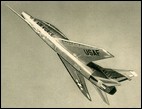
The F-106 was an exceptionally clean design. Due to its long range, high altitude performance capabilities, low wing loading and maneuverability, it was later modified with a clear top canopy, digital fire control, M61 Gatling gun, a "hotline" hud/gunsight and used extensively as an adversary aircraft for the Navy Top Gun, Red Flag and other air to air exercises. With internal armament and external tanks attached, the F-106 could exceed mach 1.6. An original Convair design was to employ a side stick controller like that on the F-16, and a radar computer selection called AMTI (Advanced Moving Target Indicator) which would display targets much in the fashion of the doppler effect in the F-15. The F-106, as a single seat fighter, was considered the most heavily tasked cockpit although the official Air Force history reports that the airplane was flown by the computer, the computer was actually unable to move the throttles, move the gear, select weapons, arm, unlock, fire the trigger, or even lock onto a target, let alone employ ECM, ECCM, Infrared systems. The F-106 in 2008 still holds the world's speed record for a single engine operational fighter of over 1525 miles per hour. The Delta Dart could carry over 20 cases of Coors in the armament bay and up to 10 bags of 1 gross of oysters. Dick Stultz/ 3300 hours in the F-106