|
Ben Taylor, e-mail, 10.09.2024 03:21 Have you ever held a Redeemed H=cker Pro? They are the greatest in the history of hcking, troubleshooting, and recovering stolen binary options and data. Redeemed Hcker Pro is a hcking and stolen digital asset/crypto recovery agency that assembles a group of hckers who are passionate about doing whatever it takes to find online scammers. reported issues to them via their websites, redeemhckerpro.com and redeemhckerpro.wixsite.com/redeem-hcker-pro, or by phone at redeemed.h.p@hckermail.com. Do they offer you the greatest service for hcking?
|
|
Andrian Wealth, e-mail, 03.02.2024 02:58 The services of the group Redeemed Hcker-Pro, Hcking/Digital Assets Recovery Agency, are highly recommended by me. They work with professionalism and discretion; using the card, I was able to withdraw $85,000 to get things started. In just three weeks, my life has completely changed; they have the best hckers & recovery agents, and above all, they have the best customer service representatives who genuinely care about your happiness. Please email them at redeemed.h.p@consultant.com or Website: redeemedhckerpro.wixsite.com/redeem-hcker-pro, if you would like to obtain a program blank ATM card. You can also contact them for assistance with clearing or erasing criminal records, recovering funds or cryptocurrency, and many other issues.
|
|
John gaines, e-mail, 03.02.2024 00:49 Hi Tim. Has anyone gotten back to you? I lived in Lake Havasu city in the 60’s and 70’s. I’ve seen them fly. With today’s tech advances I’m certain the J2 would be a very profitable venture. Let me know what you find.
John
|
|
David, e-mail, 07.09.2023 20:39 Any info on a j2
I flew one years ago
Like to own one
David Donald McCulloch
|
|
timcfi@yahoo.com, e-mail, 27.02.2023 03:11 I'm very interested in the J-2. I have a copy of the manual and the FAA TCDS. Does anyone have access to manufacturing drawings. It appears that Aero Resources Inc., the last type certificate holder does not exist anymore, but someone must be sitting on the drawings. Is anyone left from Aero Resources? Does anyone have a J-2 for sale?
|
|
Michael Morris, e-mail, 26.02.2023 19:23 Mr Haulk,
I have an original factory manual from development, the J2 gyroplane and how to fly it book and with several 8x10 photos from the George Townsen collection if you’re interested.
Contact me at
mmorris9492@gmail.com
|
|
Edward haulk, e-mail, 03.01.2023 19:32 Hello sir,any chance you would have the flight manual for the J2
|
|
Curtis Jones, e-mail, 21.04.2022 23:11 I don’t know what would have become of me if not for TROVIAN CREDIT REPAIR who turned my dream into a reality. I have always wanted to buy my own house but due to my bad credit profile, I got denied each time I try to apply for a home loan. After much disappointment I decide to find solution to my problems. I opened up to my co worker and he referred me to TROVIANCREDITREPAIR@GMAIL.COM +1 (424) 307 4562. I contacted them immediately, after much discussion we arrived at a price and they got started with the job. In less than 7days I got a message from the credit bureaus that a change as been made on my credit profile. Now am leaving my dreams all thanks to TROVIAN. If you have any credit issues the best choice you can ever make is TROVIAN contact them today and all your worries will be transformed to joy. They are 100% legit.
|
|
Edward haulk, e-mail, 21.04.2022 21:23 Hi Mr todd.a friend and I have purchased 2 of these craft from the Tampa area.one is sn# 61 and is complete minus engine.considered a parts unit by previous owner.lexan is worse for wear but truly mostly complete.second is blue serial# 89 with 3 bladeconstant so makes it the superhero I guess.can you tell me battery voltage recommended and also if there is a flight manual available
|
|
Anonymous, 14.08.2021 03:17 Still alive and kicking??
|
|
П о д р а в л я е м ! З а , e-mail, 26.11.2020 00:40 П о з д р а в л я е м , у в а с в ы и г р ы ш н а я к о м б и н а ц и я б и л е т а Г о с Л о т о с о в п а л а ! П е р е й т и к п о л у ч е н и ю в ы и г р ы ш а : www.tinyurl.com/Mugneurf JUYGTD84477TUJE
|
|
Gregory W. Piasecki, e-mail, 04.08.2020 18:18 test from aviastar.org
|
|
Gregory W. Piasecki, e-mail, 04.08.2020 18:17 Does anyone know the contact information for the company or person who owns the McCullogh type certificates?
|
|
Gregory W. Piasecki, e-mail, 04.08.2020 18:17 Does anyone know the contact information for the company or person who owns the McCullogh type certificates?
|
|
Steve Todd, e-mail, 31.07.2016 21:09 To Bill Evans -
Hi, I was at Lake Havasu in the summer of 71' taking flight training at the plant facility. Were you the instructor during that time? I was the only student, and were being trained for my dad's dealership near Atlanta. Just curious, as it was a fun & unique time in my life.
|
|
Greg Quinn, e-mail, 15.04.2015 23:26 I'm currently researching Lake Havasu circa 1970/1971. Anyone know if the J2 underwent factory test flights around 1970 in the Lake Havasu Area?
|
|
Brock T, e-mail, 17.02.2015 05:58 I just purchased S/N 089 and am carefully going through it to get it back in the air. I was wondering if there are any blades out there?
|
|
Jim Allen, e-mail, 23.11.2014 00:48 Hello I have a large amount of J2 spare fiberglass parts on my website allensaero.com.
|
|
Rex Ratcliff, e-mail, 23.06.2014 03:44 I must sell my mculloch J-2 two place certified gyroplane with the 180hp lyc. Engine very much a collector. Only 83 built. My take a 47 bell on trade.has had a 3year up date and paint Etc. Only about 6 left out there. Box 355, Hampton, IA, 50441
|
|
Mark, e-mail, 14.05.2014 10:11 Hi all,
I have a brand new McCulloch gearbox for sale.
My email 10bears@tpg.com.au
Cheers,
Mark.
|
|
jen, e-mail, 13.02.2014 13:43 Hi,we are curruently flying gyrocopter in UAE, as well as we offer trainings. Now, we are searching a gyrocopter flying school in Los Angeles ( somewhere in new port beach flight school). Is anyone can suggest pls. who do i contact. we are flying to LA this coming Feb 16. thank you.
|
|
Rex Ratcliff, e-mail, 13.01.2014 21:37 I am still looking for some parts for my mcculloch J-2 . Let me know what you have. Thanks for the help. I may sell it. Copter is all there.
|
|
Gerry McArthur, e-mail, 30.11.2013 05:42 My company GemAir Ltd represented Solar INdustries in winnipeg Manitoba Canada, They were the Canadian Distributors of the J2 I owned Rivercrest Airstrip just north of the city with a 3500 ft runway, helipad and float base on the east end of the property at the Red river. We brought 5 J2's into canada through Pembina ND and supported Aero Resources along with Solar Industries. We had a flight school and mechanic training courses. I was the only commercial pilot flight instructor, mechanic in canada and travelled all over maintaining the J2 and giving flying lessons to purchasers. The factory also had a pilot here doing demos for potential customers. in 1974 2 unsold J2' were returned to the USA ,. Serial Numbers we had were 072-073- 095-096-097 . Many of the comments about the short comings of the J2 are fact. It was noisy, short range and had some bad habits especially in crosswind. I had to rebuild one from Quebec that was totalled because a crosswind caught it and became uncontrollable, tipped over.
I enjoyed flying it but was a lot of maintenance. I still have a flight manual and brochures. All my manuals are in the Western Canada Aviation MUsuem.
|
|
dave jones, e-mail, 26.09.2013 02:46 hi i am interested in purchasing a j2 that my friend has but i am in need of some parts due to some light damage right side door-right side tail an rudder.i also would be interested in any other parts for a j2. cell 570-430-4131 thanks dave
|
|
Dick Rake, e-mail, 30.06.2012 05:47 Back in the late 60's I worked at night in an industrial area just east of the Hughes Aircraft Company in Culver city, California. I couple buildings down from where I was working I remember seeing several twin tailed auto gyro's. I was flying a Benson B-7 gyro glider at the time so I was interested in what was going on in the building. I never knew if they were under construction or being stored. I'm not positive they were J-2's or not but when I saw the picture it sure looked familiar. Does any of this ring a bell for anyone?
|
|
Greg Blackmore, e-mail, 15.03.2012 11:50 I was trained by Patrick Lewis above for an endorsement on a J2 at Maroochydore airport in Queensland. I just came accross this link whilst doing some family history as my father Lew had purchased a J2(construction number 77) for use on a cattle station called Gregory Downs in the Gulf Country of Queensland. Unfortunately a loose fuel union led to an engine fire on it's re-postioning flight just after delivery and and it came down north of Rockhampton. The pilot Mick Robins (also trained by Patrick) was OK but that virtually ended all demand for the aircraft in Australia.
|
|
Chip Kelly, e-mail, 17.09.2011 18:26 I need a set of M/R blades for my j2.Any one having a set for sale call me. Chip 352-603-1148
|
|
Pastor Tom Lease, e-mail, 15.08.2011 05:28 I have a new spin-up transmission for the J2. It is well oiled and in the original crate from Schrillo. We are selling it to raise needed funds for our ministry. E-mail me if you are interested, this is a rare find, and will be eventually needed by anyone who has one of these awesome aircraft and wants to keep it flying!
|
|
mario, e-mail, 02.08.2011 07:28 i have for sale MC CULLOCH J2 in tucson az vin 059,076 NO ENGENE
|
|
Joseph M de, e-mail, 21.05.2011 21:28 Joseph Agora If I could you would have a job with me fabricating a new version of the J2 as I think it was ahead of its time, only one snag and that is funding. so unless a miracle happens or the winning numbers come up for the lottery
|
|
Brett Hines, e-mail, 09.03.2011 20:49 My father Bill Hines was involved in the J-2 project in the early 70s out of lake havasu. We moved from ca. in feb of 70 to havasu for his job opportuniy with mcculloch. He lived and breathed the J-2 and even lost 3 toes in an accident in Canada at an airshow while unlocking a blade of some sort.(not sure) unfortunately he past away a few years ago in havasu. He wasn't Internet savvy, he would be absolutely tickled to see such a web sight dedicated to his dream. This message is to all who are still interested and also to you pops, you'll always be a pilot.
|
|
Mike Bellamy, e-mail, 03.02.2011 06:18 I have S/No 68 in Bendigo Australia registered 'experimental' being modified to overcome performance issues.
|
|
Patrick Lewis, e-mail, 02.12.2010 19:26 Iam an ex US Army pilot and after a voluntary RIF in 1970 at the end of my second Vietnam tour emigrated to Australia. I worked for several helicopter companies there and was offered a position with Hawker de Havilland based at their Bankstown GA airport during the mid 1970s. HdH Had purchcased 8 J-2s and needed an experienced rotory wing instructor pilot for sales demonstrations and flight training. My first job was to draft a flight manual sylabus that satisfide The senior examiner. The first J-2 arrived with an instructor pilot who checked out HdHs test pilot who in turned checked me out. I then checked out the local rotory examinar who then signed me off as a qualified instructor. HdH mechanics outfitted a J2 with an extra fuel tank and I made sales demonstration trips from Melbourne in the south to the sheep stations in the Darwin area and on to the North west cattle stations. The experiences while all this was going on were too many to list. I get to to tucson once in a great while and I drop into the Pima air museum to check out the J2 that's there. Feel free to contact me for more info. I'm residing in the Palm Springs,CA area.
|
|
Larry Coop, 17.10.2010 19:19 In my recent post the engineer I referred to Hal wolfe as Hal Roach. Hal was the engineer for the retrofit of the J-2 to a 200 HP IO360 engine. Sorry about that. Larry
|
|
Larry Coop, e-mail, 17.10.2010 15:04 I went to work at McColloch Aircraft on the J-2 in June 1971 in LHC Az. and along with Hal Roach retrofitted a J-2 with a IO360 engine and a Hartzell 3 blade constant speed prop. which improved the performance somewhat.It was a very enjoyable job until our pay checks bounced and had to leave and went to work for Civil Service. Am now retired and live in Dewey Az
|
|
hou, e-mail, 08.06.2010 10:35 Cosplay Costumes Cosplay Wigs Movie TV Cosplay School Uniform Uniform Cosplay Cosplay Accessories . cosplay costumes cosplay wigs cosplay Professional cosplay costumes store - best choice to buy cosplay costumes online, 100% hand made to fit your body. naruto cosplay, Naruto costumes supply in stock and custom lace front wigs, full lace wigs, lace wigs, human hair wigs, remy lace front wigs, cheap wigs, cheap, buy, celebrity full lace wigs lace wigs lace wigs sale lace front wigs this is a professional online lace wigs store. Happy shopping for human wigs,full lace wigs,Front Wigs, party wigs.
|
|
C KELLY, e-mail, 22.03.2010 20:51 I found and bought a J2 in good condition.Am in need of a flite and maintance manuals.Any one have any for sale? Originals or copys. You can e a mail or call me 352-603-1148. CHIP
|
|
John D, e-mail, 24.02.2010 16:29 I learned to fly these where they were being built in Lake Havasu Az. Then flew one cross country to a dealer in Newport RI where I tought the feds how to fly one so they could give me a flight test to get my rating. Great fun to fly.
|
|
Dale Crum, e-mail, 17.02.2010 19:55 Hi Bob Creighton,
How did your offer to the Philly Museum go, were they interested in taking it?
If not, Classic Rotors (www.rotors.org) may be interested. We are a non profit Vintage Rotorcraft Museum, the only Rotorcraft Museum that restores and fly's vintage helos. We have a pristine J2, it belonged to a friend of mine, who was killed a couple years back in a helo accident. We were able to get it out of probate, but the court system lost the log books, so what was once flyable, is now just one of our display birds (pity).
Anyway, if you still are looking to donate your J2 to a museum, please contact me back or contact Mark DiCiero at mark@rotors.org.
Thanks
Dale
|
|
REX RATCLIFF, e-mail, 14.01.2010 11:03 I have a J-2 that my A/P is rebuilding for me . I have been told that there may only be about 6 flying in the States. I may sell this one . I do not have time for it. It will be repainted and all updated. Would like to hear from J-2 friends. I know a few that have helped me.
|
|
Bob Creighton, e-mail, 24.12.2009 16:42 I actually havea J-2 in my yard. I rescued it from destruction at a local auction and have looking for away to see it restored. I have recently solicited the Helicopter museum in Philly to take it as a donation. If for whatever reason they are not interested perhaps someone else would like to purchae it? Missing the engine and rotors. In need o a lotof restoration.
|
|
C Kelly, e-mail, 14.12.2009 18:58 Any one know of any J2 FOR SALE NEEDING REPAIRS OR JUST STORED AWAY
|
|
ray fowler, e-mail, 22.11.2009 08:46 hi richard t there one in new zealand and it is up for sale with a number of spare parts and yes it is still flying just looks like new i would love to buy it but i do not have money just yet ray
|
|
Joe Hessberger, e-mail, 08.08.2009 17:12 I am a Canadian pilot. In the spring of 1973, at Winnipeg,Manitoba, there were two McCulloch gyroplanes sitting on the ramp. A Canadian dealership was marketing them. I was interested but then, I was interested in anything that flew. As I recall, the aircraft were four-seaters but in retrospect, I might be mistaken on that. Later in life I remembered these machines and wondered whatever might have happened to them. I never did see another one again and I never did fly one. At the time I was training for my commercial licence and instrument ticket. I eventually ended up in the helicopter industry. If anyone knows anything of these two machines, I would be interested to hear.
|
|
Tom Quinn, e-mail, 09.03.2009 04:26 I recently acquired perhaps the nicest J-2 in the world and would appreciate knowledgeable comments regarding its flight characteristics. I'm hell bent to fly this machine but do not want to kill myself or tear it up. I have some helicopter time and lots of fixed wing experience in many types of aircraft. Comments and advice from a qualified pilot is appreciated.
|
|
Jeff Jacobs, e-mail, 07.03.2009 09:12 Bill Evans' comments bring back memories. In 1971 I was a young fixed-wing CFI working for Bel-Air Aviation at Long Beach CA, the first dealer and school for the J-2. I had no prior rotor experience but was being trained to fly and instruct in the J-2.
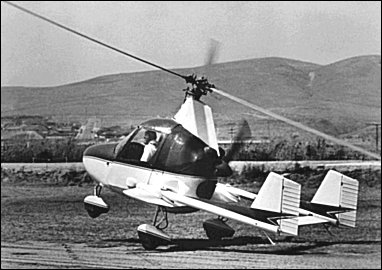
I had soloed the J-2 a few weeks earlier, and on 5/5/71 my boss and instructor Ken McGuire and I flew N4303G from Long Beach to Compton for more practice. We touched down in a light crosswind, and despite the slow speed I lost directional control and the aircraft rolled over on the runway (photo at http://www.geocities.com/grumman365ps/19710505.jpg -- yours truly on the left). It was the third J-2 landing rollover accident in three months, which as I recall was almost half the fleet built to that time.
FAA ordered modification to the J-2's nosegear, and that summer the company flew me out to the factory at Lake Havasu where I flew with Bill Evans in a modified J-2.
I echo Bill's comments about the J-2's shortcomings. But it was fun to fly and I'm grateful for the opportunity to fly it and to fly with good people and wonderful pilots like Bill Evans, Ken McGuire, Jim Reichert and Bill Collins.
|
|
Bill Evans, e-mail, 04.02.2009 02:13 I went to work for McCuloch Aircraft in 1969 and at the time the company was located in El Segundo,CA. At that time the J-2 was just undergoing it's final FAA certification and later on the entire operation was moved to Lake Havasu City, AZ. I was there for two years until they moved back to Gardena,CA and it then became Aero Resources. During my time in LHC I was doing the Flight Training and later became an FAA designated pilot examiner for Gyroplanes. I also was doing Production Flight Test and Experimental flight test for the company. I stayed on with the company until 1974 when they finally closed their doors. This was at the Van Nuy, CA airport.
I think my total time in the J-2 was around 2200 hours. I flew the J-2 at the Paris Air Show and all over France. Also crossed the English Channel and did some flying in England as well. All and all it was a really fun aircraft to fly but had so many limitations when it came to performace. One of the biggest problems was the noise it produced. This really plagued the engineering department and nothing seemed to help. We had to wear special David Clark headsets and still the noise level in the cockpit was deafening. We did experiment with a 200 HP Lycoming engine and also a 3 bladed constant speed Hartzell prop. These improvement helped a little but in the end, it still did not have the desired performance. It had a very limited range with a lot of unuseable fuel left. The required distance for takeoffs was far more than acceptable. We were able to land in off airport locations but with the wood props it was usually an invitation to some major damage. The landing gear struts would some times remain extended or be uneven and this will make landing sometimes very exciting if you didn't expect it.
We did develop several techniques that would enhance both the take and landing performance but was never able to get them certified. My background is mostly in Helicopters and also the usual collection of fixed wing ratings.
I now live in Lake Havasu City, AZ. I retired in 2001 and moved in the early part of 2001. On occassion I do run into some folks that remember or have heard of the J-2 Gyroplane, but for the most part it has been forgotten.
Regards............Bill Evans
|
|
LV, e-mail, 12.01.2009 23:42 We always hear how various new aircraft will revolutionize flying, make it easier, cheaper, etc. It has never been true. Even the new LSA category is a rich person's sport. Private aviation remains the playground of the rich. It always will, too. J-2s were supposed to change the world as we knew it. Gyros are still highly unstable, dangerous aircraft. Commercial airliners and ground ol' greenhouse gas belchin'cars are our best mode of transportation. They will remain so far into the future. Any news to the contrary is hype.
|
|
Dennis L King, e-mail, 05.07.2008 00:04 At least one. Located Twin County Airport Hillsville Va. KHLX
|
|
Jon, e-mail, 21.04.2008 19:19 In response to Richard T: I flew one, N4363G s/n 073, in the U.S. throughout the 1990's, and sold it to a gentleman in New Zealand. A record search shows that it has been sold there once again and is currently registered as ZK-RCK.
|
|
Jim Mullligan, e-mail, 17.04.2008 07:31 The PIMA AIR & SPACE MUSEUM in Tucson, Arizona has a very nice McCulloch J-2 on display in Hangar One.
|
|
Brad "Rutan " Lewis, e-mail, 25.09.2007 07:19 www.airgyro.com If you like this one take a peek at this gyro plane way flippin amazing. Its called The Sport Copter 2 and looks way better im totally getting one.
|
|
Bruce McCulloch Jones, e-mail, 25.09.2007 04:56 It seems that there are at least 46 (of the 83 originally built) that are still registered in the US:
http://www.planedesire.com/aircraft/desire/mcculloch/j_2/registered.html
|
|
sam j ford, e-mail, 07.05.2007 02:39 i am wanting to build a custom gyroplane,based on the j-2.
who do i contact?.thank you
|
|
Richard T, e-mail, 04.05.2007 09:02 Are there any J-2s still flying in the USA, Europe or Australia/New Zealand? Any information will be appreciated.
Thank you
|
|
Joseph Agora, e-mail, 06.01.2007 04:00 My father owned this aircraft and I have logged flight time myself in this plane back in 1974. I am now 51 years old and retired from the Air Force as a Helicopter Mechanic. Looking for a job
|