|
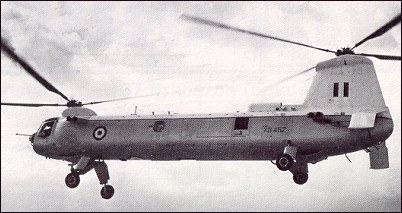
| The Bristol 173 was the first helicopter specifically designed for commercial operation and passenger transport in particular. The first prototype, which flew on 3 January 1952, was powered by two 520hp Alvis Leonides engines and could carry ten passengers. The tandem rotors were identical to those of the Bristol 171 "Sycamore". Trials were carried out with this aircraft in 1953, from the aircraft carrier HMS Eagle. The second prototype was similar to the first but was modified to test the characteristics and effects of two stub wings and later a four-bladed rotor. The Bristol 173 Mk.3, of which three were built, with capacity increased to 16 seats and Alvis Leonides Major engines, was offered to BEA.
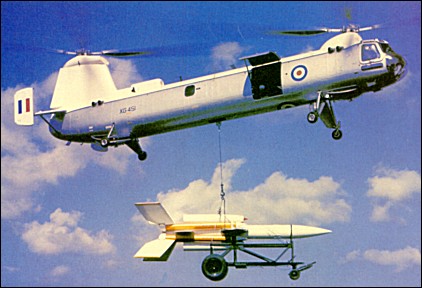
Unfortunately, none of these aircraft succeeded in overcoming a series of developmental problems and subsequent projects undertaken by Bristol — models 191 and 193 — in response to Royal Navy and Canadian naval specifications were no more successful. However the Type 192, the prototype of which flew on 5 July 1958, was adopted by the RAF. In the initial configuration, this aircraft had a purely manual system of control and wooden rotor blades but power controls and metal blades were standardized on the fifth prototype built in 1960. That year, three pre-production aircraft were assigned to the RAF for a series of trials for which they were based at Odiham. Twenty-six of these helicopters, called the "Belvedere", were ordered and used for some years for military transport, not only in the United Kingdom, but also in the Middle and Far East. The "Belvedere" was withdrawn from service in March 1969.
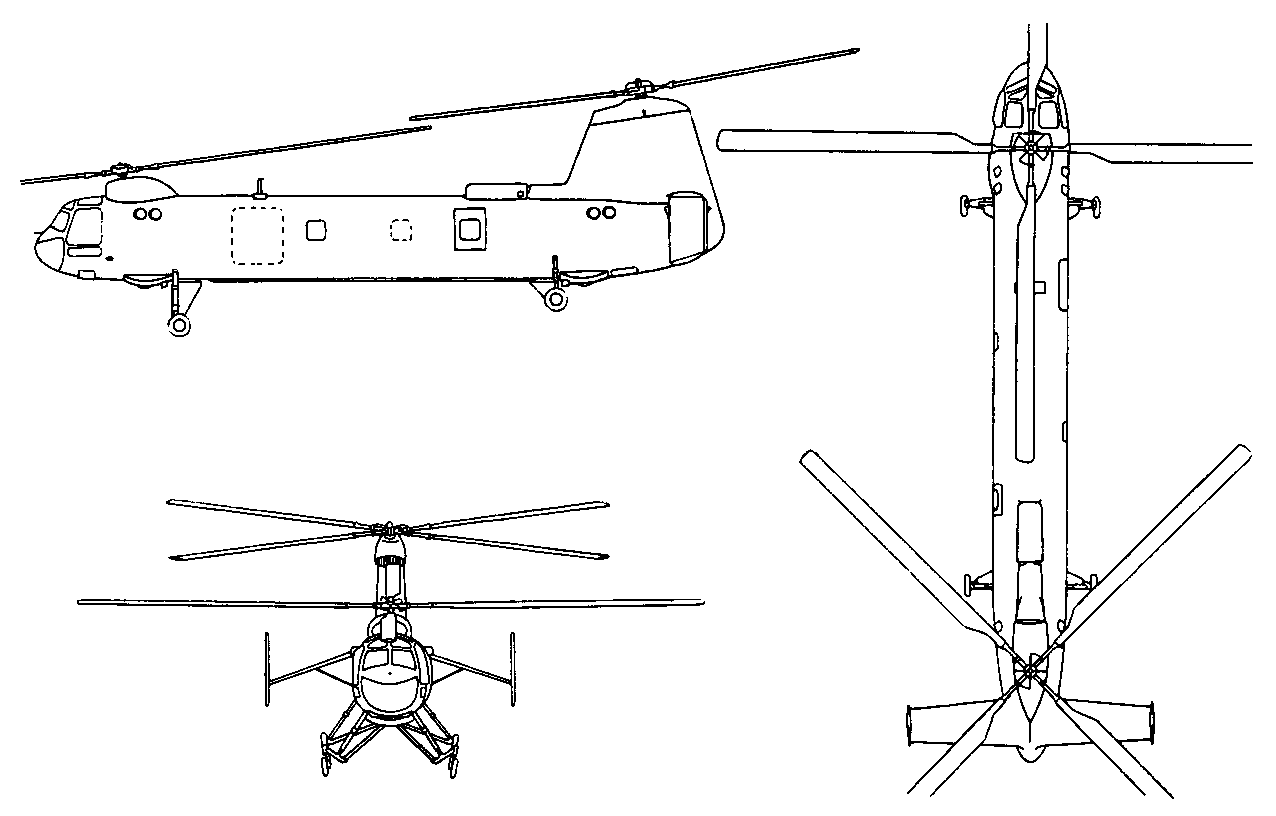
The production Bristol 192s had an all-metal, skinned fuselage and an anhedral tailplane, compared with the dihedral one of the Type 173. The two rotors had four metal blades and the front wheels of the fixed quadricycle landing gear were self-castoring. The helicopter's maximum capacity was 30 seats or 2700kg internal payload. The instrumentation also permitted night flying. G.Apostolo "The Illustrated Encyclopedia of Helicopters", 1984
Bristol 191
Ship-based development of Type 173 with modified fuselage, u/c etc. Three built but only used for static test. Bristol 192
Production version of Model 191 for RAF use with two cabin windows only, starboard cargo hatch, cargo hoist beneath fuselage, large anhedralled tailplane and powered by two 1465shp Napier Gazelle turboshafts. Prot. XG447 FF 5 Jul. 1958. 26 built.
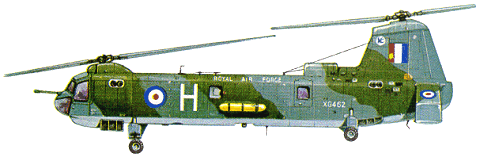
In July 1958 the Bristol 192 made its maiden flight and this marked the successful climax to the development of the 173. As the Westland Belvedere this entered service with the Royal Air Force, though this was only after the 191 and 193 had been cancelled by the RAF and Royal Canadian Air Force respectively. The 192 was powered by two Napier Gazelle Series 2 engines derated to 920shp.
As the 192C it was tested by BEA and offered its 24 passengers a unique high-speed service between London and Paris.
On May 30, 1961, C T D Hosegood flew from London to Paris in 1 hour 41 min 28 sec and on June 2, 1961, from Paris to London in 1 hour 40 mm 55 sec. This is the equivalent of 202.32km/h outwards and 203.51 km/h on the return flight. Bill Gunston "The Illustrated Encyclopedia of Commercial Aircraft", 1980
Technical data for Bristol "Belvedere" HC.1
Engine: 2 x Napier Gazelle N.Ga.2 turboshafts, rated at 1092kW,
rotor diameter: 14.91m,
length with rotors turning: 27.36m,
height: 5.26m,
max take-off weight: 9072kg,
empty weight: 5277kg,
max cruising speed: 222km/h,
service ceiling: 5275m,
range with 2722kg payload: 122km
| Terry Garmonsway, terrygarmonsway(@)yahoo.com.au, 03.01.2009 I served in Malaysia with 1RNZIR Band based at Terendak Garrison (near Malacca or Melaka) from Dec 1967 to Dec 1969. We also filled the roles of infantrymen, specifically forming a part of what was known as "Headquarters Defence Detatchment" in our Battalion. It was in this capacity that we came into contact with 66 Sqn's Belvederes on "Exercise Crown And Glory" in 1969. We were ferried from a footy field within "Wellington Lines" at Terendak to our destination in these flying sausages. Climbing into a Belvedere with full battle kit, 7 days rations and SLR was a mission in itself with the entry at head height and only a narrow ladder to use in this endeavour. Exiting at our destination in a jungle clearing was another matter after a very uncomfortable flight on a bare, slippery flat floor. The chopper, already perched atop high wheel struts, landed with its forward and aft wheels on small rises in the terrain, but straddling an indenture between the rises. With all that heavy gear we had no option but to jump to the ground, a jump of somewhere around eight to ten feet. That doesn't sound like much when you're looking up but that distance begins to look fearful when you're looking down! Thankfully long grasses helped to cushion our impact with the ground on exiting. This, I am pleased to say, was our only experience with Belvederes. Several months later, in South Vietnam, we flew from Luscombe Field, Nui Dat to a forward firebase, Firebase Discovery, aboard a US Forces Chinook. Although the Belvedere and Chinook both were in development phases around the same time comparisons between the two help to explain why Britain's aero industry ground almost to a halt. But... to your credit, 66, you flew us safely. And I thank you sincerely for that! | | tony p, tonyp1963(@)talktalk.net, 25.11.2008 Need help my dad was flying on belvedres in borneo in the 62,63 John Pattinson, With Eddie Lewis. 66sqn Looking for special xmas present,Dad has loads of photo's and will share. | | Mike Ottewell, mike-ottewell(@)msn.com, 22.10.2008 Well to my knowledge this helicopter had some issues. My elder brother lost his life in the accident at RAF Gutterslough, Germany in July 1962. There was another Belverdere lost in Borneo, about the same time. | | Sgt.KAR98, 17.08.2008 Looked to be as amazing (or even more) as the CH-47. If they had go ahead with it,the RAF and the UK Army would be less dependent of USA technology. | | Richard Walker, richardwalker4(@)mac.com, 05.11.2007 I saw the Belvedere prototype in operation at the BAC airfield at Filton Bristol, and also in subsequent Air Shows at the airfield. Was the Belvedere the first twin rotor helecoptor of this type? | | Derek Hale, platic(@)msn.com, 22.09.2007 Working with the Whirlwind Sqn at RAF Kuching as an MTD often went out to Whirlwinds which had made emergency landings normally because of gearbox problems. After the techs had stripped the aircraft of everything possible engine,gearboxes, rotorhead, etc the Belverdere would be able to pickup the stripped aircraft and carry it back to Kuching quite a sight to see a Flying Longhouse as we called them with a Whirlwind as an underslung load. | | leslie frank windsor, les(@)lwindsor52.freeserve.co.uk, 24.04.2007 i flew many times with 66 aircraft at seletar during my time there i was known as the flying rockape as i used to scrounge flights all the time i loved flying in the belvederes and have many happy memories of this brilliant helicopter it never got the recognition it deserved best wishes and thankyou for the memories les w. ex 15 field squadron raf regiment. | | Mick Winslow, m.winslow(@)homecall.co.uk, 19.01.2007 I served as groundcrew on 66 Sqn, RAF Seletar, Singapore on the last operational Belvedere Sqn from 1967 to its disbandment in 1969. This aircraft was a very difficult aircraft both to maintain and to fly, but proved to be very successfull with the army in Malaya and supported the army on all there major excerices.This was the only heavy lift helicopter in service at that time and 66Sqn operated 12 aircraft until its final disbanbment. |
|
| |
|
Do you have any comments concerning this aircraft ?
|
| FACTS AND FIGURES© The first Belvedere suffered noise
and stability problems - rectified by
redesigning the rotor hubs and tailplane. © On 24 August 1952 the prototype for the
Belvedere series made its maiden flight. © The prototype was demonstrated at the
Farnborough air show in September 1952. © British European Airways leased a
Belvedere briefly but never used it in
commercial service. © The first production aircraft with Gazelte
engines made its initial flight in July 1958. © The Belvedere had a long career, ending
its RAF service in March 1969.
 All the World's Rotorcraft
 Virtual Aircraft Museum
|
|
|