|
|
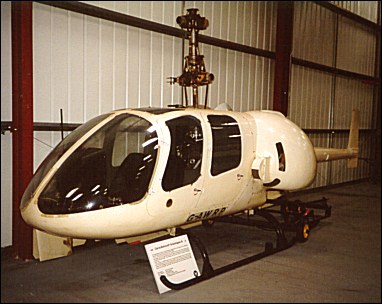
Rotorcraft Ltd. was reconstituted as the Cierva Rotorcraft Ltd, subsidiary of The Cierva Autogyro Co, and work commenced on the new "Grasshopper" Mk.III which was based on the dynamic systems of the earlier aircraft, but with a new four-seat fuselage incorporating a slim tailboom with a fin and rudder and powered by two 135hp Rolls-Royce Continental O-300 piston engines. This was designated CR.LTH-1 (otherwise known as the CR-Twin) and the first aircraft, G-AWRP, first flew in 1969 followed by G-AXFM (GB-2) later that year, and a third pre-production machine, G-AZAU (GB-3) in mid-1971. This latter aircraft was fitted with 210hp Continental IO-360-D engines, and the production variants were to be the CR.420 with 210hp Continental TSIO-360-A engines and the CR.640 with 320hp Continental Tiara T6-320 engines. Development was eventually abandoned in 1975 due to lack of further financial backing. R.Simpson "Airlife's Helicopter and Rotorcraft", 1998
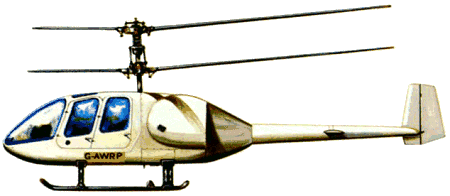
Technical data for Cierva CR.LTH-1 "Grasshopper"
Rotor diameter: 10.06m,
fuselage length: 8.58m,
max take-off weight: 1564kg,
max speed: 222km/h,
cruising speed: 193km/h
| Dr. T Opatowski, topabook(@)bezeqint.net.il, 27.03.2008 In reply to Pierre Terrail: I left the project soon after the stage shown in the photograph when Mr. Shapiro wanted me to join his office (Servotec) in an unsatisfactory position rather than work as a consultant from my own firm of Technical Investigations Ltd. I should also point out that the MK 2 version had its engines in the rear rather than the previous front location. As far as the rotor system is concerned it was very close coupled and the rotors were (theoretically) held apart by a rigid conta-rotating structure patented by Mr. Shapiro. If thay are far apart, as per the Russians, it is not very efficient. My analysis of the system concluded that it would not work safely unless there was a very sophisticated higher harmonic blade pitch control system though something could be done with an appropriate delta 3 hinge. I think that the Sikorsky high speed helicopter under development, which has close coupled contra-rotating rotors, has individual blade pitch control. | | Pierre Terrail, pierreterrail(@)hotmail.com, 16.10.2007 Dear Dr. Opatowski, may we have an evaluation of this coax helo: vibrations? performances? why there is no follow up? Why this is not a success? Why aren't we seeing more coax in the sky??? Thanks. | | Dr. T. Opatowski, topabook(@)bezeqint. net.il, 26.07.2007 I carried out some of the early development work on this aircraft at Redhill (on a consultancy basis) and have a photograph of the engineer Mr. Tony Higgins and myself running the bare platform with blades on one of the two co-axial rotors only. |
|
| |
|
Do you have any comments concerning this aircraft ?
|
| |