| Westland "Wessex" 1958 |  |
 |
|
| Westland "Wessex" 1958 | |
|
|
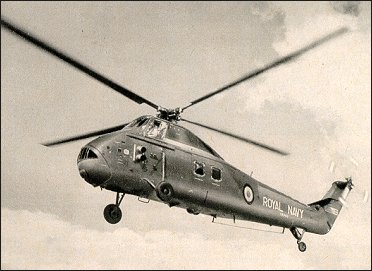
After acquiring a licence in 1956 to manufacture the Sikorsky S-58 helicopter, Westland imported one of these aircraft in HSS-1 configuration. Given the British serial number XL.722, this aircraft was test-flown for a time with its original 1525hp Wright R-1820-84 engine before being modified to accept a 1100shp Napier Gazelle NGa.11 gas turbine. In its new form it was flown for the first time on 17 May 1957, and was later joined by two pre-production Wessex HAS Mk.1's for Naval trials; the first of these flew on 20 June 1958. The HAS Mk.1 went into production in 1959 for the Royal Navy as a submarine search and strike helicopter equipped with dipping Asdic and provision for one or two homing torpedoes. Powered by a 1450shp Gazelle Mk.161 engine, it began service trials with No.700H Flight in April 1960 and has since been delivered to Nos. 706, 737, 771, 815, 819 and 848 Squadrons. The first of these to commission, in July 1961, was No.815; the Wessexes of No.848 Squadron were for commando assault duties aboard H.M.S. Albion, having the ASW gear removed to make room for 16 troops or 8 stretchers and a medical attendant in the main cabin. Alternatively, a slung load of 1814kg can be suspended from an under-fuselage hook. From January 1967 the Wessex Mk.1's have been joined in service by the HAS Mk.3, which is powered by a 1600shp Gazelle Mk.122, and has an extended rotor head fairing and large dorsal radome. Twenty-seven HAS Mk.31's supplied to Royal Australian Navy since August 1962 are similar to the HAS Mk.1 apart from their 1540shp Gazelle Mk.162 engines. All other Wessex variants so far announced have two coupled Gnome engines in place of the single Gazelle. These include the RAF's HC Mk.2, flown for the first time in production form on 5 October 1962 and entering service with No.38 Group in February 1964; the Navy's HU Mk.5, for which two orders have been placed and which entered service in summer 1964 as a commando-carrier assault transport; twelve Mk.52's for the Iraqi Air Force, three Mk.53's for the Ghana Air Force, and one Mk.54 for the Brunei government. Seven Wessex Mk.60's have been built for Bristow Helicopters Ltd. These are 10-passenger commercial equivalents of the Mk.2 and operate in support of the oil and gas drilling rigs in the North Sea. K.Munson "Helicopters And Other Rotorcraft Since 1907", 1968
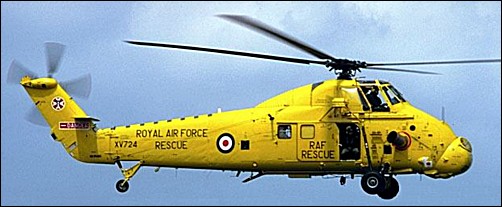
In 1956, Westland, who held the license to build the Sikorsky S-55, acquired the license for the more modern S-58. The powerplant of the latter was considered unsatisfactory and the British firm began a partial redesigning of the American aircraft to enable a 1100shp Napier Gazelle NGa. 11 turbine to be installed instead of the original 1525hp Wright R-1820-84 radial. Thus transformed, one might have assumed that the helicopter was underpowered, but the nature of turbine engines is such that- it was in fact ideal. The slight loss of power was offset by greater reliability, a reduction in vibration and weight, easier maintenance and a lowering of specific fuel consumption. The Royal Navy immediately ordered the new helicopter as the Wessex HAS Mk.1, to replace the older Whirlwind HAS Mk.7. The aircraft was basically similar to the Sikorsky S-58, but the nose profile was altered as a result of the installation of the turbine which, in the first production version, was a 1450shp Gazelle NGa.13. Later Wessex (Mk.2 and 5) were powered by twin Rolls-Royce Gnome engines and employed as troop transports. Westland built 356 Wessex in all (including those for the civil market): the HAS Mk.1 version for the Royal Navy; the HC Mk.2 tactical transport version for the RAF; the HAS Mk.3 antisubmarine version with 1550shp Gazelle NGa.18 turbine; the HU. Mk.5 for various roles on the Navy's commando carriers; the HAS Mk.31 for the Royal Australian Navy; the Wessex Mk.52 for the Iraqui Navy (12); the Wessex Mk.53 for Ghana (3); the Wessex Mk.54 for Borneo and the Wessex Mk.60 commercial version. G.Apostolo "The Illustrated Encyclopedia of Helicopters", 1984 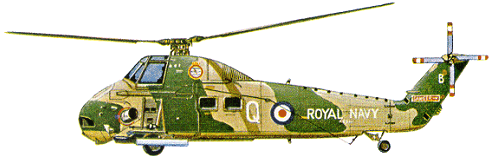 The company's success with the Whirlwind led to licence negotiations with Sikorsky to build the S-58, for Westland considered that this somewhat larger helicopter had excellent development potential with the introduction of turbine powerplant. A single example was imported and modified initially by the installation of an 820kW Napier Gazelle NGa.11 turboshaft engine, but the prototype and pre-production examples of the Westland Wessex had as powerplant the 1081kW Napier Gazelle Mk 161. The initial production version for the Royal Navy began to enter service on 4 July 1961, and the type was subsequently built in several variants. In 1993 the Wessex is in service only with No. 22 Sqn, RAF, on SAR duties, and The Queens' Flight at RAF Benson. VARIANTS Wessex HAS.Mk 1: Royal Navy ASW version with Napier Gazelle Mk 161 powerplant Wessex HC.Mk 2: high-performance development of Wessex HAS.Mk 1 for the RAF with two coupled Bristol Siddeley Gnome Mk 110/Mk 111 turboshafts, each rated at 1007kW; used primarily as transports (16 troops) or air ambulance (eight stretchers) Wessex HAS.Mk 3: advanced Royal Navy ASW version with 1193kW Napier Gazelle Mk 165 and a comprehensive automatic flight-control system Wessex HC.Mk 4: two aircraft as Wessex HC.Mk 2 but with VIP interiors for service with The Queen's Flight Wessex HU.Mk 5: troop-carrying assault helicopter for the Royal Marine Commandos; similar to Wessex HC.Mk 2 Wessex HAS.Mk 31: 27 built for Royal Australian Navy, similar to Wessex HAS.Mk 1 but with 1174kW Napier Gazelle Mk 162 flat-rated to 1148kW; delivery began in August 1962 and when later given updated ASW systems became redesignated Wessex HAS.Mk 31B Wessex Mk 52: 12 similar to Wessex HC.Mk 2 for Iraqi air force Wessex Mk 53: three similar to Wessex HC.Mk 2 for Ghana air force Wessex Mk 54: one similar to Wessex HC.Mk 2 for service in Brunei Wessex Mk 60: civil version seating 10 to 16 passengers according to role, 15 survivors in rescue operations, or as an air ambulance can carry eight stretchers, two sitting casualties and a medical attendant D.Donald "The Complete Encyclopedia of World Aircraft", 1997
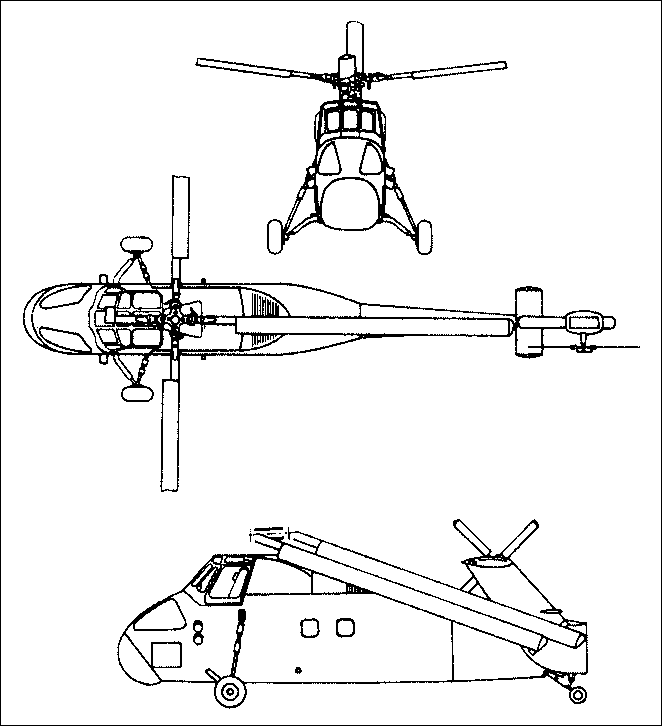
The Westland Wessex is a turbine-powered development of the Sikorsky S-58. VERSIONS Wessex HAS. Mk 1: Initial production version, developed for the Royal Navy, with one 1,450shp Napier Gazelle 161 turboshaft engine. Re-engined with a 1,100shp Gazelle NGa.11, flew for the first time 17 May 1957. Withdrawn from service. Wessex HC. Mk 2: High-performance development of the Mk 1 with two coupled 1,350shp Bristol Siddeley Gnome Mk 110/111 turboshaft engines. Power limitation of 1,550shp at rotor head. Prototype converted from Wessex 1, flew for the first time 18 January 1962, and the first production model (XR588) 5 October 1962. Still in service. Wessex Mk 3: Similar to Mk 1, but with 1,850shp Gazelle NGa.18 165 turboshaft engine. Not in service. Wessex HCC. Mk 4: Queen's Royal Flight helicopter. Wessex HC. Mk 5: SAR helicopter of the Royal Air Force based in Cyprus. Wessex HU. Mk 5: Similar to Mk 2, for Commando assault duties from carriers of the Royal Navy. Design work began in April 1962 and construction of the prototype was started in May 1962. In service with A&EE (1) and 84 Squadron Akrotiri Cyprus (5). Wessex HAS. Mk 31: Generally similar to Mk 1, but with a 1,540shp Gazelle Mk 162 engine. Ordered for the Royal Australian Navy for anti-submarine duties from HMAS Melbourne. Withdrawn from service. Wessex Mk 52: Similar to Mk 2, for Iraqi Air Force. Withdrawn from service. Wessex Mk 53: Similar to Mk 2, for Ghana Air Force. Withdrawn from service. Wessex Mk 60: Civil version in service with Uruguayan Navy. DESIGN FEATURES: Main and tail rotor each have four blades. Blades attached to hub by taper bolts. Main rotor blades fold manually. Rotor brake fitted. Shaft drive to main rotor through double epicyclic gear. Shaft drive to tail rotor through intermediate and tail gearboxes. Tail end folds to port and forward for stowage. Tail rotor carried at tip of vertical stabilising fin. Small horizontal stabiliser inset in leading-edge of fin. STRUCTURE: All blades of light-alloy extruded spar and light-alloy bonded trailing-edge structure. The fuselage is a light-alloy semi-monocoque structure, with steel tube support structure for main rotor gearbox. LANDING GEAR: Non-retractable tailwheel type. All three units fitted with Westland oleo-pneumatic shock-absorber. Dunlop wheels, tyres and hydraulic disc brakes. Tubeless treaded mainwheel tyres, size 6.00 x 11. Tailwheel tyre size 6.00 x 6. POWER PLANT: (Mk 2): One Bristol Siddeley Gnome Mk 110 and one Gnome Mk 111 turboshaft engines, with Type 10 coupling gearbox. Rated at 1,350 shp per engine; 1,550shp at rotor head. Two flexible fuel tanks under cabin floor, total capacity 1,409 litres. Provision for carrying two 500 litre auxiliary tanks in cabin for ferry purposes. Refuelling point in starboard side of fuselage. Oil capacity 9 litres per engine, 19 litres in main gearbox. POWER PLANT: (Mk 5): One Bristol Siddeley Gnome Mk 112 and one Gnome Mk 113 turboshaft engines, with Type 11 coupling gearbox. Otherwise as for Mk 2. ACCOMMODATION: (Mk 2): Crew of one to three according to role. Up to 16 passengers in main cabin, on folding troop seats, or up to eight stretchers in banks of four. Doors on each side of flight deck and on starboard side of cabin. ACCOMMODATION: (Mk 5): Crew of one to three according to role. Three fixed troop seats, and either 13 removable folding seats or eight stretchers, or 1,814kg of freight. SYSTEMS: Compressor bleed air for heating. Ambient air circulation by fan. High-pressure hydraulic system for powered flying controls and 272kg capacity hoist. 24V DC electrical system, with two 6kW generators. Jane's Helicopter Markets and Systems
- Australia's navy flew 27 Wessex helicopters on anti-submarine duties starting in August 1962. - Westland's first prototype, a rebuilt Sikorsky S-58, flew on 17 May 1957. - Users of the versatile Wessex include Australia, Brunei, Ghana and Iraq. - The Wessex had top priority and in 1960 Westland halted work on a larger 'heavylift' helicopter. - A Wessex fired AS.12 missiles at an Argentine commander in the Falklands. - Australia's Wessexes used Gazelle engines instead of coupled Gnomes.
|