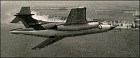
A brilliant design, far ahead of its time. Featured a greenhouse at the front where vegetables could be grown in the event of a nuclear war.
Robert Willis, e-mail, 13.10.2022 00:49
re. "The first flight-quality 222s did not arrive until October 1941, and even at this point it was clear they were nowhere near ready for full-scale production." - Misleading. The original series Jumo 222 A/Bs were in fact very close to being ready for full scale production, with only some relatively minor teething problems to be cleared up. The problem is that the RLM was constantly changing the aircrafts requirements; insisting on much heavier defensive armament, longer range, higher altitude, a larger cockpit for a crew of four instead of the original 3 and other changes that resulted in drastic weight growth. As a result, it was no longer possible to attain the demanded speeds from the by now well-developed Jumo 222 A/B. This forced Junkers to embark on the very difficult and expensive process of developing multiple ever larger and more powerful versions of the engine which never had enough time to properly mature. IMHO the Ju 288 V8 prototype should have been the basis for series production which could easily have begun in early 1943.
Mark, e-mail, 20.09.2012 17:07
Prior to the opening of World War II, the Luftwaffe bomber force was primarily aircraft of limited performance, some originally developed with civilian uses in mind as well. The only truly modern design in the inventory was the Ju 88, and although it outperformed the other designs it had numerous problems of its own. Perhaps most notable among these was its very small internal bomb bay that forced it to carry some of its load externally, slowing performance.
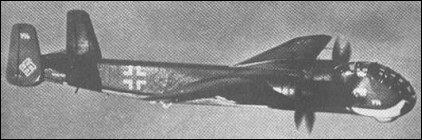
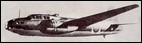
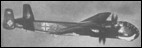
Junkers had been experimenting with a variety of improved models of the Ju 88 since 1937, powered by the Jumo 222 or 223 inline engines of greatly increased power. No serious work was undertaken on these versions, but after Heinrich Hertel left Heinkel and joined Junkers in 1939, the EF 074 design was submitted to the RLM in May 1939. The EF 074 entry was essentially a scaled-up Ju 88, sharing its general layout and most of its fuselage and wings with extensions in various places. The nose was completely redesigned, however, and featured a pressurised cockpit. All of the defensive armament was remotely-controlled, allowing it to be located in useful positions as well as eliminating "breaks" in the fuselage pressurization. The fuselage was expanded along its length to allow for a much larger bomb bay that would allow for an 3,630 kg (8,000 lb) payload to be carried internally, eliminating the need to carry ordnance on outside hardpoints. Performance would be greatly improved over the Ju 88, both due to the all-internal bombload and the greatly improved power. Ju 288 V1 prototype (twin BMW 801)
Accordingly the RLM sent out the specifications for Bomber B in July 1939, the Ju 88 retroactively becoming the second aircraft to be designated Bomber A in the Luftwaffe's existence. (The original usage, dating from 1936, was the specification for what became the He 177). The Bomber B program aimed at replacing all of the medium bombers in the Luftwaffe inventory with a new design based on the EF.74 or something with equal performance. Bomber B was intended to have even better speed than the Ju 88, high-altitude cruising with a pressurised cockpit, heavier defensive armament, range allowing it to cover any point in the British Isles, and a massive 4,000 kg (8,820 lb) warload, double that of the earlier generation bombers. A number of companies returned proposals, but these were to some extent a formality, the EF.74 had already been selected as the winner, and of the rest of the designs submitted, only the Focke-Wulf Fw 191 and Dornier Do 317 progressed even as far as prototypes, with the Henschel Hs 130 even coming under consideration as a late entrant.
Work began on building prototypes soon after, and the first example was completed by mid-1940. Power was supposed to be supplied by two 24-cylinder Jumo 222 six-bank, four cylinders per bank, hyper engine output class powerplants, but problems with 222 development meant the first prototypes flew with BMW 801 radial engines, instead. The first flight-quality 222s did not arrive until October 1941, and even at this point it was clear they were nowhere near ready for full-scale production. When it became apparent the 222 was not likely to become a viable powerplant, in May 1942, Junkers proposed replacing them with the much heavier Daimler Benz DB 606s instead, the very same "welded-together engines" that Reichsmarschall Hermann Göring complained about four months later, regarding the He 177's own endless powerplant troubles.
As these technical difficulties were being addressed, the lack of a strategic bombing doctrine within the Luftwaffe meant the mission and purpose of the Ju 288 remained nebulous throughout its development. As an interim measure, RLM ordered the Junkers Ju 188, which was a fairly minor upgrade of the original Ju 88 incorporating the basic cockpit design of the never-produced Ju 88B. Work continued on the 288 throughout, but in 1944 the project was finally abandoned as Luftwaffe priorities became more intensely focused on homeland defence. Operations
Although the 288 never even reached production status, let alone official operational service, the aircraft did see limited combat duty. In 1944, following the cancellation of the 288 programme, the surviving A and C series prototypes were hurriedly fitted with defensive armament and equipment and deployed as reconnaissance bombers on the Western Front. Very few missions were flown, owing to the scarcity of spare parts and the unresolved problems with the aircraft's powerplant and undercarriage. It is believed that the 288s were attached to the same unit operating the small number of Ju 388 reconnaissance planes that saw service; the loss of much of the relevant documentation at the end of the war means precise facts about the 288's brief combat career will always remain elusive. Variants
Ju 288A - first seven prototypes with BMW engines Ju 288B - seven prototypes with slightly enlarged airframes and better defens ...
Mark, e-mail, 20.09.2012 17:04
Ju-288b
Crew: 4 Length: 17.8 m (58 ft) Wingspan: 22.7 m (74 ft 4 in) Height: 4.50 m (14 ft 9 in) Wing area: 64.6 m˛ (696 ft˛) Loaded weight: 20,950 kg (46,186 lb) Max. takeoff weight: 21,000 kg (46,300 lb) Powerplant: 2 × Daimler-Benz DB606 24-cylinder "coupled" engine system, made from twinned DB 601 inverted V12 engines, 2,700 PS (1,985 kW, 2,663 hp) each
Performance
Maximum speed: 620 km/h (388 mph) Range: 2,700 km (1,678 mi) Service ceiling: 9,300 m (30,500 ft) Rate of climb: 435 m/min (1,420 ft/min)
Armament
Guns: 4 × 13 mm (.51 in) MG 131 machine guns 1 × 15 mm (.59 in) MG 151 cannon or 20 mm MG 151/20 cannon Bombs: 3,000 kg (6,610 lb) of bombs
paidui, 20.06.2011 11:14
the Germans probably invested more time, effort and money on this aircraft, for less material return, than any other aircraft in history.
bombardier, e-mail, 17.05.2011 12:12
The Germans should have fitted the DB606/DB610 from the beginning of the program.Had they done so production aircraft would have been available in late 1942-early 1943.These aircraft would have been devastating because they had enough range to attack Britain with a worthwhile load without needing vulnerable bases in France and because they could fly higher and faster than most opposition
Klaatu83, e-mail, 05.03.2011 20:41
The little-known Ju-288 was one of the most disastrous aircraft programs of World war II. With the possible exception of the Convair 880 jet airliner of the late 1950s, the Germans probably invested more time, effort and money on this aircraft, for less material return, than any other aircraft in history.
Fatal error: Uncaught Error: Undefined constant "isMob" in /data03/virt15346/domeenid/www.aviastar.org/htdocs/comments/comments.php:165
Stack trace:
#0 {main}
thrown in /data03/virt15346/domeenid/www.aviastar.org/htdocs/comments/comments.php on line 165