|
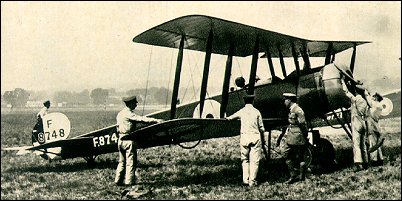
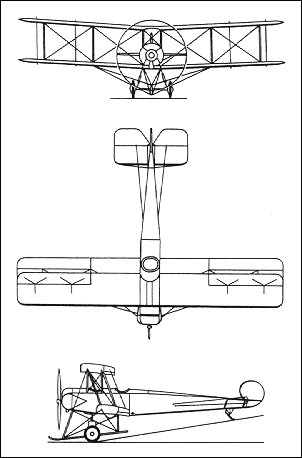
| Non-specialist readers will know, and perhaps remember, the participation in World War II of such aircraft as the Avro Anson and Lancaster. They may not have heard of the Avro 504, yet this little two-seat trainer must be numbered among the great aircraft of British aviation history.
The 504 was designed in 1912 and it was decided to introduce this aircraft to the aviation scene by entering it for the second Aerial Derby, which was scheduled for 20 September 1913, to gain as much interest and free publicity as possible. Thus, it was built behind closed doors and when subsequently flown to Hendon to take part in the race it was seen in public for the first time. It was perhaps something of an anticlimax that it did not win, coming in fourth at an average 107km/h. But this was a considerable achievement for an aircraft first flown only three days previously.
Production of 12 504s for the War Office began in the summer of 1913, the first of more than 8,000 for military service to be built during World War I. Successive variants were to remain in production for almost 20 years. The last to be operated by the RAF were seven civil 504N impressed for service in 1940 and used for glider-towing.
The 504 was designed for training and private flying, and few could have foreseen that this aircraft would ever be flown in anger. Yet when the RFC's No 5 Squadron flew to France on 13 August 1914, its small force included several 504s.
Although little used in military operations, the type is remembered for an attack on the German Zeppelin sheds at Friedriehshaven, carried out on 21 November 1914 by three 504s of the RNAS, each armed with four 9kg bombs. One Zeppelin was destroyed in its shed and hits on the associated gasworks resulted in an explosion which caused great damage.
This lightweight but robust biplane proved to be a superb training aircraft. When Maj R. R. Smith-Barry became commander of No 1 Reserve Squadron at Gosport in 1916, he evolved a completely new system of flying instruction based on demonstration and explanation. So good were the results that this squadron was developed into the School of Special Flying - using the Smith-Barry system and Avro 504J - with pupils encouraged to fly these aircraft to the limit of their capabilities. Later 504Ns were equipped especially for use by the RAF's Central Flying School, becoming the first instrument or blind-flying trainer to serve with the RAF.
Extensively built by A. V. Roe for home and export customers, in both civil and military guises, 504s were also built by manufacturers in Australia, Belgium, Canada, Japan, Netherlands East Indies, and Russia.
In an era when the general public regarded aviation as a form of transportation suited only to the brave or foolhardy, the 504 was used by Sir Alan Gobham's "Flying Circus" and Capt Percival Phillips' Cornwall Aviation Company, carrying large numbers of civilians on their first flight. It has been reported that Capt Phillips alone carried something like 91,000 passengers into the air, the majority of them in an Avro 504.
| CREW | 2 |
| ENGINE | 1 x Gnome, 74kW |
| WEIGHTS |
| Take-off weight | 816 kg | 1799 lb |
| Empty weight | 499 kg | 1100 lb |
| DIMENSIONS |
| Wingspan | 11.0 m | 36 ft 1 in |
| Length | 9.0 m | 30 ft 6 in |
| Height | 3.2 m | 11 ft 6 in |
| Wing area | 30.6 m2 | 329.38 sq ft |
| PERFORMANCE |
| Max. speed | 132 km/h | 82 mph |
| Ceiling | 3960 m | 13000 ft |
| Range | 300 km | 186 miles |
| ARMAMENT | 1 machine-guns, 4 x 9kg bombs |
| Sooraj kiran, e-mail, 31.10.2016 08:44 When the original AVRO company records caught fire in 1958 and were lost, UK started recording aviation history only after 1960 after recovery from the two world wars. AVRO history was rebuilt from the individual records, AVRO School at Brooklands and also its correspondence held by Royal air force. As S.V SETTY's personal records were in India, his name was excluded from AVRO history. Another interesting fact is recorded in one of the websites that," 1912 is a very important year as far as AVRO developmental history is concerned". S.V SETTY obtained experience certificate from HVRO(brother of AVRO) in which it was clearly stated that he has worked in the designing of his, some of the new types of machines which are Duigan aircraft, type E,F and AVRO 500. The autobiography of AVRO clearly states that S.V SETTY has worked in designing of 500 and 501. The interesting part is that 501 is originally called as type H, hence , if you sum up both AVRO and HVRO statements the following conclusions can be drawn,
• He worked in type D, TYPE E,
• He worked in designing of the following models i.e. type F,500, type G and type H(501)
Having been involved himself in the above models, if he has designed AVRO 504 it is not so great. reply | | Sven, 12.01.2012 23:25 The aircraft refered to by Doudlas can still be seen performing regularly at the Shuttleworth collection. reply | | Frank Russell, e-mail, 12.01.2012 05:55 I saw my father,flying AVRO 504s at RCAF Camp Borden in the late 1920s when the RCAF and I were about the same age --- reply | | Douglas L Clark, e-mail, 17.09.2011 21:59 At 15 years of age in 1955 I joined Avro as an apprentice at the Woodford facility. I was set to work with a group of 5 or 6 skilled men who were building from scratch a 504K. This was taking place in a relatively small area at the head of the Shackleton Mk. 3 production line and alongside the Vulcan production line. This brand new 504 was built to be used in the making of the film Reach for the Sky, the story of Douglas Bader the WW II Spitfire pilot who had learned to fly in an Avro 504K. In the three months from me joining Avro and the 504 being completed and ready for her maiden flight the sight of Wing Commander Roland Falk taking Vulcan bombers from the production line to be given their first test flights became almost commonplace. To see this same pilot climb into a 1913 designed biplane and carry out aerobatics over Woodford Aerodrome is something quite staggering. After the Reach for the Sky film had been completed the 504 went to the Shuttleworth Collection. There is also an Avro 504K on display at the Science Museum, Kensington, London. Recently my wife and I visited the museum and I was describing what I knew about the aircraft when a member of staff came over and commented that I was well informed, when I told him that I had worked at Avro's building a similar aeroplane he very affably suggested "sorry Sir, that's not possible, they were built before you were born". reply | |
| | James Vicars, e-mail, 05.02.2011 02:04 Can anyone confirm if 1) the passenger sat in front of the pilot in this type, and 2) if there were dual controls. also, what did, um, the seating arrangements consist of? reply | | JAYAPRAKASH, e-mail, 12.01.2011 16:46 Thank you very much for bringing up of one more strong evidence on S.V.Setty's presence in the design office of AVRO during the pioneering years of AVRO COMPANY (1911-1913). reply | | Nick Forder, e-mail, 06.12.2010 19:23 "In writing of the past I do not like to say that I designed this or that aeroplane, for even if a machine is of one's own conception, yet there must necessarily be others who played an important part in its final details and construction. Pioneers in any line are sure to have assistants who think they have done the deed themselves, and perhaps the following may indicate this trait.
At Brooklands in 1911 an Indian student joined us. As he had some drawing-office experience at a technical college, he assisted me in getting out drawings of the '500' and '501' types, which were then sent to our Manchester works to be actually built. I noticed whenever I had occasion to leave the aerodrome that on my return little had been done. I asked him the reason, and he always had some excuse that he wished to ask me about some detail or other. Later he returned to India, and one day I received from him an Indian newspaper in which I read an account of a dinner that was given him to celebrate the fact that he had been responsible for designing an aeroplane which had been ordered by the British Government in large numbers !"
Ref : The World of Wings and Things, Sir Alliott Verdon-Roe reply |
| martin aaron, e-mail, 10.05.2009 20:08 im a self employed carpenter /cabinet maker of many years, ive just been asked to restore the prop. of an A.V ROE 504 including (plugged) bullet holes! i feel after reading about this aircraft and its history, that to do it justice i need as much information as i can possibly get! can you help? please e-mail me! reply | | Jock Williams, e-mail, 16.04.2009 09:34 I checked out in the 504 under the tutelage of famous Canadian test pilot George Neal in 1980 in Edmonton Canada. As an Air Force pilot I had flown a CF5 to the event -at an average speed of 480 knots -and so the checkout a half hour later at 80 mph was quite a contrast!
George pointed out the differences -like lack of a throttle and brakes -and since he knew I had owned a Tiger Moth for about 10 years by this time, correctly assumed that I knew how to fly an old biplane.
The 504 was an absolute delight! It was a stately old matron -but you had to keep your eyes on the "ball" to keep it coordinated -and of course the "blip switch" which killed the engine on final approach was unusual for a guy used to reducing the throttle as I was!
Nonetheless -the 504 flew like any other well designed aircraft of its era -although if I remember the total instrumentation was a tachometer, an oil pressure indicator, a wing mounted airspeed indicator and a very primitive airspeed indicator.
On the other hand -what else do you need?
This single check flight qualified me to fly the Sopwith Pup (actually built by George!) and the Nieuport 17 which (sad to report) I ended up crashing in in 1989!
Perhaps it is true that every upside in aviation has its downside?!
Incidentally all these planes are on display at the Canadian Air Museum in Rockliffe (Ottawa) Ontario Canada.
Jock Williams Yogi 13 reply | | JAYAPRAKASH, e-mail, 03.11.2008 17:05 It appears to me that, under the supervision of A. V. Roe, S. V. Setty started designing AVRO-504 after the successful testing of AVRO-500(April 25th 1912). He completed the design of AVRO-504 by the end of June 1912. During this time he was presented an Gold Medal by A. V. Roe for having worked on two Aircrafts (Duigan-AVRO and AVRO-500) and desining two Aircratfs (Duigan-AVRO and AVRO-504).
[References can be obtained from Early Aviator.com - In an Interview to Modern Review(India) JULY 1912 S. V. Setty has said that he was designing a new type of Biplane, which invariably refers to AVRO-504.] reply |
|
Do you have any comments?
|
| 
COMPANY
PROFILE
All the World's Rotorcraft
|




20
reply