|
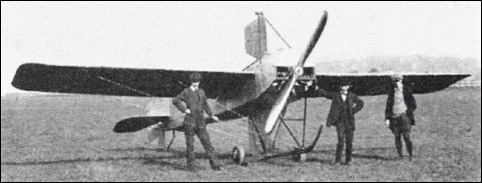
| In 1912 A. V. Roe and Company built a shoulder-wing monoplane to the
designs of Lt. Burga of the Peruvian Navy, who wished to tryout some highly original ideas on aircraft control. The machine was constructed at Brownsfield Mills at the same time as the Avto Type E ptototype and used the same tail and undercarriage, but the fuselage was much slimmer and the engine a 50hp Gnome rotary. It is probable that the Burga monoplane was, in fact, the Avro 502 of which no details survive except that it was a single seat monoplane.
Rectangular monoplane wings were wire braced to strong points on the
undercarriage and to a pylon built above the fuselage. There was no wing
warping, lateral control being obtained by two "rudders", one above and one below the fuselage, working in opposite directions. The design made provisions for wings of varying camber which fitted at varying angles of incidence to give the machine any desired performance.
Lt. Burga took a shed at Shoreham where the machine was test flown on
November 20, 1912 by H. R. Simms. The mainplanes fitted wete those
best suited for maximum speed and the pilot reported that it was certainly
fast and had a good tate of climb. Further taxying trials were made by H. S.
Powell in the following month, and in Januaty 1913 the Burga monoplane
returned to the Avro works at Manchester for modification.
| ENGINE | 1 x 50hp Gnome |
| DIMENSIONS |
| Length | 8.84 m | 29 ft 0 in |
| Sergio de la Puente, e-mail, 01.04.2012 17:58 This plane was sent to Peru in late 1913, but Lt. Burga stayed in England, so when the ship arrived to Peru nobody knew what to do with it. After several attemps, the Peruvian authorities declared the plane as "unable to fly". In 1915 Burga itself tried to repair the plane, but it never flied again... reply | | Nick Forder, e-mail, 06.01.2011 15:17 The Burga was Roe's attempt to build a 'Nieuport IV-type' monoplane, and the extent of the latter's influence on the design is clear.
Roe set Sippe and Setty to produce detailed and general arrangement drawings of a monoplane, at Brooklands, in August 1911. The monoplane was substanially complete at Brownsfield Mill by January 1912 (or before), but had stopped by then. The reasons for this would appear to be the priority of completing the 'Type E development aircraft'(worked started in September or November 1911, depending on sources used)for which there was a cash customer (Duigan), the Type E 'Military Biplane' (completed in February)and the Type F (started in January and completed in March). One wonders if there were issues relating to finance from Burga too ?
The Avro 502 was the designation given to the 5 single-seater Type E (later 500)sold to the War Office. The RFC designated the 502 the Type Es.
Perhaps one should view the Burga as the first aircarft that marked a progression from the development of the 'pioneering' Avros leading back to the first triplanes and set Roe on the path which was to lead to the first 504 in 1913 ? reply | | chaiwat kosatanakom, e-mail, 12.08.2009 05:19 I am looking for the avro data which once served in RTAF, however, this available data is too limited so it would be very kind of anyone if you kindly please provide me some additional data. Thank you. reply |
|
Do you have any comments?
|
| 
COMPANY
PROFILE
All the World's Rotorcraft
|