|
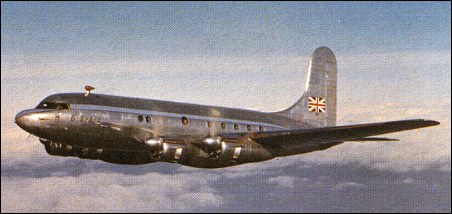
| The original Type 688 Tudor was conceived in 1943 to Specification 29/43 as a commercial conversion of the Lancaster for use over the North Atlantic as a quick replacement for the bomber-transports then being used. As then envisaged, the Tudor was to be a modification of the Lancaster IV (later the Lincoln) with a new pressurised fuselage to carry a load of 1,705kg over 6,400km. Following the issue of the specification to Avro in March 1944 two prototypes were ordered and production contracts for BOAC (14 aircraft, plus six later) followed later in the same year and in 1945.
While development of the original Tudor continued - despite many difficulties - a new version with considerably lengthened fuselage was planned. This version was intended for use on the BOAC Empire routes; two prototypes were ordered in 1944, followed by production contracts. By this time the first version of the Tudor was available in its production form, but BOAC requirements had altered. This, and the aircraft's shorter than planned range, meant that the Tudor was no longer required as a passenger-carrying transport. British South American Airways Corporation (BSAAC), however, began using a modified version on their route to South America in 1947, and some of the aircraft laid down for BOAC were turned over to this operator. The Tudor 2 (with the lengthened fuselage) suffered a similar fate, and these were planned for conversion to freighters for BOAC.
Following the unexplained disappearance of two of BSAAC's Tudors in January 1948 and January 1949 while on passenger services, the Minister of Civil Aviation decreed that the type should no longer be used on passenger routes. The ban on passenger carrying lasted until 1954 when a Tudor belonging to Aviation Traders received an unrestricted C of A for passenger flights - following extensive modification to the aircraft which included fitting 1,311kW Rolls-Royce Merlin 623 engines. Virtually all surviving Tudors were similarly modified by Aviation Traders. Five Tudors were later further modified by fitting large freight doors; known thereafter as Super Traders, they remained in service until 1959.
The versions of the Tudor are listed below:
- Avro 688 Tudor 1. Powered by four Rolls-Royce Merlin 102, 621 or 623 engines. The original short-fuselage Tudor for the Atlantic route, seating 12-24 passengers. First flown 14 June 1945;
- Avro 689 Tudor 2. Four Rolls-Royce Merlin 102 or 621 engines. The original long-fuselage version for BOAC South African and Australian routes. Accommodation for up to 60 passengers. Thirty production aircraft ordered in November 1944 and a further 49 in April 1945, plus six to be built in Australia. Order reduced to 50 in 1946 and 18 in 1948. Final 18
were to consist of two Mk 2s for development work, six Mk 5s for BSAAC - and ten modified to freighters for BOAC.
- Avro 688 Tudor 3. Two additional Mk I airframes converted by Armstrong Whitworth for use as VIP transports by ministers.
- Avro 688 Tudor 4. Four Rolls-Royce Merlin 621 or 623 engines. A modification of the Tudor 1 to meet BSAAC requirements. Fuselage lengthened by 1.83m and accommodation for 32 passengers. Four aircraft originally ordered. Subsequently augmented by conversion of BOAC Mk Is.
- Avro 688 Tudor 4B. Two Tudor Is of BOAC contract modified to have lengthened fuselage of the Mk 4 for use by BSAAC, but retaining the flight engineer's station as on Mk I. Accommodation for 28 passengers.
- Type 689 Tudor 5. Four Rolls-Royce Merlin 621 engines. A modification of the Tudor 2, of which six were completed, five for BSAAC. Accommodation for 44 day or 36 night passengers. BSAAC aircraft delivered without passenger seats and used on Berlin Airlift. Sixth airframe converted to have four Bristol Hercules 120 engines.
FACTS AND FIGURES © The Tudor I was designed for
only 12 passengers, but later
models could carry 80.
Unfortunately, in total only
11 of the longer, wider Tudor
2, 5 and 11 models were built. © By 1945 most new
transport aircraft had
tricycle undercarriage and
level floors, but the Tudor
retained the tailwheel layout
of the wartime Avro
bombers. Pronounced
swinging on take-off was a
common problem. © The Merlin engine helped win the
war but it was less suitable for a
civilian transport aircraft.
Contemporary American airliners
were using powerful radials, and
had transatlantic range, which the
Tudors didn't.
| MODEL | Avro 689 Tudor 2 |
| ENGINE | 4 x Rolls-Royce Merlin 621, 1320kW |
| WEIGHTS |
| Take-off weight | 36280 kg | 79984 lb |
| Empty weight | 21000 kg | 46297 lb |
| DIMENSIONS |
| Wingspan | 36.58 m | 120 ft 0 in |
| Length | 32.18 m | 106 ft 7 in |
| Height | 7.39 m | 24 ft 3 in |
| Wing area | 132.01 m2 | 1420.94 sq ft |
| PERFORMANCE |
| Max. speed | 475 km/h | 295 mph |
| Cruise speed | 378 km/h | 235 mph |
| Ceiling | 7790 m | 25550 ft |
| Range | 3750 km | 2330 miles |
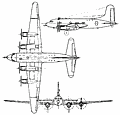 | A three-view drawing (700 x 669) |
| Trevor Webb, e-mail, 24.01.2021 06:50 Noting an old posting about the jet powered Tudors, some sources give slightly different details. The Tudor 8 is listed as a Tudor 1 airframe fitted with four of the Rolls Royce Nene 4 engines. Six Tudor 2 airframes were completed initially as the Tudor 9 and then called the Ashton. These were powered by four of the Nene 6 and had a tricycle undercarriage. reply | | jtckent@yahoo.co.uk, 22.10.2016 15:53 Structual failure - unlikely - Avro aircraft were well built
Engine fires - unlikely. Fuel starvation - possible - reserve cocks were in the pax cabin (why?) total navigation /radio etc.,systems failure ? sabotage ? fire - unlikely - the W /Op would have had time to send SOS then "clamp" the key. Altimeter - the 3 pointer type was still in use despite it being dangerous as it could be misread so flight into the sea ? CO poisoning from heaters ? pressurisation failure ? failed hi-jacking - unlikely. Remember - most of the pilots /Flt Engrs /W.Ops were ex Bomber Command so were experienced reply | | Charles Milner., e-mail, 25.05.2012 21:07 In 1950 I flew from Johannesburg to London on a Tudor, it belonged to a charter company my father sold tickets for.
I remember we took 3 flying days to London (no night flying).
I do remember (I was a 4yo) stopping in Nairobi and being driven around a game reserve in the evening. I cannot remember the other stop.
I still have my childish drawings of the plane.
My first ever flight as a 3 yo was from Johannesburg to Cape Town in a Viking. reply |
| Steve Rickard, e-mail, 11.02.2011 04:24 Avro got a lot of distance using the Lancaster wing, with the York and the Tudor. One article I read had a statement from a BSAA pilot the Tudor had the worst systems he had ever seen. Most tudors on the Berlin
ailift were used as tankers. RAF and British civil contractors delivered about 31% of he total tonnage flown
to Berlin. The rest by the USAF. reply | |
| | Kinta Jennings, e-mail, 24.01.2011 00:10 Kia Ora,
Am trying to get in touch with someone re the photographs on this website and if it would be possible to get permission to use them in a television broadcast we do in New Zealand for ANZAC (Australian & New Zealand Army Corps.) Day - April 25th. Would be great if someone could please get in contact with me.
Thanks,
Kinta reply | | Barry, 20.01.2011 13:06 It was in an Avro Tudor V that the deigner of the Lancaster and Lincoln and in fact the Tudor itself, Roy Chadwick, lost his life. He went up in a test flight where control wires had been crossed over and the pilot failed to notice in his pre flight checks. The plane took off and promptly nose dived killing both Chadwick and the pilot.
This plane was a very poorly put together aeroplane and a great disservice to the name of Avro. An example of how bad, was that the heating was provided by bleeding off fuel from the fuel tanks. Consider that high octane aviation fuel to heat the aeroplane what a great idea! reply | | anthony leyfeldt, e-mail, 06.01.2010 00:09 Just to reed about the Avro Tudor, it fascinates me..her history and I am very lucky to get original pictures of the Tudor 8 fitted with 4RR nene turbojets, just what Peter reed is mentioning.
Is there still something, somewhere left of these Tudors?
Still a fascinating aircraft, just like the Vickers Viking.....but that is another story reply | | Rhodri Thomas, e-mail, 24.11.2009 13:19 To gerwyn Morgan.
Yes you are right it was an Avro tudor 5 tail no G-AKBY, (STAR GIRL)It crashed on the approach to Llandow airport, killing all but three of the passengers and crew. My father Mel Thomas is now the only living survivor of the air crash, and it will be 50 years since the crash in march 2010. reply | | Salil, e-mail, 18.09.2009 20:02 today i seen Avro's (2 engine) landing and take-off, its really miracle compare to jet liners. I do not know about it model, but it is still in use in defence. so open search page for avro. reply | | Mike Hosgood, e-mail, 05.06.2009 18:05 I seem to recal that at the time BSAAC were flying the Tudors to South America, no one else had even attempted this. This loss of Star Tiger and Star Aries were used as a political excuse to cut back on the Tudors and order some DC 4's and 6's as part of a complex deal to get cheap grain from the U.S.
Had the development of the Tudor 8 continued, it may have been in service at the same time as the Comet.
The Tudors were reputed to have carried a larger tonnage during the Berlin Airlift, than any other aircraft.
Just another example of Politicians destroying British Industry as the did with the TSR 2 and Blue Steel. reply | | Sgt.KAR98, 15.11.2008 21:35 Nice plane,looks a prettier DC-3 reply | | Gerwyn Morgan, e-mail, 01.09.2008 22:11 I think i am right in saying that a Tudor crashed as it approached Llandow Airport near Cardiff in March 1950 killing some 75 passengers and crew. The aircraft was on a return charter flight from Dublin and was full of Welsh rugby supporters. The crash was the worst airliner disaster up to that time. reply | | Michael CROSS, e-mail, 12.04.2008 13:55 Does anybody have the company records for these aircraft, I have a merlin engine from one of these aircraft, and am trying to trace the history. reply | | Peter Reed, e-mail, 06.10.2007 22:30 A correction: The sixth Tudor 5 was completed as a Tudor 5, not as the Hercules engined aircraft. The Hercules engined aircraft, G-AGRX, was a converted Mk 2, called the Tudor 7.
There was also the Tudor 8, which was a Mark 4 fitted with 4 RR Nene turbojets.
The most commonly overlooked fact about the Tudors may be that the long fuselage Marks (2,5 and 7) were not only longer bu WIDER--a different diameter fuselage tube than the Marks 1,3,4, 4B and 8. Some of the larger Tudor airframes were completed as Ashtons (jet powered, tricycle undercart). reply | |
| | ian kidger, e-mail, 28.09.2007 19:15 do u think the b.s.s.a tutors that went missing could have had a weakness in the air frame? reply |
|
Do you have any comments?
|
| 
COMPANY
PROFILE
All the World's Rotorcraft
|

 Charles Milner.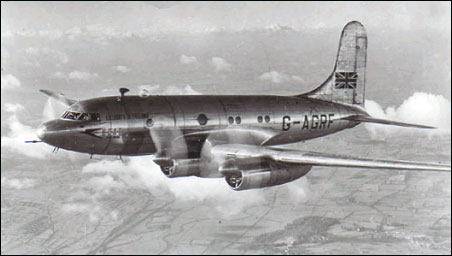


Hi Charles. I’ve attempted to send you a detailed email.If not received, please notify me and I’ll resend. Thanks, Anthony
reply