|
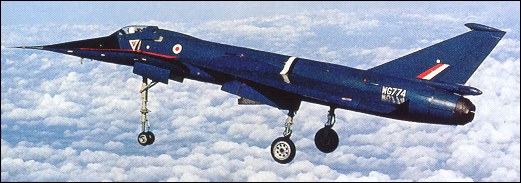
| Test aircraft modified from F.D.2 to test the delta wing of the "Concorde". The first flight was on May 1, 1964. FACTS AND FIGURES © An ogival wing was chosen to give the best combination of lift, drag and stability characteristics at high Mach numbers. © Fixed inlets for optimum performance at Mach 1.5-1.75 were chosen for simplicity. © Some parts of the control system were based on those of the Hawker P.1127. © One of the BAC 221's hydraulic systems was similar to that of the Bristol 188; the second was similar to that of the P.1127. © Continuous voice transmission enabled the chase-plane to hear the 221 pilot. © The blue finish was applied to make the woollen tufts stand out better on film.
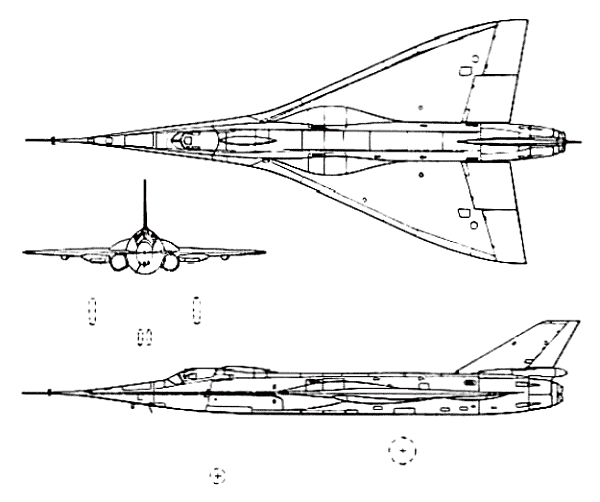
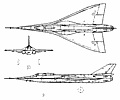 | A three-view drawing (600 x 502) |
| CREW | 1 |
| ENGINE | 1 x 5000kg |
| DIMENSIONS |
| Wingspan | 7.62 m | 25 ft 0 in |
| Length | 17.55 m | 58 ft 7 in |
| Height | 3.96 m | 13 ft 0 in |
| Wing area | 46.82 m2 | 503.97 sq ft |
| PERFORMANCE |
| Max. speed | 1707 km/h | 1061 mph |
| John White, e-mail, 03.10.2015 14:53 I worked on theT221 in the 60's Our department removed the wings from the Fiarey Delta 2 which at one time held the speed record and built & fitted a concord shaped wing. I worked on nights doing this & later back onto days when the wings were ready to be fitted to the fuselage. I went to Boscombe Down to test the new type of cockpit, all plastic as the FD had an all metal one the plastic one would allow the ejector seat to be fired through it if anything went wrong & the pilot needed to bail out. Earlier I had worked on the T188 the all stainless steel Research aircraft that was, I believe to test the engines & air intakes at high speed & altitude, especially at high altitude where Concord was going to Operate. I was an apprentice from 1955 to 1960 and was sent to the MDD dept in the last two years of my apprenticeship and stayed in that dept until Concord flew & two days later I joined the Bristol Ambulance Service reply | | martin williamson, e-mail, 08.01.2015 08:36 my father talked about flying both the 221 and the 188 often, they had to adjust the canopy, to fit his helmet (willie williamson) reply | | John Munro, e-mail, 09.10.2014 16:48 I was a Graduate Apprentice at Filton 1961-1963 and spent some time in the Concorde hangar where the T188 and T221 were in the final stage of production. Worked on the control cables of the T188 and the fuel tanks of the T221, fascinating. Sadly unable to remember the name of the Project production manager who tolerate my many 'naive' questions and comments.
Was in the the new projects office when the Vulcan test bed went up in smoke as did the company fireengine!!! reply | | Susannah Baring Tait, e-mail, 28.09.2013 23:33 I was the only girl apprentice at Filton that time and this picture brings back memories. Does anyone remember when the Concorde's test engine flew off the Vulcan Bomber, at the end of the runaway, and it almost hit the 188 parked further up, plus another couple of planes parked on the apron? The brand new Works' fire engine went up in flames because it drove under the Vulcan's wings trying to rescue the pilots and got drenched in fuel. Escaping firemen running all over the place! So the Bristol fire engines eventually arrived and saved the day. I had been enjoying a quiet lunch sandwich whilst sitting out on the grass 'verge' when it all happened in front of me...... I loved gazing the 188; it was a marvel of engineering and design. reply | |
| | Colin Stevens, e-mail, 26.06.2013 17:22 I was on vacation from the States recently and decided to visit the museum at Yeovilton. Well you could have knocked me over with the proverbial feather when I saw the 221 standing there. I was an apprentice at the time and can remember the previous contributer Terry Flower very well. I litereally clambered over the entire airplane during the course of my workshop training. I sat in the cockpit (minus ejector seat and had the canopy closed on me. I then had to measure gaps between the canopy and main structure with feeler gauges and chart the measurements. I also helped fit the nacelle fairings. My mentor was a great guy named Bob Berry (I think). There was a bad situation one day when a hydraulic fitting blew out on the nose wheel and drenched Skydrol over the chief engineer. He was not happy about that! Great memories and times. reply | | Terry Flower, e-mail, 28.02.2012 16:55 I was fortunate during the completion of my Bristol Aircraft Student Apprenticeship to have joined the Manufacturing Development Department (MDD) in 1963, eventually becoming a technical assistant to John Dickens. I was deeply involved (working with Tony Wilkey and the Design Office systems specialists and their documentation) in compiling the hangar ground test working documentation and coordinating and assisting the ground test team through all the 'Design' and later the 'Aircraft' Acceptance Procedure systems testing on the aircraft in the West bay of the Aircraft Assembly Hanger. There were no test rigs.
This work subsequently led to similar activities for several weeks on the Engine Ground Running Base on the north side of the airfield prior to first flight. It involved integrating all of the Design office specialist systems group's data requirements into each engine run to maximise the data collection however short the engine run. There was no telemetry available, the pilot Godfery Auty reading out the data from the cockpit in response to the detailed engine run schedule called from the Test Van (usually called by Danny Godfrey).
I was also privileged to be part of the airfield and hanger team for the first 10 or so flights. On occasion I collected the jettisoned braking parachute in my 3rd hand Mini Van! A highlight at the end of those flights was the flyover of the ground test team, by Willie Williamson in the Hunter chase aircraft, as we waited half way up the airfield near the engine running base immediately after the Type 221 had touched down. A great team. They were some of the best days of my life! reply | | Mick Talbot, e-mail, 04.02.2012 22:05 My Father was the Project Aerodynamicist for the 221. He remembers this and the 188 quite fondly and all the people he worked with before moving onto Concorde. reply | | Ken Dunn, e-mail, 27.01.2012 01:16 I don't think there'll be many around now who worked on this wonderful aircaft. I had the priveledge of designing the powered elevon system on the new OG wing. I later spent 10 years working on the design of the mechanical systems of Concorde. Ah! those were the days, never forgotten. reply | | John Pitchford, e-mail, 15.11.2011 20:10 I was a craft machinist apprentice in Rodney works during this time and seem to remember we were allowed to go out and look at it take off and land. The pilot was plaesed with the flight. reply | | John Moore, e-mail, 20.12.2010 20:32 I remember one of my first jobs as a design apprentice was to design a means of stopping the nose undercarriage leg overrunning on extension. My names sake was in charge of the Hydraulics Section at that time. I seem to remember that the aircraft was regularly plagued with radio fires. In hind sight it does seem such a pity that one famous aircaft was cannibalised in order to produce another less famous design. reply | | Martin Eagle, e-mail, 15.08.2010 14:08 I well remember seeing the first flight from the Training Drawing Office while an Engineering Apprentice. I was just in time to stand by the Runway Garage to see it land directly overhead. reply |
| John Merchant, e-mail, 13.03.2010 18:50 I did some work on Type 221 whilst with the Radio /Navigation Group at Filton - exact details now forgotten! I recall crawling around cockpit & designing a Resistor mounting (which subsequently overheated!) with a colleague. reply | | Kevin Morrow, e-mail, 03.09.2010 13:25 I don't know about this aircraft but was it a Prototype bomber or a fighter? reply |
| Bill Hallett, e-mail, 10.02.2010 22:19 Is anyone out there who worked in the parachute hangar at Filton in 1962- 1963, who was involved in the conversion of this a /c from the FD2? reply |
|
Do you have any comments?
|
| 
COMPANY
PROFILE
All the World's Rotorcraft
|


 Kevin Morrow

A blast from the past. 55 years ago, we had just finished our Lightning course & moved to RAF Wattisham. Hope you are well, best wishes.
reply