|
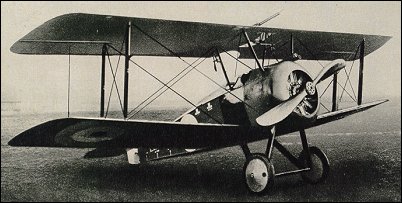
| The Camel is remembered as the most successful British single-seat fighter of World War I and is credited with 1,294 'kills'. It ranked with the German Fokker D.VII but did not achieve the extended post-war service of the German type. It also had its vices, the most obvious of which was the high torque produced by the large rotary engine, giving it a vicious right pull. This was acceptable to experienced pilots, who found it a positive advantage for rapid manoeuvring during dogfights, but it caused the demise of many pilots during their conversion period (the S.E.5 had an in-line engine and so was preferred by many pilots).
Camels entered service with the RFC and RNAS in mid-1917 and remained in first-line use until the Armistice. A total of 5,490 was built, serving also with Belgian and AEF squadrons and with other air forces. It was a Camel that shot down the German ace Rittmeister Manfred von Richthofen (the 'Red Baron') at the hands of Captain Roy Brown of No.209 Squadron, RAF, over Sailly-le-Sec on 21 April 1918.
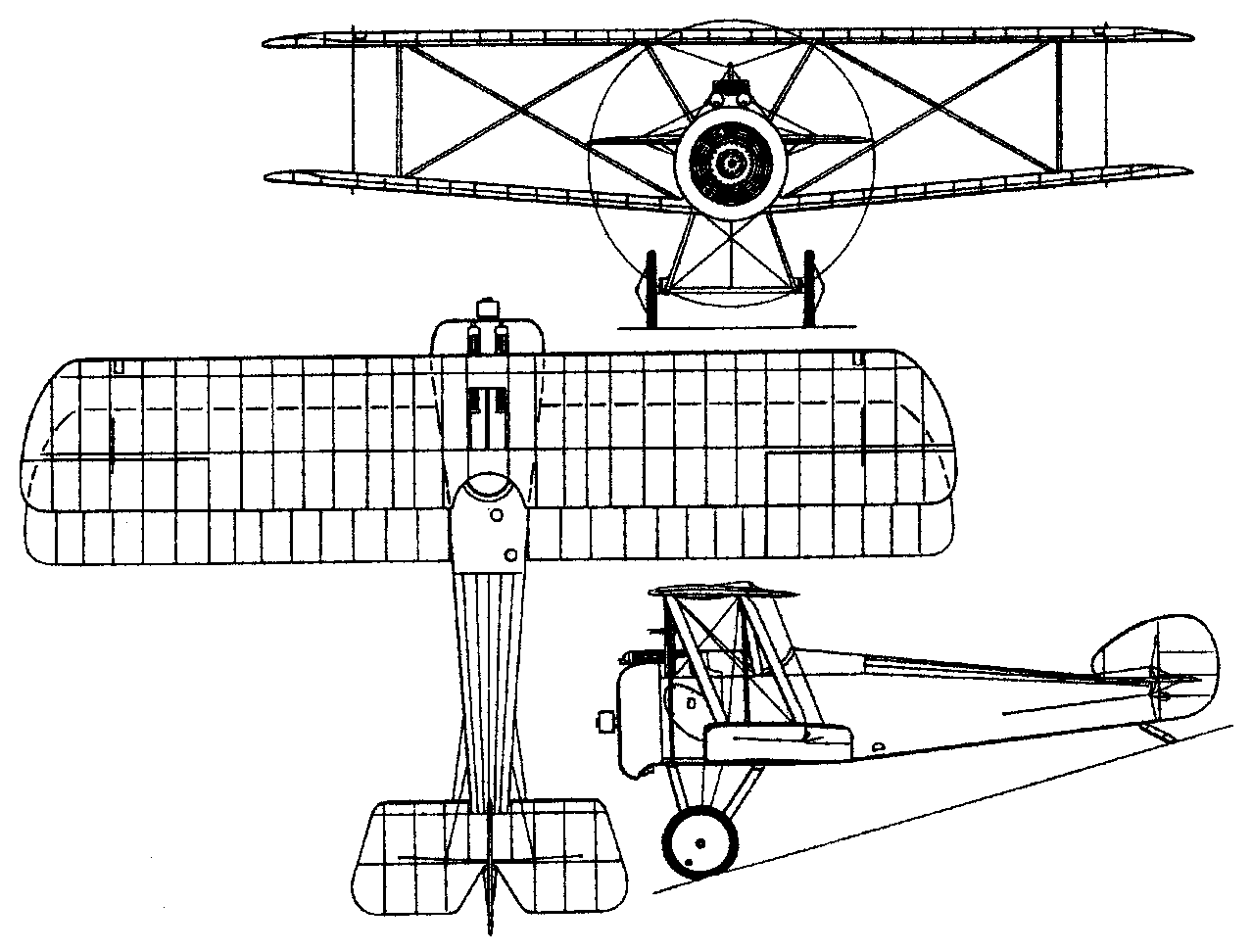
 | A three-view drawing (1278 x 972) |
| CREW | 1 |
| ENGINE | 1 x Clerget 9B, 96kW |
| WEIGHTS |
| Take-off weight | 659 kg | 1453 lb |
| Empty weight | 422 kg | 930 lb |
| DIMENSIONS |
| Wingspan | 8.5 m | 28 ft 11 in |
| Length | 5.7 m | 19 ft 8 in |
| Height | 2.6 m | 9 ft 6 in |
| Wing area | 21.5 m2 | 231.42 sq ft |
| PERFORMANCE |
| Max. speed | 185 km/h | 115 mph |
| Ceiling | 5790 m | 19000 ft |
| Range w/max.fuel | 350 km | 217 miles |
| ARMAMENT | 2 machine-guns, 4 bombs |
| Paul Willson, e-mail, 13.10.2013 02:24 Re who shot down the Red Baron;
I hold that it was Capt. Roy Brown , however he well may have driven the Baron onto the range of Australian MG fire . And there even then would have been non way to tell because the Sopwith Camel used an aero version of the.303 mg used by British Empire forces. In the long run what does it matter ? reply | | Spike, e-mail, 09.10.2013 23:58 Cjc is correct: Roy Brown was credited with the kill for propaganda reasons but from the start, this was disputed by a unit of Aussie machine-gunners on the ground. Study of the after-action report written by Brown himself, the autopsy documents and the reported flight path over the Aussie guns leave little doubt that Von Richtofen was indeed brought down by ground-fire. reply | | Dr. A. K. Kundu, e-mail, 17.04.2013 11:54 Dear Sir /Madam,
I have authored a book titled 'Aircraft Design' published by Cambridge University Press. In my next publication titled 'Aircraft Performance' and in the 2nd edition of 'Aircraft Design', I wish to use this 3-view diagram of the Sopwith Camel.
I will be grateful if you kind allow me to use the selected one, of course acknowledged with the credit 'Courtesy of......',.
Thanking you. reply | | Sunderajan, e-mail, 24.04.2012 02:17 You will notice that its rudder and fin are unusualy small. This is surprising, seeng the tremendous torque developed by its rotary engine. reply | |
| | Cjc, e-mail, 10.01.2012 02:09 Maybe revisionist history, but the latest I read is that the Red Baron was brought down by ground fire. reply | | Snoopy, 05.04.2011 03:29 It was a sonovabitch!! reply | | Phil, e-mail, 29.03.2011 22:32 Is the following well known?
"Hang up your Gold Star, mother. Your son's going up in a Sop." reply | | Matthew, e-mail, 26.01.2011 11:49 I've been told that around 12 pints of castor oil per hour go straight out of the engine during flight (all over the pilot - and anyone behind i guess!). I can imagine the poor pilot permanently in a "goggle-wipe" status...! reply | | Peter B.Hall, e-mail, 23.06.2010 23:55 As Major James Bigglesworth said "if you can fly a Sopwith Camel you can fly anything!" As stated because of the engine torque due to the rotary engine and a concentration of pilot, guns & engine in the front an inexperienced pilot often 'spun' into the ground. In the hands of a good pilot it was a formidable machine. Many of the aces flew SE5a's.Reference Cross & Cockade Internetional for WW1 aviation history. reply | | carl wollaston, e-mail, 09.05.2010 01:09 I heard that alot of WW1 pilots died trying to master the camel.But why the heck did it have such terrible maneuverability? reply | | James Philbrick, e-mail, 29.04.2010 05:46 My Dad, Jack Egerton Philbrick, RAF, flew them.His RoyalAero club Certificate No.6196 was awarded on 20 /3 /1918.
I have a pen and ink drawing of tha Camel by my father's friend and fellow pilot, Douglas E. Culver, who referred to the plane as the "Little Beast" reply | | d.jay, 05.07.2009 18:24 To a pilot this plane was Marmite (yeast extract spred) they either loved it or hated it. You could say it was 80 years ahead of its time with unstable flight to get maximum manouverability. It was just as likely to kill its own pilot as an enermy. reply | | graham plumbe, e-mail, 03.04.2009 15:05 I'm in the course of reading "Winged Victory" by V M Yeates. Essential reading for anyone interested in Camels. I suspect you've pre-empted the last chapter! reply |
|
Do you have any comments?
|
| 
COMPANY
PROFILE
All the World's Rotorcraft
|