|
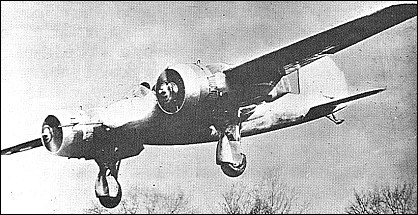
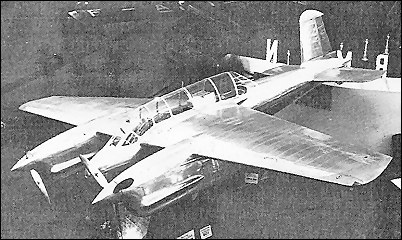
| Included among exhibits at the Salon de l'Aeronautique
held in Paris in November 1936 was a striking all-metal
twin-engined three-seat fighter. It had a somewhat
abbreviated oval-section monocoque fuselage, a
shoulder-mounted semi-cantilever wing carrying split
trailing-edge flaps over its entire span and two 450hp
Renault 12Roi 12-cylinder inline air-cooled engines projecting ahead of the fuselage nose. This, the H.220, had
been designed to a C3 requirement prepared by the
Service Technique de l'Aeronautique and issued in
October 1934. Other contenders were the Breguet 690, the Potez 630, the Loire-Nieuport 20 and the Romano
110. As it became evident that the H.220 would be
underpowered, the Renault engines were discarded in
favour of 680hp Gnome-Rhone 14M 14-cylinder radials,
and, with these installed, the first flight test was made
at Avord on 21 September 1937. The intended armament
of the H.220 comprised two forward-firing 20mm
cannon and two aft-firing 7.5mm MAC 1934 machine
guns on a flexible mounting, but, in the event, no armament
was fitted. On 17 February 1938, the prototype
made a forced landing at Avord after losing the starboard
propeller following a failure in the reduction
gearbox. The poor stability evinced during flight testing
of the H.220 (which had resulted in progressive
changes in the contours and size of the vertical surfaces),
coupled with inadequate internal capacity and
some lack of sturdiness revealed by the forced landing
(as a result of which the fuselage was irreparable), dictated
major redesign, resulting in the H.220-2.
| WEIGHTS |
| Take-off weight | 3700 kg | 8157 lb |
| Empty weight | 2673 kg | 5893 lb |
| DIMENSIONS |
| Wingspan | 12.80 m | 42 ft 0 in |
| Length | 7.87 m | 26 ft 10 in |
| Height | 3.40 m | 11 ft 2 in |
| Wing area | 21.16 m2 | 227.76 sq ft |
| PERFORMANCE |
| Max. speed | 520 km/h | 323 mph |
| Range | 850 km | 528 miles |
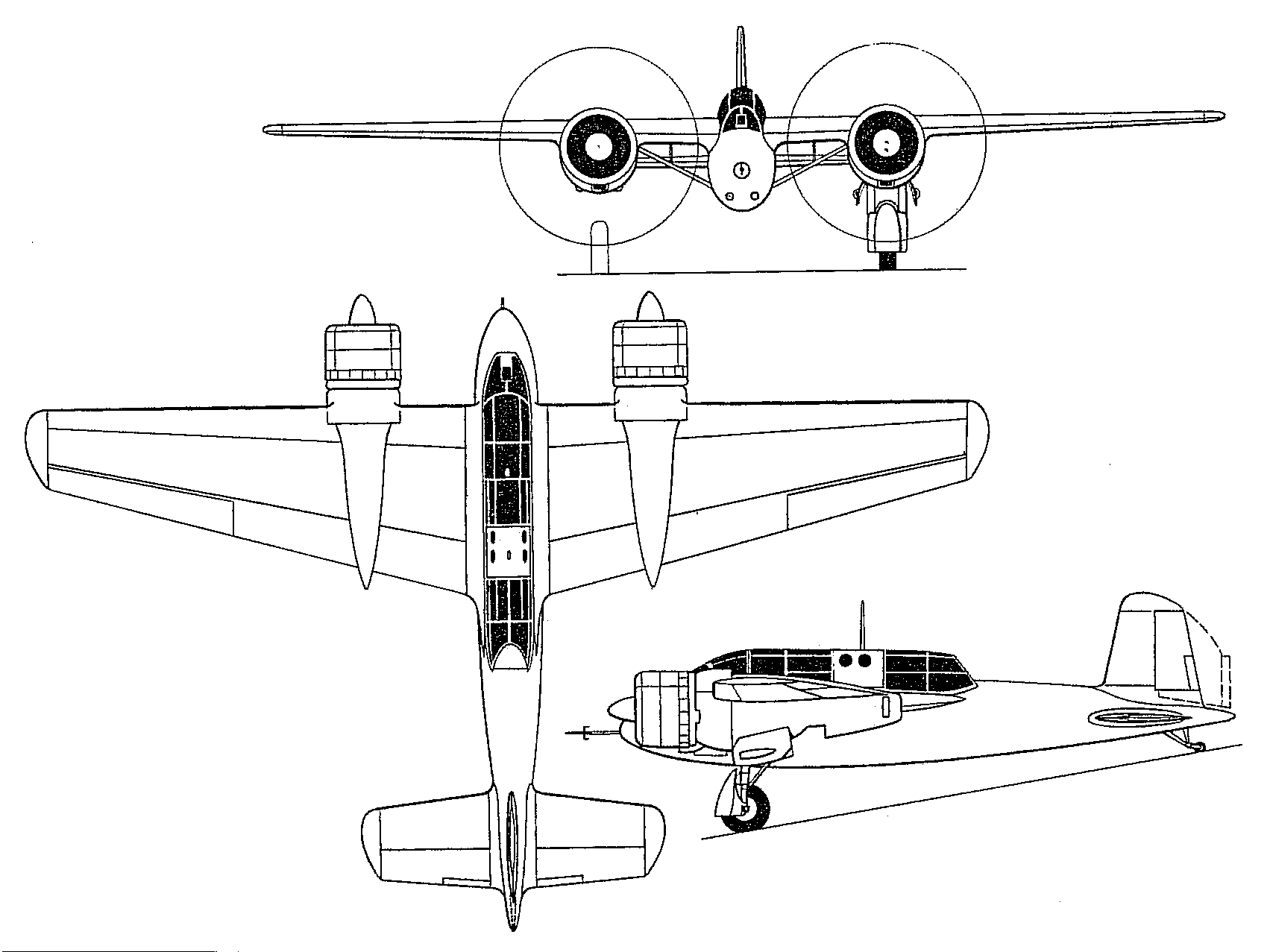
 | A three-view drawing (1703 x 1277) |
| Robert Willis, e-mail, 21.08.2020 03:02 Making this a single seater would sacrifice rear defense & render the aircraft far more vulnerable, eliminating the gunner who could warn of such attacks. The type was from the outset designed to carry two fixed forward firing 20 mm HS 404 cannon plus two 7.7 mm MAC 1934 machine guns. Such armament was already more than adequate.
re. "and fit bigger engines and you have the French P-38 Lightning."- Absurd. The aircraft was already too lightly built to be able to properly handle the weight & stresses imposed by the relatively small Gnome-Rhone 14Ms. Trying to fit the Allison V-1710 would have resulted in extremely high wing loading, likely have torn the airframe to shreds during high-G maneuvers, or at least ensured undercarriage collapse. More to the point, the U.S. specifically blocked the sale of the Allison until after the invasion of France! If not the V-1710, then what? Sacrifice the HS 12Ys needed for D-520 production in favour of building half as many 12Y equipped Hanriots?!
No. The best idea would have been to fit the H-220 with Renault 12s or Ranger V-770s & produce it as a two seat night-fighter. This would allow for a reduction in Potez 631 production in favour of Potez 637. This in turn would allow for a reduction in Potez 63.11 production in favour of increasing Amiot 351 production. reply | | bombardier, e-mail, 22.10.2011 20:29 Reduce the crew to 1,fit all armament forward and fit bigger engines and you have the French P-38 Lightning. reply | | mike cole, e-mail, 07.02.2011 21:57 If they'd made it as a sinle seater withy forward firing armament,it could have worked. reply |
|
Do you have any comments?
|
| 
COMPANY
PROFILE
All the World's Rotorcraft
|