|
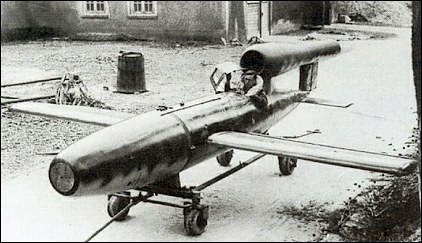
| SS officer Otto Skorzeny is credited with the idea of a piloted version of the
V-1 flying bomb able to make precision attacks, and design began before
the first unguided V-1s fell on London in June 1944. To study why many test
V-1s crashed soon after launch an earlier piloted version was tested. Two pilots
were injured before famed woman test pilot Hanna Reitsch confirmed that the
engine noise was vibrating the airframe off course. The operational manned
V-1, also called the Reichenberg IV, was not intended as a suicide weapon,
unlike the Japanese "Ohka", although in practice the distinction would have
been narrow. The 100 volunteers who signed up to fly the bombs were known
unofficially as 'Selbstopfermaenner' or 'Self-sacrifice Men'. Although about 70
Reichenberg IVs were built for use by special unit KG 200, none were actually
used operationally and development stopped in October 1944. FACTS AND FIGURES © A simple bead sight
supposedly aided target
lineup, and dive angles
marked on the side windo'
provided the pilot lastminute
reading before he
left his mount to its fate. © The Reichenberg IV had
only basic instrumentation
and could supposedly be
flown after minimal training
training. The cockpit had
only four instruments. © Having reached his target,
the pilot was supposed to
aim accurately and then bail
out, somehow avoiding the
sucking intake of the pulse
jet behind him. There was
no landing gear. © The nose of the Fi 103R-IV
was packed with 800kg of explosives. © On operations the piloted flying
bomb would have been carried and
launched in pairs from modified
Heinkel He 111 bombers.

| MODEL | Fi.103R-IV |
| ENGINE | 1 x Argus 109-014 pulse-jet, 350kg |
| DIMENSIONS |
| Wingspan | 5.72 m | 19 ft 9 in |
| Length | 8.0 m | 26 ft 3 in |
| Height | 1.42 m | 5 ft 8 in |
| PERFORMANCE |
| Max. speed | 650 km/h | 404 mph |
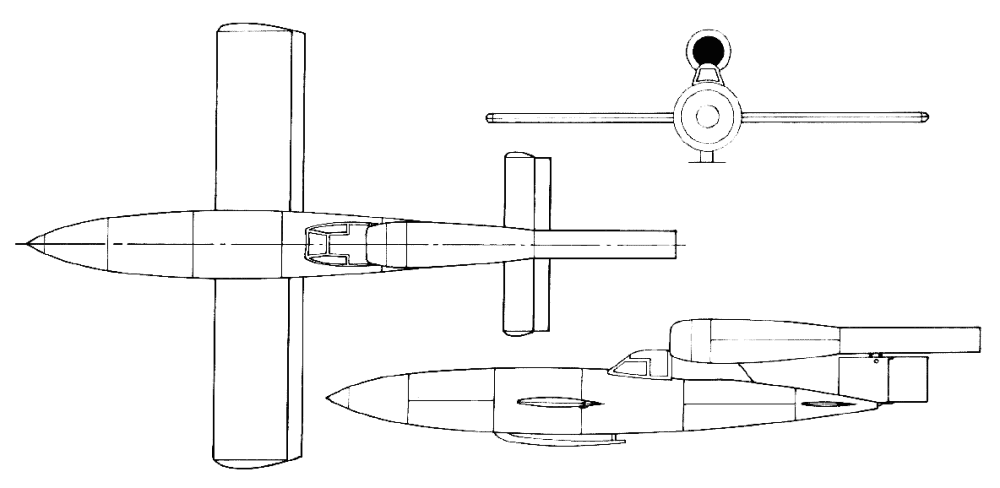
 | A three-view drawing (1000 x 488) |
| Andy, e-mail, 27.03.2016 00:03 I remember my Grandfather telling me about these. He told me that he was part of a unit that actually captured one in France after D Day reply | | sven, 10.12.2015 09:46 IRONWRENCH. Thank you for an interesting and well informed comment. A V1 complete with launch ramp may be seen at IWM DUXFORD. reply | | Ironwrench, e-mail, 10.12.2015 07:28 "and then bail out, somehow avoiding the sucking intake of the pulse jet behind him."
~~~~~~~~~~~~~~~~~~~~~~~~~~~~~~~~~~~~~~~~~~~~~~~~~~~~~
You have confused the turbine jet engine with the pulse jet engine. There is no "sucking intake" on a pulse jet. Combustion is sustained by ram air operating a set of spring loaded shutters that rapidly open and close from ram air impacting the shutters.
A pulse jet must travel at nominal speed to produce thrust efficiently. The reason the V-1 was a rail-launched weapon was because the pulse jet generated insufficient thrust for takeoff. However, the V-1's resonant jet could operate while stationary on the launch ramp, but thrust was very nominal. The steam catapult produced the airspeed necessary for the Argus to produce flight-sustaining thrust. Air launch from an He-111 achieved the same result.
By contrast, a jet engine's compressor section does produce tremendous suction as it draws in increasing amounts of air air to sustain combustion. A jet engine will pick up debris off the tarmac. Thus jets are provided with an FOD device that shoots a stream of bleed air in font of the open nacelle to blow away debris that would damage turbine blades.
That said, a fair amount of gasses exit the intake of a pulse jet as hot, expanding gasses escape before the shutters, or "valves" can close. Therefore, I would think a pilot, not wanting to face that flaming inferno with a parachute exit, would resort to the simple answer of shutting the engine down and rolling the aircraft over to drop away from the cockpit.
Try imagining yourself in that place for a moment. Flying a jet propelled bomb to a target and then executing the roll and bail-out maneuver somewhere over enemy territory. Wheeee - HAH! reply | | chris lomas, e-mail, 11.02.2014 03:35 Wings were made of wood.Had ailerons on this one.This one was dropped from a plane and not a ramp. reply | |
| | Mark, e-mail, 13.06.2013 12:04 Example of this can be seen at Headcorn Airfield Kent reply | | MAD BIKER FRANKEN, e-mail, 31.03.2013 18:30 Für einen Modellbauer ein schönes Objekt.Allein schon um die älteren Nachbarn zu erschrecken.
gruß aus Franken, Germany reply |
| Rob, e-mail, 13.12.2010 23:11 A fellow modeler built a RC version in the late '70's. It had a small pulse jet engine (Jetex?) he got from England. It was about 200dB while I held the thing back during final checks. I let go on his command and it disappeared trailing white smoke over the horizon toward Monterey Bay in about 4 seconds. We never found or heard anything of it again. His next project (a JATO Aero Commander 500) fared no better, but we found the pieces. The 103 could have only worked with an ejection system, but pity the pilot captured immediately after a successful mission. I remember the poor aircrew captured immediately after the sinking of the Kaga, Akagi, and Soryu, not to mention the Doolittle Raid. But all POW rules were off when Bushido was involved. As to RC, you could not go strict scale (insane wing loading), but if you went for an impression (longer wings and slightly larger control surfaces) and built super light, but if you're experienced enough with RC to be able to scratch build and fly it you already know all that. I've thought about a ramp launched Estes powered glider. It would have to be fairly large for any RC project and too twitchy to enjoy. reply | | MJD, 31.07.2010 21:05 Spaced-Monkey - Hanna Reitsch was a test pilot, not a fighter pilot. There are many exaggerated stories about her out there. She was not the first to fly the Fi103R either, the third I think, but the first to land it safely as she was a top notch glider pilot as opposed to a fighter pilot like the two guys who banged themselves up badly in prior Fi103R test flights. The vehicle had a very high wing loading, was not meant to be manouverable, and the engine was usually crapped out after 25 minutes of run time. Not to mention the terrible vibration and noise. It was not a viable fighter, the chief role of the manned V1's flown in that program was to investigate why a bunch of V-1's went in shortly after launch. "Flying for the Fatherland" is a very interesting read, it is a biography of Hanna Reitsch and an interesting viewpoint esp. of the last days in Hitler's bunker. reply | | David Rushton, e-mail, 21.12.2009 03:08 Any one out there; I am looking to build a r /c aircraft of this. I've seen and heard of one but, found ZIP. Any info, drop me a e-mail! Make a nice First Ducted Fan air craft. Yes I am INSAIN. reply | | spaced_monkey, e-mail, 20.01.2009 22:33 @Aero-Fox a female test pilot(can't remember her name)piloted the V1 to see if it shape was viable missile. she flew several allied planes into the ground and return to base not having been hit once. The size of the control surfaces is linked to the overall size of the vehicle, smaller the vehicle the smaller the control surfaces have to be. reply | | Jim Lloyd, e-mail, 13.03.2009 07:23 Hannah Reitsch reply | | Pierre Koreman, e-mail, 12.07.2008 16:42 Who have a good picture from the cockpit of the Reichenberg?
Thanks in advance reply | | Aero-Fox, 17.04.2008 23:15 I'm afraid it would have been rather useless in that roll. It was fast, but not faster than the more modern piston-engined fighters. Plus, it had TINY control surfaces (which weren't designed for much beyond cruise flight, certainly not aerobatics), which would have given it abysmal maneuverability. reply | | THE WHO, 25.03.2008 23:43 IF THEY DIDN'T USE THE BOMBS IN THE MISSEL, THEY COULD OF USED IT AS A PULSE-JET FIGHTER AND COULD GIVE IT A 20MM CANNON. reply | |
| | THE WHO, 25.03.2008 23:43 IF THEY DIDN'T USE THE BOMBS IN THE MISSEL, THEY COULD OF USED IT AS A PULSE-JET FIGHTER AND COULD GIVE IT A 20MM CANNON. reply |
|
Do you have any comments?
|
| 
COMPANY
PROFILE
All the World's Rotorcraft
|




Ihr Kommentar uber die alten Leute ist sehr komisch.
Wir ubernachteten vor sieben Jahren in einem Bed & Breakfast in einem Dorf, ungefahr 30 min. von Nordlingen. Dann nach Rothenburg o.d.T.
Der Nachtwachter Tour in Roth. ist einmalig, und interressant.
Tschuss,
David, in der Nahe von Memphis, US.
reply