|
| Adequate information of an enemy's positions, reserves, movements and supplies has long been a vital factor in war. Before the outbreak of World War II Germany's Col-Gen Baron von Fritsch had predicted: "The next war will be won by the military organisation with the most efficient photographic reconnaissance." It is not surprising, therefore, that Germany made special efforts to have adequate photo-reconnaissance aircraft with which to fight the coming war.
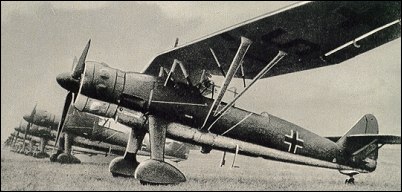
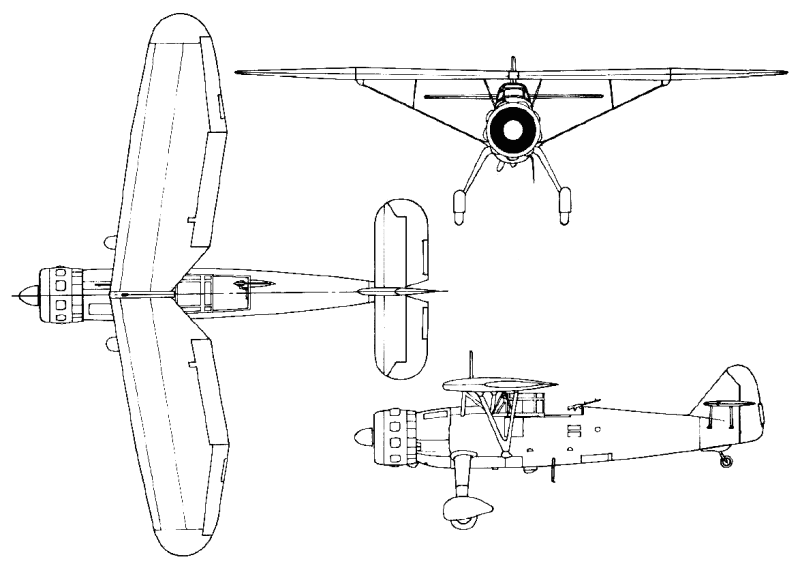
One of the most important in the early years of the war was the Henschel Hs 126 short-range reconnaissance aircraft, the first all-metal aircraft of this type to enter service with the Luftwaffe. This evolved from the earlier Hs 122 design of 1935, but the Hs 126 was developed to offer improved performance and handling characteristics. Of parasol-wing configuration with an absolute minimum of supporting and bracing struts, it had a strut-braced tail unit and tailwheel-type landing gear with streamlined cantilever main-gear struts. Initial production Hs 126A-1 were powered by the 656kW BMW 132Dc radial engine. Accommodation was provided for a pilot and observer/gunner.
At the beginning of the war the Hs 126 was in service with most of the Luftwaffe's army co-operation reconnaissance units, used for both day and night sorties over battle areas. Used extensively and successfully at the beginning of the Russian campaign, they were later to meet severe opposition and often could be operated only with fighter escort. By early 1943 they were almost completely superseded by more advanced types, thereafter being used as glider tugs and for training.
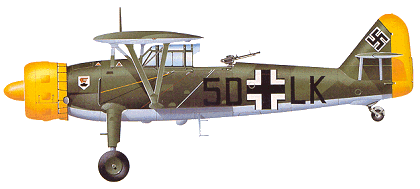
| MODEL | Hs 126B-1 |
| CREW | 2 |
| ENGINE | 1 x Bramo 323A-1, 634kW |
| WEIGHTS |
| Take-off weight | 3090 kg | 6812 lb |
| Empty weight | 2030 kg | 4475 lb |
| DIMENSIONS |
| Wingspan | 14.5 m | 48 ft 7 in |
| Length | 10.85 m | 36 ft 7 in |
| Height | 3.75 m | 12 ft 4 in |
| Wing area | 31.6 m2 | 340.14 sq ft |
| PERFORMANCE |
| Ceiling | 8300 m | 27250 ft |
| Range | 720 km | 447 miles |
| ARMAMENT | 2 x 7.2mm machine-guns, 50kg of bombs |
 | A three-view drawing (800 x 566) |
| John D. Gallaspy, e-mail, 31.01.2017 04:23 Have all four 1 /72 kits, all boast mightily incorrect wings. I haven't looked at the 1 /48th scale kit, will have to overcome scepticism to buy it. Would like to do a resin replacement wing, if I knew the airfoil (aerofoil) section, and some other details of the wing (Did the center-section have the same angle of attack as the wing main panels, or was it angled up slightly, maybe to provide a better view for the pilot?).
I, too, would be interested in manuals, although I don't expect these would provide any answers to the above questions. Note there was not one service manual, but a number related to different systems. Common maintenance was covered in the LDv.521 series, but a xerox copy of the radio installation (FuG I) in my records is D.(Luft) T.564 /2a, Nov. 1940, with wiring diagrams and testing procedures. No photos. reply | | Barry, 08.01.2013 16:30 Designed by Friedrich Nicolaus and based on the earlier Hs122 the original prototype was powered by a 610hp Junkers Jumo 210 engine. This was followed by two development aircraft powered by Bramo Fafnir 323A-1 engine developing 830 h.p. In 1937 Henschel produced 10 pre production Hs126 A-0 aircraft for evaluation by the Luftwaffe Lehrgruppe reconnaissance unit. The A-1 model was powered by a BMW 132Dc unit developing 880h.p. as noted in the text. The later B-1 model reverted to the Bramo Fafnir 323A-1 or the later 900h.p. 323A-2 engine.
The majority of production went to the Luftwaffe but six went to Spain via the Condor Legion and 16 were sold to the Greek airforce. reply | | choqing, 20.06.2011 11:42 I`m looking for the manual to this aircraft. reply | | Geir J. Valla, e-mail, 31.10.2008 21:15 Hello ! I have some parts from two HS 126,and I`m looking for the manual to this aircraft. reply |
|
Do you have any comments?
|
| 
COMPANY
PROFILE
All the World's Rotorcraft
|