|
| Certainly the most versatile German warplane of World War II, the Junkers Ju 88 in progressively improved versions continued in production throughout the war. It was originated to meet a requirement for a three-seat high-speed bomber and the first prototype, powered by two 746kW Daimler-Benz DB 600Aa engines, made its initial flight on 21 December 1936. Further prototypes followed, the third with 746kW Junkers Jumo engines and this, during evaluation, attained a speed of 520km/h. Such high performance encouraged record-breaking attempts, and in March 1939 the fifth prototype set a 1,000km closed-circuit record of 517km/h carrying a 2000kg payload. A total of 10 prototypes was completed, and the first of the pre-production Ju 88A-0 bombers flew in early 1939, the initial Ju 88A-1 production version entering service in September 1939.
Early operational deployment showed that despite good performance and a worthwhile bombload, defensive armament was totally inadequate, leading to the Ju 88A-4 with increased span wings, structural strengthening to carry greater loads and gunpower increased substantially. This formed the basis for further diverse development of the type, ultimately in so many versions that a detailed listing of them is not possible:
for example, the Ju 88A series extended over Ju 88A-1 to Ju 88A-17 sub-variants. While the Ju 88A was in production an improved Ju 88B was planned, with a more extensively glazed nose and power provided by two 1193kW B.M.W. 801MA radials, but flight testing showed only marginal performance improvement and only 10 pre-production Ju 88B-0 aircraft were built.
The Ju 88 was almost as fast as contemporary fighters, and such performance coupled with excellent manoeuvrability brought development of the Ju 88C series. The planned Ju 88C-1 with B.M.W. 801 MA engines was abandoned because the new Focke-Wulf Fw 190 fighter had priority for this powerplant. As a result the first production version was the Ju 88C-2, this being the Ju 88A-1 converted on the production line to have a solid nose mounting three 7.92mm MG 17 machine-guns and a 20mm MG FF cannon. Defensive armament comprised two additional 7.92mm MG 15 machine-guns. The Ju 88C-4 was a heavy fighter/reconnaissance model, the Ju 88C-5 an improved heavy fighter, the Ju 88C-6a an improved Ju 88C-5, the Ju 88C-6b and Ju 88C-6c night-fighters, the Ju 88C-7a and Ju 88-C7b intruders, and the Ju 88C-7c, a heavy fighter. Alphabetically out of sequence were the Ju 88R-1 and Ju 88R-2 night-fighters, which were developed and powered by B.M.W. 801 MA engines when the supply position of this powerplant eased.
The Ju 88D series was long-range reconnaissance aircraft based on the Ju 88A-4, in Ju 88D-1 to Ju 88D-5 variants that differed in engines, and detail. The Ju 88G series represented definitive night-fighter versions that from the early summer of 1944 replaced the earlier Ju 88C and Ju 88R aircraft. Equipped with airborne interception radar and bristling with weapons, the Ju 88Gs were extremely formidable night-fighters, taking a heavy toll of Allied night bombers. They were followed by small numbers of Ju 88H aircraft which had a lengthened fuselage to provide increased internal fuel capacity, providing extra long-range Ju 88H-1 reconnaissance and Ju 88H-2 fighter aircraft. The tank-busting Ju 88P was developed from the Ju 88A-4, the Ju 88P-1 with a 75-mm PaK 40 cannon and the ensuing Ju 88P-2 to Ju 88P-4 with different combinations of heavy anti-tank weapons.
The increasing capability of Allied fighters meant that losses began to rise, leading to the higher-performance Ju 88S bomber and Ju 88T photo-reconnaissance aircraft that represented the final production versions. When production ended almost 15,000 had been built, this total emphasising the significant role that the Ju 88 had played in Luftwaffe operations.
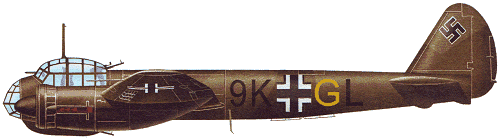
| MODEL | Ju-88A-4 |
| CREW | 4 |
| ENGINE | 2 x Junkers Jumo 211J-1, 1007kW |
| WEIGHTS |
| Take-off weight | 14000 kg | 30865 lb |
| Empty weight | 9860 kg | 21738 lb |
| DIMENSIONS |
| Wingspan | 20.0 m | 66 ft 7 in |
| Length | 14.40 m | 47 ft 3 in |
| Height | 4.85 m | 16 ft 11 in |
| Wing area | 54.50 m2 | 586.63 sq ft |
| PERFORMANCE |
| Max. speed | 470 km/h | 292 mph |
| Ceiling | 8200 m | 26900 ft |
| Range w/max.fuel | 2730 km | 1696 miles |
| ARMAMENT | 5-7 machine-guns, 2000kg of bombs |
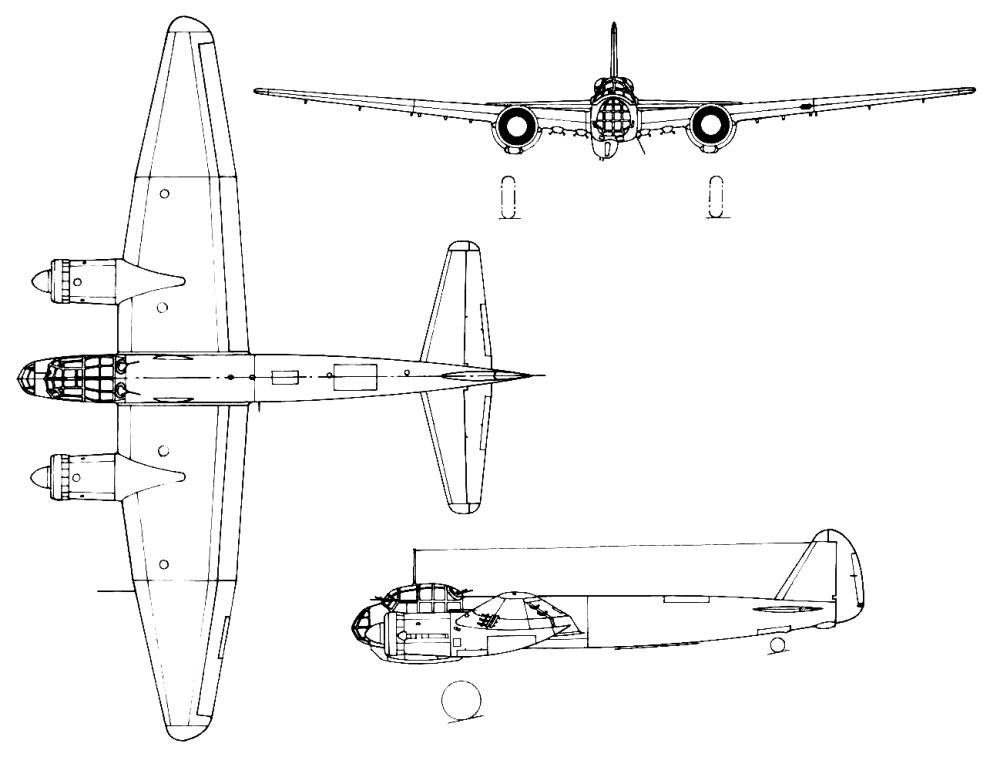
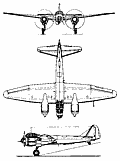 | A three-view drawing (1000 x 757) |
| Daniel Haynes, e-mail, 19.02.2015 07:58 A takeoff weight of > 13'000 kg was considered overweight and had to be ordered. Normal gross weight without bombs was 10560 kg (A-4 & Jumo211J). Max. Bombload was 28 x 50SC internally + 2 x 500 kg externally + 2 x 250 kg externally. Largest Bomb(only one at the right inner external mounting): 1800 kg. So, the largest bombload was 2900 kg (1400 kg internally, 1500 externally). reply | | Ron Gram, e-mail, 04.07.2013 09:23 A friend was a pilot of a JU88 "night fighter". His plane had two cannons pointed upward, I believe 15 degrees forward to the vertical. They were at least 20mm. The strategy was to approach the Lancs from below and heavily "stitch" between the two engines on one side. This was very effective as the Lancs had no radar coverage or gun-turret defense of the area below the aircraft. One JU88 crewmember had excellent night-vision to spot the planes. The Brits painted their Lancs flat-black, but the night sky was not quite that dark. If the Brits had painted them a blotchy black /dark grey the Lancs would probably have been more difficult to spot visually. reply | | BOB POKARTH, e-mail, 29.09.2012 00:37 I JUST GOT THE JU A-1 NOW I WANT THE JU 88 P-5 WITH THE 88 MM GUN, THIS MUST BE THE BIG GUN ON ANY PLANE. HAVE NOT SEEN A PIC. I KNOW THEY HAD THE 75MM US AND GERMANY. HOW MANY WERE MADE? ONE OR TWO. reply | | Naga, 14.07.2012 01:37 While most bombers suffer from a lack of speed or agility, and thus fall prey to enemy fighters, German bombers like those built by Junkers and Dornier had the performance to give enemy aircraft a run for their money, and they certainly packed teeth. The problem is in the design of the aircraft. You'll notice German bombers tend to have most defenses concentrated forward or towards the center of the wing. This greatly restricts the firing arcs of any weapons therein, and sure you might pack 15 and 13mm weapons, but without appropriate coverage all that speed and armor just delays the inevitable. reply | |
| | George D. Gilmore, e-mail, 21.06.2012 03:09 Is it true that on return to base they could cut back on each engine to save gas???? reply | | pree, 21.06.2011 06:24 I find terribly lacking in the nerly all of the aircraft books. Lots about the engines and even some pictures of the bearers, but no metal designation. reply | | Ben Beekman, e-mail, 06.02.2011 03:45 It's not generally known, but the Ju88 wasn't a pure German design. Though credited to Junkers chief designer, Dipl. Ing. Zindel, it was actually designed by a W.H. Evers and an American citizen, Alfred Gassner. Evers had worked in the U.S. aircraft industry, returning to Germany in 1935 accompanied by Gassner. Soon employed by Junkers, design work on the Ju88 began Jan. 1936. in December of that year the first prototype was flown by chief test pilot Flugkapitan Kindermann. Gassner had returned to the U.S. by way of Sweden prior to the first flight and Evers was never given recognition for his work. This informastion from Wm. Green's book, "Famous Bombers of the Second World War" (Hanover House, 1959). reply | | Mel Brooks, 16.10.2010 09:42 I am currently filming,"Blazing Saddles 2" starring Barak OBAMA as that fun loving sheriff who comes to Washington D.C. to clean up the mess that Dick Cheney left. My favorite scene is when Anna Kreisling The White Wolf of the Luftwaffe lands a Junkers JU-88 in front of the White House, and while the engines are running, OBAMA runs like O.J.Simpson chased by over one million angry taxpayers who want their free Obama money, which he promised them!!
When he reaches the airplane he goes cross-eyed staring at her heavenly cleavage!! HE tries desperately to undo her Stainless Steel bra that was designed by Albert Speer!! But he can't get it off. He feels frustrated and a born loser, just like his days as President! But Anna smiles and goes to full throttle and flies him home to his native Kenya! There he trains daily to become a Marathon Runner! reply |
| Jane Russell Hollywood, 28.09.2010 01:00 Yes it is true that Howard Hughes bought the famous stainless steel bra from Albert Speer! Hughes gave him $30,000 dollars and his own personal Junkers JU-88 aeroplane!!
ANNA Kreisling has
gorgeous full breasts because her bra fit me perfectly!!Mel Brooks is in a new Broadway Play called,"ANNA KREISLING, MY HOTSY TOTSY NAZI SWEETHEART!!"
Here are the Lyrics to the opening song!!
"ANNA BABY, FLY ME TO NEW YORK!!
Lets get high over NEW YORK!!
Lets pretend its 1943!! We'll make love and history!!
ANNA FRAULEIN, FLY ME TO NEW YORK!!
I'll climb into your junkers, just like before!!
ANNA, YOUR MY HOTSY TOTSY NAZI OF THE MASTER RACE!!
Put on your stainless steel bra and lets dance some more reply | | wlkriessmann, e-mail, 26.09.2010 04:21 It is a bukged canopywith a single gun orobably on a Ju88 C6 (check swuadron.signalpublictions-aircraft numbr 113-Carrollton /Texas
I flew quite a few JU`s after left KG 53 April 1944 as a ferryin pilot Checked out at Hannover-Langenhagen April 17 1944(PK+CS), then, Schleswig, Hildfesheim and quite few Ju88 G1 and G6 ( nightfighters ) from the factory in Bernburg to different fields and units( Sept,. Oct. Nov. Dez 1944 /Jan / Febr 1945 reply | | Tad Foran, e-mail, 16.09.2010 03:43 I saw a "cut away" drawing of the Ju-88 and can't figure out what the long tube that extended from just rear of the cockpit to the top of the horizontal stabilizer. Any clue as to what the purpose of this long tube is? reply | | Descarrier, e-mail, 28.06.2010 13:59 Hi, same question than jkervin. I am looking for photo's or drawing of Junker 88 A-4 bomb bay and fuselage tanks. It seems Ju-88 A4 had their bomb bay load replaced by an extra tanks ? It seems indeed quite hard to find references about this on the web even the website in Norway were they restore 2 Ju-88 ? Any help welcome. Contact me direct at my e-mail: Descarrier1957@yahoo.com.
Thanks you very much reply | | Sgt.KAR98, 19.04.2010 01:11 I love the Ju-88 too.What wonderful plane. reply | | johnnyb, e-mail, 19.01.2010 19:09 i play a ww2 war game and the JU 88-4 has been finally released. i am trying to get a list of units that operated the a-4 model could you direct me? reply | |
| | kevin kelly, e-mail, 29.01.2009 16:25 My son is turning 7 and he is in love with the JU 88! I am looking for an in- air action picture of a JU 88 which I can print and frame for a birthday present. I was hoping you could sent me one. Very kindly, Kevin Kelly reply | | Geir J. Valla, e-mail, 31.10.2008 20:40 Hello !
I am collecting parts for my JU-88 plane,and i am looking for the manual for this aircraft. reply | | jkervin, e-mail, 05.09.2008 17:38 I am trying to build a JU 88 bomb bay, but can not find any diagrams /photos... I know Squadron's "JU 88 in Action" states the A /C had "horizontal bomb racks." Anyone know location of photos /drawings on web or in books? Thanks ahead reply | | Ben Gowen, e-mail, 20.06.2008 08:54 NWA had an "ICE RESEARCH" project we had a B24, B26,and a JU88
I do not recal that the JU88 ever flw but it had fabrec cover body and had pressed saw dust props, 1942 in Minneapolis reply | | Robert Brown, e-mail, 07.06.2008 08:50 Prof. Hertel at Dessau was the pioneer of using forged magnesium for the engine bearers. Many of the Junkers aircraft used magnesium for this purpose as did the ME109, 110, FW190, JU88, JU87, etc. It is almost never mentioned but it gave much lighter weight, which turned into more manuverability. I visit the Dessau Museum a few years ago and no one there (that spoke English) had a clue as to what I was asking about. There are a few mentions of Elektron metal which was the magnesium alloy used. But it is a subject that I find terribly lacking in the nerly all of the aircraft books. Lots about the engines and even some pictures of the bearers, but no metal designation. reply |
|
Do you have any comments?
|
| 
COMPANY
PROFILE
All the World's Rotorcraft
|


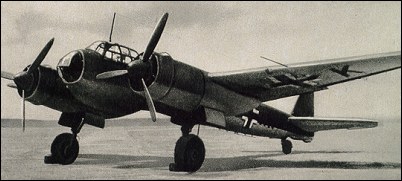


bored huh? better sites than this for trash ,just because you dreamed of chance to mention the aircraft above to get you NOTICED ? well done ! now off to bed lil one ! you must be exhausted as most here are from your yapping
reply