 |
Mikoyan/Gurevich MiG-191954 |  |
| FIGHTER | Virtual Aircraft Museum / USSR / Russia / Mikoyan/Gurevich |
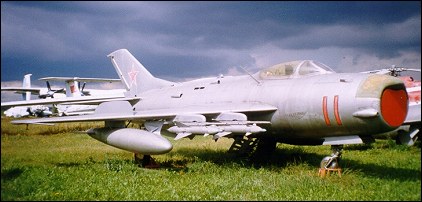 |
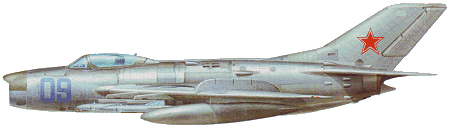
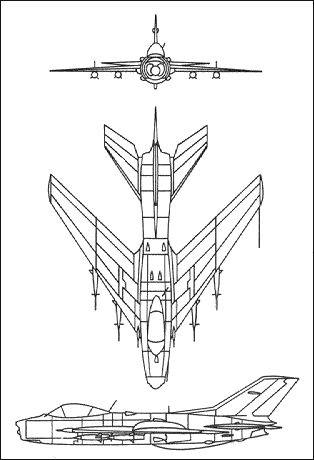
The I-350 prototype of the MiG-19 first flew in September 1953. The initial production day fighter began to enter service with the Soviet air defence force in early 1955, but before long an all-moving tailplane replaced the elevators of early production aircraft. At the same time three 30mm guns replaced the original armament of a 37mm and two 23mm cannon, which had been standard on all MiG jets from the earliest MiG-9; and an attachment was added under each wing for a bomb or an air-to-surface rocket. This new version was designated MiG-19S (for Stabilisator). With the adoption in 1957 of the Tumansky R-9 axial-flow turbojet as the standard engine, the MiG-19SF was produced. At the same time another version appeared with limited all-weather capability as the MiG-19PF, supporting a small Izumrud radar scanner inside its engine air intake and a ranging unit in the intake lip. The later MiG-19PM differed from the PF in having four first-generation Alkali radar-homing missiles instead of guns. In the Soviet Union the MiG-19 was phased out of production by the end of the 1950s, making way for expanded MiG-21 production. However in 1958 a licence to build the MiG-19 had been agreed with China but, following delivery of knocked-down MiGs for Chinese construction, relations between the two countries deteriorated. Nevertheless the MiG-19 construction went ahead under the Chinese designation F-6 (MiG-19S), the first of which flew in December 1961. F-6 became the standard equipment of the Chinese Air Force of the People's Liberation Army from mid-1962. Production of the F-6 was stepped up from about 1966 and it is thought that several thousand have been built, including counterparts of the MiG-19PF and SF. China has developed a number of variants of its own design. One is a tactical reconnaissance aircraft, while the TF-6 is a trainer version and the A-5 (formerly referred to as the F-9 and F-6 bis) a strike fighter with different appearance because of its pointed nose radome between the semi-circular side air intakes. The span of the A-5 has also been increased to about 10.2m. Maximum level speed of this version is estimated to be close to Mach 2.
|  COMPANY PROFILE | ||||||||||||||||||||||||||||||||||||||||||||||||||||||
|


|
20
reply