|
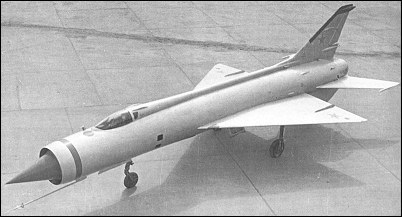
| For high speed development purposes and as a test bed
for a 15-tonne engine that was being developed by the
Tumansky bureau with a view to powering a proposed
Mach=3.0 high-altitude interceptor (which was to materialise
as the MiG-25), the MiG OKB developed what
was ostensibly a pure research aircraft, the Ye-150.
Powered by a Tumansky R-15-300 engine of 6840kg boosted to 10150kg with
afterburning, the Ye-150 flew for the first time on 8 July
1960, and was subsequently to attain a speed of
Mach=2.65 or 2816km/h and a ceiling of
22500m. Design of an all-weather high-altitude
interceptor based on the research aircraft had
paralleled work on the Ye-150. As the Ye-152A, this had
been adapted to take two thoroughly proven R-11F-300
engines owing to development problems with the large
R-15 engine which were resulting in serious delays. In
consequence, the Ye-152A interceptor fighter was
ready to fly before the Ye-150 research aircraft upon
which it was based, this event taking place on 10 July
1959. Powered by two R-11F-300 engines each rated at
3900kg and 5740kg with
afterburning, the Ye-152A was intended to carry the
Uragan 5B radar accommodated in a large, fixed intake
centrebody and a pair of MiG-developed K-9 (K-155)
long-range beam-riding missiles. While the intake centrebody
of the Ye-152A was non-translatable, the extreme forward fuselage with intake orifice was
hydraulically movable, thus achieving the same effect
as a fully-variable shock cone. The Ye-152A was overtaken
by the R-15-powered Ye-152, and its
flight test programme was terminated after 55 flights of
which only two were made carrying K-9 AAMs.
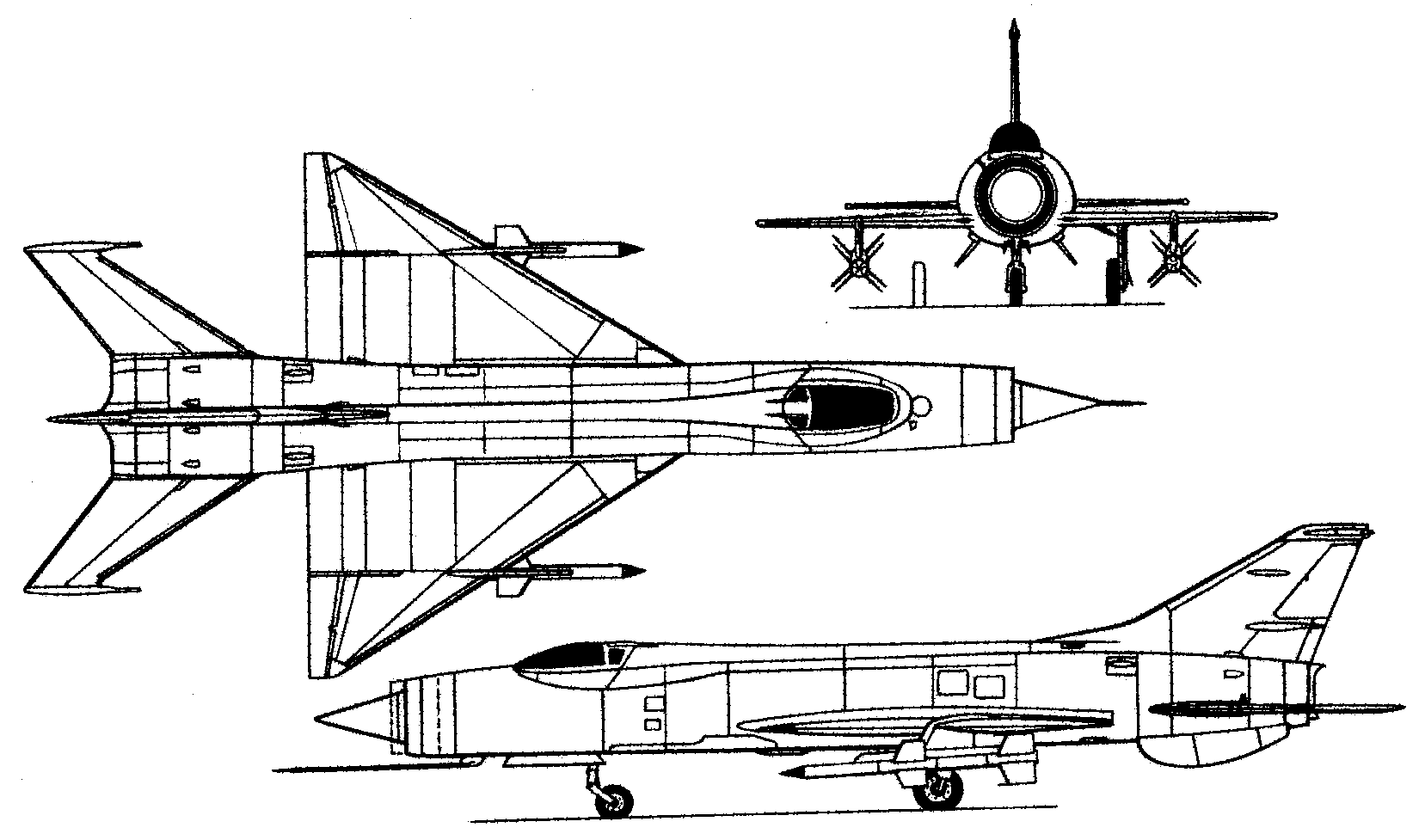
 | A three-view drawing (1657 x 977) |
| WEIGHTS |
| Take-off weight | 13960 kg | 30777 lb |
| DIMENSIONS |
| Wingspan | 8.49 m | 28 ft 10 in |
| Length | 19.00 m | 62 ft 4 in |
| Wing area | 34.02 m2 | 366.19 sq ft |
| PERFORMANCE |
| Max. speed | 2500 km/h | 1553 mph |
| Ceiling | 19800 m | 64950 ft |
| Jamie, e-mail, 30.07.2014 18:27 I have always been a fna of teh mid time fram Mig planes. This development has to be my favorite after the cancelled YF-23 (And of course the Avro Arrow. I am Canadian and grew up with my father and uncles telling me stories abouyt it.) I allways thought that if I was very rich, I would build an exact reproduction of the 152-1 with the engine built with modern design and materials of the same thrust class and go after the low altitude speed record currently held by a (Then privately owned) CF-105. This plane crashed by the way shoretly there after but the pilot ejected safely.
Both of these planes probably best reflect the minimalist design philosophy in their class. The 152-1 just took it to a whole new level. reply | | bombardier, e-mail, 12.10.2011 16:15 It would have been very interesting to see this plane in Vietnam instead of the MiG-21.It would certainly have been a hard foe for the F-4. reply | | mike richards, e-mail, 14.09.2010 09:58 the f-8 crusader III would have been a good contender reply | | Luiz Carlos Magalhães, e-mail, 30.07.2009 21:36 Sorry, the photos of this aircraft were really taken in Tushino 1961. I am not sure, but probably the Air Progress magazine issue was published around that time too. reply | |
| | Luiz Carlos Magalhães, e-mail, 30.07.2009 21:06 If I remember correctly, there are really very interesting photos of this aircraft over Tushino in 1966 or 1967 which were published in American Air Progress magazine around that time including other Russian aircraft. I also remember the title in that issue was "New Generation Russian Aircraft?" If someone knows about that I would appreciate very much to see again those photos. reply | | luke nilsen, e-mail, 27.06.2009 06:42 If anyone thinks that steel= heavy, they are missing the point because it is about distribution. Have a look at the wall thickness of aluminium versus cro-moly bicycle tubing and you will find the aluminium is millimeters thick where steel is only half as thick and swaged half as thin again in the middle of the tube, both equally suitable. Nickel steel (rene41,iconel x)were used for the x15 among others. Anyone,east or west, building a 66kW radar at the time would have used valves at the power output stage,they are still the most scalable and linear rf technology. reply | | Nikos J. Farsaris, 03.05.2009 02:19 And A-11 /YF-12 /SR-71
As a counter part to MiG trisonic family.
Only for USA (Many countries still have old Mig-25s)(I wish Greece had onmy four old Mig-25P)
Decomisssioned (Still in production as MiG-31B /F)
2-g limit for SR-71 (4-5 g in supersonic flight the steel construction can outperform any other in subsonic hard turns - energy loss was the limit!)
Radar on the Mig-25P was made out of vacouum electronics rather than trasistors...a crude way to make electronics theese days. ...only that an american Nuclear Engineer said that ""ït is the best way to survive near a nuclear explosion""-and theese years MiGs were meant to intercept Nuclear Bombers
Sink rate was awful! Like an F-104G and ....SR-71! and any aircraft with a hihg wing load!Actually they meant to land with engines on (at least one,therefore there were no producion single engined E-152A but insted over 1500 MiG25 /31)
Many Interceptor or recon versions actually were exported to foreign nations (at least degraded)
And they were succesfully gained victories over American fighters although many destroyed on the ground.
Let's face it!
MiG really makes good fighters. reply | | Nikos J. Farsaris, 03.05.2009 01:42 Nothing more to say, but I agree with the other two.
E-150 /152 were engine testbeds based on an aprooved chasis (Mig-21)
I think the R-15-300 was the limit of first versions of MiG-25P or Mig-25R (Clean aircraft Mach 3.2 as approoved by Jewish Radars Mach 2.83 for interceptors with 2400 kg of four AA-6 Missiles and no external tank)
After all theesewere unacceptable and after Belyenko's defect The Mig-25M emerged with new engines wich evenualy led to MiG-31.
The Ye-152A was the aircraft that prooved that an engine originally developed for an unmanned (thus expendable reccon probe -Tu-123- as far as I know)
Steel use was another technical matter in order to produce some thousands of trisonic aircraft and not soome dozens as all other western and eastern countries did. alltogether.
Steel (iron) is the best airborne radiation absorbing material also... think.... reply | | Pater, 13.11.2008 18:43 First F-14's suffered from US-capitalist-made engines "self-destruction". Two of them were destroyed at laughable speed of M=0,5, pretty far from Soviet-build engines' "redline"...
Keep on trying, branwashed wannabe-a-doctor. reply | | Dr. Nick Stage phd., e-mail, 26.05.2008 01:22 This aircraft, an "actively-deployed-prototype"
was wrongly-called, by N.A.T.O., in 1964-through-1967,
the "MIG-23" and the "FLIPPER", and was flown to
MACH 2.94, before the Soviet-built Tumansky-266-305 exploded, killing the pilot and destroying this plane.
This tragedy occured on December 15th, 1966.
After this, any Soviet Mig or Soviet Sukhoi aircraft had
"red-line" limits on speed, engine duration, structural
integrity,turning-capability and altitude-sustainablity.
Even the new SU-37 "Super-Flanker", also called
"the Terminator-B" can only go at Mach-3.4--only in a dive.
The new U.S. F-22 fighter-jet, and the new U.S. F-15K ,
would be able the "kill" the SU-37 by a theoritical
air-combat "kill-ratio" of 22-to-1.
These same Tumansky jet engines were used, after some
modifications, in the twin-engined Soviet MIG-25 "Foxbat" interceptor.
MIG-25 pilots could use these same engines, later
called the Tumansky R-15G-2 engine,
lacked advanced analog-control, so the Mig-25 was limited
to no more than 375 miles--in radius, and the aircraft
was "red-lined" at Mach 2.8-to-3.0.
Above this speed, the R-15 engines went into ramjet-mode,
but after 5-to-8 minutes, these engines were totally
wrecked, and to be entirely replaced.
This information came from Captain Viktor Belenko,
on his defection from Vladivostol and landing
in Japan, and surrendering his Mig-25, early
September of 1976.
Just as Captain Belenko's Mig-25 was "touching down",
the aircraft completely ran out of fuel--guaranteeing
one heck of a VERY HARD landing.
The MIG-25's "sink-rate" was as bad a the U.S. Space
Shuttle which has only a ONE CHANCE-only landing
approach.
To return to YE-152A:
For the late 1960's or even the early 1970's, this
aircraft would have been a "sky-killing" jet, especially
in the INTERCEPTOR role, but like the MIG-25, the
G-loads of 4 or 5 G's, would have enough to have
had this otherwise good aircraft to structural failure.
The Soviets did this best they could with the crude
building techniques, like using heavy steel, and very
heavy nickel-plated stainless steel engines.
Keep em' flying--smilin' Ivan!! reply |
|
Do you have any comments?
|
| 
COMPANY
PROFILE
All the World's Rotorcraft
|