|
| The outbreak of war in Europe in 1939 made it essential that USAAC planners should at least talk about long-range bomber projects, and the initial identification of such was VHB (very heavy bomber). When it seemed likely that such an aircraft might have to be deployed over the vast reaches of the Pacific Ocean the identification VLR (very long-range) seemed more apt, and it was the VLR project which General Henry H. ('Hap') Arnold, head of the USAAC, got under way at the beginning of 1940.
Requests for proposals were sent to five US aircraft manufacturers on 29 January 1940: in due course design studies were submitted by Boeing, Consolidated, Douglas and Lockheed, these being allocated the respective designations XB-29, XB-32, XB-31 and XB-30. Douglas and Lockheed subsequently withdrew from the competition, and on 6 September 1940 contracts were awarded to Boeing and Consolidated (later Convair) for the construction and development of two (later three) prototypes of their respective designs. Convair's XB-32 Dominator was the first to fly, on 7 September 1942, but extensive development delayed its entry into service.
Boeing, because of the company's foresight, was much further along the design road in 1940, and being able to convince the USAAC that it would have production aircraft available within two or three years, had received orders for more than 1,500 before a prototype was flown. The reason for the advanced design state of Boeing's proposal was due to the fact that as early as 1938 the company had offered to the USAAC its ideas for an improved B-17, with a pressurised cabin to make high-altitude operations less demanding on the crew. While there was then no requirement for such an aircraft, the US Army encouraged Boeing to keep the design updated to meet the changing conditions of war. This was reflected by designs identified as Models 316, 322, 333, 334 and 341. The design for the XB-29 was a development of the Model 341, designated Model 345, and the first of the prototypes made its maiden flight on 21 September 1942.
The USAAC's specification had called for a speed of 644km/h, so the XB-29 had a high aspect ratio cantilever monoplane wing mid-set on the circular-section fuselage. Because such a wing would entail a high landing speed, the wide-span trailing-edge flaps were of the Fowler type which effectively increased wing area by almost 20%, thus allowing a landing to be made at lower speed. Electrically retractable tricycle landing gear was provided and, as originally proposed by Boeing, pressurised accommodation was included for the flight crew. In addition, a second pressurised compartment just aft of the wing gave accommodation to crew members who, in the third XB-29 and production aircraft, sighted defensive gun turrets from adjacent blister windows. The crew and aft compartments were connected by a crawl-tunnel which passed over the fore and aft bomb bays. The tail gunner was accommodated in a pressurised compartment, but this was isolated from the other crew positions. The powerplant consisted of four Wright R-3350 Cyclone twin-row radial engines, each with two General Electric turbochargers mounted one in each side of the engine nacelle.
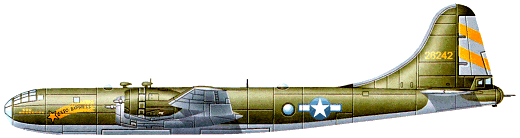
Prototype production was followed by 14 YB-29 service test aircraft, the first of these flying on 26 June 1943. Deliveries of YB-29s began almost immediately to the 58th Very Heavy Bombardment Wing (VHBW), a unit which had been established on 1 June in advance of the first flight. B-29 production was the most diverse aircraft manufacturing project undertaken in the USA during World War II, with literally thousands of sub-contractors supplying components or assemblies to the four main production plants: Boeing at Renton and Wichita; Bell at Marietta, Georgia; and Martin at Omaha, Nebraska.
B-29 production totalled 1,644 from Boeing's Wichita plant, with 668 built by Bell and 536 by Martin. The Renton plant produced only the B-29A variant, with slightly increased span and changes in fuel capacity and armament: production continued until May 1946 and totalled 1,122 aircraft.
The designation B-29B related to 311 of the aircraft built by Bell. These were reduced in weight by removal of all
defensive armament except for the tail guns, which were then unmanned, being aimed and fired automatically by an AN/APG-15B radar fire-control system. The production total of nearly 4,000 B-29s of all versions must be regarded as very large, having regard to their size and cost, and it is not surprising that they saw a wide variety of employment in the post-war years, operating under several designations. A number of B-29s were used operationally during the Korean War.
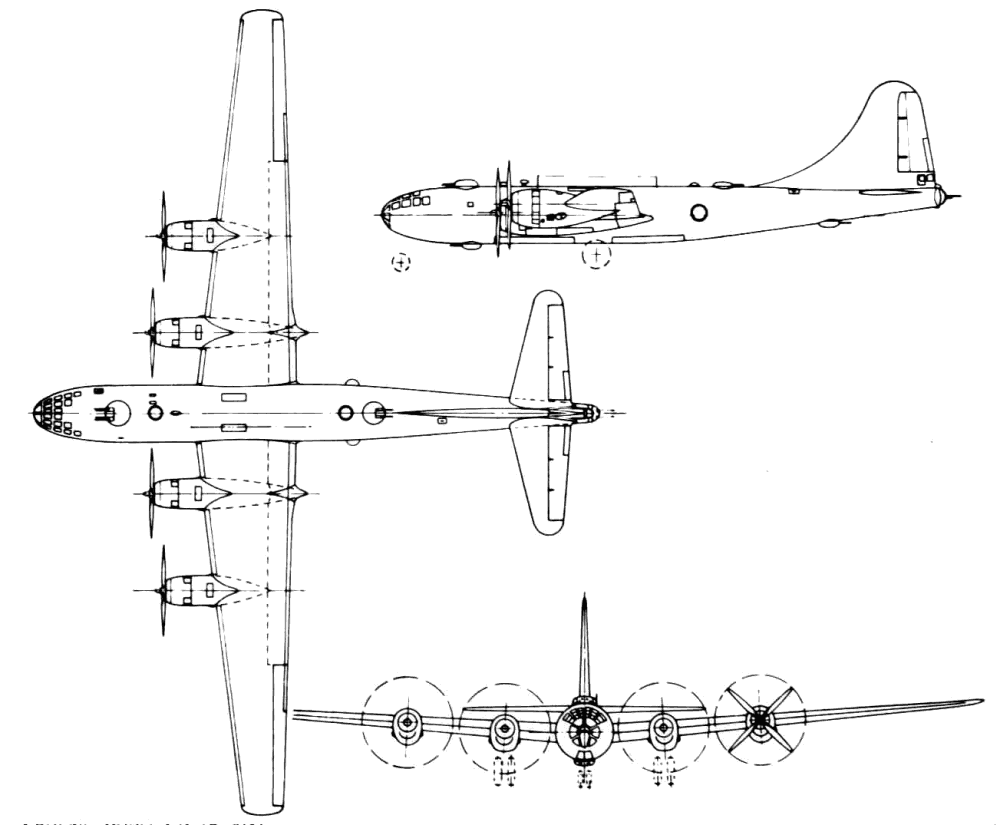
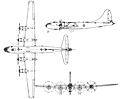 | A three-view drawing (1000 x 825) |
| MODEL | B-29 |
| CREW | 10 |
| ENGINE | 4 x Wright R-3350-23-23A/-41 Cyclone 18, 1641kW |
| WEIGHTS |
| Take-off weight | 56245 kg | 124000 lb |
| Empty weight | 31815 kg | 70140 lb |
| DIMENSIONS |
| Wingspan | 43.05 m | 141 ft 3 in |
| Length | 30.18 m | 99 ft 0 in |
| Height | 9.02 m | 30 ft 7 in |
| Wing area | 161.27 m2 | 1735.89 sq ft |
| PERFORMANCE |
| Max. speed | 576 km/h | 358 mph |
| Cruise speed | 370 km/h | 230 mph |
| Ceiling | 9710 m | 31850 ft |
| Range w/max.fuel | 5230 km | 3250 miles |
| Range w/max payload | 2880 km | 1790 miles |
| ARMAMENT | 11 x 12.7mm machine-guns, 9000kg of bombs |
| Chris Ruddell, e-mail, 12.11.2021 14:40 It is with humble pride that we inform you that we have as many ancient historical sites as Sigiriya and fascinating places in Sri Lanka that will delight your mind. Accordingly, I am happy to inform you that after you visit Sigiriya, it will also cover the various places in Sri Lanka that you can reach from Sigiriya. So, now let's go around Sri Lanka from Sigiriya reply | | Martin Coddington, e-mail, 27.02.2021 23:42 It is good to see that some ARS guys are still kicking and reported in but I was hoping to see more stories about their work. The KB-29 was he original aerial refueling workhorse of the USAF. I was an Air Traffic Controller at Malmstrom AFB in Great Falls, in 55, 56, 57, 58. We were home to the 407th ARS plus three F-84F squadrons, all of those were SAC units. We also had a FIS flying F-94Cs, an itinerant unit from the ADC.
From my perch, the obvious threat regarding the KBs was whether or not they would fly. They raced down the two miles of runway, were horsed off the ground and as soon as they cleared the highway sank back down into the Missouri River Valley where we couldn't see them for almost 10 miles. But once they got the speed and altitude, they seemed like they could do their job and came home at the end of the mission.
When KC-97s eventually replaced the KBs, they did a better job but just barely. Still a doggy performer. reply | | Tom Teate, e-mail, 07.02.2018 00:44 My father, then Capt. Thomas L. Teate, was credited by the Pentagon for writing the first flight manual for the B-29. When the first B-29's rolled out of production and were headed to the training schools around the US, there was no "How-To"instructions nobody could fly them-- He wrote the manual that cross-trained the crews and got them ready for the Ferry Command to fly them out to Europe. The Pentagon sent him to each school to set up training programs--it saved the Air Force millions of dollars by keeping the crews from crashing the planes during training.. He also piloted the "Winged Victory" used for display for the War Bond effort to raise money. It was during one of these War Bond tours where the public could see the B-29 that he met Charles Lindburgh. Col. Lindburgh approached my father, as he was the plane captain, and asked him if he would take him up. My father called the Pentagon, got permission, got him a flight suit, put him in the right "seat" and taught Lindburgh how to "fly" the '29. They spent several hours in the air. My father, Col. Thomas L. Teate had his pilot's license when he was 16, in Jacksonville, Florida-- Lindburgh was his childhood Idol--it was something for him to give a "check Ride" to Lindy. reply | | Charles D Kowalski, e-mail, 28.04.2015 23:39 I went through crew training at Randolph Field in 1954. I was an observer in the nose to start. Then I was a radio /ECM operator when our unit, the 582 Air Re-supply squadron flew to RAF Molesworth in England. We often flew 17 hour missions resulting in a lot of total hours in this aircraft. A great airplane. reply | |
| | Jim Dunigan jr., e-mail, 26.03.2015 02:31 My Dad, F /O James F. Dunigan was a B-29 Pilot in training at Roswell N.M. At the end of the WWII. He was also a Flight Engineer on the B-29. He was in the second class to be trained for delivery of the Atom Bomb. Just before he passed in Sept 2002, he told me that in the training group he was in that everybody in the cockpit of the B-29's they had were all pilots and qualified to fly it. He had been to Flight Engineering school at Colorado Springs where he got his observer wings and then went to Roswell to continue training. He kept all of his orders and flight logs in his B4 bag. I still have them along with his uniforms and flight suit. He also told me of one training flight where they had an engine fire on their B-29. reply | | Pat Daily, e-mail, 11.02.2015 18:04 I was a Scanner on "Doc", TB-29J at Griffiss AFB in Rome, NY in 1954 through 1958. I have known for many years that "Doc" has been undergoing restoration at Wichita, KC. Simple question. Is "Doc" ever going to be restored to flying conditions? I dougt it. Msgt. Pat Daily USAF Ret. reply | | CV Gregory, e-mail, 25.03.2014 03:11 I was a mechanic on B-29 s at yuma county airport 17th tow target sqd.in 1955 and 56. the main problem I remember was the fuel leaks. many a flight was aborted when the flight crew found a leaking injector fitting we finaly wised up and ran the engines up just before they got there. reply | | Richard Burr, e-mail, 31.01.2014 03:11 I was a navigator w / the 506th ARS @ Bergstrom AFB (1956-1957). Capt Buddy Hubbard was our A /C. Major Wallen was our Sqd. Commander. Great crew! Lifetime memories. Would love to hear from others w / the 506th at that time. reply | | Frank Ridout, e-mail, 08.07.2013 20:51 I was a Flight Engineer on KB-29's in the 506 Air Refueling Sqdn. I was stationed in Bangor,Me from Jan. 1954 until July 1955 when the 506th transferred to Bergstrom AFB
Austen, TX
Would like to hear from anyone who was in the 506ARS reply | | Mark, e-mail, 20.09.2012 17:46 B-29
Βομβαρδιστικό βαρέως τύπου, τετρακινητήριο, ελικοφόρο, κατασκευασμένο από την Boeing για τις Ενωμένες Πολιτείες. Χρησιμοποιήθηκε σε στρατιωτικές επιχειρήσεις κυρίως κατά τον 2ο Παγκόσμιο Πόλεμο και τον Πόλεμο της Κορέας. Το όνομά Superfortress (υπέρ φρούριο) προήλθε από τον προκάτοχό του B-17 Flying Fortress και συνεχίστηκε και στα επόμενα μοντέλα βομβαρδιστικών της Boeing. Κατασκευάστηκαν περίπου 4.000 τέτοια βομβαρδιστικά στη περίοδο 1943 έως 1946, ενώ αποσύρθηκε οριστικά το 1960
To B-29 αν και προηγμένο τεχνολογικά και οπλικά για την εποχή του, συμμετείχε σχετικά λίγο σε αποστολές του 2ου Παγκοσμίου Πολέμου, καθώς η παραγωγή του ξεκίνησε το 1944, στο τέλος του πολέμου δηλαδή. Αποτέλεσε το βασικό βομβαρδιστικό των Αμερικανών στο τέλος του πολέμου και χρησιμοποιήθηκε κυρίως κατά της Ιαπωνίας. Ήταν επίσης το αεροπλάνο που μετέφερε και έριξε τις ατομικές βόμβες στο Ναγκασάκι και τη Χιροσίμα. Ήταν οπλισμένο με 12 πολυβόλα M2 Browning 0.5 ιντσών, από τα οποία, τα 10 ήταν τηλεχειριζόμενα και μπορούσε να μεταφέρει βόμβες μέγιστου βάρους 9 τόνων
Μερικά από τα χαρακτηριστικά του ήταν:
Μήκος: 30.2 μ.
Άνοιγμα πτερυγίων: 43.1 μ.
Μέγιστο βάρος φορτίου: 30 τόνοι
Μέγιστη ταχύτητα: 357 μίλια /ώρα
Ακτίνα δράσης: 5.230 χλμ. reply | | Jerry Plumbley, e-mail, 23.07.2012 00:14 I was stationed at Barksdale AFB from 1951 to 1954 and flew in a Kb29. We were refueling B-29's. Inflight refueling in the early stages of this learning curve was interesting to say the least. In 1952 we flew to England and were training over there from came back home to Barksddale in early 1953. I was a Radio Operator at the time. reply | | Glenn Hickman, e-mail, 22.07.2012 03:06 Hi , Im looking to buy 2 B29 breathing oxygen bottles (stainless steel)if anyone can help It would be most appreciated.
Regards
Glenn reply | | Roy Emberland, e-mail, 15.04.2012 08:49 I was a Tail Gunner on Capt.Sheppards crew flew 26 mission over North Korea from August '52 thru Febuary '53 with the 372 BS,307 Bw from Kadena AFB Okinawa. reply | | Roy Emberland, e-mail, 15.04.2012 08:48 I was a Tail Gunner on Capt.Sheppards crew flew 26 mission over North Korea from August '52 thru Febuary '53 with the 372 BS,307 Bw from Kadena AFB Okinawa. reply | |
| | ronald costello, e-mail, 30.03.2012 17:49 I was a tailgunner on this aircraft in the korean war. Stationed at Yakoto AB in Japan 1952. Flew 27 missions over North Korea.
This aircraft not only is fantastic . But a beautiful piece of equipment. The only problem i saw with it was that it had no glide power. Drops like a rock. And loves oil leaks. reply | | peter, e-mail, 21.02.2012 14:37 Has anyone seen a film " Last flight of Noah's Ark".The pilot ( Eliot Gould- I think ) starts the engines of his B29 from the flight engineers position, goes to the front and then takes off all by himself. Seems unlikley. Sometimes I think these guys at Disney just make stuff up.
Terrible film. Some nice flying sequences though.. reply | | Kristine Olson Ringsrud, e-mail, 04.02.2012 21:42 My father Vern Floyd Olson was stationed at Yakota AB in Fussa Tokyo during the Korean war. I recently came across this excerpt in a letter he wrote home in December 1955, and would love to learn more about this incident. Dad never discussed his military service.
---
"Maybe you read in the paper or heard on the radio that we had a ship crack up. That was the third and we haven't had any peace yet, or they still don't know why it happened.
They took off at 0415 & found their gear wouldn't come up all the way and also wouldn't go back down. It was jammed right where it was at.
The ship was "Miss FuFu", one of the 29s we picked up from Okinawa when we got here. It was part of my old team 706 who work on it. They were to transfer after the first of the year for testing and training.
Well, to get back, they knew then they would either have to crash land or bail out. They decided that two of them would bail out & the rest said they would ride her out.
We got on the radio and talked to them from 0715 till just before landing, going over check lists and what to throw out and figuring out how much item would take the weight of the aircraft down. Radio, radar, life rafts, guns, ammo, and etc. At 1:30 they had the ship down to 89,000 lbs (unintelligible) and brought her in.
I don't think I seen so many men pray so hard that the would get out OK & that the ship wouldn't catch fire. When Cpt West turned "final" to land, he called the tower & said "I have two green lights, one red & a prayer." There are green and red lights which tell if a (unintelligible) is safe to land or not.
The two who jumped made it out OK. Also Cpt. Borton's chute didn't open and he was lucky it was a chest pack & he pulled it open by hand. Said he died a thousand deaths when he pulled the handle & nothing happened. Said all he could think of was to take it apart with his hands, maybe it would open before he hit the ground. He was lucky & it opened with little trouble after he started tearing on it.
They had quite a choke up over it down at 'chute re-pack. They ground every one until there chute went through re-pack. They brought parachutes in from all the boys around here to get the job done.
We had been flying like mad with getting all these aircraft test-hopped since the crash. They tore all the gears apart to see if they could find anything on the rest of the ships. We had been flying "specials", "Bull Ropes" regular & then had typhoon Patsy come in on us and then this crash. This outfit is all in a mess yet from it. There have been more brass around hre since the crash than I seen in all the time I have been in."
If anyone could fill in any details or make any suggestions about how I could find additional information, I would be most grateful. reply | | Chuck Hayes, e-mail, 28.01.2012 17:16 I flew as a flight engineer on the KB-29P model in the 506 ARS at Bergstrom AFB, TX from 1955 to 1957. Good aircraft and very forgiving. The only acft I ever experienced a flat pitch runaway prop on. The only crew member I can recall is the A /C, Lt. George L. Carr. Good pilot, no supervisory skills-a driver not a leader. reply |
| Mike Kelly, e-mail, 24.04.2011 05:29 My dad, Daniel Kelly, was working for Wright Aeronautical in Paterson NJ when the war started. he was subsequently set up as a Warrant Officer for security clearance and shipped to Wichita for the "Battle of Kansas" and the duration of the war. I grew up hearing all the stories about the numerous engine problems holding up production of reliable aircraft. He was always very proud of his involvement, and I still have all his notebooks and manuals. reply | | Don Hallock, e-mail, 16.04.2011 04:14 I am happy to say that I flew 47 missions over North Korea and lived through it. 38 missions in 1951 with the 98th Bomb Gp 345th Bomb Sq as an 18 year old gunner and 9 more as a pilot with the 19th Bomb Group flying from Okinawa in 1953 as the war ended. The airplane was easy and fun to fly, the engines however were extremely unreliable. We had some scarely moments with engine failures. After being released from active duty, I spent the next 35 years flying with a major airline; during that time I had only two actual engine failures. Does anyone remember Captain Herbert A Charlsons crew from the 345th Bomb Sq. at Yokota Air base in late 1951. We flew 46-2106 "Miss Yankee Doodle" and 46-2253 "The Reluctant Dragon". reply |
|
Do you have any comments?
|
| 
COMPANY
PROFILE
All the World's Rotorcraft
|




Hey Chuck, probably crewed with you and Lt. Carr as a brand new A /2 class boom operator, Charlie Cook was my IBO. I went with the new 92ARS to Fairchild AFB and boomed on the new KC-135's. Ended up a T /SGT and discharged in August of 63. Moved back home to MPLS MN. and acquired all of pilot ratings up through the airline transport rating. Flew many different types of aircraft for the next 40 plus years, but mostly corporate jets and held chief pilot positions for large corporations. SO see what you and Lt. Carr did after crawling thru the tunnel to observe what you guys were doing to fly that great KB-29P airplane. Thank you, John Gillquist
reply