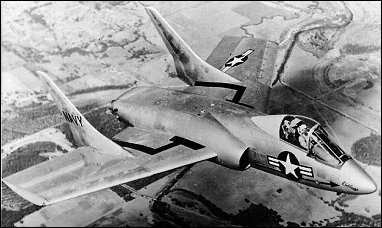
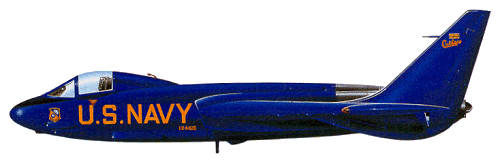
The Cutlass was a swept-wing tailless single-seat carrier-borne fighter which entered service with the US Navy in several versions from 1952. Production ended in December 1955. It was the first production naval aircraft to achieve supersonic flight, the first to release bombs at a speed greater than the speed of sound and the first to be catapulted from a carrier while carrying nearly 2300kg of external stores. It was also the first fighter to have incorporated in its design the use of afterburners, full power controls with an 'artificial feel' system and an automatic stabilisation system.
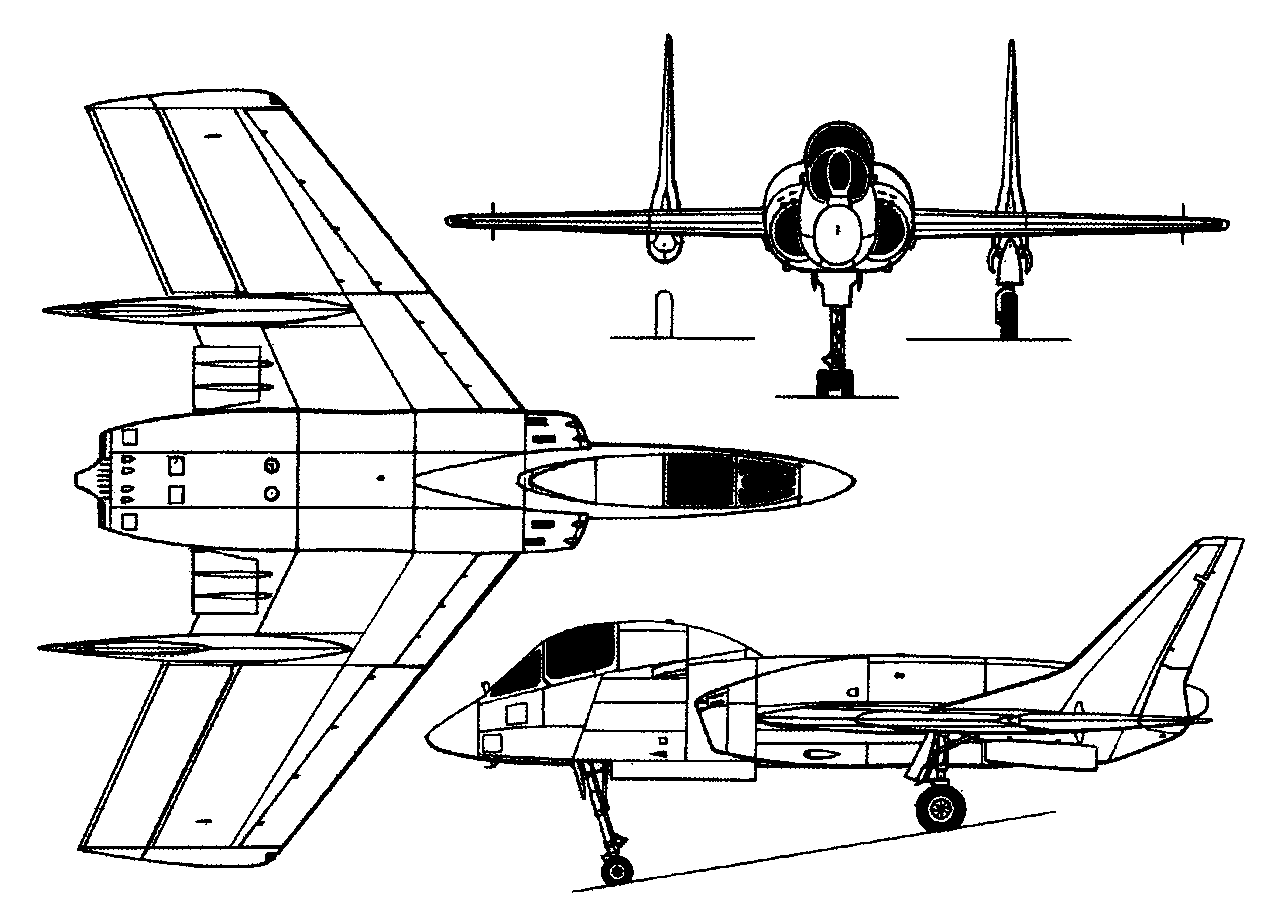
The Cutlass wing, which was of symmetrical section, was fitted with full-span leading-edge slats, air brakes, power-operated irreversible 'ailavators' (combined ailerons and elevators) and vertical fin and rudder surfaces.
Four versions were produced, beginning with 14 F7U-1 for training and operational evaluation for aircraft carrier use. Power was provided by two J34-WE-32 turbojets. The F7U-1 were followed by 180 larger F7U-3 with folding wings, arrester gear and 20.46kN J46-WE-8A turbojet engines. Armament was increased to four 20mm cannons and a new type of underfuselage rocket launcher carrying a Mighty Mouse pack. For strike missions two further packs could be carried under the wings. Delivery of production F7U-3 to the Navy began in 1954. In 1955 the F7U-3P variant was produced for photographic reconnaissance duties and 12 were subsequently completed, each featuring an elongated nose to house the camera equipment. The final version of the Cutlass (of which 98 were produced) was the F7U-3M, basically similar to the F7U-3 but with provision for carrying four Sparrow I beam-riding missiles.
I went to Nebraska Vocational Technical School, (NVTS), Milford, Nebraska. 1960-1962 There on Highway 6 corner NVTS entrance was a Vought Cutlass on display. This display was one reason that inspired me to attend that school. The plane still had fuel dripping. I used to climb up in the cockpit and dream about flying. The flight controls were still mechanically working. Now 65 years later am looking for a photo of that setting. I never did get to fly a jet but had fun in my Cessna 150.
I was an avionics tech with VA_151, Alameda 1955 1956. we were on the Lexington cruise ,May 1956. And yes it was an "exciting" air ship! I believe we lost 3 total , one on fire after cat launch when fuel sprayed from vent and after burners made it a torch. lost the pilot, did not eject, Set deck on fire and a lot of diving for the catwalks. one on runway at NAS moffit with same type of "tail' fire, one in Moraga California being ferried to Fallon NV ,pilot tried to eject but seat failed. never had a nose gear fail, but was a leaking hydraulic "bucket. But the airplane was a good weapon platform. We trained at china lake and Fallon, in ,loft bombing and over the shoulder bombing based on time and "G"'s with LABS equipment some we retrofitted in Alameda. I still remember all of pilots as a great group with SKILLs One was an new ensign that I flew with in O&R flight test in Norfolk Virginia, one of vanishing breed of enlisted pilots from WWII. We also spent about 30 days in the "formosa' straights after the chinese shot down a P4M1Q from Atsugi which the "ensign" flew as co pilot in Norfolk and I flew as a equipment operator. had general quarters and atayed on station. suffered serious damage from a Typoon. All of this is entirely missing from the USS Lexington, " May, 1956 "cruise" records. The F7U was an aircraft way before its time.
My uncle was Cdr. James S. "Bud" Brown, deceased since 1978. He was the CO of VF-124 and in charge of Project Cutlass. I am interested in photos or info about him. Thank you. Steve Wells Email me at vb21wells@att.net
I made the 1956 mid.cruise on the u.s.s.intrepid and had first hand at seeing this a /c in operation.beautiful to watch when in the air,with the sun shining bounceing off the surfice of the wings,beautiful it was when flying...
I flew the 3's & 3M's w / VA 83 /;NAS Oceana,'55-'56,w / cruise on Interepid.Great A /C except for MANY system failures.In 10 month 'workup & cruise" we lost 6 A /C.Very stable ord. platform,Many problems aboard ship w / nosegear.However, it was a 'showstopper' wherever you went. Great plane to fly, especially in A /B. Maint. always a problem, managed to acquire 480 hrs however. Lifetime experiance tho..Will never forget it.
Mark A Blocksom, e-mail, 29.04.2023 Capt. Dudley Gillaspy USN/Ret
CAPT Dudley, I am a researcher on the USS Midway Museum library and am writing the history of our Cutlass, BuNo 129565. It was one of the first to arrive at Miramar for the "Project Cutlass" team. I would be interested in speaking with you about your experience if you have the time.
I was in VF124 and Project Cutlass 1954 and 1953. I didn't go on the deployment to Japan but I did go on the Hancock short cruise to test the steam cats. I was a brown shirt and my plane was 01. One our pilots went on to be an astronaut and vowed being an astronaut was safer than flying a Cutlass.
I am a researcher on the USS Midway Museum library and am writing the history of our Cutlass, BuNo 129565. It was one of the first to arrive at Miramar for the "Project Cutlass" team. I would be interested in speaking with you about your experience if you have the time.
I dont know what ship Gilbert Baron was on but I was on the Hancock not the Hornet when we were put ashore to Atsugi. We were not sent back to Miramar. I was at atsugi for about 1 month. So Robert Morris was right.
I WAS ON THE HANCOCK FOR THE CRUISE TO JAPAN N 1957.WE WERE TAKEN OFF THE SHIP IN YOKOHAMA . WE WERE DETACHED FROM THE SHIP ON THE ISLAND IN YOKOHAMA HARBOR FOR MAINTENANCE, AND THEN WE WERE ALL TRANSFERRED TWO AT SUGIE AIRBASE FOR THE DURATION OF THE CRUISE. HAD A LOT OF GREAT TIMES BUT HAD A LOT OF PROBLEMS WITH THE PLANE AND LOST A LOT OF GOOD PILOTS INCLUDING MY FRIEND JACK'S SHIELDS
My father, Bobby Crosson, was in aircraft maintenance with the Cutlass on that cruise. He was part of the staff left in Japan for part of the deployment. He told me a few stories, something about the marine squadron that replaced the Cutlass crews not being too happy about their unexpected deployment. We still have a few things he collected while in Japan. Unfortunately he passed in 2008. Like most grown kids, I wish I had paid better attention.
During a 1956 deployment to Morocco from the USS Intrepid with half of VA-83's F7U-3M aircraft I was driving a jeep down the hill toward the airstrip at night I was watching one of our aircraft doing touch and goes. When the aircraft touched down it created sparks of light from its underside. I immediately thought his nose gear had collapsed. I sped down to the strip and followed the A /C and found that the pilot had not let down his gear and there was no one in the cockpit. By this time the magnesium structure was starting to burn brightly and the fire crew was there. We looked for the pilot but found him in the hanger about a quarter of a mile away with a broken back. Thank God he was alive.
I am a researcher on the USS Midway Museum library and am writing the history of our Cutlass, BuNo 129565. It was one of the first to arrive at Miramar for the "Project Cutlass" team. I would be interested in speaking with you about your experience if you have the time.
I am repairing a 64" wing for a single rudder cutlass, and I can not find any information. The only cutlass I can find has two rudders. Thanks for any helb you can send me.
All the negatives may be true, but look at the design of this fighter. Look at the year is was built. Then, look at a bunch of contemporary airplanes and you will see the similarities in configuration to the F7U. If the engines that the airplane was designed for had been available it might have been a great airplane. (Former Chance Vought employee.)
This was a bad plane. It's serviceability was extremely poor and the downtime, especially when embarked on the USS Hancock, was such that the number of flight hours achieved was far lower than any other plane in the fleet. Problems with the engines and flight controls were exacipated by corrosion problems that were experienced with the natural metal finish, somewhat releived by the application of paint.
Had the scare of my life watching one of these things stall on takeoff and sideslip across the local airfield. The pilot corrected and managed to dodge the control tower. This was on a visit to San Diego some time in 1952.
When all systemms were go in the F7U-3, she was one heck of an airplane. In a fight, burners gave us the edge unitl the F-100 series came along. But she burned too much gas and was not carrier suitable (nose gear collapse).
The Cutlass was one of my first jetex-powered Keil Kraft planes. Admired the real thing, being 12 years old. 1954. A Dutch aircraft-carrier was in Mayport,Fla in feb '59. From a film I took a snapshot of a rare Cutlass on a barge in the harbour, obtained it only today. How do I send a picture to you?
VA-83 deployed to the med in 1956 and I wound up with a total of 58 carrier landings onthe Uss Intrepid,CVA-11. A straight deck. I loved the nCutless.Questions' I have answers.
There was a surplus Cutlass near Highway 6 going through Milford, Nebraska. 1959-1962 time period. I attended then, NVTS Milford and during off class time I would sit in the cockpit and fantasize flying it.


 reuben w. williams



Al,
I'd be interested in talking with you. I am a researcher on the USS Midway Museum and we just recently brought a Cutlass aboard.
Thanks,
Mark
619-312-7670
mblocksom@midway.org
reply