|
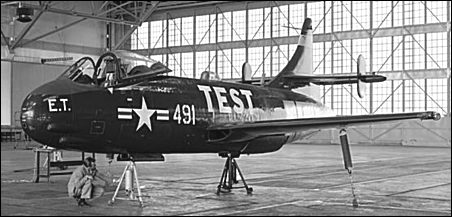
| Before World War II ended, Chance Vought was busy with the design of the Chance Vought V-340 single-seat jet-propelled fighter for service with the US Navy. It was the first turbojet-powered aircraft to be designed by the company, but proved sufficiently attractive for the US Navy to award a contract for three XF6U-1 prototypes on 29 December 1944.
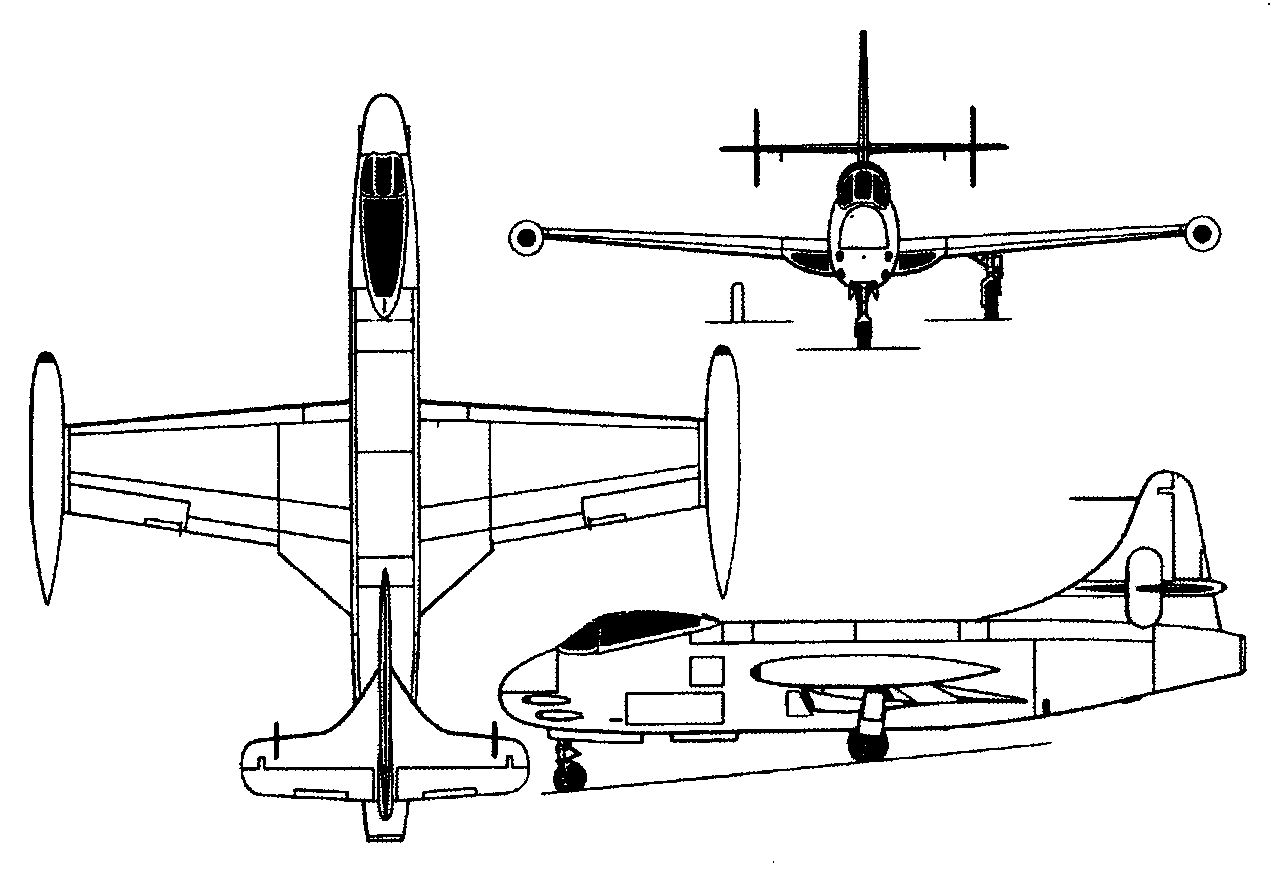
Of low-wing monoplane configuration, the all-metal structure of the air-frame had Metalite skins, patented by the company and comprising two sheets of high-strength light alloy bonded to a balsawood core. The tailplane was mounted on the fin, just above the fuselage, but production aircraft had two auxiliary fins, one towards the tip on each side of the tailplane. The Pirate had retractable tricycle landing gear, jettison-able auxiliary fuel tanks at each wingtip, and the pilot accommodated high on the fuselage, well forward of the wing.
The first of the three prototypes made its maiden flight at Muroc Dry Lake on 2 October 1946, powered by a 1361kg thrust Westinghouse J34-WE-22 turbojet mounted in the aft fuselage. Production examples of the F6U-1, of which the first flew during July 1949, began to enter service with the US Navy in the following month. A total of 65 had been ordered but after 30 had been delivered the remainder were cancelled.
FACTS AND FIGURES © The Pirate never received radar
or other mission avionics. The
aerodynamics were equally
unsophisticated. © Extra fins were added on the
tailplane to reduce the lateral
instability caused by the
extended rear fuselage. © The wing and tailfin were
skinned with Metalite, a
material composed of a
sandwich of Duralumin and
balsa wood. Other parts
were Fabrilite, a laminate of
balsa and glass fibre.
 | A three-view drawing (1278 x 870) |
| MODEL | F6U-1 "Pirate" |
| CREW | 1 |
| ENGINE | 1 x Westinghouse J34-WE-30, 1916kg |
| WEIGHTS |
| Take-off weight | 5702 kg | 12571 lb |
| Empty weight | 3320 kg | 7319 lb |
| DIMENSIONS |
| Wingspan | 10.1 m | 33 ft 2 in |
| Length | 11.46 m | 38 ft 7 in |
| Height | 3.94 m | 13 ft 11 in |
| Wing area | 18.91 m2 | 203.55 sq ft |
| PERFORMANCE |
| Max. speed | 908 km/h | 564 mph |
| Ceiling | 14110 m | 46300 ft |
| Range | 1851 km | 1150 miles |
| ARMAMENT | 4 x 20mm cannons |
| GrahamClayton, e-mail, 05.05.2024 02:59 The only claim of fame of the Pirate was that it was the first production aircraft equipped with an afterburner. reply | | RB, e-mail, 23.03.2021 03:39 It may've been a disappointment in person, just look at it!
But how can we ignore 8,060 fpm initial clime rate by 1949? reply | | jesseblenn@gmail.com, e-mail, 13.12.2020 00:51 The SAE (Society of Automotive Engineers) sells reprints /downloads of an excellent article on the aluminum and balsa wood sandwich construction used. They achieved useful strength much higher than that of the aluminum facing. Too bad it was underpowered, it could have opened more doors if it weren't. reply | | Klaatu83, e-mail, 20.02.2017 19:32 One of the worst jet fighters ever built, a complete waste of the Navy's time and the taxpayers' money. Most of those produced went straight to the scrapheap. And for those who try to excuse this monstrosity by saying that it was an 'easy jet", bear in mind that this piece of rubbish was a contemporary of the McDonnell FH Phantom and North American American FJ Fury and Grumman F9F Panther, all of which were WAY better. reply | |
| | George, e-mail, 08.01.2016 09:59 The 564 MPH speed claimed is doubtful. Some sources claim the Pirate was only marginally faster than the propeller driven Corsair. reply | | Stu Sammis, e-mail, 12.08.2010 21:26 Was underpowered as were most early jets. Airframe development far outpaced the available power plants. reply | | rob combs, e-mail, 02.04.2010 23:45 aviation historian here; also flew in Vietnam; excellent post; thanks for sharing. reply | | Patrick, e-mail, 14.05.2008 16:06 Lamest plane every you dummy made worst airplane book reply |
|
Do you have any comments?
|
| 
COMPANY
PROFILE
All the World's Rotorcraft
|