|
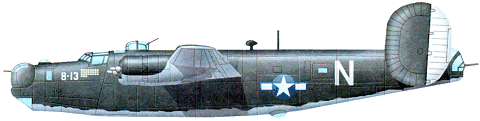
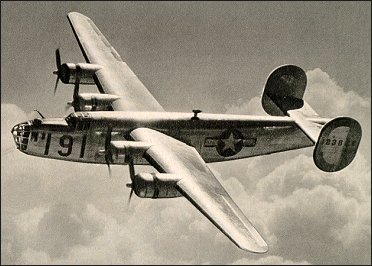
| When in 1939 Consolidated Aircraft Corporation began design of a bomber aircraft intended to be superior to the Boeing B-17, the company could never have imagined that more than 18,000 of these aircraft would be built (as the B-24A to -M for the USAAF and Liberator I to IX for RAF Coastal Command and Bomber Command). The aim of the design team was to achieve better load/range performance than that of the B-17, the basis of the design being a wide-span narrow-chord cantilever wing, mounted high on a deep-section fuselage.
Construction was conventional all-metal, but there were several innovations in addition to the new wing. For the first time on a large aircraft a retractable tricycle-type landing gear was introduced. The bomb bay was deep enough for bombs to be stowed vertically and wide enough to comprise two bays separated by a catwalk providing communication between the flight deck and rear fuselage. Instead of conventional bomb doors, which can affect flight characteristics when open, the bomb bay was closed by roller-shutter-type doors.
The prototype XB-24 flew for the first time on 29 December 1939, by which time the USAAC had ordered seven YB-24 for service trials and others had been ordered by Great Britain and France. These had the same engines as the prototype, but introduced pneumatic de-icing boots for wing and tail unit leading edges. The first production B-24A were delivered in 1941 to the USAAF (and others to Britain 4s LB-30A transports for transatlantic ferry flights). During the period of their construction the original prototype was re-engined with turbocharged Pratt & Whitney R-1830-4I, at the same time having the oil coolers mounted on each side of the engine. This was responsible for the unusual elliptical cowlings which, together with the large twin oval endplate fins, made the Liberator easily identifiable.
Subsequent Liberators had increased armament and armour protection. The first major production version was the B-24D, powered by R-1830-43 engines, of which the majority of more than 2,700 built went to the USAAF as bombers. A number were subsequently taken over by the US Navy as PB4Y-1 anti-submarine aircraft. RAF Bomber Command and Coastal Command also received 382 as Liberator III/IIIA and V. The major production version of the Liberator was, however, the B-24J with R-1830-65 engines, making up more than one-third of the total production. These were supplied to the US, British, Canadian and other air forces.
Although the B-24 was deployed alongside the B-17 in Europe, and flew in Africa and the Middle East, its major contribution to America's wartime operations was in the Pacific, where it was first flown in action against the Japanese in January 1942. In Europe it is best remembered for bombing Rome on 19 July 1943 and for a low-level attack by 177 aircraft on the Ploesti oil refineries in Romania on 1 August 1943, a 4,345km round-trip mission from Benghazi in Libya, during which 57 of these eight-ten-crew aircraft were lost.
| CREW | 7-12 |
| ENGINE | 4 x P+W R-1830-43, 880kW |
| DIMENSIONS |
| Wingspan | 33.6 m | 110 ft 3 in |
| Length | 20.2 m | 66 ft 3 in |
| Height | 5.5 m | 18 ft 1 in |
| Wing area | 97.4 m2 | 1048.40 sq ft |
| PERFORMANCE |
| Max. speed | 487 km/h | 303 mph |
| Ceiling | 9750 m | 32000 ft |
| Range w/max.fuel | 4580 km | 2846 miles |
| ARMAMENT | 10 x 12.7mm machine-guns, 5800kg of bombs |
| Beverly Juan, e-mail, 16.12.2023 03:35 How do I recover $222,500. BTC sent to a romance scammer?
It's possible to get back your money little I know it was a big shock of my life because the company i sent my money to was revealed to be a total scam.
I contacted the professional and they helped me with the recovery of all my money successfully, you can also contact them for help. They will help you retrieve back your money, I was able to retrieve all my money back through the professional, you can contact them too they are ready to help....
Email Address: dwchzone@gmail.com
Whats-App: +1 (803) 392-1735 reply | | Francisco C Garcia, e-mail, 08.12.2023 01:29 My uncle was a gunner on the "Perils of Pauline".. I have photos of him & other crewmembers posing next to his plane..however I can't find any information regarding as to him (his name doesn't
appear on the manifest) on the Pauline on the day it went down. He was presumed to be shot down somewhere in Germany. His body never recovered and returned home. His name is Pual D DeLuna of North Platte Nebraska USA. anyone with information, please help. reply |
| Francisco C Garcia, e-mail, 08.12.2023 01:29 My uncle was a gunner on the "Perils of Pauline".. I have photos of him & other crewmembers posing next to his plane..however I can't find any information regarding as to him (his name doesn't
appear on the manifest) on the Pauline on the day it went down. He was presumed to be shot down somewhere in Germany. His body never recovered and returned home. His name is Pual D DeLuna of North Platte Nebraska USA. anyone with information, please help. reply | | David Malcolm, e-mail, 04.12.2021 22:38 Hi seeking info on the crew of The Gremlins Roost 93rd BG H Hardwick England lost feb 6 1945 Akersloot Holland. I am researching this crew especially the pilot Howard Eugene Jennings. Sadly all of the crew are now deceased. So family members hopefully might have information or documentation. Many thanks.
David Malcolm Sunderland UK reply |
|
| | Steve Leathers, e-mail, 22.07.2017 09:41 My father was a pilot for a b-24 bomber named "boomerang" (not the classic kangaroo with a bomb in its hand & one in its pouch. The nose art was a calm kangaroo with a vicious baby roo in its pouch (teeth & drooling) with a boomerang in his hand. My father was Oscar Luther Leathers. Does anyone have any information & /or pictures? reply | | TJ Meyer, e-mail, 07.10.2015 12:54 Hello. I work for NASA Wallops Flight Facility, formerly the Chincoteague Naval Auxiliary Air Station, Chincoteague Virginia. A number of B-24 Squadrons (VB-103, 105, 107 and 110) were initially formed at Chinco and many additional replacement crews trained here. I have spoken to about 10 former B-24 crew members and would like to hear from more. Pleae feel free to contact me at theodore.j.meyer@nasa.gov. I will gladly share info and photos. reply | | George James Delgado, e-mail, 18.04.2015 06:42 Response to Kelly Taylor's post:
How do you do! I read your post dated 3 /1 /15. This is the first time I have been back on this web site in a while and I saw your post about Mr. Rekow and his barber shop. Thank you for the very interesting information. My cousin, Manuel Trevino Jr., was a very interesting person. His wife is still alive and living in Bakersfield California along with my cousin's sons and daughters, whom I have never met. Jessie Trevino is Bambino's (my cousin's nickname)wife and she is about my older brother's age, about 85 years old now.
My older brother is a Korea War veteran. My twin brother and I were Vietnam veterans. I served in Korea in 1965 and Gilbert, my twin, served 3 tours in Vietnam with the Marines, fighting in the jungles during search and destroy operations. Gilbert was in the Navy but was assigned with the Marines. The military used us where ever they needed us.
Well, I don't want to make a short story long, so I will end for tonight. Today is Friday, April 17, 2015.
God Bless,
George James Delgado
El Paso, TX
Cell is 915-615-9002 reply | | merle fister, e-mail, 07.04.2015 22:41 Flew out of Italy. 454th Bomb Group. Bombed Ploesti Oil fields 3 times. 500 heavy guns on ground shooting at us. Direct hit #3 engine. Caught fire. shut down engine. Used fire bootle. Fire out. Hydraulic system shot out. Nose wheel flat. No brakes or flaps on landing. Lost #2 engine on base leg. Lost #1 as we entered final. Lost last engine on touch down. Flew 50 missions in 3 months. Came home to fly P-38's for the war with Japan. Abomb dropped so no need for me. Stayed in 28 years and flew 25 kinds of planes. Bombers, fighters, transports, etc. Became a Radar Instructor and communications specialist. And a planner /programmer of communications equipment. Started out as a Private and ended as a Colonel in the pentagon. reply | | Grant, e-mail, 02.04.2015 23:56 I saw a picture of a B24 over France. The upper gunner was waving at his buddy as he took his picture. The wing was just coming off and I have not seen this picture again. Its history frozen in time. IT needs to be found. Thanks Grant reply | | Gerry Cabot (Capatch), e-mail, 13.02.2015 23:02 I flew 27 missions out of England with the 458th Bomb Group.based in Norwich during 1944and 1945. Looking for any crew still alive or anyone who flew at the same time. I am 90 years old and hope there are other members of my crew alive. Crew included Andy Anderson (NJ), Dave Minsker(Mich), Matt Dorfman (CA), Joe Thomas(IL), Joe Cohen(MA), Mac Swafford(OK), Edgar Phillips, Duane Smith (IL), J Howard Sweeney. (KY) reply | | Kelly Taylor, e-mail, 03.01.2015 04:14 George James Delgado. Hope you see this post. If you ever get to a little town called Emmett, Idaho, you must step into my barber Ron Rekow's barber shop for a hair cut. It will be one of the great experiences of your life. He was the engineer on your cousin's B-24. He's an amazing guy. 92 years old and still gets up to cut hair 5-days a week. He said he is the last of your cousin's crew still around. My email is kandktaylor10@msn.com. Again, I hope you see this post and get ahold of me. reply | | Barry flewitt, e-mail, 08.09.2014 21:30 On the 23th Aug 1944. Two newly refurbished B-24s were on a training flight from Warton Aerodrome, Lancashire, England. There was a sudden and violent storm. The air traffic control ordered the B-24s back to base. One of the aeroplanes crashed in nearby Freckleton. Hitting houses, a cafι and a primary school. The fuel caught fire. There was a heavy casualty list of civilians, children and service personnel from GB and the USA. This year. 2014. There was a special event to mark the 70th anniversary of the tragedy.People still come from the States to visit the site, where there is a memorial. The Warton airfield is now owned and run by British Aerospace. reply | | Leroy McVay, e-mail, 13.07.2014 06:28 Sand Point Naval Air Station, Seattle, about 1956. Reserve squdron, pilot shooting touch-n-gos. Touched little too hard, broke PB4Y2's back. Crew in aft compartment suddenly had a sky light and could hear engings rev up for go around. Tower saw incident and called Abort! reply | | George James Delgado, e-mail, 19.03.2014 04:31 As additional information to my original commentary note, Lt. Manuel Trevino,Jr. piloted the Yankee Doodle Dandy B-24 Liberator in the South Pacific. reply | |
| | Billy Grubb, e-mail, 28.01.2014 22:41 My oldest brother flew 35 missions and had hand full of flac from the cockpit. He was Captain George L. Grubbs at that time. Retired as Col. Grubbs. Never talked much about the war but the B24 always brought him and his crew home. Some were wounded including him. reply | | George James Delgado, e-mail, 20.12.2013 04:48 Hello!
My cousin, Manuel Trevino Jr., was a pilot on the Yankee Doodle Dandy during WWII. He was a 2nd Lt.(received his wings when he just celebrated his 19th birthday)and had 66 missions which included downing 7 Jap fighters. He flew out of Port Moresby, New Guinea. He later became a 1st Lt. and received two Air Medals with clusters. "Bombino" (his nickname) was born here in El Paso, Texas but later moved to Superior Arizona, where my uncle Manny started a music shop and later moved to Oxnard, CA. He was a great guy (he passed away in 2003) and I miss him very much. He served in the 90 Bomb Group, Jolly Rogers. reply |
| Mark, e-mail, 20.09.2012 17:42 B-24
Πρόκειται για ένα βαρύ βομβαρδιστικό της αεροπορίας των Ηνωμένων Πολιτειών. Εμφανίστηκε πρώτη φορά στις αμερικανικές δυνάμεις το 1941, αλλά η μαζική του παραγωγή ξεκίνησε το 1943, με μέγιστη παραγωγή 650 βομβαρδιστικών ανά μήνα το 1944. Ήταν το μεγαλύτερο σε παραγωγή βαρύ βομβαρδιστικό των Συμμάχων κατά τον 2ο Παγκόσμιο Πόλεμο, αφού κατασκευάστηκαν συνολικά πάνω από 18.000 τέτοια αεροπλάνα και παραμένει μέχρι σήμερα το μεγαλύτερο σε παραγωγή στρατιωτικό αεροσκάφος της Αμερικής. Χρησιμοποιήθηκε από σχεδόν όλες τις αεροπορικές και ναυτικές δυνάμεις των Συμμάχων, κερδίζοντας ένα ρεκόρ συμμετοχής στις επιχειρήσεις του πολέμου, στη Δυτική Ευρώπη, στον Ειρηνικό, στη Μεσόγειο και στην Ασία. Η ονομασία Liberator δόθηκε αρχικά από τη RAF και υιοθετήθηκε αργότερα από τη USAAF, ως επίσημο όνομα. Η παραγωγή του σταμάτησε το 1945 με το τέλος του πολέμου
Είχε πλήρωμα 7-10 ανδρών, μήκος 20 μέτρων, άνοιγμα φτερών 33.5 μέτρα, μέγιστη ταχύτητα 470 χλμ /ώρα, ακτίνα δράσης 3.400 χλμ και μέγιστο φορτίο πυρομαχικών 3.6 τόνους. Μπορούσε να μεταφέρει 3.6 τόνους πυρομαχικών ενώ διέθετε μια συστοιχία πολυβόλων 12.7 χιλιοστών M2 Browning σε 6 θέσεις για άμυνα σε αεροπορικές επιθέσεις. Σε σχέση με το πιο γνωστό B-17 Flying Fortress, είχε πιο σύχρονη τεχνολογία, μεγαλύτερη ταχύτητα, μεγαλύτερη ακτίνα δράσης και μετέφερε μεγαλύτερο όγκο πυρομαχικών, αλλά μικρότερη ευελιξία και μεγαλύτερο κίνδυνο πυρκαγιάς ή έκρηξης από εχθρικά πυρά, λόγω της θέσης των δεξαμενών καυσίμου. Το B-24 αποτέλεσε το 1 /3 της δύναμης αεροπορικού βομβαρδισμού της USAAF, ένω τα άλλα 2 /3 αφορούσαν τα B-17. To B-24 κατασκευάστηκε σε πάρα πολλές εκδόσεις τόσο από τις Ηνωμένες Πολιτείες, όσο και από τη Μεγάλη Βρετανία, δίνοντας του και άλλους ρόλους όπως αναγνωριστικό, μεταγωγικό cargo, καυσίμων, προσωπικού και για περιπολίες reply | | Jennifer, e-mail, 01.05.2012 19:15 My grandfather, Felix DeJean, was a pilot or co-pilot of a b24. He was in the 514 squadron, 376 group. I'm looking for any information that anyone may have. thank you. reply | | jim vail, e-mail, 24.04.2012 16:59 My brother claude Vail pilot of the no 1 crew 451st bomb group 724 squadron shot down mar 11 flying lead on a mission over Toulan france bombing the submarine base. Loved flying the B24. His stateside plane was Adolph&Tojo the the plane they had in Italy was the Peacemaker reply | | greg lauer, e-mail, 02.04.2012 03:15 my grandfather was in b 24 in ww2. was downed serveral times but we have no idea what planes. only have a photo marked korea and a b24 with 939 on the nose.
his name was samuel parker shelley. he was from milton ky and inlisted in ohio i think. honorably discharged in july of 45 where it is listed section 1 112th army air corps.
any help is more than i have reply |
|
Do you have any comments?
|
| 
COMPANY
PROFILE
All the World's Rotorcraft
|


 David Malcolm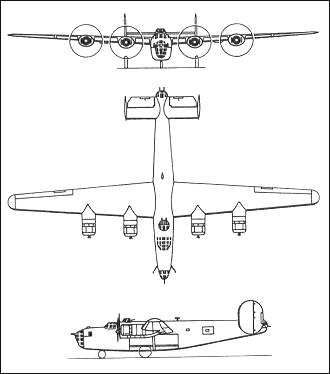


I searched several databases, and I think I found a match. The data may have been entered incorrectly as SSGT "Paul D Luna" of NE.
Here are the deals:
"Hit by flak and Killed in Action (KIA) while TG (tail gunner?) in B-24H #41-29385 'Double Trouble'"
ASN: 17164726
Rank: SS
First Name: Paul D
Last Name: Luna
State: NE
Day: 21
Month: 6
Year: 1944
Details: B-24H-15-CF serial number 41-29385 β€œDouble Troubleβ€, 789th Bomb Squadron, 467th Bomb Group, 8th Air Force
No MACR indicating that the aircraft was not lost.
I can't add the URL, but if you email me, directly I can attach the URLs to the databases.
I'd guess that your uncle may have been on rest and relaxation, sick or reassigned to a different crew when the "Perils of Pauline" was lost.
My uncle, SSGT Earnest Nahigian, was a waist gunner lost on a B-24H on 25 Feb 44 over Germany.
reply