|
| In 1940, with Europe already at war, the US Army Air Corps knew that it was essential to begin preparations for the very real possibility that, in the not too distant future, the United States of America might become involved. As a part of this general thinking the US Army had already begun evaluation of the Cessna T-50 as an 'off-the-shelf' twin-engined trainer which would prove suitable for the transition of a pilot qualified on single-engined aircraft to a twin-engined aircraft and its very different handling technique. Procured as the AT-8, Cessna's T-50 was built in large numbers.
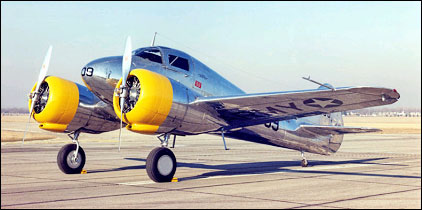
For the more specific transition to a 'high-performance' twin-engine bomber it. was considered that something less stable than the T-50 was needed. However, Curtiss-Wright had anticipated this requirement with the design of the Curtiss-Wright CW-25, a twin-engined pilot transition trainer which had the take-off and landing characteristics of a light bomber aircraft. The CW-25 was of low-wing cantilever monoplane configuration, provided with retractable tail-wheel landing gear and powered by two Lycoming R-680-9 radial engines. The single prototype acquired for evaluation had a welded steel-tube fuselage structure with the wings, fuselage and tail unit fabric-covered.
Evaluation proving satisfactory, the type was ordered into production under
the designation AT-9, and name Jeep. The production examples differing from the prototype by being of all-metal construction. A total of 491 AT-9s was produced and these were followed into service by 300 generally similar AT-9A aircraft. They remained in use for a comparatively short time, for the USA's involvement in World War II in late 1941 resulted in the early development of far more effective training aircraft.
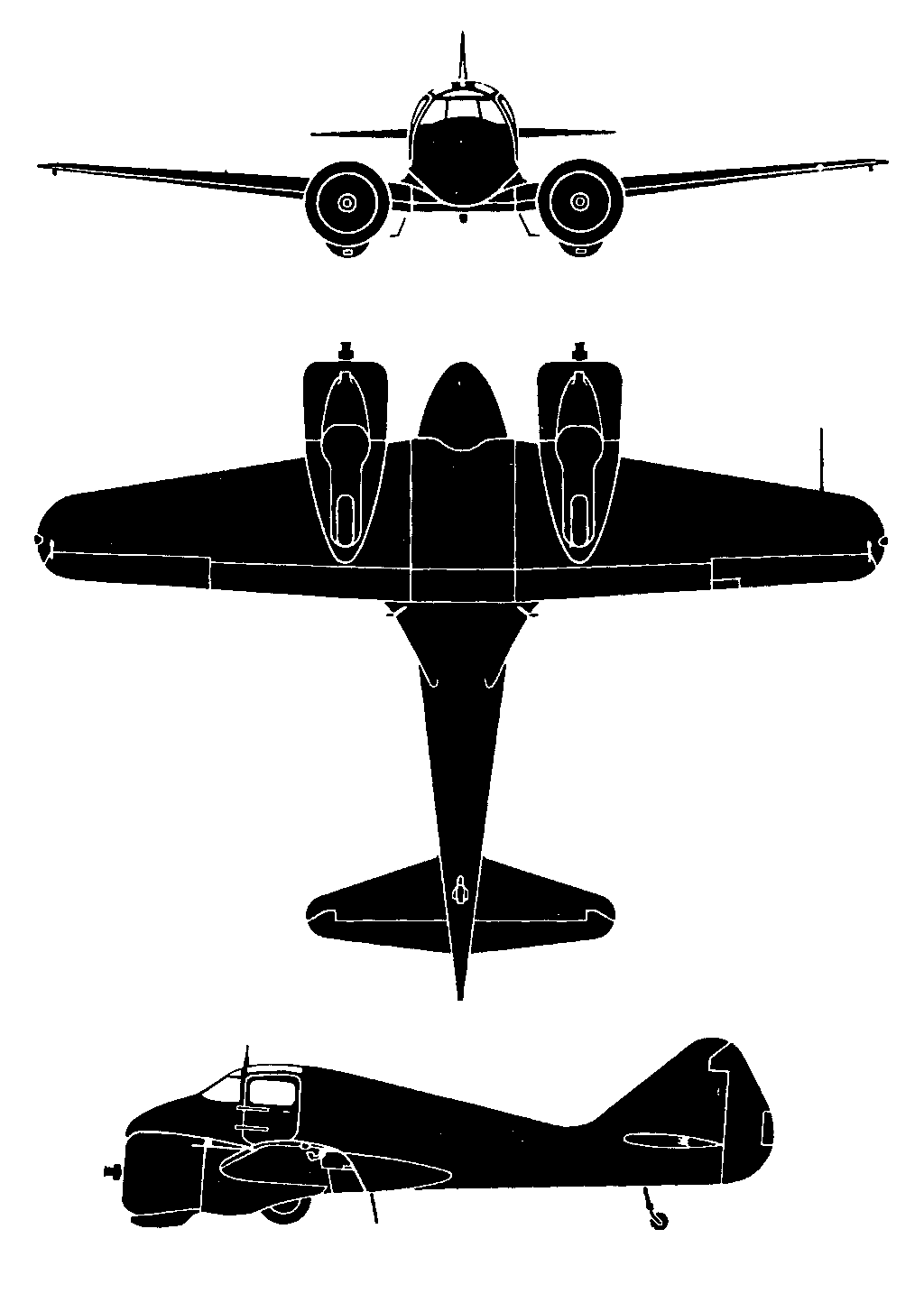
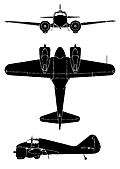 | A three-view drawing (1024 x 1444) |
| ENGINE | 2 x 220kW Avco Lycoming R-680-9 radial piston engines |
| WEIGHTS |
| Take-off weight | 2722 kg | 6001 lb |
| Empty weight | 2087 kg | 4601 lb |
| DIMENSIONS |
| Wingspan | 12.29 m | 40 ft 4 in |
| Length | 9.65 m | 32 ft 8 in |
| Height | 3.00 m | 10 ft 10 in |
| Wing area | 21.65 m2 | 233.04 sq ft |
| PERFORMANCE |
| Max. speed | 317 km/h | 197 mph |
| Cruise speed | 282 km/h | 175 mph |
| Range | 1207 km | 750 miles |
| Joe D. Reynolds, e-mail, 12.01.2011 04:03 In 1946 I was 16 years old and lived near Muskogee, Okla. The local airport, Hatbox Field, was covered with the AT-9's Jeep trainers. Every one of the airplanes and engines were chopped up for scrap within a relatively short time. I remember standing at the fence watching them being chopped up. I do not know if any exist today. reply | | Bill Haase, e-mail, 18.11.2010 02:54 I flew the AT-9 at Lubbock Army air base in 1942. Pilot Class 42-I. It was great fun flying dog fights. On power off landings you viewed the air strip through the upper window! Sorry there are so few around now.
Good luck, Bill reply | | al handley 44F, e-mail, 06.10.2010 20:47 Flew AT-9's at Altus, OKlahoma- agreat airplane,You just had to fly it. A dead stick landing was done at a 45 degree angle as there was little if any gliding rattio. al reply | | haginshogan@usamedia.tv, 28.04.2010 22:19 Mather Field, just outside of Sacramento, was first dedicated to twin-engine advanced training. Starting in spring 1941 with AT-6's, then in l942 to AT-9's /UC-78's and finally to B-25's from 1942 to 1944.Multi=engine training moved do Douglas AAF in 1944 when Mather became a heavy bomber
base
it was also a navigator training base with AT-7's starting in 1941. reply | |
| | Steve Passow, e-mail, 26.04.2010 18:31 My Father-in-law Lt. Col. Edmund Lutz completed his advanced multi-engine training in the AT-9 at Pampa, Tx in 1943. He went on the become highly decorated B-17 Commander 379th Bomb Group Triangle K 525th Squadron Kimbolton, Eng. with 30 completed missions over Germany. reply | | W.C. Marckhoff, e-mail, 27.01.2010 04:49 I was a pilot instructor at DouglasAAF in 1943 and 1944.The AT-9 was a great airplane and fun to fly and instruct in.It was used in conjunction with the UC-78. reply | | cecil j. poss, 26.01.2010 18:44 I flew the AT-9 in advanced training at George field, Il in April and March 1943. I graduated on the 25th of March. I think the field is now known as Lawrenceville Il which is just west of Vicennes. It was a nice plane and much better than the AT-10 which was also there. They alternated the 9's and 10 by classes. I was in 43C.I was in WWii, Korea and Vietnam. Last a /c flown in the USAF was the RF 101 reccy bird. Am 88 and still flying. Cheers. reply | | Dave Hanst, e-mail, 07.12.2009 07:11 I flew the AT-9 in advanced flying school at Columbus Army Airbase in 1943. It was a great flying machine, landed pretty fast, terrific for formation flying. The wing was so short you could almost spit over the end from the cockpit. reply | | John M. Kuharic, s/sgt, e-mail, 23.07.2009 23:56 I crewed this bird during 1943 at Williams Air Base, AZ.
We had Lycomings R-680s, 300 hp. A great twin advanced
trainer reply | | Ray Scully, e-mail, 31.01.2009 18:30 My Dad climed to have trained in an AT-9 at Blytheville, Arkansas in November & December 1943 as a USAAF Cadet class 44A. He later went on to Co-Pilot transition at Fort Meyers, Fla reply | | Steve Howard, e-mail, 20.01.2009 23:33 My father said he flew the AT-9 for one month during flight instructor school at Kelly Field in San Antonio. He later taught at Altus Oklahoma in the AT-9 and UC78. I believe this was 1943 to 1945. He name is Vincent Howard.
Thanks reply |
| Fritz Schuetzeberg, e-mail, 10.12.2008 22:30 AT-9s were at Brady and Pampa Texas. The AT9 at the Air Force Museum, I plaied on as a kid in a junk yard in Lockhart,Texas, in 1948 and was suprised to see Roger Freeman had restored it. I have a 2"to the foot very scale model I have been flying for 16 years. I also have all the manuals for the aircraft. reply | | Bob Abresch, 15.07.2008 02:25 Hi Iwas at Blythville,Airfield,Arkansas flying the AT 10. They took all the AT 10s away and brought in AT 9s. We were told at the time that we were the only base with AT9s and we were training to go into P38s. They lied and we ended up as co-pilots in the B-17. The AT 9 was a great plane and we did acrobactics in it. Don't know if that was legal or not but my instructor did them with us so we just figured it was OK reply | | W.H. Jackson, e-mail, 18.05.2008 03:23 Altus Oklahoma twin engine advanced flew AT-9's. reply | |
| | Robert Dawson, e-mail, 19.04.2008 01:22 I was a crew chief on a AT-9A during WW2 at Douglas Arizona. It was considered a fine aircraft and my ship never gave me any problems. Serial number 42-56913.All the "9's in our squadron had large numbers painted in red to indicate they were instrument aircraft. reply | | David Curtis, e-mail, 23.12.2007 02:09 Does any one have any info one which Army Air Fields had Curtiss AT-9s based there for training units? reply | | David Curtis, e-mail, 23.12.2007 02:09 Does any one have any info one which Army Air Fields had Curtiss AT-9s based there for training units? reply | | Bill Tucker, e-mail, 05.09.2007 23:59 David. I can't ad any info re Y-225 , - but relish vivid memories and respect for the AT-9 which I flew in advanced
at William's Field, July /May '43 before going on to P-38s which was a relative piece of cake after the AT-9 !
Good luck with your project !, - Bill reply | | David Curtis, e-mail, 24.04.2007 14:24 I need info about this airplane. Collect-Aire makes a model of the AT-9; the aircraft depicted on the front of the box of this model has red and white cowling stripes, and the unit number Y-255 on the side of the fuselage. The overall finsh is bare metal. Does anyone one have any info on which training squadron or unit used these markings? reply |
|
Do you have any comments?
|
| 
COMPANY
PROFILE
All the World's Rotorcraft
|




That's quite a coincidence, My father, Vincent Howard Homer was an AT-9 instructor at Blythville.
Vincent H. Homer Jr.
reply