|
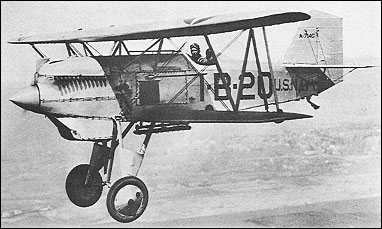
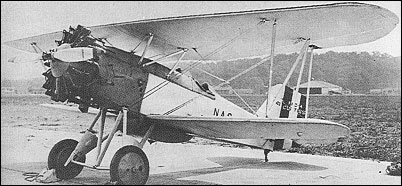
| In March 1925, the US Navy ordered nine P-1s with provision
for float operation as F6Cs (the F5C designation
was not assigned, to avoid confusion with the F-5 flying
boat), five of these being delivered as F6C-1s and four
(with arrester hooks) as F6C-2s. These had similar
power plant and armament to the USAAC's P-1. Two of
the F6C-1s were later converted to -2 standard. In 1927,
35 additional aircraft were ordered, these using the
P-1A airframe and being designated F6C-3. Two F6C-1s
were converted to -3 standard and one F6C-3 was fitted
with a Pratt & Whitney R-1340 radial as the XF6C-3.
The US Navy had decided, by 1927, to standardise on
air-cooled radial engines, which were more easily
maintained at sea than liquid-cooled inline engines.
Accordingly, after trials with a Pratt & Whitney R-1340-
engined F6C-3, a production contract was placed for 31
fighters powered by this 410hp radial as F6C-4s. The
first of these aircraft, which was retained for test purposes,
was assigned the designation XF6C-4 and deliveries
commenced in February 1927. Possessing the
same twin-gun armament as its predecessors, the
F6C-4 proved more manoeuvrable than the V-1150-
powered models, but was becoming obsolescent by the
time that it was delivered. It remained first-line equipment
only until the beginning of 1930. Experimental
F6C models were the XF6C-5 (first F6C-1 fitted with a
525hp Pratt & Whitney R-1690 Hornet), XF6C-6 (an
F6C-3 converted to parasol monoplane configuration
for the 1930 Thompson Trophy race), F6C-6 (an F6C-3
modified for 1929 air races and returned to -3 standard),
and the XF6C-7 (an F6C-4 with an inverted air-cooled
Ranger SGV-770 engine).
| MODEL | F6C-3 |
| WEIGHTS |
| Take-off weight | 1344 kg | 2963 lb |
| Empty weight | 980 kg | 2161 lb |
| DIMENSIONS |
| Wingspan | 9.60 m | 32 ft 6 in |
| Length | 6.96 m | 23 ft 10 in |
| Height | 3.25 m | 11 ft 8 in |
| Wing area | 23.41 m2 | 251.98 sq ft |
| PERFORMANCE |
| Range | 1 054 km | 655 miles |
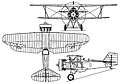 | A three-view drawing of F6C-4 (1280 x 894) |
| Peter Bruce, e-mail, 31.10.2012 15:29 I have posted the renovation of this plane on YouTube for anyone who is interested with the following information...
Renovation of an old Curtis F6C-3 Hawk of VB-1B Bombing squadron one, "The Red Rippers"; third a /c of 1st section U.S.S. Lexington... This R /C model was acquired and had a lot of hanger rash together with some severe warps on the lower wing which was why the extensive renovation had to take place - "in for a penny in for a pound".
I had been told the model was originally scratch built from just photographs by Mr Cliff Allen (died 2007) who lived somewhere near Peterborough - because the model is unique I felt it was worth the effort to bring it back to its former glory although I do not profess to be of the skill level of Mr Allen...
Before I could start I needed to find out as much info as I could and I managed to find a drawing of the original aircraft which was a start because it had the same Reg number.
I also asked for help on the RCM&E magazine forum site and a reply produced an original photograph of one of the squadrons planes from a kind reader with just enough quality for me to consider the renovation...
As far as I am aware this is the only r /c model of this exact plane with the correct markings and registration number which flew from the USS Lexington. This was also the last bi-plane the US Navy used which makes it even more unique.
The exhaust ports on the model are functional and I can only marvel at the skill the original builder had to produce this from photographs long since gone.
The engine is a Laser 70 and after all the work the model is now ready to take to the air again - it will fly better now because one major problem I came across was that all the control lines were thin nylon which stretched so easy and this must have caused problems in flight as it would stretch and it must have been like you was flying a slinky spring - the exact movement of the Tx control stick would not relate to the models control surfaces. The amount of control surface movement on the plane would be dependant on the speed the model was flying...
Anyone who can supply any information on either the original builder Mr Cliff Allen or can supply any photographs of this plane when it was in active service (and who the pilot was) I would be very grateful.
Free Music - supplied by Music4yourvids - many thanks.
INFORMATION - The Red Rippers were commissioned in 1927 as VF-5S in the earliest days of Naval Aviation and are proud to be the Navy's oldest continuously active fighter squadron. The Rippers began their distinguished heritage in Hampton Roads, Virginia flying the Curtis F6C-3 HAWK reply | | Luis Carrasco, e-mail, 24.10.2010 22:55 I understand, that under US-Government peace policies, this combat plane was not allowed to export. But, 30 Curtiss Falcons were bought by the new Chilean Air Force. Some of these aircraft were made in Chile under a different name, using US-made parts. Factory in Santiago was later dismantled during 30's because of Recession. reply | | Robert Whiston, e-mail, 13.03.2010 20:40 Is this the model sold by Curtis to the Chinese in their war agsint the Japanese in the mid-1930s ? reply | | prince Imeh, e-mail, 09.12.2009 18:55 Dear sir,
It is a pleasure for me to say that these aircraft are the best among the best aircraft i have ever seen, and i will like to learn how to make aircraft fly, because the little aircraft i am building uses electric motor instead of using piston of turbofan engines.
Thanks,from Prince Imeh reply |
|
Do you have any comments?
|
| 
COMPANY
PROFILE
All the World's Rotorcraft
|