 |
Douglas DC-5 / R3D1939 |  |
| TRANSPORT | Virtual Aircraft Museum / USA / Douglas |
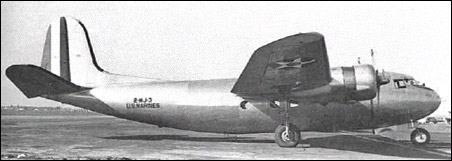 |
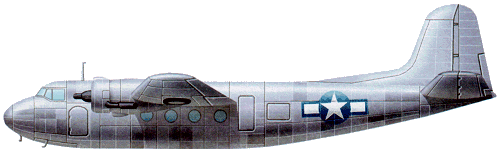
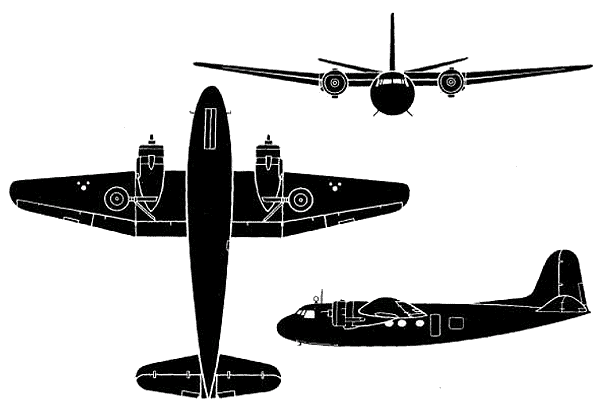
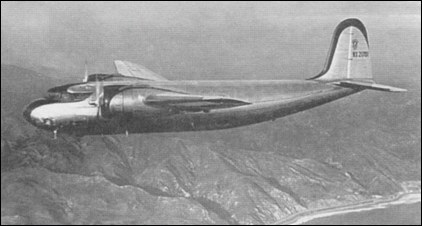
Designed at Douglas Aircraft Company's El Segundo facility, the Douglas DC-5 was developed as a 16/22-passenger commercial transport for local service operations out of smaller airports. Interestingly, at a time when the low-wing configuration was in the ascendant, the DC-5 was a high-wing monoplane, although it also featured the then relatively novel tricycle-type landing gear. With a design gross weight of 8391kg, the DC-5 was offered with either Pratt & Whitney R-1690 or Wright Cyclone radial engines. The prototype, powered by two 850hp Wright GR-1820-F62 Cyclones, flew for the first time on 20 February 1939, piloted by Carl Cover. Orders were placed by KLM (four aircraft), Pennsylvania Central Airways (six) and SCADTA of Columbia (two), but the programme was overtaken by the war and only the KLM aircraft were delivered. Although intended for service in Europe, two went first to the Netherlands West Indies to link Curacao and Surinam and the other two to Batavia in the Netherlands East Indies. All four were used to evacuate civilians from Java to Australia in 1942 and one, damaged at Kemajoran Airport, Batavia, on 9 February 1942, was captured by the Japanese and extensively test-flown at Tachikawa Air Force Base. The three surviving DC-5s were operated in Australia by the Allied Directorate of Air Transport and were given the USAAF designation C-110. The earliest DC-5 military operations, however, were by the US Navy which had ordered seven examples in 1939. Three were R3D-1 16-seat personnel transports, the first of which crashed before delivery, and four were R3D-2 aircraft for the US Marine Corps with 1000hp R-1820-44 engines, a large sliding cargo door, and bucket seats for 22 paratroops. The prototype, after certification and development flying had been completed, was sold with a 16-seat executive interior to William E. Boeing, and was later impressed for US Navy use as the sole R3D-3.
 Derived from the DB-7 bomber, the DC-5 was dramatically superior to Santa Monica's DC-3. Designer Ed Heinemann was told by General H. H. Arnold to cancel the programme because of the Army's selection of the C-47. D.Donald "The Encyclopedia of World Aircraft", 1997
|  COMPANY PROFILE | |||||||||||||||||||||||||||||||||||||||||||||||||||||||
|


|