|
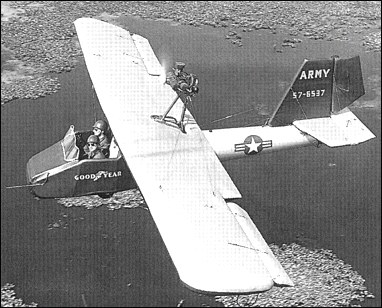
| As well as their famous blimps, the Goodyear Company built military
aircraft under licence, such as versions of the Vought Corsair. Of course,
what they really wanted to do was build rubber aeroplanes and they got their
chance in the 1950s. The US Army was particularly open to new ideas and
sponsored development of the Inflatoplane (sometimes called the Inflatibird).
Goodyear claimed it was 'suitable for all types of Army field operations,
particularly reconnaissance'. It could be packed into a 1.25 cubic metre container and transported by truck, jeep trailer or aircraft. One
proposed use was to
drop the container
behind enemy lines so
downed pilots could
rescue themselves.
Testing of a single- and
two-seat version carried
on into the 1970s, but
no orders were ever
forthcoming. FACTS AND FIGURES © The Inflatoplane was pressurized
at 544mbar, less than a car
tyre, and could be inflated in less
than 10 minutes. Endurance was
over five hours on the two-seater. © The original single-seat model
had a 40hp Nelson
engine and the two-seater had a
60hp McCulioch. In
both cases the engine was started
by hand-swinging the propeller. © The Inflatoplane's
undercarriage allowed the
packed-up aeroplane to be
moved around like a
wheelbarrow.
| CREW | 2 |
| ENGINE | 1 x 60hp McCulloch 4318 piston engine |
| WEIGHTS |
| Take-off weight | 336 kg | 741 lb |
| DIMENSIONS |
| Wingspan | 8.53 m | 28 ft 0 in |
| Length | 5.82 m | 19 ft 1 in |
| Height | 1.22 m | 4 ft 0 in |
| PERFORMANCE |
| Cruise speed | 113 km/h | 70 mph |
| GrahamClayton, e-mail, 01.01.2023 12:01 Blowing up the fuselage wouldn't have been the main problem - attaching the engine would have been time consuming. reply | | Anonymous, 05.09.2022 20:11 There is an inflatoplane located in Columbus,Ohio sitting in a storage garage of the state historical society.
I, and members of MAPS Air Museum tried to get it for our museum a number of years ago but they wanted to share it for 3 months at a time
if we would restore it. Needless to say ,we balked because we would do
the restoration and they would end up keeping the plane!
K. Olinger Jr. reply | | Anonymous, 18.01.2022 22:31 �hhvcmmvgjjnvnfkfkfjfmjfjgmcumnjfjfmv reply | | Anonymous, 14.01.2022 22:42 Your mom reply | |
| | TORBJÖRN KAMPE, e-mail, 29.04.2015 18:27 Please GOODYEAR. you can build such a fun airplane to me please.
I do not have so much space at home so it might be fun if I got one.
PLEASE reply | | Dalhats Laudzafata Avicena, e-mail, 22.09.2013 18:31 I can ride this aircraft to my school. reply | | David DeBar, e-mail, 04.12.2012 17:35 About 1960 I was standing on a ladder painting the widows on the Goodyear hanger in Akron Ohio, when a I saw a car pull onto the tarmac. A man and a child got out of the car and proceed to inflate a big folded blob of rubber. Wings popped out and soon there was a fully inflated plane. The adult attached an engine that he had in the car's trunk to the craft. The man and the boy got into the plane. I watched slack jawed as the plane taxied down the runway and took off, leaving the car on the side of the Tarmac. reply |
| Manuel Raad Berrio, e-mail, 25.08.2012 10:30 It will be very usefull if goodyear manufactured a similar model but for civil purposes... I´ll surelly look forward to buy one... reply | | zam, e-mail, 15.08.2011 09:48 How could it be use for gun fighting if all the gunners are shooting it down? Does it has a bullet proof elastic body? Secondly, would it be costly to build and most of the gadgets , could it be used with it? Just wonder... reply | | deaftom, e-mail, 04.04.2011 21:48 One of these Inflatoplanes was on display in the Ohio Museum of Aviation, which was located at the Columbus, Ohio airport but went defunct around 2002. This Inflatoplane no longer appears in an up-to-date comprehensive directory of museum aircraft that I have (nor does any other specimen, for that matter). Does anyone know what happened to it? reply | | Dan Cook, e-mail, 04.04.2011 01:56 I was working at Wingfoot Lake when the crash occured that Jesse Shannon mentioned. The report we were given is that the engine was missing and acting up. The pilot tried to bail out and was struck in the head by the blades. His helmet did not preserve his life. We were told that if he had stayed with the plane he could have landed it safely. Where is the Shadow when you need him. reply | | Dan Devery, e-mail, 11.02.2011 02:58 I own a Goodyear GA468 Inflatoplane single seat with a Nelson engine. reply | | John Ackerman, e-mail, 09.10.2010 00:12 Someone needs to get to the Goodyear Flight Department on the Akron Canton Airport.. They have pictures in the boardroom there of every plane ever made by Goodyear and they go around the room reply | | Dan Cook, e-mail, 02.07.2010 01:36 There was another Goodyear plane that is missing. It was also built in the Engineering Shops. It was an ultralight one man helicopter called the Gizmo as I recall. It was successfully test flown several times but evidently there was no interest, so it was stored away. reply |
|
| | Barrett, 18.08.2010 00:12 "Okay, honey- The kids are back from camp and they want to play in the inflatable jungle gym now. And when are you going to put the lawnmower back together??" reply | | Jesse Shannon, e-mail, 01.09.2010 04:00 I was one of the Army mechanics that witnessed the crash and the death 1LT Wallace, one of the Army aviators testing the Inflatoplane. It crashed at Wingfoot Lake, Akron, OH in 1958 or 1959 if I recall. The one we were testing had a pusher prop and a McCulloch engine. reply |
| Barry Walze, e-mail, 25.04.2009 03:35 Is there anyone in the near future trying to make a light sport aircraft or new experimental aircraft or kits for this airpalne? I am very interested. reply | | Gary B, e-mail, 19.08.2008 23:55 ca.groups.yahoo.com /group /inflatoplane reply | | Jim Stoveken, e-mail, 24.07.2008 17:59 the surviving test pilot of that plane now lives in Washington NC. His name is Phil Talbott and he is a very good friend of mine. reply |
|
Do you have any comments?
|
| 
All the World's Rotorcraft |


 Dan Cook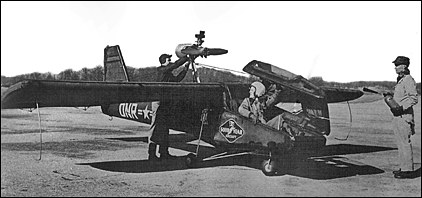


20
reply