|
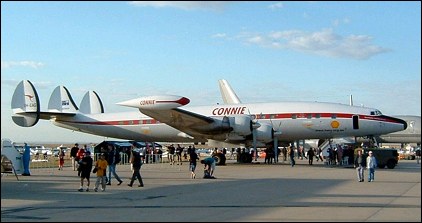
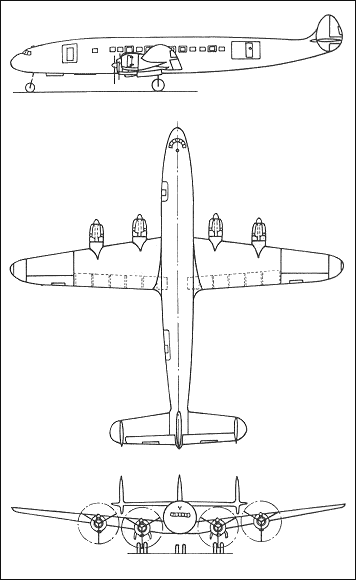
| The next stage in development of the Constellation was the L-1049 Super Constellation with lengthened fuselage, strengthening for higher gross weight, increased fuel capacity and more powerful engines. The first prototype Super Constellation (a conversion of the original C-69 prototype) flew for the first time on 13 October 1950. First in commercial service (on 15 December 1951) was one owned by Eastern Air Lines. This version could accommodate 71 first-class or 95 coach-class passengers (14 delivered to Eastern and ten to TWA during 1951-52). A number of improved variants followed - the last and most important being the L-1649A Starliner, regarded as the ultimate development of the piston-engined civil airliner.
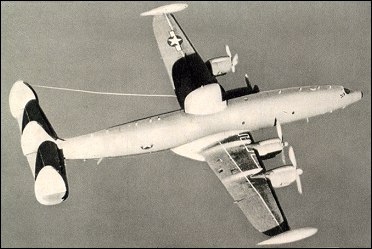
L-1049 Super Constellation were in use by both the USAF and US Navy under a variety of C-121 and R7V designations respectively.
| MODEL | L-1049G |
| CREW | 4 |
| PASSENGERS | 62-109 |
| ENGINE | 4 x 3400hp Wright R-3350-972T-C18DA-3 |
| WEIGHTS |
| Take-off weight | 4õ3400 kg | 9 lb |
| Empty weight | 33119 kg | 73015 lb |
| DIMENSIONS |
| Wingspan | 37.62 m | 123 ft 5 in |
| Length | 35.41 m | 116 ft 2 in |
| Height | 7.55 m | 25 ft 9 in |
| Wing area | 154.40 m2 | 1661.95 sq ft |
| PERFORMANCE |
| Cruise speed | 589 km/h | 366 mph |
| Ceiling | 6950 m | 22800 ft |
| Range | 6700 km | 4163 miles |
| Ray Johnson, e-mail, 15.05.2025 02:14 I was in VW 11 from 1959 1960 left there in February of 1961 married a girl from Newfoundland she just passed away last August I lived near Chicago Illinois now reply | | Dan Kasper, e-mail, 03.06.2024 22:49 I had the distinct pleasure of flying (as a passenger) on Connie #131659 out of Agana, Guam in August of 1973. We flew to Palau and Yap before returning two-days later to Guam.I have a couple nice photos of the plane on the tarmac at Guam. What ever happened to #131659, when was it scrapped? reply | | Allen W Riggert, e-mail, 16.07.2020 15:22 With VW-3 and ACWBARRONPAC 1959-1962 as ACW-2nd Class. reply | | Bill Heaphy, e-mail, 06.02.2018 06:33 What a grand old girl the Connie was. Flew on her as FE with Flying Tigers out of EWR in early 60's. Nothing lit up the night like a PRT oil seal failure at take off. Oil quantity dropping rapidly and a trail of flames from that oil hitting that red hot turbine. Made the tower operators talk fast and funny too. Hot days and most likely over MTOGW departures sometimes made the cockpit crew talk fast and funny also. It was a great learning experience with some first rate people. Served me well in the future. reply | |
| | Graham Brown, e-mail, 11.10.2017 01:14 I was a radar tech. At the 552 EM in Mcclellen from May, 56 to July 59. Logged over 2000 hours in this wonderful aircraft. Lost my 2k pin but I still have my 1000 hr. Pin. Great group of guys. I managed to travel to Mccllen about 10 years ago to a radar tech reunion . Saw many old friends. reply | | Chuck Lavoie, e-mail, 16.08.2017 20:24 I was an FE on C-97, C-124 and EC121G&R. In 26 years of flying I must say the the Connie was the best aircraft of it's time. reply | | Lemuel "Jack" E. Gatewood SSgt, e-mail, 29.06.2017 15:40 Proudly flew with the great VQ-1 crews out of Danang in 67 as the Korling. In 69 vol to fly the N. Korea mission after the Apr 69 shot down reply | | nick traino, e-mail, 27.08.2016 01:48 I was responsible for maintaining all the electronic equipment from 1959-1962 as a atr-2 reply | | Jim, e-mail, 21.06.2016 06:18 I flew on the EC-121R(Crew 5) AKA The Lockheed Flying Speedbrake at Korat RTAFB with the 553 Recon. sq as a CIM(Combat Information Monitor)69-70. It beat packing parachutes in Kansas. reply | | former Eastern S/O Jim Miller, e-mail, 12.06.2016 02:58 I went with Eastern Air Lines in 1967 and was fortunate enough to get sent to the Connies which were the stand-by aircraft on the Shuttle. I flew primarily L-1 which usually meant I got to work instead of set around a bridge game! I flew one charter out to Michigan and am probably one of the few engineers that never shifted blowers on the aircraft. We had basics, C's, and G's I only had one dreaded - DOUBLE SHORTED SECONDARY! The aircraft were pretty much gone by the end of 1967. reply | | S,M. (Jack) Schrager, e-mail, 01.06.2016 18:56 Flew on these magnificent machines in the original VW13 '55 till decommissioning. Sent to VW-4 in '58 as an ACW. Believe or not, became a flight engineer in '60 while they were in PR. Xfr'd to PMR on the Connie Crew and ultimately sent to PMRF Hawaii to crew 141311. From there wound up crewing P3's. Retired 1984 after 30 years. Loved the connie best bird ever. Love to hear from other "3-tailed" enthusiasts. reply | | William Morrow, Jr, e-mail, 15.04.2016 07:04 My dad (Bill Morrow) from North Carolina served with VW-11 in Argentia from 1956-1960. We would love to hear from anyone who served with him or knew him. Dad passed away this week. reply | | William Morrow, Jr, e-mail, 15.04.2016 07:02 My dad (Bill Morrow) from North Carolina just passed away this week. He was stationed in Argentia, Newfoundland with VW-11 as an AT-2. He spoke highly of the great fishing up there. Thanks to the Lockheed team for designing a great aircraft to bring my dad and his mates home safely! reply | | Earles L. McCaul, e-mail, 02.04.2016 02:27 Daniel Gray the e-mail link doesn't work for me, so here's my e-mail (elmccaul -at- q.com) for you to contact me. reply | |
| | Daniel Gray, e-mail, 24.03.2016 03:05 I am looking for any of the following who might have served in VW-13 with my father, Navigator Gary A. Gray during mid-sixties at Argentia. Please e-mail me. Ron Perrilloux, Don Gilliamsen, Doug Johnson ATW 2, George F. Handel, Earl Conro, Charles B. Williams, Fred Handy, Earles L. McCaul, Mel Hofer LCDR USNR (ret), John A. Peterson, reply | | George Young, e-mail, 25.12.2015 03:39 Walter Polk - I, too, flew as an electronic engineer on the NC-121s at Wright-Patterson. Specifically, the 2 aircraft with microwave antenna above and below the fuselage, with testing done out of San Juan International in Nov and Dec 1965. Do you have any photos? reply | | Jack "Toby" Tyler AT2, e-mail, 10.12.2015 22:40 USN '58-'62 Got orders to VW-2, Pax River out of ATN School. Went to code school and flew as Radioman, transferred to AEWTULANT also at Pax. Total of 1.200 hrs. flight time. Did barrier flights out of Argentia, NFL, Kef, Iceland and several Mercury shots as contingency search /recovery. The Connie was a very comfortable ride and got us safely home every time. KB5TXS reply | | Bob White, e-mail, 20.04.2015 17:52 Jerry Eisenhaur was a little before my time. I also served with NADU, at So.Weymouth.Ma. We had four of the Willie Victors including the only WV2E to survive its way to the scrappers yard. I'm told the other two crashed. I was an AE2. reply | | Ed Holleran, e-mail, 11.04.2015 05:56 Any Info on 551st OMS Otis A.F.B. 62-66 etc.??? reply | | Jerry Eisenhaur, e-mail, 25.03.2015 20:00 I served with NADU in 1953 - 1955 where we accepted two WV-2 Super Connies. These and other Naval aircraft were used in conjunction with MIT Lincoln Labs in the development of radio, radar, sonar systems.
We lost one when it crash landed in Willow Grove, PA. Fortunately no one was injured, although the aircraft was totaled. reply |
|
Do you have any comments?
|
| 
COMPANY
PROFILE
All the World's Rotorcraft
|