|
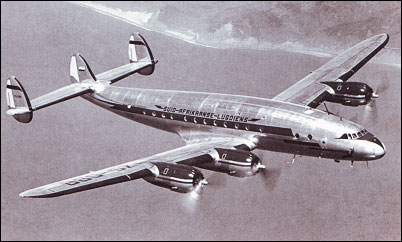
| Design of the Lockheed L-49 began in 1939 to meet the requirement of Pan American Airways and Transcontinental & Western Air (now Trans World Airlines), for a 40-passenger airliner for use on domestic routes. Manufacture was initiated but with the outbreak of World War II aircraft on the production line were commandeered for service with the USAAF as transports under the designation C-69, the first being flown on 9 January 1943. A total of 22 entered USAAF service before the contract cancellations following VJ-Day. Production of civil aircraft then began under the company designation L-049 Constellation, using components that had been intended for C-69s, but with the interiors completed to airline standard and with basic accommodation for 43 to 48 passengers, or a maximum of 60 in a high-density layout. The first Constellation was certificated for civil operations on 11 December 1945, the type entering service first with Pan Am and TWA, the latter inaugurating a regular US-Paris service on 6 February 1946.
The first true civil Constellations were Lockheed L-649 aircraft with 2,500hp Wright 749C-18BD-1 engines and far more luxurious interiors seating 48 to 64 passengers as standard, or 81 in a high-density arrangement. This version was replaced in production during 1947 by the longer-range L-749 with additional fuel yet able to carry the same payload, but by the end of 1949 the demand for air travel was increasing and operators were then looking for aircraft of greater capacity. This brought development of the L-1049 Super Constellation, with the fuselage lengthened by 5.59m, and Super 'Connies' entered service during their production life with a variety of interior layouts that could seat a maximum of 109 passengers. Last of the civil Constellation-derived airliners was the L-1649A Starliner, with a completely new wing of increased span and with far greater fuel capacity, providing a range considerably in excess of any of its predecessors. When production ended in the late 1950s a total of 856 aircraft of all versions, both civil and military, had been built.
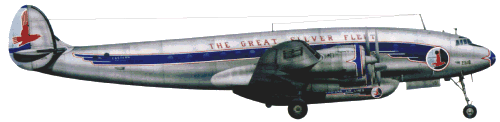
| MODEL | L-749 |
| PASSENGERS | 48-81 |
| ENGINE | 4 x 2500hp Wright R-3350-749C18BD |
| WEIGHTS |
| Take-off weight | 48534 kg | 107000 lb |
| Empty weight | 25670 kg | 56593 lb |
| DIMENSIONS |
| Wingspan | 37.49 m | 123 ft 0 in |
| Length | 29.66 m | 97 ft 4 in |
| Height | 6.83 m | 22 ft 5 in |
| Wing area | 148.20 m2 | 1595.21 sq ft |
| PERFORMANCE |
| Cruise speed | 555 km/h | 345 mph |
| Ceiling | 7350 m | 24100 ft |
| Range | 4185 km | 2601 miles |
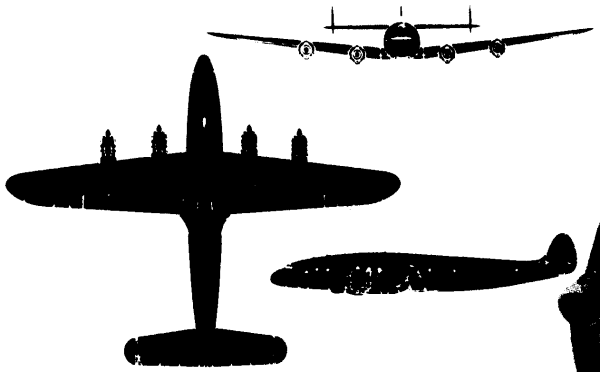
 | A three-view drawing (600 x 372) |
| bernard schnieders, e-mail, 13.12.2021 18:50 I was in the 964th sqdn from March62 uutil retiring in Jan 73. Flew both as a Nav and a WC. Flew mission s out of Fiji during high alt atomic testing, missons during Mercury 7 landing in the Pacific. Landed in Venzuala . Was on the 1st 552nd bird to land in Saigon. My first tour was 150 days, The 2nd was 120 days and 3tours of 90 days, Also a couple of tours in Iceland.Now I am a full Rver traveling in the good USA. reply | | Ron Spacone, e-mail, 05.08.2016 15:52 I flew as Weapons Controller on the EC-121 for the 964th out of McClellan AFB from 1965-68 with three tours with Big Eye and College Eye. Really enjoyed my Air Force years and the many fine individuals I served with. This was a very dependable aircraft although but radar system wasn't that great. reply | | Ken Bendy, e-mail, 28.01.2016 17:23 I posted a comment about 5 years ago on this site. I just want to let all my connie brothers to know there are two great facebook pages you can join. EC121 /C121 /C69 and Lockheed Constellation. The former is mostly Ex Military guys like me and the latter mostly Airline guys but every one with Connie experience is welcome to join both sites. Lots of great memories and loads of photos of the old gal! reply | | Bud Johnson, e-mail, 22.01.2016 00:26 I was a
I was a FE on R7V-1 from 1956 to 1963 with VR-7 first at Hickam AFB an later at Moffit Field Ca. We flew the embasy route from Travis AFB to Dahran Saudi Arabia. That Plane had more panache then any aircraft I ever flew or worked on
s reply | |
| | Klaatu83, e-mail, 28.10.2015 04:54 Thanks to Howard Hughes, who personally ordered the development of this outstanding airplane, when WW-II was over Lockheed was all ready to mass-produce this world-beating airliner. reply | | Jim, e-mail, 17.09.2015 06:30 I flew on the EC-121R AKA The Lockheed Flying Speedbrake at Korat RTAFB with the 553 Recon. sq as a CIM(Combat Information Monitor)69-70. It beat packing parachutes in Kansas. reply | | Herman Willemsen, e-mail, 01.04.2015 02:40 I would like to make contact with anyone who served as
Radio Operator on a Connie. reply | | Charles Lindsey, e-mail, 20.01.2015 01:51 I have a picture of one I took at Chu Lai about September, 1969. A beautiful plane. Although a c-47 is still my Favourite. reply | | Ronnie Smith, e-mail, 27.12.2014 00:47 the first 2 weeks of jan 1963 i flew out of hickem to san francisco about half way we lost our 2nd engine and returned to hickem for about 3 days,the plane was repaired and we left on the same plane headed to san francisco this time we made it if anyone remenbers this flight please contact me its very important thanks Ronnie reply | | Frank Heckart, e-mail, 10.07.2014 00:35 Worked on the EC-121 with the 551st FMS Otis, AFB, Mass.
1956-57. Also, flew on a C-121 from South Pacific to Moffet Field, CA Apr 54. Good flight except lost one engine on way to Hawaii. reply | | Joseph Aksamit Jr, e-mail, 25.01.2014 21:11 I flew on the Connie from Charleston SC to Wheelus in Tripoli Libya, 1959 returned 1961. We made stops in Bermuda, Azores and then to Tripoli Libya. I was a long trip but a very nice airplane. No stop in Burmuda on the way back. reply | | Barry Fulcher, e-mail, 16.01.2014 00:01 I was in the 964 at McClellan Dec 66 to Aug 70.I know the Triple nickle vary well. She became my mane AC on College Eye. She had some IFF mods that kept the Migs down. I had lot of aborts but always got home safe. Scope Dope and Intelligence Officer for the wing as an E4, I know, makes no sense at all. reply | | Ole Olson, e-mail, 07.01.2014 23:37 I flew the "connies" out of McClellan, CA during the early 1970s. Was first assigned to BatCat, the radio connie at Korat,TH and when it cancelled before my first mission I got stuck in the 963rd out of McClellan CA. I say "stuck" because it was not a prestegious airplane in what the AFChiefofStaff referred to as "our All Jet AF"! But I sure did enjoy our role in SEA flying lookout for the B-52s bombing NVNam. I earned my 2nd AirMedal when our crew assisted in shooting down a Mig-17 ( we steered the F-4 in for the kill ). Even more rewarding was our role in putting friendly aircraft that had taken a hit onto the 135 tankers orbiting Laos airspace like ourselves. But the best thing we did was marking our radar scopes and directing rescue traffic in to pick up "downed pilots"!
It doesn't get any better than successfully recovering a downed fellow airman! reply | | Ed Worsham, e-mail, 30.12.2013 10:30 A question really: I saw a Connie display in the window of some airline in NY in late 40's. I seem to recall that the display showed slits cut in the side of the tires that would catch the wind and start them turning before landing. I have never found anyone to verify this, so am beginning to wonder if I dreamed it. Anyway, as a 12 year old I understood and was impressed. True, or not? reply | |
| | Norman Houle, e-mail, 09.12.2013 22:13 Dec. 09-2013 Up at the L&A Airport in Auburn, ME there is a major reconstruction project on the way on a CONSTELLATION.
I think this CONNIE was owned by LUFTHANSA when new and latter by TWA. If you can find it there is a article in the Feb 2009 (Vol.45 - No 2)issue of AIR CLASSICS MAGAZINE. reply | | Lou DeSantis, e-mail, 16.01.2013 00:59 1961-1962 I was a mechanic asigned to the 445th FIS (F101B), then to the 1503rd, MATS, Tachikawa AFB Japan. I first had to retrain from Jets to Recips on C121s at Moffit Naval Air Station for 5 weeks. Learned alot about "OIL LEAKS". At Tachi I worked mostly on C124s, C118s, C54s, and C130s, but hated to see a C121 on the deck "Oil-Oil-Oil" I had to have a spare uniform at the shop. Spent most of the time on many TDYs East and South Asia. I got discharged July 1965. I got an FAA A&P licence and went to work for TWA in Kansas City, in was Super Conies "heaven". reply | | Louis Luchini, e-mail, 19.12.2012 00:20 I was and AE2 on the super connie's stationed at NAS Agana Guam from 1968 to 1971, in VW-1. The first Typhon scared the crap out of me, eventually it became old hat. Flew MIG barriers out of Chu-li and Danang when we wern't typhonning. Very proud to have served with the finest sailors in the fleet. Always a special place in my heart. God bless and pray for our service personnal in harms way. reply | | Dusty Rhoads, e-mail, 31.08.2012 16:47 I worked on 6 Connie s at Brunswick Ga 1961 / 1964 If it did not leak oil some where it had something wrong . just a wonderful plane. reply | | Jim Williamson, e-mail, 16.07.2012 06:43 I got the chanch to fly to alaska on a connie as smooth
as silk.
I was talking with the crew chief,he was with the Air Force
N /G there two week summer training was split up and they
would fly wounded out of Nam. reply | | John J. Doyle, e-mail, 07.07.2012 05:50 Just stopped by this Connie site to see what's cooking.
When I left Allegeny County Airport in Pittsburgh for Lackland AFB a Connie was waiting for us. I had a window seat next to the left wing. An oil slick covered both engine nacelles. You could watch the oil quiver in the wind. So I end up a recip engine mech on KC-97's in SAC. Then I was transferred to Tachikawa, Japan to work on
C-124's and anything else that broke on the flight line.
In comes a Navy Super G Med Evac with a feathered engine.
We pop the cowling and discover the exhaust collector ring had broken and the heat blast burned off half the top of the cylinder, rocker box cover completely gone. We repaired the exhaust and replaced the jug in the middle of the night. We had her run up and ready to go in the morning. What comes around goes around. Always loved the looks of the Connie, but nothing beats the KC-97, the Cadillac of the Sky, for a smooth ride. reply |
|
Do you have any comments?
|
| 
COMPANY
PROFILE
All the World's Rotorcraft
|