|
| To meet a US Army Air Force requirement for a day fighter that could be used also as an escort fighter or dive-bomber, North American submitted a design known as the NA-140.
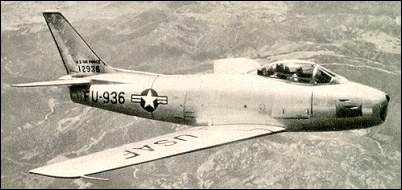
Two XP-86 prototypes of the NA-140 design were contracted in late 1944, but when German research data on the characteristics of swept wings became available soon after the end of the war, North American sought USAAF agreement to redesign the XP-86 to incorporate swept wings and tail surfaces. This cost a year's delay, and it was not until 1 October 1947 that the first prototype was flown, then powered by a Chevrolet-built General Electric TG-180 (or J35-C-3) turbojet of 1701kg thrust; on 25 April 1948, by then re-engined with a General Electric J47 turbojet as the YP-86A, this aircraft exceeded a speed of Mach 1 in a shallow dive. The first production version was the P-86A, powered initially by a 2200kg thrust General Electric J47-GE-1 turbojet and flown first on 20 May 1948. A month later USAF redesignation resulted in the P-86A becoming the F-86A and in 1949, by which time it had gained the name Sabre, the new fighter began to enter service with the USAF's 1st, 4th and 81st Fighter Groups, the 94th Squadron of the 1st Fighter Group receiving the first in February 1949. F-86A production totalled 554, the majority having 2359kg thrust J47-GE-3, -7, -9, or -13 turbo-jets. Subsequent production, arranged chronologically, included the F-86E with an all-moving tailplane, and the F-86F (1,539) with a modified wing. Most extensively built was the ensuing F-86D (2,054), a redesigned all-weather/night fighter, followed by the F-86H fighter-bomber (477) with powerful J73 engine, and the F-86K (120) which was a simplified version of the F-86D. Under the designation TF-86 two dual-control trainers were produced as conversions of F-86Fs, and the designation F-86L was applied to rebuilds (827) from F-86Ds, which introduced an increased span wing and updated avionics. The F-86B (deeper fuselage and larger tyres) and F-86C (redesigned fuselage) did not enter production. In addition to aircraft built by North American, Canadair Ltd in Montreal built 60 F-86Es for the USAF, followed by 290 generally similar Sabre Mk 2 fighters, comprising 230 for the RCAF and 60 for the. Mutual Defense Assistance Program. Canadian production continued with one Sabre Mk 3 to flight test the indigenous Orenda engine, 438 Sabre Mk 4 for the RAF with General Electric engines, 370 Sabre Mk 5 aircraft with the 2883kg thrust Orenda 10 turbojet, and 655 Sabre Mk 6 aircraft with the 3300kg thrust Orenda 14. The Commonwealth Aircraft Corporation in Australia also became involved in Sabre production, modifying the airframe for
two 30mm Adens and the 3402kg thrust Rolls-Royce Avon 26 engine, and built for the RAAF 21 Sabre Mk 30 and 20 Sabre Mk 31 aircraft,
plus 69 Sabre Mk32 fighters with Australian-built engines. Fiat in Italy assembled 221 F-86Ks from North American-built kits of components, and production in Japan began in the same way, with Mitsubishi leading a group of Japanese companies which first assembled, then increasingly constructed, a total of 300 similar to the F-86F and RF-86F.
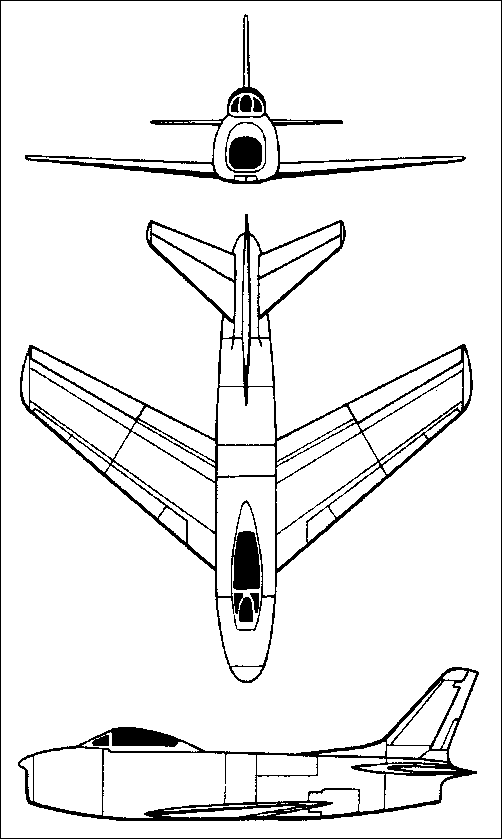
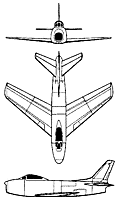 | A three-view drawing (502 x 839) |
| MODEL | F-86D |
| CREW | 1 |
| ENGINE | 1 x General Electric J47-GE-17B, 33.34kN |
| WEIGHTS |
| Take-off weight | 7756 kg | 17099 lb |
| Empty weight | 5656 kg | 12469 lb |
| DIMENSIONS |
| Wingspan | 11.30 m | 37 ft 1 in |
| Length | 12.29 m | 40 ft 4 in |
| Height | 4.57 m | 15 ft 0 in |
| Wing area | 27.76 m2 | 298.81 sq ft |
| PERFORMANCE |
| Max. speed | 1138 km/h | 707 mph |
| Ceiling | 16640 m | 54600 ft |
| Range | 1344 km | 835 miles |
| ARMAMENT | 24 x 69.9mm missiles |
| Bill Henderson, e-mail, 22.09.2015 01:13 The saber had 6 -50 cal. I was in the 18wg on 1956 when they had the best fire meet at Okinawa. I was on a inst flight which we always checked with radar as cover. When wecheckedin with the radar guys and the navy also checked in they had a Runn away bearcat. They called for F 86 :Ds to shoot it dwn the had 6 86 dogs try. They told me to mak a try. I did and with my 6 50 cals shot it down on ONE try. The dgg guys had a time that night at their club. The day fighter had a gay time reply | | Harold Wade, e-mail, 02.03.2015 21:25 Like squadron mates John Irwin, and Chuck Kendrick,I logged about a thousand hours in the Dawg and the L. In spite of a few problems it was a great airplane. I wrote about it extensively in my book, "Cold War Fighter Pilot". reply | | Karen Bailey, e-mail, 26.02.2015 17:44 My dad called me to tell me about this article. He told me that there were two of you who were stationed in Africa /Morocco that same time he and his twin brother were there in 1954-55. Maurice Sheehey and Andy Lundback. My dad is Ken Sonderman and his brother is Karl Sonderman. Seeing your names on there really made his day. Thank You for your service! reply | | Howard Pelton, e-mail, 24.02.2015 00:04 I was stationed with the 15 TRS at Komaki AB in Japan. We were the only SQ that had the RF's. The guns were removed and cameras were installed where the guns were. In 55 the Sq. moved to Yokota AB an received the new RF-84F's. reply |
|
| | Barry, 06.05.2014 11:28 The F86F manufactured by CAC in Australia as the CAC27 used the RR Avon engine as noted above. This engine was more powerful than the existing General Electric engine and at the same time lighter in weight, which resulted in the fuselage having only 40% commonality with it's Amercan made predecessor. reply | | Gene Zutell, e-mail, 18.04.2014 02:51 In 1955 as a young Airman, I was assigned to the 50th Fighter Bomber Wing stationed at Hahn AFB, Germany. At that time, the Wing was equipped with the F-86E. Several months later, the Wing transitioned into the F-86H which was the first F-86 capable of going supersonic in level flight. The "H" model carried four 20mm cannon as opposed the six fifty calibers in the "E" model. The commander of the 417th Fighter Bomber Squadron in the Wing was Lt. Col. Chuck Yeager. reply | | Jim Barita, e-mail, 17.02.2014 21:23 First time I saw F-86D up close... Sitting on berm of Pa. turnpike after emergency landing. Later at Westover AFB 337FIS as Comm /Nav tech.Years later at reunion, I met commander of unit that Jet was assigned to. COL Al Coleman. reply | | Don Young, e-mail, 04.01.2014 21:16 From a different perspective, I flew N-86F(now in an Indianapolis museum)between 1985 and 1990 as a civilian. It and the DR-1 were my favorite airplanes. Both proved the hypothesis that you cannot grow up AND be a fighter pilot! reply | | William Sandlin, e-mail, 03.12.2012 18:34 I started flying in a Piper J-3 circa 1947 & fished up in the DC-10-30 circa 1989, accumulating 29,604 logged flight hours.
My most fun was going supersonic in a F86A at Nellis AFB circa 1953. It's been a hell of a ride ! reply | | maurice sheehy, e-mail, 01.09.2012 22:18 i was the instrument mec. on the f-86f at sidi slame morroco 1954 to 1955 45th ft sq. everything worked . not much up keep for me. the good old day's ??? reply | | Evaldo Sobral, e-mail, 27.08.2012 15:35 It's a most beautiful jet airplane I ever seen, its design is amazing. reply | | Hugh G., e-mail, 09.08.2012 03:54 I flew Ls with the NANG at Lincoln, NE. It was the first single seat jet I ever flew, I'll never forget my first flight in it. Just like losing my virginity,I grin all over whenever I think about either one. reply | | Zippo, 23.06.2012 00:54 is a wonderful airplane. It's my favorite fighter of all time for its performance and outstanding and beautiful design. For me, the better. reply | | Bradford Hall, e-mail, 27.03.2012 01:41 After gunnery in F80s at Tyndall in 1953, I went to Alexandria AFB, to the 389FBS of the 366 Wing. We had new F86Fs made in Colunbus, Ohio. On my 4th flight I had a clean plane with no tanks. I took it to 51,000 feet rolled it over and went straight downand and broke the sound barrier. It something I'll never forget. The F86 was a super aiplane and fun to fly. reply | |
| | John Irwin, e-mail, 24.11.2011 21:44 I instructed in the "Dog" at Perrin 1954-1956. Great airplane, though plagued with many mechanical problems. Worst time was the Texas summer that we were restricted from using afterburner. We would use all of an 8000' runway to get into the air. There were turbine wheel failures, the flying pieces often took out the hydraulic controls. Vacuum tube failures in the electronic fuel control system would sometimes feed too much JP into the burner and result in a fire or explosion. I was lucky and never had a close call in the bird. reply | | Bradford Hall, e-mail, 17.11.2011 22:52 In 1953 I flew the F86F in the 389 FBS of the #366 FBW at Alexandria, Louisiana. We had new planes that were manufactured at Columbus, Ohio. It was a marvelous plane and a joy to fly. reply | | Art wordsman, e-mail, 23.09.2011 06:18 How come there was no mention of the F86D? I spent three years of my life working as an electronics technician on that plane. reply | | Don Kosmin, e-mail, 28.05.2011 04:36 worked on GE-J47'S 55-57 (F86-F) at chambley, 21,st fld. maint. sq.,J57'S ,at phalsbourg (RF-101 VOODOO'S) and last but not least J-47's again on the KB50-J at Langley, also worked on the 4360's on that A /C, anyone out there from 21'st fld. maint. at chambley, would like to hear from them reply | | Don Kosmin, e-mail, 28.05.2011 04:31 worked on GE-J47'S 55-57 (F86-F) at chambley, 21,st fld. maint. sq.,J57'S ,at phalsbourg (RF-101 VOODOO'S) and last but not least J-47's again on the KB50-J,also worked on the 4360's on that A /C, anyone out there from 21'st fld. maint. at chambley, would like to hear from them reply | | Andy Lundback, e-mail, 02.05.2011 01:38 I was a crew chief on F-86f #108 assigned to the 45th fighter sqdn. at Sidi Slimane AFB North Africa in 1953. My pilot was Capt.Richard Becker, second MIG Ace out of Korea.Dam good aircraft & easy to maintain. The desert sand was rough on the hydraulic systems. Lots of leaks after a year duty. Our sqdns. mission was to fly cover for the B-47s in the event that Russia became more aggressive. reply |
|
Do you have any comments?
|
| 
COMPANY
PROFILE
All the World's Rotorcraft
|



Howard,
I was also stationed in Japan in the 6021st Tac Recon squadron (1956-1958). My name is Robert Cassero (an Aircraft Electrician) and remember working with you. You were a S /Sargent at the time and I was a Airman 1st class later promoted to S /Sgt. I didn't know till recently that these RF-86F's and the RF-100A's were making important history - I wish I had taken more pictures! I left Japan in early 1959 and was discharged from the AF soon after. I fortunately used my AF experience to find a great career in the Aerospace Industry. But I do wish i would have stayed in the Air Force longer - looking back on it, it sure was an exciting time.
I hope you are doing OK.
Robert in Woodland, CA
reply